▼ 1 Hypothesis activity for the query {"user":"","group":"all","url":"","wildcard_uri":"","tag":"","any":"sweet spot","max":"200","service":"https://hypothes.is","exactTagSearch":"true","expanded":"true","addQuoteContext":"true","format":"html","_separate_replies":"false","groupName":"All","sortBy":"recency"} jonudell.info
::faceted.search.hypothesis?any=sweet+spot
▼ 1 Migration book.peergos.org
no need to move server with loss of network and even data
a clear case of a "better spot"
the dual of a sweat spot
one that is clearly bellow the threshold of what is required
again it should have said sweet spot
creative dislexia
▼ 2 Video: The Future of Text 2017 Session 2. (DocDrop) www.youtube.com
five things together give you what u want
what is required just beyond the threshold the sweat spot
creative typo
of course it is sweet spot of Alan Kay
Creative type
I meant to write Sweet Spot Alan Kays term
▼ 2 Local-first software: You own your data, in spite of the cloud www.inkandswitch.com
💻/thinkpad/🧊/me/📓/2026/02/09?t=local.first.software&extra=requirements
extended list of required green check marks
what is required above the threshold, the sweet spot
- Fast
- Multi-device 3
- Offline
- Collaboration
- continuous without being synchronous
- eventual consistency with full verifiable provenance
- recapitulable, summarisable history of co-evolution
- Longevity
- Privacy
- User control
- evergreen reproducibikity
- future compatibility
seven green checkmarks
what is required above the threshold, the sweet spot
- Fast
- Multi-device 3
- Offline
- Collaboration
- Longevity
- Privacy
- User control
▼ 1 suspiciously precise floats, or, how I got Claude's real limits she-llac.com
Summary: Claude Usage Limits & Cost Analysis
Subscription vs. API Efficiency
- Massive Cost Savings: Claude subscriptions can be up to 36x cheaper than using the API for equivalent token throughput.
- The "Max 5x" Sweet Spot: The $100/mo Max 5x plan is identified as the most optimized tier, offering roughly 8.3x more weekly usage than the Pro plan (exceeding its "5x" marketing).
- The "Max 20x" Diminishing Returns: While the $200/mo tier provides 4x higher short-term (5-hour) burst limits than the Max 5x, its weekly ceiling is only ~2x higher, making it less efficient for consistent long-term work.
Dual-Layer Usage Framework
- 5-Hour Rolling Window: Controls "burst" activity. The counter starts at your first prompt; once reached, you must wait for the window to reset.
- 7-Day Weekly Ceiling: A hard cap on total "active compute hours" (time spent processing tokens/reasoning). This acts as a global safety valve for the system.
- Unified Quota: All usage across the browser (claude.ai), Claude Desktop, and Claude Code (terminal) counts toward the same unified limit.
Token Consumption Dynamics
- Exponential Context Cost: Claude re-reads the entire chat history for every new message. A 50-message thread uses significantly more tokens (and quota) than five separate 10-message chats.
- Input-Heavy Bias: Large file attachments, long project instructions, and extensive "Extended Thinking" sessions consume the quota much faster than short, text-only queries.
Optimization Strategies
- The /compact Command: Users are encouraged to use
/compact(in Claude Code) or manually summarize/restart chats every 15–20 messages to reset the "token tax" of long histories. - Lean Context: Keeping
CLAUDE.mdand project documentation concise prevents "context bloat" from draining limits prematurely. - Strategic Timing: Since the 5-hour window starts with the first prompt, power users should time their first interaction to align with their most intensive coding blocks.
Recommendation: Which Claude Tier is Right for You?
1. The "Value King": Max 5x ($100/mo)
- Why it’s recommended: Data analysis shows this tier is "over-provisioned." While marketed as 5x, it often provides ~6x higher session limits and ~8.3x higher weekly limits than the Pro plan.
- The Sweet Spot: It offers the best balance between a massive increase in capacity and price. Most daily professional users and developers find it nearly impossible to hit these limits even with "all-day" use.
- Best For: Professional developers, heavy researchers, and those who want consistent access to the Claude 3.5 Opus model without hitting daily caps.
2. The "Sprint Specialist": Max 20x ($200/mo)
- The Caveat: Despite the name, the weekly ceiling is only ~2x higher than the Max 5x plan, not 4x higher. You are essentially paying for a much higher "burst" capacity.
- Why choose it: It allows for extremely high-intensity sessions (up to 900+ messages in 5 hours). This is useful if you do massive "sprints" where you need Claude to process huge amounts of data or code in a very short window.
- Best For: Solopreneurs building products in rapid bursts, or users who never want to think about rate limits during a 4–6 hour deep-work session.
3. The "Standard Choice": Pro ($20/mo)
- Why it’s recommended: It is 5x cheaper than the next tier and sufficient for 90% of users who use Claude for general writing, light coding, or occasional complex tasks.
- Best For: Students, casual coders, and users with small projects (under 1,000 lines of code).
Summary Table
- Quick Comparison Summary
- Pro: $20/mo | Baseline Capacity | Best for personal/standard use.
- Max 5x: $100/mo | ~8.3x Weekly Capacity | Best overall value for power users.
- Max 20x: $200/mo | ~16x Weekly Capacity | Best for high-intensity "burst" work.
▼ 1 Fishing line as a drawband replacement www.reddit.com
u/Koponewt aka Pelicram's advice for using fishing line to replace drawbands.
▼ 1 Chapter 2: Audience open.library.okstate.edu
This is what I was arriving at in my last combat, where is the sweet spot of too much information and not enough information? A good alternative is to include a key with information on difficult words or phrases that may not be known to a newcomer or beginner in certain areas. Providing this key, will provide information for those who need it and simultaneously allow readers who are familiar to skip past it and not get 'annoyed' with the product or writing.
▼ 1 What do you guys have your typewriters on? www.reddit.com
For the average office-type chair, the sweet spot you're looking for is a tabletop about 26 inches off of the floor.
Most modern desks have their tabletops at 28-29" off of the floor which is too high for comfortably typing on a typewriter. The larger old school typewriter desks (double and single pedestals) often had a flip top or spring loaded side compartment that brought the surface that the typewriter sat on down to a more comfortable 26" off of the floor. Similarly you'll see desk returns for these desks which are an inch or two shorter to allow for a typewriter off to the side. Many of the same tanker desks had writing drawers that pulled out to provide space over the other drawers for writing and these also make great surfaces for typewriters to be an inch or two lower than the standard height. These desks usually are heavy and take up some significant floor space.
From the 1920s, a variety of manufacturers made stand-alone typewriter stands, typically with two drop leaves on either side and wheels to give one easy space for their typewriter that didn't take up a huge footprint and could be moved around the office or home as needed. Similar to these in the modern furniture space, you might find a variety of side tables or occasional tables with tabletops at a more comfortable 26-27" for your typing.
For off-label use cases, you could try a counter-height stool (24-26") as a temporary typewriter stand to pair with most standard office chairs. Generally bar stools are much taller in the 36" range, so don't do this unless it's your intention to type standing up.
I've got a 20 drawer library card catalog with a tabletop height of 36.5" that makes an excellent height for a standing desk for typing.
reply to u/The-Wolf-Bandit at https://old.reddit.com/r/typewriters/comments/1q6e8oo/whatdoyouguyshaveyourtypewriters_on/
▼ 1 Targeted disruption of phage liquid crystalline droplets abolishes antibiotic tolerance of bacterial biofilms www.biorxiv.org
Note: This preprint has been reviewed by subject experts for Review Commons. Content has not been altered except for formatting.
Learn more at Review Commons
Referee #2
Evidence, reproducibility and clarity
In the well-written manuscript by Tarafder et al., the authors follow up on their previous investigations of the filamentous bacteriophage Pf4, which self-assembles into a crystalline droplet surrounding Pseudomonas aeruginosa cells within a biofilm. Using theoretical coarse-grained molecular dynamics (MD) simulations, they predict that binding a small molecule or protein to the surface of bacteriophage Pf4 should disrupt the attraction-in this case depletion attraction-between individual phage particles. To test this hypothesis, nanobodies were raised against Pf4, and two promising candidates, Nb43 and Nb-D11, were identified. These nanobodies were characterized using biochemical assays, and binding of Nb43 to CoaB, the major coat protein, was visualized using cryo-EM. Using fluorescence microscopy and cryo-ET, the authors convincingly demonstrate that nanobodies can disrupt Pf4 crystalline droplet formation. Strikingly, nanobody-mediated disruption of Pf4 droplets also increases antibiotic susceptibility of P. aeruginosa both in vitro and in biofilm settings.
Major comments
1) Theoretical modelling: The MD simulations, as currently presented, do not add conceptual depth to the study. The idea that blocking an interaction site between phages (whether through active-site interference, obstruction of a protein-protein interface, or simple steric hindrance) would prevent alignment is straightforward and does not necessarily require MD simulations to justify. As such, this section feels superfluous and is currently the weakest point in an otherwise strong manuscript. Unless the simulations can meaningfully address at least some of the questions listed below, the authors should consider removing this part:
The MD simulation is very simplistic, and filamentous phages are clearly not hard rods, as seen in the cryo-EM images. Would a certain degree of Pf4 flexibility allow to stabilize droplets even in the presence of low concentrations of Pf4 binders?
How do the MD simulations explain that already pre-formed crystalline droplets can be penetrated and disassembled by small Pf4 binders?
The authors state that Pf4 binders must be large relative to the depletant particles. Can this be demonstrated experimentally? Is there a sweet spot, as large molecules potentially cannot penetrate preformed droplets?
2) Nanobody penetration into crystalline droplets (Extended Data Fig. 6a-d) vs. antibiotic penetration (Fig. 4) The authors show that Nb43 penetrates Pf4 droplets even at concentrations that do not disrupt droplet stability. How do the authors explain that a relatively large nanobody penetrates the crystalline droplet, whereas a much smaller antibiotic does not diffuse trough the droplet?
In the experiments shown in Figure 4, the authors assess antibiotic activity against P. aeruginosa in the presence of Pf4 crystalline droplets. If I understand correctly, the additionally added Pf4 droplets do not physically encompass the bacteria, yet they still reduce antibiotic tolerance. If so, this appears to contradict the conclusion that Pf4 droplets act primarily as a diffusion barrier (as stated in the section title). Instead, this would suggest that Pf4 may reduce antibiotic potency through another mechanism (e.g., direct binding or sequestration). Would it be possible to test the addition of Pf4 alone, without the biopolymer alginate, to determine whether Pf4 itself is sufficient to increase antibiotic tolerance?
Minor comments:
- Title: The title is overstated. Please consider changing it to something similar to: "Targeted disruption of phage liquid crystalline droplets abolishes antibiotic tolerance in Pseudomonas aeruginosa biofilms."
- Introduction sentence: "...where filamentous phage particles align along their axis in the presence of biopolymer,..." Please introduce what biopolymers are and specify which types are relevant here.
- Amorphous Pf4 aggregates after Nb43 treatment (Fig 3b,e): The authors should discuss the nature of these aggregates. It appears that smaller spindles are both broken up and impeded in their formation after Nb43 treatment, whereas larger aggregates seem to persist.
- Fig. 3c and 3f: Please describe how liquid crystalline structures were defined in the fluorescence images. Were thresholds for size, intensity, or morphology applied?
- Use of P. aeruginosa ΔPAO728: For clarity, please explain why the strain lacking the Pf4 integrase is included in the in-vitro assays.
Discussion:
Neisseria meningitidis and Vibrio cholerae use filamentous phages to increase virulence. Do these phages also form liquid crystalline droplets? If not, how do the authors envision that the nanobody strategy described here could be applied to prevent infection? In general, the findings are hard to generalize to other biofilms matrices, which are highly heterogenous.
Significance
Bacterial biofilms and their associated antibiotic tolerance represent a major clinical burden, and new strategies to overcome these defenses are urgently needed. The strategy presented here-targeting and disrupting the protective extracellular matrix formed by liquid crystalline Pf4 phage droplets-is an exciting and innovative approach with clear translational potential for combating P. aeruginosa biofilms. The study is experimentally rigorous, well written, and carefully analyzed, and it represents a logical and impactful next step following the group's previous work. This manuscript will have significant impact on the field of P. aeruginosa biofilm research by providing a mechanistically grounded method to disrupt the protective biofilm architecture. However, it is important to note that the extracellular matrix architecture of biofilms formed by other bacterial species differs substantially, and thus the current findings cannot be directly generalized beyond P. aeruginosa without further investigation.
▼ 1 Go ahead, self-host Postgres | Pierce Freeman pierce.dev
Cloud hosting can become an expensive abstraction layer quickly. I also think there's an entire generation of coders / engineers who treat silo'd cloudhosting as a given, without considering other options and their benefits. Large window for selfhosting in which postgres almost always falls
▼ 1 /hyperpost/0/hyperpost-0.html bafybeig7nrhxx3nyb5rfmuj7cfy5xbl4ldtwr57ol6lykibww625qkxnke.ipfs.dweb.link
Instead of shipping early shipping often
or "Get IT Right First time"
Get the IT right first.
If you do that IT can self-host and self-realize the IT
as a Conversations
After all Software is a Symmathetic Conversaiton creating the Medium, the Sweet spot, just above the threshold that is trully required.
Proving that the "Worse IS Not Better"
Need the Jewel like Diamond approach
▼ 2 Atypical collective oscillatory activity in cardiac tissue uncovered by optogenetics www.biorxiv.org
Reviewer #2 (Public review):
In the presented manuscript, Teplenin and colleagues use both electrical pacing and optogenetic stimulation to create a reproducible, controllable source of ectopy in cardiomyocyte monolayers. To accomplish this, they use a careful calibration of electrical pacing characteristics (i.e., frequency, number of pulses) and illumination characteristics (i.e., light intensity, surface area) to show that there exists a "sweet spot" where oscillatory excitations can emerge proximal to the optogenetically depolarized region following electrical pacing cessation, akin to pacemaker cells. Furthermore, the authors demonstrate that a high-frequency electrical wave-train can be used to terminate these oscillatory excitations. The authors observed this oscillatory phenomenon both in vitro (using neonatal rat ventricular cardiomyocyte monolayers) and in silico (using a computational action potential model of the same cell type). These are surprising findings and provide a novel approach for studying triggered activity in cardiac tissue.
The study is extremely thorough and one of the more memorable and grounded applications of cardiac optogenetics in the past decade. One of the benefits of the authors' "two-prong" approach of experimental preps and computational models is that they could probe the number of potential variable combinations much deeper than through in vitro experiments alone. The strong similarities between the real-life and computational findings suggest that these oscillatory excitations are consistent, reproducible, and controllable.
Triggered activity, which can lead to ventricular arrhythmias and cardiac sudden death, has been largely contributed to sub-cellular phenomena, such as early or delayed afterdepolarizations, and thus to date has largely been studied in isolated single cardiomyocytes. However, these findings have been difficult to translate to tissue- and organ-scale experiments, as well-coupled cardiac tissue has notably different electrical properties. This underscores the significance of the study's methodological advances: use of a constant depolarizing current in a subset of (illuminated) cells to reliably result in triggered activity could facilitate the more consistent evaluation of triggered activity at various scales. An experimental prep that is both repeatable and controllable (i.e., both initiated and terminated through the same means) is a boon for further inquiry.
The authors also substantially explored phase space and single cell analyses to document how this "hidden" bi-stable phenomenon can be uncovered during emergent collective tissue behavior. Calibration and testing of different aspects (e.g.: light intensity, illuminated surface area, electrical pulse frequency, electrical pulse count) and other deeper analyses, as illustrated in Figures S3-S8 and Video S1, are significant and commendable.
Given the study is computational, it is surprising that the authors did not replicate their findings using well-validated adult ventricular cardiomyocyte action potential models, such ten Tusscher 2006 or O'Hara 2011. This may have felt out-of-scope, given the nice alignment of rat cardiomyocyte data between in vitro and in silico experiments. However, it would have been helpful peace-of-mind validation, given the significant ionic current differences between neonatal rat and adult ventricular tissue. It is not fully clear whether the pulse trains could have resulted in the same bi-stable oscillatory behavior, given the longer APD of humans relative to rats. The observed phenomenon certainly would be frequency-dependent and would have required tedious calibration for a new cell type, albeit partially mitigated by the relative ease of in silico experiments.
There are likely also mechanistic differences between this optogenetically-tied oscillatory behavior and triggered activity observed in other studies. This is because the constant light-elicited depolarizing current is disrupting the typical resting cardiomyocyte state, thereby altering the balance between depolarizing ionic currents (such as Na+ and Ca2+) and repolarizing ionic currents (such as K+ and Ca2+). The oscillatory excitations appear to later emerge at the border of the illuminated region and non-stimulated surrounding tissue, which is likely an area of high source-sink mismatch. The authors appear to acknowledge differences in this oscillatory behavior and previous sub-cellular triggered activity research in their discussion of ectopic pacemaker activity, which are canonically observed in genetic, pharmacologic, or pathological ionic conditions. Regardless, it is exciting to see new ground being broken in this difficult-to-characterize experimental space, even if the method illustrated here may not necessarily be broadly applicable.
Comments on revisions:
I have read the authors' rebuttal to our earlier comments and do not have any further questions or comments. Thank you for implementing the minor improvements to Figure visualizations and for creating Video S1 to accompany the article.
Author response:
The following is the authors’ response to the original reviews
Public Reviews:
Reviewer #1 (Public review):
Summary:
The study by Teplenin and coworkers assesses the combined effects of localized depolarization and excitatory electrical stimulation in myocardial monolayers. They study the electrophysiological behaviour of cultured neonatal rat ventricular cardiomyocytes expressing the light-gated cation channel Cheriff, allowing them to induce local depolarization of varying area and amplitude, the latter titrated by the applied light intensity. In addition, they used computational modeling to screen for critical parameters determining state transitions and to dissect the underlying mechanisms. Two stable states, thus bistability, could be induced upon local depolarization and electrical stimulation, one state characterized by a constant membrane voltage and a second, spontaneously firing, thus oscillatory state. The resulting 'state' of the monolayer was dependent on the duration and frequency of electrical stimuli, as well as the size of the illuminated area and the applied light intensity, determining the degree of depolarization as well as the steepness of the local voltage gradient. In addition to the induction of oscillatory behaviour, they also tested frequency-dependent termination of induced oscillations.
Strengths:
The data from optogenetic experiments and computational modelling provide quantitative insights into the parameter space determining the induction of spontaneous excitation in the monolayer. The most important findings can also be reproduced using a strongly reduced computational model, suggesting that the observed phenomena might be more generally applicable.
Weaknesses:
While the study is thoroughly performed and provides interesting mechanistic insights into scenarios of ventricular arrhythmogenesis in the presence of localized depolarized tissue areas, the translational perspective of the study remains relatively vague. In addition, the chosen theoretical approach and the way the data are presented might make it difficult for the wider community of cardiac researchers to understand the significance of the study.
Reviewer #2 (Public review):
In the presented manuscript, Teplenin and colleagues use both electrical pacing and optogenetic stimulation to create a reproducible, controllable source of ectopy in cardiomyocyte monolayers. To accomplish this, they use a careful calibration of electrical pacing characteristics (i.e., frequency, number of pulses) and illumination characteristics (i.e., light intensity, surface area) to show that there exists a "sweet spot" where oscillatory excitations can emerge proximal to the optogenetically depolarized region following electrical pacing cessation, akin to pacemaker cells. Furthermore, the authors demonstrate that a high-frequency electrical wave-train can be used to terminate these oscillatory excitations. The authors observed this oscillatory phenomenon both in vitro (using neonatal rat ventricular cardiomyocyte monolayers) and in silico (using a computational action potential model of the same cell type). These are surprising findings and provide a novel approach for studying triggered activity in cardiac tissue.
The study is extremely thorough and one of the more memorable and grounded applications of cardiac optogenetics in the past decade. One of the benefits of the authors' "two-prong" approach of experimental preps and computational models is that they could probe the number of potential variable combinations much deeper than through in vitro experiments alone. The strong similarities between the real-life and computational findings suggest that these oscillatory excitations are consistent, reproducible, and controllable.
Triggered activity, which can lead to ventricular arrhythmias and cardiac sudden death, has been largely attributed to sub-cellular phenomena, such as early or delayed afterdepolarizations, and thus to date has largely been studied in isolated single cardiomyocytes. However, these findings have been difficult to translate to tissue and organ-scale experiments, as well-coupled cardiac tissue has notably different electrical properties. This underscores the significance of the study's methodological advances: the use of a constant depolarizing current in a subset of (illuminated) cells to reliably result in triggered activity could facilitate the more consistent evaluation of triggered activity at various scales. An experimental prep that is both repeatable and controllable (i.e., both initiated and terminated through the same means).
The authors also substantially explored phase space and single-cell analyses to document how this "hidden" bi-stable phenomenon can be uncovered during emergent collective tissue behavior. Calibration and testing of different aspects (e.g., light intensity, illuminated surface area, electrical pulse frequency, electrical pulse count) and other deeper analyses, as illustrated in Appendix 2, Figures 3-8, are significant and commendable.
Given that the study is computational, it is surprising that the authors did not replicate their findings using well-validated adult ventricular cardiomyocyte action potential models, such as ten Tusscher 2006 or O'Hara 2011. This may have felt out of scope, given the nice alignment of rat cardiomyocyte data between in vitro and in silico experiments. However, it would have been helpful peace-of-mind validation, given the significant ionic current differences between neonatal rat and adult ventricular tissue. It is not fully clear whether the pulse trains could have resulted in the same bi-stable oscillatory behavior, given the longer APD of humans relative to rats. The observed phenomenon certainly would be frequency-dependent and would have required tedious calibration for a new cell type, albeit partially mitigated by the relative ease of in silico experiments.
For all its strengths, there are likely significant mechanistic differences between this optogenetically tied oscillatory behavior and triggered activity observed in other studies. This is because the constant light-elicited depolarizing current is disrupting the typical resting cardiomyocyte state, thereby altering the balance between depolarizing ionic currents (such as Na+ and Ca2+) and repolarizing ionic currents (such as K+ and Ca2+). The oscillatory excitations appear to later emerge at the border of the illuminated region and non-stimulated surrounding tissue, which is likely an area of high source-sink mismatch. The authors appear to acknowledge differences in this oscillatory behavior and previous sub-cellular triggered activity research in their discussion of ectopic pacemaker activity, which is canonically expected more so from genetic or pathological conditions. Regardless, it is exciting to see new ground being broken in this difficult-to-characterize experimental space, even if the method illustrated here may not necessarily be broadly applicable.
We thank the reviewers for their thoughtful and constructive feedback, as well as for recognizing the conceptual and technical strengths of our work. We are especially pleased that our integrated use of optogenetics, electrical pacing, and computational modelling was seen as a rigorous and innovative approach to investigating spontaneous excitability in cardiac tissue.
At the core of our study was the decision to focus exclusively on neonatal rat ventricular cardiomyocytes. This ensured a tightly controlled and consistent environment across experimental and computational settings, allowing for direct comparison and deeper mechanistic insight. While extending our findings to adult or human cardiomyocytes would enhance translational relevance, such efforts are complicated by the distinct ionic properties and action potential dynamics of these cells, as also noted by Reviewer #2. For this foundational study, we chose to prioritize depth and clarity over breadth.
Our computational domain was designed to faithfully reflect the experimental system. The strong agreement between both domains is encouraging and supports the robustness of our framework. Although some degree of theoretical abstraction was necessary (thereby sometimes making it a bit harder to read), it reflects the intrinsic complexity of the collective behaviours we aimed to capture such as emergent bi-stability. To make these ideas more accessible, we included simplified illustrations, a reduced model, and extensive supplementary material.
A key insight from our work is the emergence of oscillatory behaviour through interaction of illuminated and non-illuminated regions. Rather than replicating classical sub-cellular triggered activity, this behaviour arises from systems-level dynamics shaped by the imposed depolarizing current and surrounding electrotonic environment. By tuning illumination and local pacing parameters, we could reproducibly induce and suppress these oscillations, thereby providing a controllable platform to study ectopy as a manifestation of spatial heterogeneity and collective dynamics.
Altogether, our aim was to build a clear and versatile model system for investigating how spatial structure and pacing influence the conditions under which bistability becomes apparent in cardiac tissue. We believe this platform lays strong groundwork for future extensions into more physiologically and clinically relevant contexts.
In revising the manuscript, we carefully addressed all points raised by the reviewers. We have also responded to each of their specific comments in detail, which are provided below.
Recommendations for the Authors:
Reviewer #1 (Recommendations for the authors):
Please find my specific comments and suggestions below:
(1) Line 64: When first introduced, the concept of 'emergent bi-stability' may not be clear to the reader.
We concur that the full breadth of the concept of emergent bi-stability may not be immediately clear upon first mention. Nonetheless, its components have been introduced separately: “emergent” was linked to multicellular behaviour in line 63, while “bi-stability” was described in detail in lines 39–56. We therefore believe that readers could form an intuitive understanding of the combined term, which will be further clarified as the manuscript develops. To further ease comprehension of the reader, we have added the following clarification to line 64:
“Within this dynamic system of cardiomyocytes, we investigated emergent bi-stability (a concept that will be explained more thoroughly later on) in cell monolayers under the influence of spatial depolarization patterns.”
(2) Lines 67-80: While the introduction until line 66 is extremely well written, the introduction of both cardiac arrhythmia and cardiac optogenetics could be improved. It is especially surprising that miniSOG is first mentioned as a tool for optogenetic depolarisation of cardiomyocytes, as the authors would probably agree that Channelrhodopsins are by far the most commonly applied tools for optogenetic depolarisation (please also refer to the literature by others in this respect). In addition, miniSOG has side effects other than depolarisation, and thus cannot be the tool of choice when not directly studying the effects of oxidative stress or damage.
The reviewer is absolutely correct in noting that channelrhodopsins are the most commonly applied tools for optogenetic depolarisation. We introduced miniSOG primarily for historical context: the effects of specific depolarization patterns on collective pacemaker activity were first observed with this tool (Teplenin et al., 2018). In that paper, we also reported ultralong action potentials, occurring as a side effect of cumulative miniSOG-induced ROS damage. In the following paragraph (starting at line 81), we emphasize that membrane potential can be controlled much better using channelrhodopsins, which is why we employed them in the present study.
(3) Line 78: I appreciate the concept of 'high curvature', but please always state which parameter(s) you are referring to (membrane voltage in space/time, etc?).
We corrected our statement to include the specification of space curvature of the depolarised region:
“In such a system, it was previously observed that spatiotemporal illumination can give rise to collective behaviour and ectopic waves (Teplenin et al. (2018)) originating from illuminated/depolarised regions (with high spatial curvature).”
(4) Line 79: 'bi-stable state' - not yet properly introduced in this context.
The bi-stability mentioned here refers back to single cell bistability introduced in Teplenin et al. (2018), which we cited again for clarity.
“These waves resulted from the interplay between the diffusion current and the single cell bi-stable state (Teplenin et al. (2018)) that was induced in the illuminated region.”
(5) Line 84-85: 'these ion channels allow the cells to respond' - please describe the channel used; and please correct: the channels respond to light, not the cells. Re-ordering this paragraph may help, because first you introduce channels for depolarization, then you go back to both de- and hyperpolarization. On the same note, which channels can be used for hyperpolarization of cardiomyocytes? I am not aware of any, even WiChR shows depolarizing effects in cardiomyocytes during prolonged activation (Vierock et al. 2022). Please delete: 'through a direct pathway' (Channelrhodopsins a directly light-gated channels, there are no pathways involved).
We realised that the confusion arose from our use of incorrect terminology: we mistakenly wrote hyperpolarisation instead of repolarisation. In addition to channelrhodopsins such as WiChR, other tools can also induce a repolarising effect, including light-activatable chloride pumps (e.g., JAWS). However, to improve clarity, we recognize that repolarisation is not relevant to our manuscript and therefore decided to remove its mention (see below). Regarding the reported depolarising effects of WiChR in Vierock et al. (2022), we speculate that these may arise either from the specific phenotype of the cardiomyocytes used in the study, i.e. human induced pluripotent stem cell-derived atrial myocytes (aCMs), or from the particular ionic conditions applied during patch-clamp recordings (e.g., a bath solution containing 1 mM KCl). Notably, even after prolonged WiChR activation, the aCMs maintained a strongly negative maximum diastolic potential of approximately –55 mV.
“Although effects of illuminating miniSOG with light might lead to formation of depolarised areas, it is difficult to control the process precisely since it depolarises cardiomyocytes indirectly. Therefore, in this manuscript, we used light-sensitive ion channels to obtain more refined control over cardiomyocyte depolarisation. These ion channels allow the cells to respond to specific wavelengths of light, facilitating direct depolarisation (Ördög et al. (2021, 2023)). By inducing cardiomyocyte depolarisation only in the illuminated areas, optogenetics enables precise spatiotemporal control of cardiac excitability, an attribute we exploit in this manuscript (Appendix 2 Figure 1).”
(6) Figure 1: What would be the y-axis of the 'energy-like curves' in B? What exactly did you plot here?
The graphs in Figure 1B are schematic representations intended to clarify the phenomenon for the reader. They do not depict actual data from any simulation or experiment. We clarified this misunderstanding by specifying that Figure 1B is a schematic representation of the effects at play in this paper.
“(B) Schematic representation showing how light intensity influences collective behaviour of excitable systems, transitioning between a stationary state (STA) at low illumination intensities and an oscillatory state (OSC) at high illumination intensities. Bi-stability occurs at intermediate light intensities, where transitions between states are dependent on periodic wave train properties. TR. OSC, transient oscillations.”
To expand slightly beyond the paper: our schematic representation was inspired by a common visualization in dynamical systems used to illustrate bi-stability (for an example, see Fig. 3 in Schleimer, J. H., Hesse, J., Contreras, S. A., & Schreiber, S. (2021). Firing statistics in the bistable regime of neurons with homoclinic spike generation. Physical Review E, 103(1), 012407.). In this framework, the y-axis can indeed be interpreted as an energy landscape, which is related to a probability measure through the Boltzmann distribution:  . Here, p denotes the probability of occupying a particular state (STA or OSC). This probability can be estimated from the area (BCL × number of pulses) falling within each state, as shown in Fig. 4C. Since an attractor corresponds to a high-probability state, it naturally appears as a potential well in the landscape.
(7) Lines 92-93: 'this transition resulted for the interaction of an illuminated region with depolarized CM and an external wave train' - please consider rephrasing (it is not the region interacting with depolarized CM; and the external wave train could be explained more clearly).
We rephrased our unclear sentence as follows:
“This transition resulted from the interaction of depolarized cardiomyocytes in an illuminated region with an external wave train not originating from within the illuminated region.”
(8) Figure 2 and elsewhere: When mentioning 'frequency', please state frequency values and not cycle lengths. Please also reconsider your distinction between high and low frequencies; 200 ms (5 Hz) is actually the normal heart rate for neonatal rats (300 bpm).
In the revised version, we have clarified frequency values explicitly and included them alongside period values wherever frequency is mentioned, to avoid any ambiguity. We also emphasize that our use of "high" and "low" frequency is strictly a relative distinction within the context of our data, and not meant to imply a biological interpretation.
(9) Lines 129-131: Why not record optical maps? Voltage dynamics in the transition zone between depolarised and non-depolarised regions might be especially interesting to look at?
We would like to clarify that optical maps were recorded for every experiment, and all experimental traces of cardiac monolayer activity were derived from these maps. We agree with the reviewer that the voltage dynamics in the transition zone are particularly interesting. However, we selected the data representations that, in our view, best highlight the main mechanisms. When we analysed full voltage profiles, they didn’t add extra insights to this main mechanism. As the other reviewer noted, the manuscript already presents a wide range of regimes, so we decided not to introduce further complexity.
(10) Lines 156-157: Why was the model not adapted to match the biophysical properties (e.g., kinetics, ion selectivity, light sensitivity) of Cheriff?
The model was not adapted to the biophysical properties of Cheriff, because this would entail a whole new study involving extensive patch-clamping experiments, fitting, and calibration to model the correct properties of the ion channel. Beyond considerations of time efficiency, incorporating more specific modelling parameters would not change the essence of our findings. While numeric parameter ranges might shift, the core results would remain unchanged. This is a result of our experimental design where we applied constant illumination of long duration (6s or longer), thus making a difference in kinetical properties of an optogenetic tool irrelevant. In addition, we were able to observe qualitatively similar phenomena using many other depolarising optogenetic tools (e.g. ChR2, ReaChR, CatCh and more) in our in-vitro experiments. We ended up with Cheriff as our optotool-of-choice for the practical reasons of good light-sensitivity and a non-overlapping spectrum with our fluorescent dyes.
Therefore, computationally using a more general depolarising ion channel hints at the more general applicability of the observed phenomena, supporting our claim of a universal mechanism (demonstrated experimentally with CheRiff and computationally with ChR2).
(11) Line 158: 1.7124 mW/mm^2 - While I understand that this is the specific intensity used as input in the model, I am convinced that the model is not as accurate to predict behaviour at this specific intensity (4 digits after the comma), especially given that the model has not been adapted to Cheriff (probably more light sensitive than ChR2). Can this be rephrased?
We did not aim for quantitative correspondence between the computational model and the biological experiments, but rather for qualitative agreement and mechanistic insight (see line 157). Qualitative comparisons are computationally obtained in a whole range of different intensities, as demonstrated in the 3D diagram of Fig. 4C. We wanted to demonstrate that at one fixed light intensity (chosen to be 1.7124 mW/mm^2 for the most clear effect), it was possible for all three states (STA, OSC. TR. OSC.) to coexist depending on the number of pulses and their period. Therefore the specific intensity used in the computational model is correct, and for reproducibility, we have left it unchanged while clarifying that it refers specifically to the in silico model:
“Simulating at a fixed constant illumination of 1.7124 𝑚𝑊∕𝑚𝑚2 and a fixed number of 4 pulses, frequency dependency of collective bi-stability was reproduced in Figure 4A.”
(12) Lines 160, 165, and elsewhere: 'Once again, Once more' - please delete or rephrase.
We agree that we could have written these binding words better and reformulated them to:
“Similar to the experimental observations, only intermediate electrical pacing frequencies (500-𝑚𝑠 period) caused transitions from collective stationary behaviour to collective oscillatory behaviour and ectopic pacemaker activity had periods (710 𝑚𝑠) that were different from the stimulation train period (500 𝑚𝑠). Figure 4B shows the accumulation of pulses necessary to invoke a transition from the collective stationary state to the collective oscillatory state at a fixed stimulation period (600 𝑚𝑠). Also in the in silico simulations, ectopic pacemaker activity had periods (750 𝑚𝑠) that were different from the stimulation train period (600 𝑚𝑠). Also for the transient oscillatory state, the simulations show frequency selectivity (Appendix 2 Figure 4B).”
(13) Line 171: 'illumination strength': please refer to 'light intensity'.
We have revised our formulation to now refer specifically to “light intensity”:
“We previously identified three important parameters influencing such transitions: light intensity, number of pulses, and frequency of pulses.”
(14) Lines 187-188: 'the illuminated region settles into this period of sending out pulses' - please rephrase, the meaning is not clear.
We reformulated our sentence to make its content more clear to the reader:
“For the conditions that resulted in stable oscillations, the green vertical lines in the middle and right slices represent the natural pacemaker frequency in the oscillatory state. After the transition from the stationary towards the oscillatory state, oscillatory pulses emerging from the illuminated region gradually dampen and stabilize at this period, corresponding to the natural pacemaker frequency.”
(15) Figure 7: A)- please state in the legend which parameter is plotted on the y-axis (it is included in the main text, but should be provided here as well); C) The numbers provided in brackets are confusing. Why is (4) a high pulse number and (3) a low pulse number? Why not just state the number of pulses and add alpha, beta, gamma, and delta for the panels in brackets? I suggest providing the parameters (e.g., 800 ms cycle length, 2 pulses, etc) for all combinations, but not rate them with low, high, etc. (see also comment above).
We appreciate the reviewer’s comments and have revised the caption for figure 7, which now reads as follows:
“Figure 7. Phase plane projections of pulse-dependent collective state transitions. (A) Phase space trajectories (displayed in the Voltage – xr plane) of the NRVM computational model show a limit cycle (OSC) that is not lying around a stable fixed point (STA). (B) Parameter space slice showing the relationship between stimulation period and number of pulses for a fixed illumination intensity (1.72 𝑚𝑊 ∕𝑚𝑚2) and size of the illuminated area (67 pixels edge length). Letters correspond to the graphs shown in C. (C) Phase space trajectories for different combinations of stimulus train period and number of pulses (α: 800 ms cycle length + 2 pulses, β: 800 ms cycle length + 4 pulses, γ: 250 ms cycle length + 3 pulses, δ: 250 ms cycle length + 8 pulses). α and δ do not result in a transition from the resting state to ectopic pacemaker activity, as under these circumstances the system moves towards the stationary stable fixed point from outside and inside the stable limit cycle, respectively. However, for β and γ, the stable limit cycle is approached from outside and inside, respectively, and ectopic pacemaker activity is induced.”
(16) Line 258: 'other dimensions by the electrotonic current' - not clear, please rephrase and explain.
We realized that our explanation was somewhat convoluted and have therefore changed the text as follows:
“Rather than producing oscillations, the system returns to the stationary state along dimensions other than those shown in Figure 7C (Voltage and xr), as evidenced by the phase space trajectory crossing itself. This return is mediated by the electrotonic current.”
(17) Line 263: ‘increased too much’ – please rephrase using scientific terminology.
We rephrased our sentence to:
“However, this is not a Hopf bifurcation, because in that case the system would not return to the stationary state when the number of pulses exceeds a critical threshold.”
(18) Line 275: 'stronger diffusion/electrotonic influence from the non-illuminated region' - not sure diffusion is the correct term here. Please explain by taking into account the membrane potential. Please make sure to use proper terminology. The same applies to lines 281-282.
We appreciate this comment, which prompted us to revisit on our text. We realised that some sections could be worded more clearly, and we also identified an error in the legend of Supplementary Figure 7. The corresponding corrections are provided below:
“However, repolarisation reserve does have an influence, prolonging the transition when it is reduced (Appendix 2 Figure 7). This effect can be observed either by moving further from the boundary of the illuminated region, where the electrotonic influence from the non-illuminated region is weaker, or by introducing ionic changes, such as a reduction in IKs and/or Ito. For example, because the electrotonic influence is weaker in the center of the illuminated region, the voltage there is not pulled down toward the resting membrane potential as quickly as in cells at the border of the illuminated zone.”
“To add a multicellular component to our single cell model we introduced a current that replicates the effect of cell coupling and its associated electrotonic influence.”
“Figure 7. The effect of ionic changes on the termination of pacemaker activity. The mechanism that moves the oscillating illuminated tissue back to the stationary state after high frequency pacing is dependent on the ionic properties of the tissue, i.e. lower repolarisation reserves (20% 𝐼𝐾𝑠 + 50% 𝐼𝑡𝑜) are associated with longer transition times.”
(19) Line 289: -58 mV (to be corrected), -20 mV, and +50 mV - please justify the selection of parameters chosen. This also applies elsewhere- the selection of parameters seems quite arbitrary, please make sure the selection process is more transparent to the reader.
Our choice of parameters was guided by the dynamical properties of the illuminated cells as well as by illustrative purposes. The value of –58 mV corresponds to the stimulation threshold of the model. The values of 50 mV and –20 mV match those used for single-cell stimulation (Figure 8C2, right panel), producing excitable and bistable dynamics, respectively. We refer to this point in line 288 with the phrase “building on this result.” To maintain conciseness, we did not elaborate on the underlying reasoning within the manuscript and instead reported only the results.
We also corrected the previously missed minus sign: -58 mV.
(20) Figure 8 and corresponding text: I don't understand what stimulation with a voltage means. Is this an externally applied electric field? Or did you inject a current necessary to change the membrane voltage by this value? Please explain.
Stimulation with a specific voltage is a standard computational technique and can be likened to performing a voltage-clamp experiment on each individual cell. In this approach, the voltage of every cell in the tissue is briefly forced to a defined value.
(21) Figure 8C- panel 2: Traces at -20 mV and + 50 mV are identical. Is this correct? Please explain.
Yes, that is correct. The cell responds similarly to a voltage stimulus of -20 mV or one of 50 mV, because both values are well above the excitation threshold of a cardiomyocyte.
(22) Line 344 and elsewhere: 'diffusion current' - This is probably not the correct terminology for gap-junction mediated currents. Please rephrase.
A diffusion current is a mathematical formulation for a gap junction mediated current here, so , depending on the background of the reader, one of the terms might be used focusing on different aspects of the results. In a mathematical modelling context one often refers to a diffusion current because cardiomyocytes monolayers and tissues can be modelled using a reaction-diffusion equation. From the context of fine-grain biological and biophysical details, one uses the term gap-junction mediated current. Our choice is motivated by the main target audience we have in mind, namely interdisciplinary researchers with a core background in the mathematics/physics/computer science fields.
However, to not exclude our secondary target audience of biological and medical readers we now clarified the terminology, drawing the parallel between the different fields of study at line 79:
“These waves resulted from the interplay between the diffusion current (also known in biology/biophysics as the gap junction mediated current) and the bi-stable state that was induced in the illuminated region.”
(23) Lines 357-58: 'Such ectopic sources are typically initiated by high frequency pacing' - While this might be true during clinical testing, how would you explain this when not externally imposed? What could be biological high-frequency triggers?
Biological high-frequency triggers could include sudden increases in heart rates, such as those induced by physical activity or emotional stress. Another possibility is the occurrence of paroxysmal atrial or ventricular fibrillation, which could then give rise to an ectopic source.
(24) Lines 419-420: 'large ionic cell currents and small repolarising coupling currents'. Are coupling currents actually small in comparison to cellular currents? Can you provide relative numbers (~ratio)?
Coupling currents are indeed small compared to cellular currents. This can be inferred from the I-V curve shown in Figure 8C1, which dips below 0 and creates bi-stability only because of the small coupling current. If the coupling current were larger, the system would revert to a monostable regime. To make this more concrete, we have now provided the exact value of the coupling current used in Figure 8C1.
“Otherwise, if the hills and dips of the N-shaped steady-state IV curve were large (Figure 8C-1), they would have similar magnitudes as the large currents of fast ion channels, preventing the subtle interaction between these strong ionic cell currents and the small repolarising coupling currents (-0.103649 ≈ 0.1 pA).”
(25) Line 426: Please explain how ‘voltage shocks’ were modelled.
We would like to refer the reviewer to our response to comment (20) regarding how we model voltage shocks. In the context of line 426, a typical voltage shock corresponds to a tissue-wide stimulus of 50 mV. Independent of our computational model, line 426 also cites other publications showing that, in clinical settings, high-voltage shocks are unable to terminate ectopic sustained activity, consistent with our findings.
(26) Lines 429 ff: 0.2pA/pF would correspond to 20 pA for a small cardiomyocyte of 100 pF, this current should be measurable using patch-clamp recordings.
In trying to be succinct, we may have caused some confusion. The difference between the dips (≈-0.07 pA/pF) and hills (≈0.11 pA/pF) is approximately 0.18 pA/pF. For a small cardiomyocyte, this corresponds to deviations from zero of roughly ±10 pA. Considering that typical RMS noise levels in whole-cell patch-clamp recordings range from 2-10 pA , it is understandable that detecting these peaks and dips in an I-V curve (average current after holding a voltage for an extended period) is difficult. Achieving statistical significance would therefore require patching a large number of cells.
Given the already extensive scope of our manuscript in terms of techniques and concepts, we decided not to pursue these additional patch-clamp experiments.
Reviewer #2 (Recommendations for the authors):
Given the deluge of conditions to consider, there are several areas of improvement possible in communicating the authors' findings. I have the following suggestions to improve the manuscript.
(1) Please change "pulse train" straight pink bar OR add stimulation marks (such as "*", or individual pulse icons) to provide better visual clarity that the applied stimuli are "short ON, long OFF" electrical pulses. I had significant initial difficulty understanding what the pulse bars represented in Figures 2, 3, 4A-B, etc. This may be partially because stimuli here could be either light (either continuous or pulsed) or electrical (likely pulsed only). To me, a solid & unbroken line intuitively denotes a continuous stimulation. I understand now that the pink bar represents the entire pulse-train duration, but I think readers would be better served with an improvement to this indicator in some fashion. For instance, the "phases" were much clearer in Figures 7C and 8D because of how colour was used on the Vm(t) traces. (How you implement this is up to you, though!)
We have addressed the reviewer’s concern and updated the figures by marking each external pulse with a small vertical line (see below).
(2) Please label the electrical stimulation location (akin to the labelled stimulation marker in circle 2 state in Figure 1A) in at least Figures 2 and 4A, and at most throughout the manuscript. It is unclear which "edge" or "pixel" the pulse-train is originating from, although I've assumed it's the left edge of the 2D tissue (both in vitro and silico). This would help readers compare the relative timing of dark blue vs. orange optical signal tracings and to understand how the activation wavefront transverses the tissue.
We indicated the pacing electrode in the optical voltage recordings with a grey asterisk. For the in silico simulations, the electrode was assumed to be far away, and the excitation was modelled as a parallel wave originating from the top boundary, indicated with a grey zone.
(3) Given the prevalence of computational experiments in this study, I suggest considering making a straightforward video demonstrating basic examples of STA, OSC, and TR.OSC states. I believe that a video visualizing these states would be visually clarifying to and greatly appreciated by readers. Appendix 2 Figure 3 would be the no-motion visualization of the examples I'm thinking of (i.e., a corresponding stitched video could be generated for this). However, this video-generation comment is a suggestion and not a request.
We have included a video showing all relevant states, which is now part of the Supplementary Material.
(4) Please fix several typos that I found in the manuscript:
(4A) Line 279: a comma is needed after i.e. when used in: "peculiar, i.e. a standard". However, this is possibly stylistic (discard suggestion if you are consistent in the manuscript).
(4B) Line 382: extra period before "(Figure 3C)".
(4C) Line 501: two periods at end of sentence "scientific purposes.." .
We would like to thank the reviewer for pointing out these typos. We have corrected them and conducted an additional check throughout the manuscript for minor errors.
▼ 1 Forsaking Industrialism: The Most Expensive Thing You Didn’t Buy | Conrad Bastable www.conradbastable.com
Find that sweet spot between a technology that's in demand now and still is far from its full potential.
▼ 1 search.hyp.is-groan-zone indy

working towards a sweet-spot
achive what's above the threshold that is required
▼ 1 https://bafybeibje2lf6mvlla6qirggc5kwjnk2cpcfki43qw2i2x3vbyidopdxbe.ipfs.inbrowser.link/ bafybeibje2lf6mvlla6qirggc5kwjnk2cpcfki43qw2i2x3vbyidopdxbe.ipfs.inbrowser.link
working towards a sweet-spot
achive what's above the threshold that is required
▼ 1 Collaboration: From groan zone to growth zone i2insights.org
https://hyp.is/95kSDrJPEfCvcauZZHECLg/www.futuresplatform.com/blog/s-curve-analysis-foresight
working towards a sweet-spot
REALize what's just above the threshold that is required
groan zone of perseverance where progress appears to be stalled for a long long time
▼ 1 S-Curve Analysis: Identifying when an emerging change signal becomes a viable opportunity — Futures Platform www.futuresplatform.com
working towards a sweet-spot
achive what's above the threshold that is required
▼ 1 New submission 17/01/2024, 09:58:02 www.biorxiv.org
Author Response
The following is the authors’ response to the current reviews.
Public Reviews:
Reviewer #2 (Public Review):
Summary:
This paper tests the idea that schooling can provide an energetic advantage over solitary swimming. The present study measures oxygen consumption over a wide range of speeds, to determine the differences in aerobic and anaerobic cost of swimming, providing a potentially valuable addition to the literature related to the advantages of group living.
Response: Thank you for the positive comments.
Strengths:
The strength of this paper is related to providing direct measurements of the energetics (oxygen consumption) of fish while swimming in a group vs solitary. The energetic advantages of schooling has been claimed to be one of the major advantages of schooling and therefore a direct energetic assessment is a useful result.
Response: Thank you for the positive comments.
Weaknesses:
1) Regarding the fish to water volume ratio, the arguments raised by the authors are valid. However, the ratio used is still quite high (as high as >2000 in solitary fish), much higher than that recommended by Svendsen et al (2006). Hence this point needs to be discussed in the ms (summarising the points raised in the authors' response)
Response: Thank you for the comments. We have addressed this point in the previous comments. In short, our ratio is within the range of the published literature. We conducted the additional signal-to-noise analysis for quality assurance.
2) Wall effects: Fish in a school may have been swimming closer to the wall. The fact that the convex hull volume of the fish school did not change as speed increased is not a demonstration that fish were not closer to the wall, nor is it a demonstration that wall effect were not present. Therefore the issue of potential wall effects is a weakness of this paper.
Response: Thank you for the comments. We have addressed this point in the previous comments. We provided many other considerations in addition to the convex hull volume. In particular, our boundary layer is < 2.5mm, which was narrower than the width of the giant danio of ~10 mm.
3) The authors stated "Because we took high-speed videos simultaneously with the respirometry measurements, we can state unequivocally that individual fish within the school did not swim closer to the walls than solitary fish over the testing period". This is however not quantified.
Response: Thank you for the comments. We have addressed this point in the previous comments. We want to note that the statement in the response letter is to elaborate the discussion points, but not stated as data in the manuscript. The bottom line is very few studies used PIV to quantify the thickness of the boundary layer like what we did in our experiment.
4) Statistical analysis. The authors have dealt satisfactorily with most of the comments.
However :
(a) the following comment has not been dealt with directly in the ms "One can see from the graphs that schooling MO2 tends to have a smaller SD than solitary data. This may well be due to the fact that schooling data are based on 5 points (five schools) and each point is the result of the MO2 of five fish, thereby reducing the variability compared to solitary fish."
(b) Different sizes were used for solitary and schooling fishes. The authors justify using larger fish as solitary to provide a better ratio of respirometer volume to fish volume in the tests on individual fish. However, mass scaling for tail beat frequency was not provided. Although (1) this is because of lack of data for this species and (2) using scaling exponent of distant species would introduce errors of unknown magnitude, this is still a weakness of the paper that needs to be acknowledged here and in the ms.
Response: Thank you for the comments. We have addressed both points in the previous comments and provided comprehensive discussions. We also stated the caveats in the method section of the manuscript.
Reviewer #3 (Public Review):
Zhang and Lauder characterized both aerobic and anaerobic metabolic energy contributions in schools and solitary fishes in the Giant danio (Devario aequipinnatus) over a wide range of water velocities. By using a highly sophisticated respirometer system, the authors measure the aerobic metabolisms by oxygen uptake rate and the non-aerobic oxygen cost as excess post-exercise oxygen consumption (EPOC). With these data, the authors model the bioenergetic cost of schools and solitary fishes. The authors found that fish schools have a J-shaped metabolism-speed curve, with reduced total energy expenditure per tail beat compared to solitary fish. Fish in schools also recovered from exercise faster than solitary fish. Finally, the authors conclude that these energetic savings may underlie the prevalence of coordinated group locomotion in fish.
The conclusions of this paper are mostly well supported by data.
Response: Thank you for the positive comments.
Recommendations for the authors:
Reviewer #3 (Recommendations For The Authors):
I have read carefully the revised version of the manuscript and would like to thank the authors for addressing all my comments/suggestions.
I have no additional comments/suggestions. Now, I strongly believe that this manuscript deserves to be published in eLife.
Response: Thank you for the positive comments.
The following is the authors’ response to the original reviews.
General responses
Many thanks to the reviewers and editors for their very helpful comments on our manuscript. Below we respond (in blue text) to each of the reviewer comments, both the public ones and the more detailed individual comments in the second part of each review. In some cases, we consider these together where the same point is made in both sets of comments. We have made several changes to the manuscript in response to reviewer suggestions, and we respond in detail to the comments of reviewer #2 who feels that we have overstated the significance of our manuscript and suggests several relevant literature references. We prepared a table summarizing these references and why they differ substantially from the approach taken in our paper here.
Overall, we would like to emphasize to both reviewers and readers of this response document that previous studies of fish schooling dynamics (or collective movement of vertebrates in general, see Commentary Zhang & Lauder 2023 J. Exp. Biol., doi:10.1242/jeb.245617) have not considered a wide speed range and thus the importance of measuring EPOC (excess post-exercise oxygen consumption) as a key component of energy use. Quantifying both aerobic and non-aerobic energy use allows us to calculate the total energy expenditure (TEE) which we show differs substantially and, importantly, non-linearly with speed between schools and measurements on solitary individuals. Comparison between school total energy use and individual total energy use are critical to understanding the dynamics of schooling behaviour in fishes.
The scope of this study is the energetics of fish schools. By quantifying the TEE over a wide range of swimming speeds, we also show that the energetic performance curve is concave upward, and not linear, and how schooling behaviour modifies this non-linear relationship.
In addition, one key implication of our results is that kinematic measurements of fish in schools (such as tail beat frequency) are not a reliable metric by which to estimate energy use. Since we recorded high-speed video simultaneously with energetic measurements, we are able to show that substantial energy savings occur by fish in schools with little to no change in tail beat frequency, and we discuss in the manuscript the various fluid dynamic mechanisms that allow this. Indeed, studies of bird flight show that when flying in a (presumed) energy-saving V-formation, wing beat frequency can actually increase compared to flying alone. We believe that this is a particularly important part of our findings: understanding energy use by fish schools must involve actual measurements of energy use and not indirect and sometimes unreliable kinematic measurements such as tail beat frequency or amplitude.
Reviewer #1 (Public Review):
Summary:
In the presented manuscript the authors aim at quantifying the costs of locomotion in schooling versus solitary fish across a considerable range of speeds. Specifically, they quantify the possible reduction in the cost of locomotion in fish due to schooling behavior. The main novelty appears to be the direct measurement of absolute swimming costs and total energy expenditure, including the anaerobic costs at higher swimming speeds.
In addition to metabolic parameters, the authors also recorded some basic kinematic parameters such as average distances or school elongation. They find both for solitary and schooling fish, similar optimal swimming speeds of around 1BL/s, and a significant reduction in costs of locomotion due to schooling at high speeds, in particular at ~5-8 BL/s.
Given the lack of experimental data and the direct measurements across a wide range of speeds comparing solitary and schooling fish, this appears indeed like a potentially important contribution of interest to a broader audience beyond the specific field of fish physiology, in particular for researchers working broadly on collective (fish) behavior.
Response: Thank you for seeing the potential implications of this study. We also believe that this paper has broader implications for collective behaviour in general, and outline some of our thinking on this topic in a recent Commentary article in the Journal of Experimental Biology: (Zhang & Lauder 2023 doi:10.1242/jeb.245617). Understanding the energetics of collective behaviours in the water, land, and air is a topic that has not received much attention despite the widespread view that moving as a collective saves energy.
Strengths:
The manuscript is for the most part well written, and the figures are of good quality. The experimental method and protocols are very thorough and of high quality. The results are quite compelling and interesting. What is particularly interesting, in light of previous literature on the topic, is that the authors conclude that based on their results, specific fixed relative positions or kinematic features (tail beat phase locking) do not seem to be required for energetic savings. They also provide a review of potential different mechanisms that could play a role in the energetic savings.
Response: Thank you for seeing the nuances we bring to the existing literature and comment on the quality of the experimental method and protocols. Despite a relatively large literature on fish schooling based on previous biomechanical research, our studies suggest that direct measurement of energetic cost clearly demonstrates the energy savings that result from the sum of different fluid dynamic mechanisms depending on where fish are, and also emphasizes that simple metrics like fish tail beat frequency do not adequately reflect energy savings during collective motion.
Weaknesses:
A weakness is the actual lack of critical discussion of the different mechanisms as well as the discussion on the conjecture that relative positions and kinematic features do not matter. I found the overall discussion on this rather unsatisfactory, lacking some critical reflections as well as different relevant statements or explanations being scattered across the discussion section. Here I would suggest a revision of the discussion section.
Response: The critical discussion of the different possible energy-saving mechanisms is indeed an important topic. We provided a discussion about the overall mechanism of ‘local interactions’ in the first paragraph of “Schooling Dynamics and energy conservation”. To clarify, our aim with Figure 1 is to introduce the current mechanisms proposed in the existing engineering/hydrodynamic literature that have studied a number of possible configurations both experimentally and computationally. Thank you for the suggestion of better organizing the discussion to critically highlight different mechanisms that would enable a dynamic schooling structure to still save energy and why the appendage movement frequency does not necessarily couple with the metabolic energy expenditure. Much of this literature uses computational fluid dynamic models or experiments on flapping foils as representative of fish. This exact issue is of great interest to us, and we are currently engaged in a number of other experiments that we hope will shed light on how fish moving in specific formations do or don’t save energy.
Our aim in presenting Figure 1 at the start of the paper was to show that there are several ways that fish could save energy when moving in a group as shown by engineering analyses, but before investigating these various mechanisms in detail we first have to show that fish moving in groups actually do save energy with direct metabolic measurements. Hence, our paper treats the various mechanisms as inspiration to determine experimentally if, in fact, fish in schools save energy, and if so how much over a wide speed range. Our focus is to experimentally determine the performance curve that shows energy use as speed increases, for schools compared to individuals. Therefore, we have elected not to go into detail about these different hydrodynamic mechanisms in this paper, but rather to present them as a summary of current engineering literature views and then proceed to document energy savings (as stated in the second last paragraph of Introduction). We have an Commentary paper in the Journal of Experimental Biology that addresses this issue generally, and we are reluctant to duplicate much of that discussion here (Zhang & Lauder 2023 doi:10.1242/jeb.245617). We are working hard on this general issue as we agree that it is very interesting. We have revised the Introduction (second last paragraph of Introduction) and Discussion (first paragraph of Discussion) to better indicate our approach, but we have not added any significant discussion of the different hydrodynamic energy saving proposals as we believe that it outside the scope of this first paper and more suitable as part of follow-up studies.
Also, there is a statement that Danio regularly move within the school and do not maintain inter-individual positions. However, there is no quantitative data shown supporting this statement, quantifying the time scales of neighbor switches. This should be addressed as core conclusions appear to rest on this statement and the authors have 3d tracks of the fish.
Response: Thank you for pointing out this very important future research direction. Based on our observations and the hypothesized mechanisms for fish within the school to save energy (Fig. 1), we have been conducting follow-up experiments to decipher the multiple dynamic mechanisms that enable the fish within the school to save energy. Tracking the 3D position of each individual fish body in 3D within the fish school has proven difficult. We currently have 3D data on the nose position obtained simultaneously with the energetic measurements, but we do not have full 3D fish body positional data. Working with our collaborators, we are developing a 3-D tracking algorithm that will allow us to quantify how long fish spend in specific formations, and we currently have a new capability to record high-speed video of fish schooling moving in a flow tank for many hours (see our recent perspective by Ko et al., 2023 doi.org/10.1098/rsif.2023.0357). The new algorithms and the results will be published as separate studies and we think that these ongoing experiments are outside the scope of the current study with its focus on energetics. Nevertheless, the main point of Fig. 1 is to provide possible mechanisms to inspire future studies to dissect the detailed hydrodynamic mechanisms for energy saving, and the points raised by this comment are indeed extremely interesting to us and our ongoing experiments in this area. We provide a statement to clarify this point in the 1st paragraph of “Schooling dynamics and energy conservation” section.
Further, there is a fundamental question on the comparison of schooling in a flow (like a stream or here flow channel) versus schooling in still water. While it is clear that from a pure physics point of view that the situation for individual fish is equivalent. As it is about maintaining a certain relative velocity to the fluid, I do think that it makes a huge qualitative difference from a biological point of view in the context of collective swimming. In a flow, individual fish have to align with the external flow to ensure that they remain stationary and do not fall back, which then leads to highly polarized schools. However, this high polarization is induced also for completely non-interacting fish. At high speeds, also the capability of individuals to control their relative position in the school is likely very restricted, simply by being forced to put most of their afford into maintaining a stationary position in the flow. This appears to me fundamentally different from schooling in still water, where the alignment (high polarization) has to come purely from social interactions. Here, relative positioning with respect to others is much more controlled by the movement decisions of individuals. Thus, I see clearly how this work is relevant for natural behavior in flows and that it provides some insights on the fundamental physiology, but I at least have some doubts about how far it extends actually to “voluntary” highly ordered schooling under still water conditions. Here, I would wish at least some more critical reflection and or explanation.
Response: We agree completely with this comment that animal group orientations in still fluid can have different causes from their locomotion in a moving fluid. We very much agree with the reviewer that social interactions in still water, which typically involve low-speed locomotion and other behaviours such as searching for food by the group, can be important and could dictate fish movement patterns. In undertaking this project, we wanted to challenge fish to move at speed, and reasoned that if energy savings are important in schooling behaviour due to hydrodynamic mechanisms, we should see this when fish are moving forward against drag forces induced by fluid impacting the school. Drag forces scale as velocity squared, so we should see energy savings by the school, if any, as speed increases.
We also quantified fish school swimming speeds in the field from the literature and presented a figure showing that in nature fish schools can and do move at considerable speeds. This figure is part of our overview on collective behaviour recently in J. Exp. Biol. (Zhang & Lauder 2023 doi:10.1242/jeb.245617). It is only by studying fish schools moving over a speed range that we can understand the performance curve relating energy use to swimming speed. Indeed, we wonder if fish moving in still water as a collective versus as solitary individuals would show energy savings at all. We now provided the justification for studying fish schooling in moving fluids in the second and third paragraph of the Introduction. When animals are challenged hydrodynamically (e.g. at higher speed), it introduces the need to save energy. Movement in still water lacks the need for fish to save energy. When fish do not need to save locomotor energy in still water, it is hard to justify why we would expect to observe energy saving and related physiological mechanisms in the first place. As the reviewer said, the ‘high polarization in still water has to come purely from social interactions’. Our study does not dispute this consideration, and indeed we agree with it! In our supplementary materials, we acknowledged the definitions for different scenarios of fish schooling can have different behavioural and ecological drivers. Using these definitions, we explicitly stated, in the introduction, that our study focuses on active and directional schooling behaviour to understand the possible hydrodynamic benefits of energy expenditure for collective movements of fish schools. By stating the scope of our study at the outset, we hope that this will keep the discussion focused on the energetics and kinematics of fish schools, without unnecessarily addressing other many possible reasons for fish schooling behaviours in the discussion such as anti-predator grouping, food searching, or reproduction as three examples.
As this being said, we acknowledge (in the 2nd paragraph of the introduction) that fish schooling behaviour can have other drivers when the flow is not challenging. Also, there are robotic-&-animal interaction studies and computational fluid dynamic simulation studies (that we cited) that show individuals in fish schools interact hydrodynamically. Hydrodynamic interactions are not the same as behaviour interactions, but it does not mean individuals within the fish schooling in moving flow are not interacting and coordinating.
Related to this, the reported increase in the elongation of the school at a higher speed could have also different explanations. The authors speculate briefly it could be related to the optimal structure of the school, but it could be simply inter-individual performance differences, with slower individuals simply falling back with respect to faster ones. Did the authors test for certain fish being predominantly at the front or back? Did they test for individual swimming performance before testing them in groups together? Again this should be at least critically reflected somewhere.
Response: Thank you for raising this point. If the more streamlined schooling structure above 2 BL/s is due to the weaker individuals not catching up with the rest of the school, we would expect the weaker individuals to quit swimming tests well before 8 BL/s. However, we did not observe this phenomenon. Although we did not specifically test for the two questions the reviewer raises here, our results suggest that inter-individual variation in the swimming performance of giant Danio is not at the range of 2 to 8 BL/s (a 400% difference). While inter-individual differences certainly exist, we believe that they are small relative to the speeds tested as we did not see any particular individuals consistently unable to keep up with the school or certain individuals maintaining a position near the back of the school. As this being said, we provide additional interpretations for the elongated schooling structure at the end of the 2nd paragraph of the “schooling dynamics and energy conservation” section.
Reviewer #1 (Recommendations For The Authors):
Line 58: The authors write "How the fluid dynamics (...) enable energetic savings (...)". However, the paper focuses rather on the question of whether energetic savings exist and does not enlighten us on the dominant mechanisms. Although it gives a brief overview of all possible mechanisms, it remains speculative on the actual fluid dynamical and biomechanical processes. Thus, I suggest changing "How" to "Whether".
Response: Great point! We changed “How” to “Whether”.
Lines 129-140: In the discussion of the U-shaped aerobic rate, there is no direct comparison of the minimum cost values between the schooling and solitary conditions. Only the minimum costs during schooling are named/discussed. In addition to the data in the figure, I suggest explicitly comparing them as well for full transparency.
Response: Thanks for raising this point. We did not belabor this point because there was no statistical significance. As requested, we added a statement to address this with statistics in the 1st paragraph of the Results section.
Line 149: The authors note that the schooling fish have a higher turning frequency than solitary fish. Here, a brief discussion of potential explanations would be good, e.g. need for coordination with neighbors -> cost of schooling.
Response: Thank you for the suggestion. In the original version of the manuscript, we discussed that the higher turning frequency could be related to higher postural costs for active stability adjustment at low speeds. As requested, we now added that high turn frequency can relate to the need for coordination with neighbours in the last paragraph of the “Aerobic metabolic rate–speed curve of fish schools” section. As indicated above, the suspected costs of coordination did not result in higher costs of schooling at the lower speed (< 2 BL s-1, where the turn frequency is higher).
Line 151: The authors discuss the higher maximum metabolic rate of schooling fish as a higher aerobic performance and lower use of aerobic capacity. This may be confusing for non-experts in animal physiology and energetics of locomotion. I recommend providing somewhere in a paper an additional explanation to clarify it to non-experts. While lines 234-240 and further below potentially address this, I found this not very focused or accessible to non-experts. Here, I suggest the authors consider revisions to make it more comprehensible to a wider, interdisciplinary audience.
Response: We agree with the reviewer that the difference between maximum oxygen uptake and maximum metabolic rate can be confusing. In fact, among animal physiologists, these two concepts are often muddled. One of the authors is working on an invited commentary from J. Exp. Biol. to clearly define these two concepts. We have made the language in the section “Schooling dynamics enhances aerobic performance and reduces non-aerobic energy use” more accessible to a general audience. In addition, the original version presented the relevant framework in the first and the second paragraphs of the Introduction when discussing aerobic and non-aerobic energy contribution. In brief, when vertebrates exhibit maximum oxygen uptake, they use aerobic and non-aerobic energy contributions that both contribute to their metabolic rate. Therefore, the maximum total metabolic rate is higher than the one estimated from only maximum oxygen uptake. We used the method presented in Fig. 3a to estimate the maximum metabolic rate for metabolic energy use (combining aerobic and non-aerobic energy use). In kinesiology, maximum oxygen uptake is used to evaluate the aerobic performance and energy use of human athletes is estimated by power meters or doubly labelled water.
Line 211: The authors write that Danio regularly move within the school and do not maintain inter-individual positions. Given that this is an important observation, and the relative position and its changes are crucial to understanding the possible mechanisms for energetic savings in schools, I would expect some more quantitative support for this statement, in particular as the authors have access to 3d tracking data. For example introducing some simple metrics like average time intervals between swaps of nearest neighbors, possibly also resolved in directions (front+back versus right+left), should provide at least some rough quantification of the involved timescales, whether it is seconds, tens of seconds, or minutes.
Response: As responded in the comment above, 3-D tracking of both body position and body deformation of multiple individuals in a school is not a trivial research challenge and we have ongoing research on this issue. We hope to have results on the 3D positions of fish in schools soon! For this manuscript, we believe that the data in Figure 4E which shows the turning frequency of fish in schools and solitary controls shows the general phenomenon of fish moving around (as fish turn to change positions within the school), but we agree that more could be done to address this point and we are indeed working on it now.
Lines 212-217: There is a very strong statement that energetic savings by collective motion do not require fixed positional arrangements or specific kinematic features. While possibly one of the most interesting findings of the paper, I found that in its current state, it was not sufficiently/satisfactorily discussed. For example for the different mechanisms summarized, there will be clearly differences in their relevance based on relative distance and position. For example mechanisms 3 and 4 likely have significant contributions only at short distances. Here, the question is how relevant can they be if the average distance is 1 BL? Also, 1BL side by side is very much different from 1BL front to back, given the elongated body shape. For mechanisms 1 and 2, it appears relative positioning is quite important. Here, having maybe at least some information from the literature (if available) on the range of wall or push effects or the required precision in relative positioning for having a significant benefit would be very much desired. Also, do the authors suggest that a) these different effects overlap giving any position in the school a benefit, or b) that there are specific positions giving benefits due to different mechanisms and that fish "on purpose" switch only between these energetic "sweet" spots, I guess this what is towards the end referred to as Lighthill conjecture? Given the small group size I find a) rather unlikely, while b) actually also leads to a coordination problem if every fish is looking for a sweet spot. Overall, a related question is whether the authors observed a systematic change in leading individuals, which likely have no, or very small, hydrodynamic benefits.
Response: Thank you for the excellent discussion on this point. As we responded above, we have softened the tone of the statement. In the original version, we were clear that the known mechanisms as summarized in Fig. 1 lead us to ‘expect’ that fish do not need to be in a fixed position to save energy.
In general, current engineering/hydrodynamic studies suggest that any fish positioned within one body length (both upstream and downstream and side by side) will benefit from one or more of the hydrodynamic mechanisms that we expect will reduce energy costs, relative to a solitary individual. Our own studies using robotic systems suggest that a leading fish will experience an added mass “push” from a follower when the follower is located within roughly ½ body length behind the leader. We cited a Computational Fluid Dynamic (CFD) study about the relative distance among individuals for energy saving to be in effect. Please keep in mind that CFD simulation is a simplified model of the actual locomotion of fish and involves many assumptions and currently only resolves the time scale of seconds (see commentary of Zhang & Lauder 2023 doi:10.1242/jeb.245617 in J. Exp. Biol. for the current challenges of CFD simulation). To really understand the dynamic positions of fish within the school, we will need 3-D tracking of fish schools with tools that are currently being developed. Ideally, we would also have simultaneous energetic measurements, but of course, this is enormously challenging and it is not clear at this time how to accomplish this.
We certainly agree that the relative positions of fish (vertically staggered or in-line swimming) do affect the specific hydrodynamic mechanisms being used. We cited the study that discussed this, but the relative positions of fish remain an active area of research. More studies will be out next few years to provide more insight into the effects of the relative positions of fish in energy saving. The Lighthill conjecture is observed in flapping foils and whether fish schools use the Lighthill conjecture for energy saving is an active area of research but still unclear. We also provided a citation about the implication of the Lighthill conjecture on fish schools. Hence, our original version stated ‘The exact energetic mechanisms….would benefit from more in-depth studies’. We agree with the reviewer that not all fish can benefit Lighthill conjecture (if fish schools use it) at any given time point, hence the fish might need to rotate in using the Lighthill conjecture. This is one more explanation for the dynamic positioning of fish in a school.
Overall, in response to the question raised, we do not believe that fish are actively searching for “sweet spots” within the school, although this is only speculation on our part. We believe instead that fish, located in a diversity of positions within the school, get the hydrodynamic advantage of being in the group at that configuration.
We believe that fish, once they group and maintain a grouping where individuals are all within around one body length distance from each other, will necessarily get hydrodynamic benefits. As a collective group, we believe that at any one time, several different hydrodynamic mechanisms are all acting simultaneously and result in reduced energetic costs (Fig. 1).
Figure 4E: The y-axis is given in the units of 10-sec^-1 which is confusing is it 10 1/s or 1/(10s)? Why not use simply the unit of 1/s which is unambiguous?
Response: Thank you for the suggestions. We counted the turning frequency over the course of 10 seconds. To reflect more accurately on what we did, we used the suggested unit of 1/(10s) to more correctly correspond to how we made the measurements and the duration of the measurement. We recognize that this is a bit non-standard but would like to keep these units if possible.
Figure 4F: The unit in the school length is given in [mm], which suggests that the maximal measured school length is 4mm, this can't be true.
Response: Thank you for pointing this out. The unit should be [cm], which we corrected.
Reviewer #2 (Public Review):
Summary:
This paper tests the idea that schooling can provide an energetic advantage over solitary swimming. The present study measures oxygen consumption over a wide range of speeds, to determine the differences in aerobic and anaerobic cost of swimming, providing a potentially valuable addition to the literature related to the advantages of group living.
Response: Thank you for acknowledging our contribution is a valuable addition to the literature on collective movement by animals.
Strengths:
The strength of this paper is related to providing direct measurements of the energetics (oxygen consumption) of fish while swimming in a group vs solitary. The energetic advantages of schooling have been claimed to be one of the major advantages of schooling and therefore a direct energetic assessment is a useful result.
Response: Thank you for acknowledging our results are useful and provide direct measurements of energetics to prove a major advantage of schooling relative to solitary motion over a range of speeds.
Weaknesses:
The manuscript suffers from a number of weaknesses which are summarised below:
1) The possibility that fish in a school show lower oxygen consumption may also be due to a calming effect. While the authors show that there is no difference at low speed, one cannot rule out that calming effects play a more important role at higher speed, i.e. in a more stressful situation.
Response: Thank you for raising this creative point on “calming”. When vertebrates are moving at high speeds, their stress hormones (adrenaline, catecholamines & cortisol) increase. This phenomenon has been widely studied, and therefore, we do not believe that animals are ‘calm’ when moving at high speed and that somehow a “calming effect” explains our non-linear concave-upward energetic curves. “Calming” would have to have a rather strange non-linear effect over speed to explain our data, and act in contrast to known physiological responses involved in intense exercise (whether in fish or humans). It is certainly not true for humans that running at high speeds in a group causes a “calming effect” that explains changes in metabolic energy expenditure. We have added an explanation in the third paragraph in the section “Schooling dynamics enhances aerobic performance and reduces non-aerobic energy use”. Moreover, when animal locomotion has a high frequency of appendage movement (for both solitary individual and group movement), they are also not ‘calm’ from a behavioural point of view. Therefore, we respectfully disagree with the reviewer that the ‘calming effect’ is a major contributor to the energy saving of group movement at high speed. It is difficult to believe that giant danio swimming at 8 BL/s which is near or at their maximal sustainable locomotor limits are somehow “calm”. In addition, we demonstrated by direct energetic measurement that solitary individuals do not have a higher metabolic rate at the lower speed and thus directly show that there is very likely no cost of “uncalm” stress that would elevate the metabolic rate of solitary individuals. Furthermore, the current version of this manuscript compared the condition factor of the fish in the school and solitary individuals and found no difference (see Experimental Animal Section in the Methods). This also suggests that the measurement on the solitary fish is likely not confounded by any stress effects.
Finally, and as discussed further below, since we have simultaneous high-speed videos of fish swimming as we measure oxygen consumption at all speeds, we are able to directly measure fish behaviour. Since we observed no alteration in tail beat kinematics between schools and individuals (a key result that we elaborate on below), it’s very hard to justify that a “calming” effect explains our results. Fish in schools swimming at speed (not in still water) appear to be just as “calm” as solitary individuals.
2) The ratio of fish volume to water volume in the respirometer is much higher than that recommended by the methodological paper by Svendsen et al. (J Fish Biol 2016) Response: The ratio of respirometer volume to fish volume is an important issue that we thought about in detail before conducting these experiments. While Svendsen et al., (J. Fish Biol. 2016) recommend a respirometer volume-to-fish volume ratio of 500, we are not aware of any experimental study comparing volumes with oxygen measuring accuracy that gives this number as optimal. In addition, the Svendsen et al. paper does not consider that their recommendation might result in fish swimming near the walls of the flume (as a result of having relatively larger fish volume to flume volume) and hence able to alter their energetic expenditure by being near the wall. In our case, we needed to be able to study both a school (with higher animal volumes) and an individual (relatively lower volume) in the same exact experimental apparatus. Thus, we had to develop a system to accurately record oxygen consumption under both conditions.
The ratio of our respirometer to individual volume for schools is 693, while the value for individual fish is 2200. Previous studies (Parker 1973, Abrahams & Colgan, 1985, Burgerhout et al., 2013) that used a swimming-tunnel respirometer (i.e., a sealed treadmill) to measure the energy cost of group locomotion used values that range between 1116 and 8894 which are large and could produce low-resolution measurements of oxygen consumption. Thus, we believe that we have an excellent ratio for our experiments on both schools and solitary individuals, while maintaining a large enough value that fish don’t experience wall effects (see more discussion on this below, as we experimentally quantified the flow pattern within our respirometer).
The goal of the recommendation by Svendsen et al. is to achieve a satisfactory R2 (coefficient of determination) value for oxygen consumption data. However, Chabot et al., 2020 (DOI: 10.1111/jfb.14650) pointed out that only relying on R2 values is not always successful at excluding non-linear slopes. Much worse, only pursuing high R2 values has a risk of removing linear slopes with low R2 only because of a low signal-to-noise ratio and resulting in an overestimation of the low metabolic rate. Although we acknowledge the excellent efforts and recommendations provided by Svendsen et al., 2016, we perhaps should not treat the ratio of respirometer to organism volume of 500 as the gold standard for swim-tunnel respirometry. Svendsen et al., 2020 did not indicate how they reached the recommendation of using the ratio of respirometer to organism volume of 500. Moreover, Svendsen et al., 2020 stated that using an extended measuring period can help to resolve the low signal-to-noise ratio. Hence, the key consideration is to obtain a reliable signal-to-noise ratio which we will discuss below.
To ensure we obtain reliable data quality, we installed a water mixing loop (Steffensen et al., 1984) and used the currently best available technology of oxygen probe (see method section of Integrated Biomechanics & Bioenergetic Assessment System) to improve the signal-to-noise ratio. The water mixing loop is not commonly used in swim-tunnel respirometer. Hence, if a previously published study used a respirometer-to-organism ratio up to 8894, our updated oxygen measuring system is completely adequate to produce reliable signal-to-noise ratios in our system with a respirometer-to-organism ratio of 2200 (individuals) and 693 (schools). In fact, our original version of the manuscript used a published method (Zhang et al., 2019, J. Exp. Biol. https://doi.org/10.1242/jeb.196568) to analyze the signal-to-noise ratio and provided the quantitative approach to determine the sampling window to reliably capture the signal (Fig. S5).
3) Because the same swimming tunnel was used for schools and solitary fish, schooling fish may end up swimming closer to the wall (because of less volume per fish) than solitary fish. Distances to the wall of schooling fish are not given, and they could provide an advantage to schooling fish.
Response: This is an issue that we considered carefully in designing these experiments. After considering the volume of the respirometer and the size of the fish (see the response above), we decided to use the same respirometer to avoid any other confounding factors when using different sizes of respirometers with potentially different internal flow patterns. In particular, different sizes of Brett-type swim-tunnel respirometers differ in the turning radius of water flow, which can produce different flow patterns in the swimming section. Please note that we quantified the flow pattern within the flow tank using particle image velocimetry (PIV) (so we have quantitative velocity profiles across the working section at all tested speeds), and modified the provided baffle system to improve the flow in the working section.
Because we took high-speed videos simultaneously with the respirometry measurements, we can state unequivocally that individual fish within the school did not swim closer to the walls than solitary fish over the testing period (see below for the quantitative measurements of the boundary layer). Indeed, many previous respirometry studies do not obtain simultaneous video data and hence are unable to document fish locations when energetics is measured.
In studying schooling energetics, we believe that it is important to control as many factors as possible when making comparisons between school energetics and solitary locomotion. We took great care as indicated in the Methods section to keep all experimental parameters the same (same light conditions, same flow tank, same O2 measuring locations with the internal flow loop, etc.) so that we could detect differences if present. Changing the flow tank respirometer apparatus between individual fish and the schools studied would have introduced an unacceptable alteration of experimental conditions and would be a clear violation of the best experimental practices.
We have made every effort to be clear and transparent about the choice of experimental apparatus and explained at great length the experimental parameters and setup used, including the considerations about the wall effect in the extended Methods section and supplemental material provided.
Our manuscript provides the measurement of the boundary layer (<2.5 mm at speeds > 2 BL s-1) in the methods section of the Integrated Biomechanics & Bioenergetic Assessment System. We also state that the boundary layer is much thinner than the body width of the giant danio (~10 mm) so that the fish cannot effectively hide near the wall. Due to our PIV calibration, we are able to quantify flow near the wall.
In the manuscript, we also provide details about the wall effects and fish schools as follows from the manuscript: ”…the convex hull volume of the fish school did not change as speed increased, suggesting that the fish school was not flattening against the wall of the swim tunnel, a typical feature when fish schools are benefiting from wall effects. In nature, fish in the centre of the school effectively swim against a ‘wall’ of surrounding fish where they can benefit from hydrodynamic interactions with neighbours.”’ The notion that the lateral motion of surrounding slender bodies can be represented by a streamlined wall was also proposed by Newman et al., 1970 J. Fluid Mech. These considerations provide ample justification for the comparison of locomotor energetics by schools and solitary individuals.
4) The statistical analysis has a number of problems. The values of MO2 of each school are the result of the oxygen consumption of each fish, and therefore the test is comparing 5 individuals (i.e. an individual is the statistical unit) vs 5 schools (a school made out of 8 fish is the statistical unit). Therefore the test is comparing two different statistical units. One can see from the graphs that schooling MO2 tends to have a smaller SD than solitary data. This may well be due to the fact that schooling data are based on 5 points (five schools) and each point is the result of the MO2 of five fish, thereby reducing the variability compared to solitary fish. Other issues are related to data (for example Tail beat frequency) not being independent in schooling fish.
Response: We cannot agree with the reviewer that fish schools and solitary individuals are different statistical units. Indeed, these are the two treatments in the statistical sense: a school versus the individual. This is why we invested extra effort to replicate all our experiments on multiple schools of different individuals and compare the data to multiple different solitary individuals. This is a standard statistical approach, whether one is comparing a tissue with multiple cells to an individual cell, or multiple locations to one specific location in an ecological study. Our analysis treats the collective movement of the fish school as a functional unit, just like the solitary individual is a functional unit. At the most fundamental level of oxygen uptake measurements, our analysis results from calculating the declining dissolved oxygen as a function of time (i.e. the slope of oxygen removal). Comparisons are made between the slope of oxygen removal by fish schools and the slope of oxygen removal by solitary individuals. This is the correct statistical comparison.
The larger SD in individuals can be due to multiple biological reasons other than the technical reasons suggested here. Fundamentally, the different SD between fish schools and individuals can be the result of differences between solitary and collective movement and the different fluid dynamic interactions within the school could certainly cause differences in the amount of variation seen. Our interpretation of the ‘numerically’ smaller SD in fish schools than that of solitary individuals suggests that interesting hydrodynamic phenomena within fish schools remain to be discovered.
Reviewer #2 (Recommendations For The Authors):
I have reviewed a previous version of this paper. This new draft is somewhat improved but still presents a number of issues which I have outlined below.
Response: Thanks for your efforts to improve our paper with reviews, but a number of your comments apply to the previous version of the paper, and we have made a number of revisions before submitting it to eLife. We explain below how this version of the manuscript addresses many of your comments from both the previous and current reviews. As readers can see from our responses below, this version of the manuscript version no longer uses only ‘two-way ANOVA’ as we have implemented an additional statistical model. (Please see the comments below for more detailed responses related to the statistical models).
1) One of the main problems, and one of the reasons (see below) why many previous papers have measured TBF and not the oxygen consumption of a whole school, is that schooling also provides a calming effect (Nadler et al 2018) which is not easily differentiated from the hydrodynamic advantages (Abraham and Colgan 1985). This effect can reduce the MO2 while swimming and the EPOC when recovering. The present study does not fully take this potential issue into account and therefore its results are confounded by such effects. The authors state (line 401) that " the aerobic locomotion cost of solitary individuals showed no statistical difference from (in fact, being numerically lower) that of fish schools at a very low testing speed. The flow speed is similar to some areas of the aerated home aquarium for each individual fish. This suggests that the stress of solitary fish likely does not meaningfully contribute to the higher locomotor costs". While this is useful, the possibility that at higher speeds (i.e. a more stressful situation) solitary fish may experience more stress than fish in a school, cannot be ruled out.
Response: Thank you for finding our results and data useful. We have addressed the comments on calming or stress effects in our response above. The key point is that either solitary or school fish are challenged (i.e. stressed) at a high speed where the sizable increases in stress hormones are well documented in the exercise physiology literature. We honestly just do not understand how a “calming” effect could possibly explain the upward concave energetic curves that we obtained, and how “calming” could explain the difference between schools and solitary individuals. Since we have simultaneous high-speed videos of fish swimming as we measure oxygen consumption at all speeds, we are able to directly observe fish behaviour. It is not exactly clear what a “calming effect” would look like kinematically or how one would measure this experimentally, but since we observed no alteration in tail beat kinematics between schools and individuals (a key result that we elaborate on below), it’s very hard to justify that a “calming” effect explains our results. Fish in schools appear to be just as “calm” as solitary individuals.
If the reviewer's “calming effect” is a general issue, then birds flying in a V-formation should also experience a “calming effect”, but at least one study shows that birds in a V-formation experience higher wing beat frequencies.
In addition, Nalder et al., 2018 (https://doi.org/10.1242/bio.031997) did not study any such “calming effect”. We assume the reviewer is referring to Nalder et al., 2016, which showed that shoaling reduced fish metabolic rates in a resting respirometer that has little-to-no water current that would motivate fish to swim (which is very different from the swim-tunnel respirometer we used). Moreover, the inter-loop system used by Nalder et al., 2016 has the risk of mixing the oxygen uptake of the fish shoal and solitary individuals. Hence, we believe that it is not appropriate to extend the results of Nalder et al., 2016 to infer and insist on a calming effect for fish schools that we studied which are actively and directionally swimming over a wide speed range up to and including high speeds. Especially since our data clearly show that ‘the aerobic locomotion cost of solitary individuals showed no statistical difference from (in fact, being numerically lower) that of fish schools at very low testing speeds’. More broadly, shoaling and schooling are very different in terms of polarization as well as the physiological and behavioural mechanisms used in locomotion. Shoaling behaviour by fish in still water is not the same as active directional schooling over a speed range. Our supplementary Table 1 provides a clear definition for a variety of grouping behaviours and makes the distinction between shoaling and schooling.
Our detailed discussion about other literature mentioned by this reviewer can be seen in the comments below.
2) The authors overstate the novelty of their work. Line 29: "Direct energetic measurements demonstrating the 30 energy-saving benefits of fluid-mediated group movements remain elusive" The idea that schooling may provide a reduction in the energetic costs of swimming dates back to the 70s, with pioneering experimental work showing a reduction in tail beat frequency in schooling fish vs solitary (by Zuyev, G. V. & Belyayev, V. V. (1970) and theoretical work by Weihs (1973). Work carried out in the past 20 years (Herskin and Steffensen 1998; Marras et al 2015; Bergerhout et al 2013; Hemelrijk et al 2014; Li et al 2021, Wiwchar et al 2017; Verma et al 2018; Ashraf et al 2019) based on a variety of approaches has supported the idea of a reduction in swimming costs in schooling vs solitary fish. In addition, group respirometry has actually been done in early and more recent studies testing the reduction in oxygen consumption as a result of schooling (Parker, 1973; Itazawa et al., 1978; Abrahams and Colgan 1985; Davis & Olla, 1992; Ross & Backman, 1992, Bergerhout et al 2013; Currier et al 2020). Specifically, Abrahams and Colgan (1985) and Bergerhout et al (2013) found that the oxygen consumption of fish swimming in a school was higher than when solitary, and Abrahams and Colgan (1985) made an attempt to deal with the confounding calming effect by pairing solitary fish up with a neighbor visible behind a barrier. These issues and how they were dealt with in the past (and in the present manuscript) are not addressed by the present manuscript. Currier et al (2020) found that the reduction of oxygen consumption was species-specific.
Response: We cannot agree with this reviewer that we have overstated the novelty of our work, and, in fact, we make very specific comments on the new contributions of our paper relative to the large previous literature on schooling. We are well aware of the literature cited above and many of these papers have little or nothing to do with quantifying the energetics of schooling. In addition, many of these papers rely on simple kinematic measurements which are unrelated to direct energetic measurements of energy use. To elaborate on this, we present the ‘Table R’ below which evaluates and compares each of the papers this reviewer cites above. The key message (as we wrote in the manuscript) is that none of the previous studies measured non-aerobic cost (and thus do not calculate the total energy expenditure (TEE), which we show to be substantial. In addition, many of these studies do not compare schools to individuals, do not quantify both energetics and kinematics, and do not study a wide speed range. Only 33% of previous studies used direct measurements of aerobic metabolic rate to compare the locomotion costs of fish schools and solitary individuals (an experimental control). We want to highlight that most of the citations in the reviewer’s comments are not about the kinematics or hydrodynamics of fish schooling energetics, although they provide peripheral information on fish schooling in general. We also provide an overview of the literature on this topic in our paper in the Journal of Experimental Biology (Zhang & Lauder 2023 doi:10.1242/jeb.245617) and do not wish to duplicate that discussion here. We summarized and cited the relevant papers about the energetics of fish schooling in Table 1.
Author response table 1.
Papers cited by Reviewer #2, and a summary of their contributions and approach.
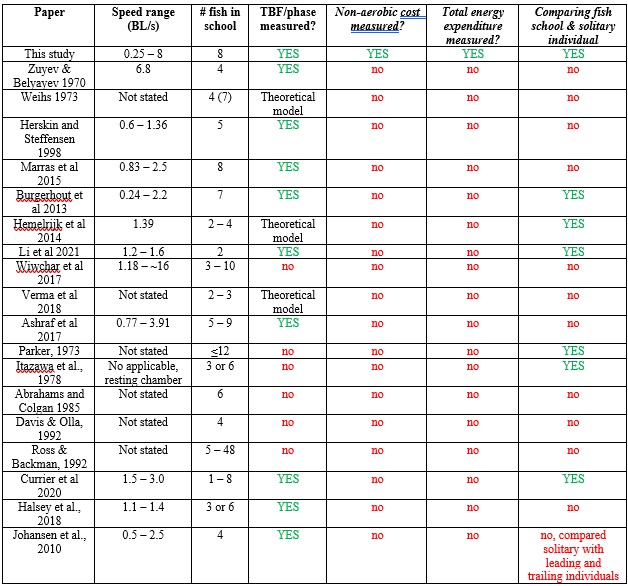
References cited above:
Zuyev, G., & Belyayev, V. V. (1970). An experimental study of the swimming of fish in groups as exemplified by the horsemackerel [Trachurus mediterraneus ponticus Aleev]. J Ichthyol, 10, 545-549.
Weihs, D. (1973). Hydromechanics of fish schooling. Nature, 241(5387), 290-291.
Herskin, J., & Steffensen, J. F. (1998). Energy savings in sea bass swimming in a school: measurements of tail beat frequency and oxygen consumption at different swimming speeds. Journal of Fish Biology, 53(2), 366-376.
Marras, S., Killen, S. S., Lindström, J., McKenzie, D. J., Steffensen, J. F., & Domenici, P. (2015). Fish swimming in schools save energy regardless of their spatial position. Behavioral ecology and sociobiology, 69, 219-226.
Burgerhout, E., Tudorache, C., Brittijn, S. A., Palstra, A. P., Dirks, R. P., & van den Thillart, G. E. (2013). Schooling reduces energy consumption in swimming male European eels, Anguilla anguilla L. Journal of experimental marine biology and ecology, 448, 66-71.
Hemelrijk, C. K., Reid, D. A. P., Hildenbrandt, H., & Padding, J. T. (2015). The increased efficiency of fish swimming in a school. Fish and Fisheries, 16(3), 511-521.
Li, L., Nagy, M., Graving, J. M., Bak-Coleman, J., Xie, G., & Couzin, I. D. (2020). Vortex phase matching as a strategy for schooling in robots and in fish. Nature communications, 11(1), 5408.
Wiwchar, L. D., Gilbert, M. J., Kasurak, A. V., & Tierney, K. B. (2018). Schooling improves critical swimming performance in zebrafish (Danio rerio). Canadian Journal of Fisheries and Aquatic Sciences, 75(4), 653-661.
Verma, S., Novati, G., & Koumoutsakos, P. (2018). Efficient collective swimming by harnessing vortices through deep reinforcement learning. Proceedings of the National Academy of Sciences, 115(23), 5849-5854.
Ashraf, I., Bradshaw, H., Ha, T. T., Halloy, J., Godoy-Diana, R., & Thiria, B. (2017). Simple phalanx pattern leads to energy saving in cohesive fish schooling. Proceedings of the National Academy of Sciences, 114(36), 9599-9604.
Parker Jr, F. R. (1973). Reduced metabolic rates in fishes as a result of induced schooling. Transactions of the American Fisheries Society, 102(1), 125-131.
Itazawa, Y., & Takeda, T. (1978). Gas exchange in the carp gills in normoxic and hypoxic conditions. Respiration physiology, 35(3), 263-269.
Abrahams, M. V., & Colgan, P. W. (1985). Risk of predation, hydrodynamic efficiency and their influence on school structure. Environmental Biology of Fishes, 13, 195-202.
Davis, M. W., & Olla, B. L. (1992). The role of visual cues in the facilitation of growth in a schooling fish. Environmental biology of fishes, 34, 421-424.
Ross, R. M., Backman, T. W., & Limburg, K. E. (1992). Group-size-mediated metabolic rate reduction in American shad. Transactions of the American Fisheries Society, 121(3), 385-390.
Currier, M., Rouse, J., & Coughlin, D. J. (2021). Group swimming behaviour and energetics in bluegill Lepomis macrochirus and rainbow trout Oncorhynchus mykiss. Journal of Fish Biology, 98(4), 1105-1111.
Halsey, L. G., Wright, S., Racz, A., Metcalfe, J. D., & Killen, S. S. (2018). How does school size affect tail beat frequency in turbulent water?. Comparative Biochemistry and Physiology Part A: Molecular & Integrative Physiology, 218, 63-69.
Johansen, J. L., Vaknin, R., Steffensen, J. F., & Domenici, P. (2010). Kinematics and energetic benefits of schooling in the labriform fish, striped surfperch Embiotoca lateralis. Marine Ecology Progress Series, 420, 221-229.
3) In addition to the calming effect, measuring group oxygen consumption suffers from a number of problems as discussed in Herskin and Steffensen (1998) such as the fish volume to water volume ratio, which varies considerably when testing a school vs single individuals in the same tunnel and the problem of wall effect when using a small volume of water for accurate O2 measurements. Herskin and Steffensen (1998) circumvented these problems by measuring tailbeat frequencies of fish in a school and then calculating the MO2 of the corresponding tailbeat frequency in solitary fish in a swim tunnel. A similar approach was used by Johansen et al (2010), Marras et al (2015), Halsey et al (2018). However, It is not clear how these potential issues were dealt with here. Here, larger solitary D. aequipinnatus were used to increase the signal-to-noise ratio. However, using individuals of different sizes makes other variables not so directly comparable, including stress, energetics, and kinematics. (see comment 7 below).
Response: We acknowledge the great efforts made by previous studies to understand the energetics of fish schooling. These studies, as detailed in the table and elaborated in the response above (see comment 2) are very different from our current study. Our study achieved a direct comparison of energetics (including both aerobic and non-aerobic cost) and kinematics between solitary individuals and fish schools that has never been done before. Our detailed response to the supposed “calming effect” is given above.
As highlighted in the previous comments and opening statement, our current version has addressed the wall effect, tail beat frequency, and experimental and analytical efforts invested to directly compare the energetics between fish schools and solitary individuals. As readers can see in our comprehensive method section, achieving the direct comparison between solitary individuals and fish schools is not a trivial task. Now we want to elaborate on the role of kinematics as an indirect estimate of energetics. Our results here show that kinematic measurements of tail beat frequency are not reliable estimates of energetic cost, and the previous studies cited did not measure EPOC and those costs are substantial, especially as swimming speed increases. Fish in schools can save energy even when the tail beat frequency does not change (although school volume can change as we show). We elaborated (in great detail) on why kinematics does not always reflect on the energetics in the submitted version (see last paragraph of “Schooling dynamics and energy conservation” section). Somehow modeling what energy expenditure should be based only on tail kinematics is, in our view, a highly unreliable approach that has never been validated (e.g., fish use more than just tails for locomotion). Indeed, we believe that this is an inadequate substitute for direct energy measurements. We disagree that using slightly differently sized individuals is an issue since we recorded fish kinematics across all experiments and included the measurements of behaviour in our manuscript. Slightly altering the size of individual fish was done on purpose to provide a better ratio of respirometer volume to fish volume in the tests on individual fish, thus we regard this as a benefit of our approach and not a concern.
Finally, in another study of the collective behaviour of flying birds (Usherwood, J. R., Stavrou, M., Lowe, J. C., Roskilly, K. and Wilson, A. M. (2011). Flying in a flock comes at a cost in pigeons. Nature 474, 494-497), the authors observed that wing beat frequency can increase during flight with other birds. Hence, again, we cannot regard movement frequency of appendages as an adequate substitute for direct energetic measurements.
4) Svendsen et al (2016) provide guidelines for the ratio of fish volume to water volume in the respirometer. The ratio used here (2200) is much higher than that recommended. RFR values higher than 500 should be avoided in swim tunnel respirometry, according to Svendsen et al (2016).
Response: Thank you for raising this point. Please see the detailed responses above to the same comment above. We believe that our experimental setup and ratios are very much in line with those recommended, and represent a significant improvement on previous studies which use large ratios.
5) Lines 421-436: The same goes for wall effects. Presumably, using the same size swim tunnel, schooling fish were swimming much closer to the walls than solitary fish but this is not specifically quantified here in this paper. Lines 421-436 provide some information on the boundary layer (though wall effects are not just related by the boundary layer) and some qualitative assessment of school volume. However, no measurement of the distance between the fish and the wall is given.
Response: Please see the detailed responses above to the same comment. Specifically, we used the particle image velocimetry (PIV) system to measure the boundary layer (<2.5 mm at speeds > 2 BL s-1) and stated the parameters in the methods section of the Integrated Biomechanics & Bioenergetic Assessment System. We also state that the boundary layer is much thinner than the body width of the giant danio (~10 mm) so that the fish cannot effectively hide near the wall. Due to our PIV calibration, we are able to quantify flow near the wall.
Due to our video data obtained simultaneously with energetic measurements, we do not agree that fish were swimming closer to the wall in schools and also note that we took care to modify the typical respirometer to both ensure that flow across the cross-section did not provide any refuges and to quantify flow velocities in the chamber using particle image velocimetry. We do not believe that any previous experiments on schooling behaviour in fish have taken the same precautions.
6) The statistical tests used have a number of problems. Two-way ANOVA was based on school vs solitary and swimming speed. However, there are repeated measures at each speed and this needs to be dealt with. The degrees of freedom of one-way ANOVA and T-tests are not provided. These tests took into account five groups of fish vs. five solitary fish. The values of MO2 of each school are the result of the oxygen consumption of each fish, and therefore the test is comparing 5 individuals (i.e. an individual is the statistical unit) vs 5 schools (a school made out of 8 fish is the statistical unit). Therefore the test is comparing two different statistical units. One can see from the graphs that schooling MO2 tend to have a smaller SD than solitary data. This may well be due to the fact that schooling data are based on 5 points (five schools) and each point is the result of the MO2 of five fish, thereby reducing the variability compared to solitary fish. TBF, on the other hand, can be assigned to each fish even in a school, and therefore TBF of each fish could be compared by using a nested approach of schooling fish (nested within each school) vs solitary fish, but this is not the statistical procedure used in the present manuscript. The comparison between TBFs presumably is comparing 5 individuals vs all the fish in the schools (6x5=30 fish). However, the fish in the school are not independent measures.
Response: We cannot agree with this criticism, which may be based on this reviewer having seen a previous version of the manuscript. We did not use two-way ANOVA in this version. This version of the manuscript reported the statistical value based on a General Linear Model (see statistical section of the method). We are concerned that this reviewer did not in fact read either the Methods section or the Results section. In addition, it is hard to accept that, from examination of the data shown in Figure 3, there is not a clear and large difference between schooling and solitary locomotion, regardless of the statistical test used.
Meanwhile, the comments about the ‘repeated’ measures from one speed to the next are interesting, but we cannot agree. The ‘repeated’ measures are proper when one testing subject is assessed before and after treatment. Going from one speed to the next is not a treatment. Instead, the speed is a dependent and continuous variable. In our experimental design, the treatment is fish school, and the control is a solitary individual. Second, we never compared any of our dependent variables across different speeds within a school or within an individual. Instead, we compared schools and individuals at each speed. In this comparison, there are no ‘repeated’ measures. We agree with the reviewer that fish in the school are interacting (not independent). This is one more reason to support our approach of treating fish schools as a functional and statistical unit in our experiment design (more detailed responses are stated in the response to the comment above).
7) The size of solitary and schooling individuals appears to be quite different (solitary fish range 74-88 cm, schooling fish range 47-65 cm). While scaling laws can correct for this in the MO2, was this corrected for TBF and for speed in BL/s? Using BL/s for speed does not completely compensate for the differences in size.
Response: Our current version has provided justifications for not conducting scaling in the values of tail beat frequency. Our justification is “The mass scaling for tail beat frequency was not conducted because of the lack of data for D. aequipinnatus and its related species. Using the scaling exponent of distant species for mass scaling of tail beat frequency will introduce errors of unknown magnitude.”. Our current version also acknowledges the consideration about scaling as follows: “Fish of different size swimming at 1 BL s-1 will necessarily move at different Reynolds numbers, and hence the scaling of body size to swimming speed needs to be considered in future analyses of other species that differ in size”
Reviewer #3 (Public Review):
Summary:
Zhang and Lauder characterized both aerobic and anaerobic metabolic energy contributions in schools and solitary fishes in the Giant danio (Devario aequipinnatus) over a wide range of water velocities. By using a highly sophisticated respirometer system, the authors measure the aerobic metabolisms by oxygen uptake rate and the non-aerobic oxygen cost as excess post-exercise oxygen consumption (EPOC). With these data, the authors model the bioenergetic cost of schools and solitary fishes. The authors found that fish schools have a J-shaped metabolism-speed curve, with reduced total energy expenditure per tail beat compared to solitary fish. Fish in schools also recovered from exercise faster than solitary fish. Finally, the authors conclude that these energetic savings may underlie the prevalence of coordinated group locomotion in fish.
The conclusions of this paper are mostly well supported by data, but some aspects of methods and data acquisition need to be clarified and extended.
Response: Thank you for seeing the value of our study. We provided clarification of the data acquisition system with a new panel of pictures included in the supplemental material to show our experimental system. We understand that our methods have more details and justifications than the typical method sections. First, the details are to promote the reproducibility of the experiments. The justifications are the responses to reviewer 2, who reviewed our previous manuscript version and also posted the same critiques after we provided the justifications for the construction of the system and the data acquisition.
Strengths:
This work aims to understand whether animals moving through fluids (water in this case) exhibit highly coordinated group movement to reduce the cost of locomotion. By calculating the aerobic and anaerobic metabolic rates of school and solitary fishes, the authors provide direct energetic measurements that demonstrate the energy-saving benefits of coordinated group locomotion in fishes. The results of this paper show that fish schools save anaerobic energy and reduce the recovery time after peak swimming performance, suggesting that fishes can apport more energy to other fitness-related activities whether they move collectively through water.
Response: Thank you. We are excited to share our discoveries with the world.
Weaknesses:
Although the paper does have strengths in principle, the weakness of the paper is the method section. There is too much irrelevant information in the methods that sometimes is hard to follow for a researcher unfamiliar with the research topic. In addition, it was hard to imagine the experimental (respirometer) system used by the authors in the experiments; therefore, it would be beneficial for the article to include a diagram/scheme of that respiratory system.
Response: We agree with the reviewer and hence added the pictures of the experimental system in the supplementary materials (Fig. S4). We think pictures are more realistic to present the system than schematics. We also provide a picture of the system during the process of making the energetic measurements. It is to show the care went to ensure fish are not affected by any external stimulation other than the water velocity. The careful experimental protocol is very critical to reveal the concave upward shaped curve of bony fish schools that was never reported before. Many details in the methods have been included in response to Reviewer 2.
Reviewer #3 (Recommendations For The Authors):
Overall, this is a very interesting, well-written, and nice article. However, many times the method section looks like a discussion. Furthermore, the authors need to check the use of the word "which" throughout the text. I got the feeling that it is overused/misused sometimes.
Response: Thank you for the positive comments. The method is written in that way to address the concerns of Reviewer 2 who reviewed our previous versions. We corrected the overuse of ‘which’ throughout the manuscript.
▼ 2 Gyuri Technology Scout 1 www.youtube.com
Sweet spot
Goldilocks
Sweet spot not sweat spot
▼ 1 Viewpoints Research Institute vpri.org
InterPersonal Computing
Sweet Spot
Beyond the threshold that is required
▼ 1 Cold vs Hot: Which is Better for Women? | Dr. Stacy Sims & Dr. Andrew Huberman www.youtube.com
on 0:31-2:08 starts explaining that heat is actually more benificail for woman of the cold water bathtubs. Dr. stacy explains that the cold baths are "so cold that it causes the body to shut down". and says that the sweet spot for woman and cold baths is around 55 to 56 degrees farehnhites because they can still reap the benifitts as though they were doing ice water baths.
▼ 1 Europe's 2030 Charging Challenge: 2.5 Million Points Short www.datapulseresearch.com
Four markets define the spectrum: a fragmented giant (Germany), a concentrated small market (Denmark), a state-owned dominance (Czech Republic), and a diversified market (Netherlands). Too fragmented and drivers juggle apps, cards and tariffs; too concentrated and prices drift while choice shrinks. The practical sweet spot is a few large players and a healthy fringe, backed by real roaming, transparent pricing, and reliable uptime.
▼ 1 Integrative models of visually guided steering in Drosophila www.biorxiv.org
Author response:
The following is the authors’ response to the original reviews.
Reviewer #1 (Public Review):
Summary:
The manuscript "Drosophila Visuomotor Integration: An Integrative Model and Behavioral Evidence of Visual Efference Copy" provides an integrative model of the visuomotor control in Drosophila melanogaster. This model presents an experimentally derived model based on visually evoked wingbeat pattern recordings of three strategically selected visual stimulus types with well-established behavioral response characteristics. By testing variations of these models, the authors demonstrate that the virtual model behavior can recapitulate the recorded wing beat behavioral results and those recorded by others for these specific stimuli when presented individually. Yet, the novelty of this study and their model is that it allows predictions for natural visual scenes in which multiple visual stimuli occur simultaneously and may have opposite or enhancing effects on behavior. Testing three models that would allow interactions of these visual modalities, the authors show that using a visual efference copy signal allows visual streams to interact, replicating behavior recorded when multiple stimuli are presented simultaneously. Importantly, they validated the prediction of this model in real flies using magnetically tethered flies, e.g., presenting moving bars with varying backgrounds. In conclusion, the presented manuscript presents a commendable effort in developing and demonstrating the validity of a mixture model that allows predictions of the behavior of Drosophila in natural visual environments.
Strengths:
Overall, the manuscript is well-structured and clear in its presentation, and the modeling and experimental research are methodically conducted and illustrated in visually appealing and easy-to-understand figures and their captions.
The manuscript employs a thorough, logical approach, combining computational modeling with experimental behavioral validation using magnetically tethered flies. This iterative integration of simulation and empirical behavioral evidence enhances the credibility of the findings.
The associated code base is well documented and readily produces all figures in the document.
Suggestions:
However, while the experiments provide evidence for the use of a visual efference copy, the manuscript would be even more impressive if it presented specific predictions for the neural implementation or even neurophysiological data to support this model. Or, at the very least, a thorough discussion. Nonetheless, these models and validating behavioral experiments make this a valuable contribution to the field; it is well executed and addresses a significant gap in the modeling of fly behavior and holistic understanding of visuomotor behaviors.
We appreciate the reviewer’s thoughtful comments on the strengths and weaknesses of our manuscript. We agree that biophysically realistic model reflecting the structure of neural circuits as well as physiological data from them would be invaluable. However, we are currently unable to provide physiological evidence for EC-based suppression, nor provide circuit architecture for efference copy-based suppression of the stability circuit because the neural pathway underlying this behavior remains unidentified. Extensive recordings from the HS/VS system have revealed cell-type-specific motor-related inputs during both spontaneous and loom-evoked flight turns (Fenk et al., 2021; Kim et al., 2017, 2015). These studies predicted suppression of the optomotor stability response during such turns, and our new experiments confirmed this suppression specifically during loom-evoked turns (Figures 5, 6). However, these neurons are primarily involved in the head optomotor response, not the body optomotor response. We hope to extend our current model in future studies to incorporate more cellular-level detail, as the feedforward circuits underlying stability behavior become more clearly defined.
Here are a few points that should be addressed:
(1) The biomechanics block (Figure 2) should be elaborated on, to explain its relevance to behavior and relation to the underlying neural mechanisms.
We appreciate this suggestion. The mathematical representation of the biomechanics block has been developed by other groups in previous studies (Fry et al., 2003; Ristroph et al., 2010). We used exactly the same model, and its parameters were identical to those used in one of those studies (Fry et al., 2003; Ristroph et al., 2010), in which the parameters were estimated from the stabilizing response in response to magnetic “stumbling” pulses. In the previous version of the manuscript, we had a description of the biomechanics block in the Method section (see Equation 4). In response to the reviewer’s comment, we have made a few changes in Figure 2A and expanded the associated description in the main text, as follows.
(Line 160) “To test the orientation behavior of the model, we developed an expanded model, termed “virtual fly model” hereafter. In this model, we added a biomechanics block that transforms the torque response of the fly to the actual heading change according to kinematic parameters estimated previously (Michael H Dickinson, 2005; Ristroph et al., 2010) (Figure 2A, see Equation 4 in Methods and Movie S1). The virtual fly model, featuring position and velocity blocks that are conditioned on the type of the visual pattern, can now change its body orientation, simulating the visual orientation behavior of flies in the free flight condition.”
(2) It is unclear how the three integrative models with different strategies were chosen or what relevance they have to neural implementation. This should be explained and/or addressed.
Thank you for this valuable comment. We selected the three models based on previous studies investigating visuomotor integration across multiple species, under conditions where multiple sensory cues are presented simultaneously.
The addition-only model represents the simplest hypothesis, analogous to the “additive model” proposed by Tom Collett in his 1980 study (Collett, 1980). We used this model as a baseline to illustrate behavior in the absence of any efference copy mechanism. Notably, some modeling studies have proposed linear (additive) integration for multimodal sensory cues at the behavioral level (Liu et al., 2023; Van der Stoep et al., 2021). However, experimental evidence demonstrating strictly linear integration—either behaviorally or physiologically—remains limited. In our study, new data (Figure 5) show that bar-evoked and background movement-evoked locomotor responses are combined linearly, supporting the addition-only model.
The graded efference copy model has been most clearly demonstrated in the cerebellum-like circuit of Mormyrid fish during electrosensation (Bell, 1981; Kennedy et al., 2014). In this system, the efference copy signal forms a negative image of the predicted reafferent input and undergoes plastic changes as the environment changes—an idea that inspired our modifiable efference copy model (Figure 4–figure supplement 1). The all-or-none efference copy model is exemplified in the sensory systems of smaller organisms, such as the auditory neurons of crickets during stridulation (Poulet and Hedwig, 2006). Notably, in crickets, the motor-related input is referred to as corollary discharge rather than efference copy. Typically, “efference copy” refers to a graded, subtractive motor-related signal, while “corollary discharge” denotes an all-or-none signal, both counteracting the sensory consequences of self-generated actions. In this manuscript, we use the term efference copy more broadly, encompassing both types of motor-related feedback signals (Sommer and Wurtz, 2008).
In response to this comment, we have made the following changes in the main text to enhance its accessibility to general readers.
(Line#268) “This integration problem has been studied across animal sensory systems, typically by analyzing motor-related signals observed in sensory neurons (Bell, 1981; Collett, 1980; Kim et al., 2017; Poulet and Hedwig, 2006). Building on the results of these studies, we developed three integrative models. The first model, termed the “addition-only model”, assumes that the outputs of the object (bar) and the background (grating) response circuits are summed to control the flight orientation (Figure 4B, see Equation 14 in Methods).”
(Line#272) “In the second and third models, an EC is used to set priorities between different visuomotor circuits (Figure 4C,D). In particular, the EC is derived from the object-induced motor command and sent to the object response system to nullify visual input associated with the object-evoked turn (Bell, 1981; Collett, 1980; Poulet and Hedwig, 2006). These motor-related inputs fully suppress sensory processing in some systems (Poulet and Hedwig, 2006), whereas in others they selectively counteract only the undesirable components of the sensory feedback (Bell, 1981; Kennedy et al., 2014).”
(3) There should be a discussion of how the visual efference could be represented in the biological model and an evaluation of the plausibility and alternatives.
Thank you for this helpful comment. We have now added the following discussion to share our perspective on the circuit-level implementation of the visual efference copy in Drosophila.
(Line#481) “Efference copy in Drosophila vision
Under natural conditions, various visual features in the environment may concurrently activate multiple motor programs. Because these may interfere with one another, it is crucial for the central brain to coordinate between the motor signals originating from different sensory circuits. Among such coordination mechanisms, the EC mechanisms were hypothesized to counteract so-called reafferent visual input, those caused specifically by self-movement (Collett, 1980; von Holst and Mittelstaedt, 1950). Recent studies reported such EC-like signals in Drosophila visual neurons during spontaneous as well as loom-evoked flight turns (Fenk et al., 2021; Kim et al., 2017, 2015). One type of EC-like signals were identified in a group of wide-field visual motion-sensing neurons that were shown to control the neck movement for the gaze stability (Kim et al., 2017). The EC-like signals in these cells were bidirectional depending on the direction of flight turns, and their amplitudes were quantitatively tuned to those of the expected visual input across cell types. Although amplitude varies among cell types, it remains inconclusive whether it also varies within a given cell type to match the amplitude of expected visual feedback, thereby implementing the graded EC signal. A more recent study examined EC-like signal amplitude in the same visual neurons for loom-evoked turns, across events (Fenk et al., 2021). Although the result showed a strong correlation between wing response and the EC-like inputs, the authors pointed that this apparent correlation could stem from noisy measurement of all-or-none motor-related inputs.
Thus, these studies did not completely disambiguate between graded vs. all-or-none EC signaling. Another type of EC-like signals observed in the visual circuit tuned to a moving spot exhibited characteristics consistent with all-or-none EC. That is, it entirely suppressed visual signaling, irrespective of the direction of the self-generated turn (Kim et al., 2015; Turner et al., 2022).
Efference-copy (EC)–like signals have been reported in several Drosophila visual circuits, yet their behavioral role remains unclear. Indirect evidence comes from a behavioral study showing that the dynamics of spontaneously generated flight turns were unaffected by unexpected background motion (Bender and Dickinson, 2006a). Likewise, our behavioral experiments showed that, during loom-evoked turns, responses to background motion are suppressed in an all-or-none manner (Figures 6 and 7). Consistent with this, motor-related inputs recorded in visual neurons exhibit nearly identical dynamics during spontaneous and loom-evoked turns (Fenk et al., 2021). Together, these behavioral and physiological parallels support the idea that a common efference-copy mechanism operates during both spontaneous and loom-evoked flight turns.
Unlike loom-evoked turns, bar-evoked turn dynamics changed in the presence of moving backgrounds (Figure 5), a result compatible with both the addition-only and graded EC models. However, when the static background was updated just before a bar-evoked turn—thereby altering the amplitude of optic flow—the turn dynamics remained unaffected (Figures 5 and 7), clearly contradicting the addition-only model. Thus, the graded EC model is the only one consistent with both findings. If a graded EC mechanism were truly at work, however, an unexpected background change should have modified turn dynamics because of the mismatch between expected and actual visual feedback (Figure 4–figure supplement 1)—yet we detected no such effect at any time scale examined (Figure 7–figure supplement 1). This mismatch would be ignored only if the amplitude of the graded EC adapted to environmental changes almost instantaneously—a mechanism that seems improbable given the limited computational capacity of the Drosophila brain. In electric fish, for example, comparable adjustments take more than 10 minutes (Bell, 1981; Muller et al., 2019). Further investigation is needed to clarify how reorienting flies ignore optic flow generated by static backgrounds, potentially by engaging EC mechanisms not captured by the models tested in this study.
Why would Drosophila rely on the all-or-none EC mechanism instead of the graded one for loom-evoked turns? A graded EC must be adjusted adaptively depending on the environment, as the amplitude of visual feedback varies with both the dynamics of self-generated movement and environmental conditions (e.g., empty vs. cluttered visual backgrounds) (Figure 4—figure supplement 1). Recent studies on electric fish have suggested that a large array of neurons in a multi-layer network is crucial for generating a modifiable efference copy signal matched to the current environment (Muller et al., 2019). Given their small-sized brain, flies might opt for a more economical design for suppressing unwanted visual inputs regardless of the visual environment. Circuits mediating such a type of EC were identified in the cricket auditory system during stridulation (Poulet and Hedwig, 2006), for example. Our study strongly suggests the existence of a similar circuit in the Drosophila visual system.
We tested the hypothesis that efference-copy (EC) signals guide action selection by suppressing specific visuomotor reflexes when multiple visual features compete. An alternative motif with a similar function is mutual inhibition between motor pathways (Edwards, 1991; Mysore and Kothari, 2020). In Drosophila, descending neurons form dense lateral connections (Braun et al., 2024), offering a substrate for such competitive interactions. Determining whether—and how—EC and mutual inhibition operate will require recordings from the neurons that ensure visual stability, which remain unidentified. Mapping these pathways and assessing how they are modulated by visual and behavioral context are important goals for future work.”
Reviewer #2 (Public Review):
It has been widely proposed that the neural circuit uses a copy of motor command, an efference copy, to cancel out self-generated sensory stimuli so that intended movement is not disturbed by the reafferent sensory inputs. However, how quantitatively such an efference copy suppresses sensory inputs is unknown. Here, Canelo et al. tried to demonstrate that an efference copy operates in an all-or-none manner and that its amplitude is independent of the amplitude of the sensory signal to be suppressed. Understanding the nature of such an efference copy is important because animals generally move during sensory processing, and the movement would devastatingly distort that without a proper correction. The manuscript is concise and written very clearly. However, experiments do not directly demonstrate if the animal indeed uses an efference copy in the presented visual paradigms and if such a signal is indeed non-scaled. As it is, it is not clear if the suppression of behavioral response to the visual background is due to the act of an efference copy (a copy of motor command) or due to an alternative, more global inhibitory mechanism, such as feedforward inhibition at the sensory level or attentional modulation. To directly uncover the nature of an efference copy, physiological experiments are necessary. If that is technically challenging, it requires finding a behavioral signature that unambiguously reports a (copy of) motor command and quantifying the nature of that behavior.
We thank the reviewer for this insightful and constructive comment. We agree that our current behavioral evidence does not directly identify the underlying circuit mechanism, and that direct recordings from visual neurons modulated by an efference copy would be critical for distinguishing between potential mechanisms.
A prerequisite for such physiological investigations would be the identification of both (1) the feedforward neurons directly involved in the optomotor response, and (2) the neurons conveying motor-related signals to the optomotor circuit. Despite efforts by several research groups, the location of the feedforward circuit mediating the optomotor response remains elusive. This limitation has prevented us from obtaining direct cellular evidence of flight turn-associated suppression of optomotor signaling.
In light of the reviewer’s suggestion, we expanded our investigation to strengthen the behavioral evidence for efference copy (EC) mechanisms. In addition to our earlier experiments involving unexpected changes in the static background, we examined how object-evoked flight turns influence the optomotor stability reflex and vice versa (Figures 5 and 6). To quantify the interaction between different visuomotor behaviors, we systematically varied the temporal relationship between two types of visual motion—loom versus moving background, or moving bar versus moving background—and measured the resulting behavioral responses.
Our findings support pattern- and time-specific suppressive mechanisms acting between flight turns associated with the different visual patterns. Specifically:
The responses to a moving bar and a moving background add linearly, even when presented in close temporal proximity.
Loom-evoked turns and the optomotor stability reflex mutually suppress each other in a time-specific manner.
For both loom- and moving bar-evoked flight turns, changes in the static background had no measurable effect on the dynamics of the object-evoked responses.
These results provide a detailed behavioral characterization of a suppressive interaction between distinct visuomotor responses. This, in turn, offers correlative evidence supporting the involvement of an efference copy-like mechanism acting on the visual system. While similar efference copy mechanisms have been documented in other parts of the visual system, we acknowledge that our findings do not exclude alternative explanations. In particular, it is still possible that lateral inhibition within the central brain or ventral nerve cord contributes to the suppression we observed.
Ultimately, definitive proof will require identifying the specific neurons that convey efference copy signals and demonstrating that silencing these neurons abolishes the behavioral suppression. Until such experiments are feasible, our behavioral approach provides an important contribution toward understanding the nature of sensorimotor integration in this system.
Reviewer #3 (Public Review):
Summary:
Canelo et al. used a combination of mathematical modeling and behavioral experiments to ask whether flies use an all-or-none EC model or a graded EC model (in which the turn amplitude is modulated by wide-field optic flow). Particularly, the authors focus on the bar-ground discrimination problem, which has received significant attention in flies over the last 50-60 years. First, they use a model by Poggio and Reichardt to model flight response to moving small-field bars and spots and wide-field gratings. They then simulate this model and compare simulation results to flight responses in a yaw-free tether and find generally good agreement. They then ask how flies may do bar-background discrimination (i.e. complex visual environment) and invoke different EC models and an additive model (balancing torque production due to background and bar movement). Using behavioral experiments and simulation supports the notion that flies use an all-or-none EC since flight turns are not influenced by the background optic flow. While the study is interesting, there are major issues with the conceptual framework.
Strengths:
They ask a significant question related to efference copies during volitional movement.
The methods are well detailed and the data (and statistics) are presented clearly.
The integration of behavioral experiments and mathematical modeling of flight behavior.
The figures are overall very clear and salient.
Weaknesses:
Omission of saccades: While the authors ask a significant question related to the mechanism of bar-ground discrimination, they fail to integrate an essential component of the Drosophila visuomotor responses: saccades. Indeed, the Poggio and Reichardt model, which was developed almost 50 years ago, while appropriate to study body-fixed flight, has a severe limitation: it does not consider saccades. The authors identify this major issue in the Discussion by citing a recent switched, integrate-and-fire model (Mongeau & Frye, 2017). The authors admit that they "approximated" this model as a smooth pursuit movement. However, I disagree that it is an approximation; rather it is an omission of a motor program that is critical for volitional visuomotor behavior. Indeed, saccades are the main strategy by which Drosophila turn in free flight and prior to landing on an object (i.e. akin to a bar), as reported by the Dickinson group (Censi et al., van Breugel & Dickinson [not cited]). Flies appear to solve the bar-ground discrimination problem by switching between smooth movement and saccades (Mongeau & Frye, 2017; Mongeau et al., 2019 [not cited]). Thus, ignoring saccades is a major issue with the current study as it makes their model disconnected from flight behavior, which has been studied in a more natural context since the work of Poggio.
Thank you for this helpful comment. We agree that including saccadic turns is essential and qualitatively improves the model. In the revised manuscript, we therefore expanded our bar-tracking model to incorporate an integrate-and-saccade strategy, now presented in Figure 2—figure supplement
The manuscript now introduces this result as follows:
(Line#190) “Finally, one important locomotion dynamics that a flying Drosophila exhibits while tracking an object is a rapid orientation change, called a “saccade” (Breugel and Dickinson, 2012; Censi et al., 2013; Heisenberg and Wolf, 1979). For example, while tracking a slowly moving bar, flies perform relatively straight flights interspersed with saccadic flight turns (Collett and Land, 1975; Mongeau and Frye, 2017). During this behavior, it has been proposed that visual circuits compute an integrated error of the bar position with respect to the frontal midline and triggers a saccadic turn toward the bar when the integrated value reaches a threshold (Frighetto and Frye, 2023; Mongeau et al., 2019; Mongeau and Frye, 2017). We expanded our bar fixation model to incorporate this behavioral strategy (Figure 2--figure supplement 2). The overall structure of the modified model is akin to the one proposed in a previous study (Mongeau and Frye, 2017), and the amplitude of a saccadic turn was determined by the sum of the position and velocity functions (Figure 2--figure supplement 2A; see Equation 13 in Methods). When simulated, our model successfully reproduced experimental observations of saccade dynamics across different object velocities (Figure 2--figure supplement 2B-D) (Mongeau and Frye, 2017). Together, our models faithfully recapitulated the results of previous behavioral observations in response to singly presented visual patterns (Collett, 1980; Götz, 1987; H. Kim et al., 2023; Maimon et al., 2008; Mongeau and Frye, 2017).”
Apart from Figures 1 and 2, most of our data—whether from simulations or behavioral experiments—use brief visual patterns lasting 200 ms or less. These stimuli trigger a single, rapid orientation change reminiscent of a saccadic flight turn. In this part of the paper, we essentially have examined how multiple visuomotor pathways interact to determine the direction of object-evoked turns when several visual patterns occur simultaneously.
Critically, recent work showed that a group of columnar neurons (T3) appear specialized for saccadic bar tracking through integrate-and-fire computations, supporting the notion of parallel visual circuits for saccades and smooth movement (Frighetto & Frye, 2023 [not cited]).
Thanks for bringing up this critical issue. We have now added this paper in the following part of the manuscript.
(Line#193) “During this behavior, it has been proposed that visual circuits compute an integrated error of the horizontal bar position with respect to the frontal midline and triggers a saccadic turn toward the bar when the integrated value reaches a threshold (Frighetto and Frye, 2023; Mongeau and Frye, 2017).”
(Line#462) “Visual systems extract features from the environment by calculating spatiotemporal relationships of neural activities within an array of photoreceptors. In Drosophila, these calculations occur initially on a local scale in the peripheral layers of the optic lobe (Frighetto and Frye, 2023; Gruntman et al., 2018; Ketkar et al., 2020).”
A major theme of this work is bar fixation, yet recent work showed that in the presence of proprioceptive feedback, flies do not actually center a bar (Rimniceanu & Frye, 2023). Furthermore, the same study found that yaw-free flies do not smoothly track bars but instead generate saccades. Thus prior work is in direct conflict with the work here. This is a major issue that requires more engagement by the authors.
Thank you for your thoughtful comments and for drawing our attention to this important paper. In our experiments, bar fixation on oscillating vertical objects emerges during the “alignment” phase of the magneto-tether protocol. The pattern movement dynamics was similar those used by Rimniceanu & Frye (2023), yet the two studies differ in a key respect: Rimniceanu & Frye employed a motion-defined bar, whereas we presented a dark vertical bar against a uniform or random-dot background. The alignment success rate—defined as the proportion of trials in which the fly’s body angle is within ±25° of the target—was about 50 % (data not shown). Our alignment pattern consisted of three vertical stripes spanning ~40° horizontally; when we replaced it with a single, narrower stripe, the success rate was lowered (data not shown). These observations suggest that bar fixation in the magnetically tethered assay is less robust than in the rigid-tethered assay, although flies still orient toward highly salient vertical objects.
We also observed that bar-evoked turns were elicited more reliably when the bar moved rapidly (45° in 200 ms) in the magneto-tether assay, although the turn magnitude was significantly smaller than the actual bar displacement (Figure 3).
In response to the reviewer’s comment, we now added the following description in the paper regarding the bar fixation behavior, citing Rimniceanu&Frye 2023.
(Line#239) “Another potential explanation arises from recent studies demonstrating that proprioceptive feedback provided during flight turns in a magnetically tethered assay strongly dampens the amplitude of wing and head responses (Cellini and Mongeau, 2022; Rimniceanu et al., 2023).”
Relevance of the EC model: EC-related studies by the authors linked cancellation signals to saccades (Kim et al, 2014 & 2017). Puzzlingly, the authors applied an EC model to smooth movement, when the authors' own work showed that smooth course stabilizing flight turns do not receive cancellation signals (Fenk et al., 2021). Thus, in Fig. 4C, based on the state of the field, the efference copy signal should originate from the torque commands to initiate saccades, and not from torque to generate smooth movement. As this group previously showed, cancellation signals are quantitatively tuned to that of the expected visual input during saccades. Importantly, this tuning would be to the anticipated saccadic turn optic flow. Thus the authors' results supporting an all-or-none model appear in direct conflict with the author's previous work. Further, the addition-only model is not particularly helpful as it has been already refuted by behavioral experiments (Rimneceanu & Frye, Mongeau & Frye).
Thank you for this constructive comment. Efference copy is best established for brief, discrete actions like flight saccades. While motor-related modulation of visual processing has been reported across short- and long-duration behaviours (Chiappe et al., 2010; Fujiwara et al., 2017; Kim et al., 2015, 2017; Maimon et al., 2010; Turner et al., 2022), only flight saccade-associated signals exhibit the temporal profile appropriate to cancel reafferent input. However, von Holst & Mittelstaedt (1950) originally formulated efference copy to explain the smooth optomotor response of hoverflies. In HS/VS recordings in previous studies, however, we could not detect membrane-potential changes tied to baseline wing-beat amplitude (data not shown), but further work is needed.
Note that visually evoked flight turns analyzed in this paper have relatively fast dynamics. Fenk et al. (2021) showed that HS cells carry EC-like motor signals during both loom-evoked turns and spontaneous saccades. Building on this, we tested whether object-evoked rapid turns modulate other visuomotor pathways. Although Fenk et al. also found that optomotor turns lack motor input to HS cells, the authors did not test whether the optomotor pathway suppresses other reflexes, such as loom-evoked turns. Our new behavioral data (Figure 6) show that optomotor turns indeed suppress loom-evoked turns, suggesting a potential EC signal arising from the optomotor pathway that inhibits loom-responsive visual neurons.
In Kim et al. (2017), the authors argued that HS/VS neurons receive a “quantitatively tuned” efference copy that varies across cell types: yaw-sensitive LPTCs are strongly suppressed, roll-sensitive cells receive intermediate input, and pitch-sensitive cells receive little or none. We also showed that when the amplitude of ongoing visual drive changes, the amplitude of saccade-related potentials (SRPs) scales linearly. This proportionality does not imply a genuinely graded EC, however, because SRP amplitude could vary solely through changes in driving force (Vm – Vrest) with a fixed EC conductance. Crucially, SRPs do not fully suppress feed-forward visual signalling, arguing against an all-or-none EC mechanism.
How, then, can the cellular and behavioural data be reconciled? Silencing HS/VS neurons—or their primary inputs, the T4/T5 neurons—does not markedly diminish the optomotor response in flight (Fenk et al., 2014; Kim et al., 2017), indicating the presence of additional, as-yet-unidentified pathways.
Physiological recordings from other visual neurons that drive the optomotor response in flying Drosophila are therefore needed to determine how strongly they are suppressed during loom-evoked turns.
Behavioral evidence for all-or-none EC model: The authors state "unless the stability reflex is suppressed during the flies' object evoked turns, the turns should slow down more strongly with the dense background than the sparse one". This hypothesis is based on the fact that the optomotor response magnitude is larger with a denser background, as would be predicted by an EMD model (because there are more pixels projected onto the eye). However, based on the authors' previous work, the EC should be tuned to optic flow and thus the turning velocity (or amplitude). Thus the EC need not be directly tied to the background statistics, as they claim. For instance, I think it would be important to distinguish whether a mismatch in reafferent velocity (optic flow) links to distinct turn velocities (and thus position). This would require moving the background at different velocities (co- and anti-directionally) at the onset of bar motion. Overall, there are alternative hypotheses here that need to be discussed and more fully explored (as presented by Bender & Dickinson and in work by the Maimon group).
We appreciate the reviewer’s important suggestion. In response, we performed the recommended experiment. In Figures 5 and 6 of the revised manuscript, we now present how bar- or loom-evoked flight turns affect the response to a moving background pattern. These experiments revealed that bar-evoked turns do not suppress the optic flow response, whereas loom-evoked turns strongly suppress it. Specifically, when background motion began 100 ms after the onset of loom expansion, the response to the background was significantly suppressed. Although weak residual responses to the background motion were observed in this case, this could be due to background motion occurring outside of the suppression interval, which may correspond in duration to the duration of flight turns (Figure 6C,D).
The lack of suppression of the optic flow response during and after bar-evoked turns appears to suggest that the responses are added linearly (Figure 5), seemingly contradicting the lack of dynamic change when the background dot density was altered (Figure 7, Figure 7–figure supplement 1). That is, the experimental result in Figure 5 supports either an addition-only or a graded efference copy (EC) model. However, the result in Figure 7 supports an all-or-none EC model. If a graded EC were used, the amplitude of the EC should be updated almost instantaneously when the static background changes.
Another possibility is that the optic flow during self-generated turns in a static background is extremely weak compared to the optic flow input generated by physically moving the pattern, perhaps due to the rapid nature of head movements. Indeed, detailed kinematic analysis of head movement during spontaneous saccades in blow flies revealed that the head reaches the target angle before the body completes the orientation change, making the effective speed of reafferent optic flow higher than the speed of body rotation (Hateren and Schilstra, 1999). To test these hypotheses, further experiments will be needed for bar-evoked flight turns.
Publishing the reviewed preprint:
(1) The Reviewed Preprint (including the full text of the preprint we reviewed, the eLife assessment, and public reviews) will typically be published in two weeks' time.
Please let us know if you would like to provide provisional author responses to be posted at the same time (if so, please send these by email). Please do not resubmit within the next two/three weeks, as we will need to publish the first version of the Reviewed Preprint first.
If there are any factual errors in the eLife assessment or public reviews, or other issues we should be aware of, please let us know as soon as possible.
(2) After publication of the Reviewed Preprint, you can use the link below to submit a revised version. There is no deadline to resubmit. Before resubmitting, please ensure that you update the preprint at the preprint server to correspond with the revised version. Upon submitting a revised version, we will ask the editors and reviewers if it's appropriate to update their assessment and public reviews, which will be included alongside the revised Reviewed Preprint. At that time we will also post the recommendations to the authors and the author responses you provide with the revised version. In the author response, please respond to the public reviews (where relevant) and the recommendations to the authors.
(3) Alternatively, you can proceed with the current version of the Reviewed Preprint (once published), without revisions, and request an eLife Version of Record. See the Author Guide for further information: https://elife-rp.msubmit.net/html/elife-rp_author_instructions.html#vor. However, most authors decide to request a Version of Record after a round of revision.
(4) After publication of eLife's Reviewed Preprint, you also have the option to submit/publish in another journal instead: if you choose to do this, please let us know so we can update our records.
The reviewers identified two key revisions that could improve the assessment of the paper:
(1) Consideration of saccades within the model framework (outlined by reviewer 3).
(2) Addition of physiology data to support the conclusions of the paper (outlined by reviewer 2). If this is not feasible within the timescale of revisions, the paper would need to be revised to clarify that the model leads to a hypothesis that would need to be tested with future physiology experiments.
Thank you for these comments.
Regarding revision point #1, we have added Figure 2–figure supplement 2, where we incorporated our position-velocity model (estimated in Figure 1) into the framework of the integrate-and-saccade model. A detailed description of this model is now provided in the main text (Lines 190–203).
For revision point #2, obtaining electrophysiological evidence for efference copy remains challenging, as neither the visual neurons nor the efference-copy neuron has been identified for the wing optomotor response. As suggested by the reviewers, we have revised the title of the paper to reduce emphasis on efference copy and have noted electrophysiological recordings as a direction for future work.
old title: A visual efference copy-based navigation algorithm in Drosophila for complex visual environments
new title: Integrative models of visually guided steering in Drosophila
Specific recommendations are detailed below.
Reviewer #2 (Recommendations For The Authors):
To directly demonstrate if an efference copy is non-scaled, the following experiments can be helpful: record from HS/VS cells and examine the relation between the amplitude of the succade-suppression signal vs. succade amplitude.
Thanks for raising this important point. We previously carried out the suggested analysis for loom-evoked saccades in Fenk et al. (2021). There, significant correlations emerged between wing-response amplitude and saccade-related potentials (Figures 2F and 3C). However, we did not interpret the strong correlation (r ≈ 0.8) as evidence for a graded efference copy, because the amplitude of saccade-related potentials appeared to be bimodal. Upon presentation of the looming stimulus, flies either executed large evasive turns or showed minimal changes in wing-stroke amplitude. Large wing responses were accompanied by strong, saturated suppression of HS-cell membrane potential, whereas trials without wing responses produced only weak modulations—reflected in the bimodal distribution of saccade-related potential amplitudes (Figure 3C).
Importantly, in rigidly tethered preparations—where these potentials are typically measured—the absence of proprioceptive feedback can itself drive wingbeat amplitudes to saturation during saccades. We therefore reasoned that the lack of intermediate-sized flight saccades would naturally yield correspondingly saturated saccade-related potentials, even if a graded EC system is in play.
In Kim et al. (2017), we also performed a comprehensive analysis of spontaneous saccade-related potentials across all HS/VS cell types. When we later examined the relationship between saccade amplitude and the corresponding saccade-related potentials in each cell type, we could not find any statistically significant correlation (unpublished data).
measure how much a weak visual stimulus and a strong visual stimulus are suppressed by the suppression signal. If the signal is non-scaled, visual stimuli should always be suppressed independently of their intensities.
Thank you for this important suggestion. As mentioned in our response to the previous comment, we believe it is not feasible to record from neurons responsible for the body optomotor response at this point, as their identity remains unknown. Regarding the HS/VS cells, our previous study showed that HS cells are not always fully suppressed. The changes in saccade-related potential amplitude can be described as a linear function of the pre-saccadic visually-evoked membrane potential (Figure 7 in Kim et al., 2017).
As suggested by Fenk et al. 2014 (doi: 10.1016/j.cub.2014.10.042), HS cells might also be responsive to a moving bar. If that is the case, and if you present a bar and background (either sparse or dense) in a closed-loop manner to a head-fixed fly, HS cells might be sensitive only to the bar but not to the background (independently of the density).
Thanks for pointing out this important issue. HS cells indeed respond strongly to the horizontal movement of a vertical bar, as expected given that their receptive fields are formed by the integration of local optic flow vectors. In one of our previous studies (Supplemental Figure 1 in Kim et al., 2015), we showed that the response amplitude to a single vertical bar is roughly equivalent to that elicited by a vertical grating composed of 12 bars of the same size. Therefore, we believe that HS cells are likely to contribute to the head response to a moving vertical bar. In a body-fixed flight simulator, HS cells would respond only to the bar if the bar runs in a closed loop with a static background. In this scenario, HS cells are likely to play a role in the head optomotor response.
Note also that the role of HS cells in the wing optomotor response remains unresolved. Unilateral activation of HS cells has been shown to elicit locomotor turns in walking Drosophila (Fujiwara et al., 2017), as well as in flying individuals (unpublished data from our lab). However, a previous study also showed that strong silencing of HS/VS cells significantly reduced the head optomotor response, but not the wing optomotor response (Kim et al., 2017).
If neurophysiology is technically challenging, an alternative way might pay attention to a head movement that exclusively follows the background (Fox et al., 2014 (doi: 10.1242/jeb.080192)). Because HS cells are thought to promote head rotation to background motion, a non-scaled suppression signal on HS cells would always suppress the head rotation independently of the background density.
Thanks for this helpful comment. We have analyzed head movements during bar-evoked flight turns (Figure 7–figure supplement 1B) and found no significant changes across different background dot densities. We think that this might suggest that HS cells are unlikely to receive suppressive inputs during bar-evoked turns, akin to the lack of modulation during optomotor turns.
Another way to separate a potential efference copy from other mechanisms (more global inhibition) is the directionality. A global inhibition would suppress the response to the background even if the background moves in the same direction as self-motion, but the efference copy would not.
Thanks for this important point. In Heisenberg and Wolf, 1979, it was proposed that modulation might be bidirectional, with behavioral effects observed only for perturbations in the “unexpected” direction. In our new data on loom-evoked turns (Figure 6), the suppression appears equally strong for background motion in either direction, supporting an all-or-none suppression mechanism.
Besides, in general, it is unclear if you think an efference copy operates both in smooth pursuits and saccades or if such a signal is only present during saccades. Your previous neurophysiological work supports the latter. Are your behavioral results consistent with the previous saccade suppression idea, or do you propose a new type of efference copy that also operates in smooth pursuits?
Thanks for raising this important point. von Holst and Mittelstaedt (1950) originally introduced the concept of efference copy to explain the smooth optomotor response. We previously analyzed electrophysiological recordings from HS cells for membrane-potential changes associated with slow deviations in wing-steering angle but found none. However, this negative result does not entirely rule out modulation of visual processing during smooth flight turns, given the slow drift in membrane potential observed in most whole-cell recordings.
In this study, We examined only the interactions among visuomotor pathways during these rapid flight turns as the dynamics of visually evoked turns are almost as rapid as spontaneous saccades. Our data reveal that interactions between distinct visuomotor reflexes are more diverse than previously appreciated.
Minor comments:
Line 108, 109: match the description between here and the labels in Fig. 1F.
Thank you for indicating this issue. We have defined the general equation to obtain the position and velocity components in the main text lines 108,109, but due to a slight asymmetry in the data (Fig. 1E) we used the approach indicated in Fig. 1F. and explained in lines 113-117.
Fig.1 F: If the position-dependent component is due to fatigue, the tuning curve's shape is likely changed (shrunk or extended) depending on the stimulus speed. How can you generalize the tuning curve shown here? Does the result hold even if the stimulus speed/contrast/spatial frequency is changed?
We appreciate this indication. We believed that fatigue may be the reason why the wing response to the grating stimulus showed that significant decay (Fig. 1E). As you mention, the stimulus speed would increase the amplitude of the fly’s response up to a saturation point. We addressed this in our model by multiplying the derived value by the angular velocity of the grating.
Regarding the contrast, and spatial frequency we did not test it experimentally, instead, we simulated our model for changing visual feedback (Fig. 4A, B), which can be seen as increasing/decreasing contrast of a grating. An increase in the contrast would increase the response of the fly to the grating and so will contribute to dampening the response to the foreground object (Fig. 4C).
Line 233-255: Here, the description sounds like you will consider several parallel objects (e.g., two stripes) in the visual field instead of the combination of the figure and background (which is referred to in the following paragraph).
Thank you for pointing it out. Indeed it was slightly ambiguous. We have addressed this by explaining the specific situation of a combination of an object and the background in lines 231-233.
Figure 6C: you kept the foreground visual field between sparse and dense random dot backgrounds to keep the bar's saliency. Is it sure that this does not influence the difference in the fly's response to these two backgrounds (in Figure 6B)?
This is a good point that we have also discussed internally. We also carried out similar experiments with a fully covered background and found no significant differences (Figure 7–figure supplement 1).
Reviewer #3 (Recommendations For The Authors):
Identify and analyze flight saccade dynamics in the raw trajectories (e.g., Fig. 3B). There should be some since the bar is near the 'sweet spot' for triggering saccades (see Mongeau & Frye, 2017).
Thank you for bringing up this interesting point. In previous work, it was reported that the fly fixated on a vertical bar through saccadic turns rather than smooth-tracking (Mongeau & Frye, 2017). When the bar width was thin (<15 deg) there was barely one saccade per second (Mongeau & Frye, 2017, Fig. 4). In our magno tether essay (Fig. 3A, B) the object width was 11.25 degrees, and the object moved for a short time window, and so the fly only generated the saccade related to the onset of the object. It could not be considered as a saccade some small turns of a few degrees that are likely related to small perturbations in comparison to those previously reported (Mongeau & Frye, 2017). Additionally, in our protocol (Fig. 3A) from onset time (‘go’ mark), only a single object moved, within an empty background, so in principle there is no trigger for a switch to a smooth movement. We addressed this in lines x-x.
Consider updating the Poggio model with flight saccades (switched, integrate-and-fire).
We appreciate this suggestion. Following previous work (Mongeau et al., 2017), we expanded our model to include a saccade mechanism: the torque produced by the summed position- and velocity-dependent components is now replaced by an integrate-and-fire saccade (Figure 2—figure supplement 2). We optimized the saccade interval and amplitude so that both vary linearly with stimulus amplitude and faithfully reproduce the kinematic properties reported previously (Mongeau et al., 2017).
Please engage more with the literature, especially work that directly conflicts with your conclusions (see above). Also, highly relevant work by Bender & Dickinson was not sufficiently discussed. Spot results presented in Fig. 3 should be contextualized in light of the work of Mongeau et al., 2019, who performed similar experiments and identified a switch in saccade valence.
We appreciate your pointing out the relevant previous work. We have added references to the following papers and tried to describe the relationship between our data and previous ones.
Bender & Dickinson 2006
(Line#162) “This simulation experiment is reminiscent of the magnetically tethered flight assay, where a flying fly remains fixed at a position but is free to rotate around its yaw axis (Bender and Dickinson, 2006b; Cellini et al., 2022; G. Kim et al., 2023; Mongeau and Frye, 2017).”
(Line#218) “We tested the predictions of our models with flies flying in an environment similar to that used in the simulation (Figure 3A). A fly was tethered to a short steel pin positioned vertically at the center of a vertically oriented magnetic field, allowing it to rotate around its yaw axis with minimal friction (Bender and Dickinson, 2006b; Cellini et al., 2022; G. Kim et al., 2023).”
(Line#238) “To determine if our assay imposes additional friction compared to other assays used in previous studies, we analyzed the dynamics of spontaneous saccades during the “freeze” phase (Figure 3–figure supplement 1A). We found their duration and amplitude to be within the range reported previously (Bender and Dickinson, 2006b; Mongeau and Frye, 2017) (Figure 3–figure supplement 1B-D).
Mongeau et al., 2019
(Line#196) “During this behavior, it has been proposed that visual circuits compute an integrated error of the bar position with respect to the frontal midline and triggers a saccadic turn toward the bar when the integrated value reaches a threshold (Frighetto and Frye, 2023; Mongeau et al., 2019; Mongeau and Frye, 2017). We expanded our bar fixation model to incorporate this behavioral strategy (Figure 2–figure supplement 2).”
This paper shows that the dynamics of saccadic flight turns elicited by a rotating bar or spot determine whether flies display attraction or aversion. In that study, the visual stimulus—a bar or spot—rotated slowly at a constant 75 deg s⁻¹. By contrast, in our Figure 3 the object moves much faster, driving the neural “integrator” to saturation and triggering an almost immediate flight turn. In Mongeau et al. (2019), saccades occur at variable times and their amplitudes and directions are more stochastic, again reflecting the slower stimulus speed. Because these differences all arise from the disparity in object speed, we did not cite Mongeau et al. (2019) in Figure 3 or the associated text.
In addition to the two papers cited above, we have incorporated several relevant studies on the Drosophila visuomotor control identified through the reviewers’ insightful comments. Examples include:
Frighetto G, Frye MA. 2023 (Line#195, 464)
Rimniceanu et al., 2023 (Line#241)
Cellini & Mongeau 2020 (Line#91)
Cellini & Mongeau 2022 (Line#241)
Cellini et al., 2022 (LIne#91, 162, 218)
Many citations are not in the proper format (e.g. using numbers rather than authors' last name).
Thank you for letting us know. We have changed the remaining citations to the proper format.
▼ 1 Atypical collective oscillatory activity in cardiac tissue uncovered by optogenetics www.biorxiv.org
Reviewer #2 (Public review):
In the presented manuscript, Teplenin and colleagues use both electrical pacing and optogenetic stimulation to create a reproducible, controllable source of ectopy in cardiomyocyte monolayers. To accomplish this, they use a careful calibration of electrical pacing characteristics (i.e., frequency, number of pulses) and illumination characteristics (i.e., light intensity, surface area) to show that there exists a "sweet spot" where oscillatory excitations can emerge proximal to the optogenetically depolarized region following electrical pacing cessation, akin to pacemaker cells. Furthermore, the authors demonstrate that a high-frequency electrical wave-train can be used to terminate these oscillatory excitations. The authors observed this oscillatory phenomenon both in vitro (using neonatal rat ventricular cardiomyocyte monolayers) and in silico (using a computational action potential model of the same cell type). These are surprising findings and provide a novel approach for studying triggered activity in cardiac tissue.
The study is extremely thorough and one of the more memorable and grounded applications of cardiac optogenetics in the past decade. One of the benefits of the authors' "two-prong" approach of experimental preps and computational models is that they could probe the number of potential variable combinations much deeper than through in vitro experiments alone. The strong similarities between the real-life and computational findings suggest that these oscillatory excitations are consistent, reproducible, and controllable.
Triggered activity, which can lead to ventricular arrhythmias and cardiac sudden death, has been largely attributed to sub-cellular phenomena, such as early or delayed afterdepolarizations, and thus to date has largely been studied in isolated single cardiomyocytes. However, these findings have been difficult to translate to tissue and organ-scale experiments, as well-coupled cardiac tissue has notably different electrical properties. This underscores the significance of the study's methodological advances: the use of a constant depolarizing current in a subset of (illuminated) cells to reliably result in triggered activity could facilitate the more consistent evaluation of triggered activity at various scales. An experimental prep that is both repeatable and controllable (i.e., both initiated and terminated through the same means).
The authors also substantially explored phase space and single-cell analyses to document how this "hidden" bi-stable phenomenon can be uncovered during emergent collective tissue behavior. Calibration and testing of different aspects (e.g., light intensity, illuminated surface area, electrical pulse frequency, electrical pulse count) and other deeper analyses, as illustrated in Appendix 2, Figures 3-8, are significant and commendable.
Given that the study is computational, it is surprising that the authors did not replicate their findings using well-validated adult ventricular cardiomyocyte action potential models, such as ten Tusscher 2006 or O'Hara 2011. This may have felt out of scope, given the nice alignment of rat cardiomyocyte data between in vitro and in silico experiments. However, it would have been helpful peace-of-mind validation, given the significant ionic current differences between neonatal rat and adult ventricular tissue. It is not fully clear whether the pulse trains could have resulted in the same bi-stable oscillatory behavior, given the longer APD of humans relative to rats. The observed phenomenon certainly would be frequency-dependent and would have required tedious calibration for a new cell type, albeit partially mitigated by the relative ease of in silico experiments.
For all its strengths, there are likely significant mechanistic differences between this optogenetically tied oscillatory behavior and triggered activity observed in other studies. This is because the constant light-elicited depolarizing current is disrupting the typical resting cardiomyocyte state, thereby altering the balance between depolarizing ionic currents (such as Na+ and Ca2+) and repolarizing ionic currents (such as K+ and Ca2+). The oscillatory excitations appear to later emerge at the border of the illuminated region and non-stimulated surrounding tissue, which is likely an area of high source-sink mismatch. The authors appear to acknowledge differences in this oscillatory behavior and previous sub-cellular triggered activity research in their discussion of ectopic pacemaker activity, which is canonically expected more so from genetic or pathological conditions. Regardless, it is exciting to see new ground being broken in this difficult-to-characterize experimental space, even if the method illustrated here may not necessarily be broadly applicable.
▼ 2 Manifesto for a Humane Web humanewebmanifesto.com
Citizens, not users.
I like that. I've been grasping for a generic alternative to 'user' that is less generic than 'person' and this hits a sweet spot.
searched for sweet spot found this
https://hypothes.is/stream?q=sweet+spot
▼ 2 Enterprise Philosophy and The First Wave of AI stratechery.com
sweet spot of bicycle-riding: it's what one augmented person can produce
Searched for sweet spot on hypothesis that's how I landed here
appreciate the comment very much
sweet spot of bicycle-riding: it's what one augmented person can produce
▼ 1 A Functional Mechanism for the Commons willruddick.substack.com
Now that is indeed what is required and it is the real threshold above which a sweet spot can and must be imagined and built

▼ 1 eekim.com: OHS Launch Community: "OHS-Like Tools" eekim.com
interoperability is not enough, This is viewing computer systems, the Universal Machines apart from the People the Universal Users. We forget that all these systems are supposed to serve us Humans not the other way round. We need to focus on human needs and capabilities first. Team human.
what is needed is inter-play-ability
Humans, Language Methods Artifacts and Tools! not Training in a mutual arising flows
so the concept should involve the mutual arising capabilities that are capable to augment in holonic way people documents and affordances together wo we have evergreen coevolutionary InterPersonal InterPlays
From this sweet spot view point that is just above the threshold of what is truly required everything just falls into place and anyone can figure out how to get there just follow its own reasonable logic to make it real
Many people are already working on it. Some call it Web4 or MAP - Memetic Activation Alatform. We call it the IndyVerse, the IndyWeb and IndraNet.work Spaces
One thing is common, that it all needs to be Open, Commons Based, Peer Produced scaling Autonomy, Trust, Reach Synthesis and Symmathesy (mutual Learning) and Augmenting Human InterIntellect.
Recognizing that Software is a Symmathetic conversations in the long tail of the Internet
https://hypothes.is/a/8F3DPCysEfCgqbsf-L70nw

▼ 1 11.1. What Recommendation Algorithms Do social-media-ethics-automation.github.io
One algorithm that I really enjoy is the daily music recommendations on Netease music, and I knew its development trajectory really well. The recommendation algorithm was first introduced into the music app about 6-7 years ago, and only have a feature of "daily recommendation" that contains 30 songs based on the songs the users listen and added to playlists before. It wasn't a big feature and was not so advanced back then, but the algorithm was rapidly evolved and start to hit more and more people's sweet spot by assesing both short term data (like the songs the user listened to the day before) and long term data (like the song genres the user is interested in this month), and adding more accurate and precise labels to songs. Sometimes the labels are so precise that the algorithms can deduce the game the songs I'm listening to come from and recommend other pieces from the same game. About 2 years ago, the algorithm experiences another great upgrade and start to have sub-category recommendations. For example, there are classic and J-pop recommendations that only provides these kinds of pieces based on my interest, yet the effectiveness of the recommendation is still top-tier. It's not an exagerration to say that the recommendation algorithm of Netease music perfectly addresses the pain of finding new songs that fit my taste. I also really appreciate the data privacy of the algorithm, since it does not ask for privacy information like location, contacts, etc. Even a newly established account with no info can use the algorithm.
▼ 1 Present Moment Orientation copy ipfs.indy0.net
that is the way I work.
call it thinking/exploring/expanding by doing
start with what you can make to work that is alligned to the maximal potential that you feel into holistically of what is required, no compromises that are but bloody surrender.
Don't just hold on to the beauty of your dream but engage in work to real ized them
find the sweet spot
create the first holonic seed attend to it and grow it share it have conversations engagement and drive that creative beneficial cycle of self-improvment to what your intentional attention is focused on, always.
se it to help you learn experiment and real ize make steps towards its self-actualization
practice reflect upon and improve upon Kaitzen
▼ 1 1 E4A-TI – HemA prophylaxis treatment patterns, including rates of switching,inhibitor development, and dosing patterns for Altuviiio connect.apollo.roche.com
This seems to be the sweet spot. - Robert
▼ 1 Social Media and Mental Health in Children and Teens www.hopkinsmedicine.org
Negative side effects.
▼ 1 Brain-Cognitive Gaps in relation to Dopamine and Health-related Factors: Insights from AI-Driven Functional Connectome Predictions www.biorxiv.org
Reviewer #1 (Public review):
Summary:
The authors attempted to identify whether a new deep-learning model could be applied to both resting and task state fMRI data to predict cognition and dopaminergic signaling. They found that resting state and moving watching conditions best predict episodic memory, but only movie watching predicts both episodic and working memory. A negative 'brain gap' (where the model trained on brain connectivity predicts worse performance than what is actually observed) was associated with less physical activity, poorer cardiovascular function, and lower D1R availability.
Strengths:
The paper should be of broad interest to the journal's readership, with implications for cognitive neuroscience, psychiatry, and psychology fields. The paper is very well-written and clear. The authors use two independent datasets to validate their findings, including two of the largest databases of dopamine receptor availability to link brain functional connectivity/activity with neurochemical signaling.
Weaknesses:
The deep learning findings represent a relatively small extension/enhancement of knowledge in a very crowded field.
It's unclear from these results how much utility the brain gaps provide above and beyond observed performance. It would be helpful to take a median split of the dataset on observed performance and plot aside the current Figure 3 results to see how the cardiovascular and physical activity measures differ based on actual performance. Could the authors perform additional analyses describing how much additional variance is explained in these measures by including brain gaps?
Some of the imaging findings require deeper analysis. For Figure 1f - Which default mode regions have high salience? DMN is a huge network with subregions having differing functions.
Along the same lines, were the striatal D1R findings regionally specific at all? It would be informative to test whether the three nuclei (Accumbens, Caudate, Putamen) and/or voxelwise models would show something above and beyond what is achieved from averaging D1R across the striatum. What about cortical D1R, which is highly abundant, strongly associated with cognitive (especially WM) performance, and has much unique variance beyond striatal D1R? https://www.science.org/doi/full/10.1126/sciadv.1501672. The PET findings are one of the unique strengths of this paper and are underexplored. It's also unclear if the measure of brain entropy should simply be averaged across all regions.
It is not clear from the text that the authors met the preconditions for mediation analysis (that is, demonstrating significant correlations between D1R and entropy, in addition to the correlation with brain gap. The authors should report this as well.
Was age controlled for in the mediation analysis? I would not consider this result valid unless that is the case.
The discussion section is long, but the authors would do better to replace some less helpful sections (e.g., the paragraph on methodological tweaks to parcellations and model alignment) with a couple of other important points, including:
(1) Discuss the 'sweet-spot' of movie watching for behavior prediction in the context of studies showing that task states 'quench' neural variability: https://journals.plos.org/ploscompbiol/article?id=10.1371/journal.pcbi.1007983. This may not be mutually exclusive of the discussion on dopamine and signal-to-noise ratio, but it would be helpful for the authors to discuss their potential overlap vs. unique contributions to the observed findings.
(2) The argument that dopamine signaling increases signal-to-noise ratio is based on some preclinical data as well as correlational data using fMRI with pharmacological challenges. It is less clear how PET-derived estimates of D1R and D2R availability equate to 'dopamine signaling' as it is thought of in this context. Presumably, based on these data, higher D1R or D2R availability would be related to greater levels of tonic dopaminergic signaling. However, in the case of the COBRA dataset with D2R estimates, those are based on raclopride -- which competes with endogenous dopamine for the D2 receptor. Therefore, someone with higher levels of endogenous dopamine signaling should theoretically have lower raclopride binding and lower D2R estimates. I'm not arguing that the authors' logic is flawed or that D1R and D2R are not good measures of dopamine signaling, but I'd ask the authors to dig into the literature and describe more direct potential links for how greater receptor availability might be associated with greater dopamine signaling (and hence lower entropy). Adding this to the discussion would be very valuable for PET research.
▼ 1 Design Methods faculty.washington.edu
Having a design too minimal could make features confusing, especially if there is no feedback to if the user has done something correctly. But there is also an issue when your design becomes too cluttered. I'm thinking of the example mentioned with Google of how it has gotten harder to navigate with a screen reader. Different people have different ideas of what is too cluttered and too minimal so it can be hard to determine a sweet spot but that is still our goal. Also to tie into typography, the large time might be overwhelming and distract from other features, but if you have poor vision like me, it might actually be useful.
▼ 3 Video: Alan Kay, 2015: Power of Simplicity (DocDrop) www.youtube.com

the sweet spot
the way you make progress here is
you pick the thing that is just over that threshold
- that is qualitatively better than all the rest of the crap you can do
you can spend billions turning around and
- once you do that
- you widen up
- you give yourself a little blue plane to operate in and
for a while everything you do in there is
- something that is actually going to be meaningful and
- will not just bring lots of money
I mean money you get automatically out of doing this stuff
- even reasonably well
but the best thing you get out of this stuff is
- a way of
enabling people to think about the situation that they're in better and
- not be overwhelmed with it
the sweet spot the way you make progress here is you pick the thing that is just over that
threshold that is qualitatively better than all the rest of the crap you can do you can spend billions turning around
and once you do that you widen up you give yourself a little blue plane to operate in and for a while everything
you do in there is something that is actually going to be meaningful and will not just bring lots of money I mean
money you get automatically out of doing this stuff even reasonably well but the best thing you get out of this stuff is
a way of enabling people to think about the situation that they're in better and not be overwhelmed with it
Sweet spot
https://youtu.be/NdSD07U5uBs?t=3017
▼ 1 Design Methods faculty.washington.edu
During our class activity I assumed that this would be the best way to go. A simple solution was i thought it was until there were too many problems to be fixed to account for a diverse group of people. I found that there are tradeoffs with this kind of approach. To what extent do designers need to account for many diverse users without sacrificing the effectiveness or functionality? What is the sweet spot? What kind of data or things do designers figure out to solve this specific question?
▼ 1 Amplify Curriculum learning.amplify.com
According to all known laws of aviation,
there is no way a bee should be able to fly.
Its wings are too small to get its fat little body off the ground.
The bee, of course, flies anyway
because bees don't care what humans think is impossible.
Yellow, black. Yellow, black. Yellow, black. Yellow, black.
Ooh, black and yellow! Let's shake it up a little.
Barry! Breakfast is ready!
Ooming!
Hang on a second.
Hello?
Barry?
Adam?
Oan you believe this is happening?
I can't. I'll pick you up.
Looking sharp.
Use the stairs. Your father paid good money for those.
Sorry. I'm excited.
Here's the graduate. We're very proud of you, son.
A perfect report card, all B's.
Very proud.
Ma! I got a thing going here.
You got lint on your fuzz.
Ow! That's me!
Wave to us! We'll be in row 118,000.
Bye!
Barry, I told you, stop flying in the house!
Hey, Adam.
Hey, Barry.
Is that fuzz gel?
A little. Special day, graduation.
Never thought I'd make it.
Three days grade school, three days high school.
Those were awkward.
Three days college. I'm glad I took a day and hitchhiked around the hive.
You did come back different.
Hi, Barry.
Artie, growing a mustache? Looks good.
Hear about Frankie?
Yeah.
You going to the funeral?
No, I'm not going.
Everybody knows, sting someone, you die.
Don't waste it on a squirrel. Such a hothead.
I guess he could have just gotten out of the way.
I love this incorporating an amusement park into our day.
That's why we don't need vacations.
Boy, quite a bit of pomp… under the circumstances.
Well, Adam, today we are men.
We are!
Bee-men.
Amen!
Hallelujah!
Students, faculty, distinguished bees,
please welcome Dean Buzzwell.
Welcome, New Hive Oity graduating class of…
…9:15.
That concludes our ceremonies.
And begins your career at Honex Industries!
Will we pick ourjob today?
I heard it's just orientation.
Heads up! Here we go.
Keep your hands and antennas inside the tram at all times.
Wonder what it'll be like? A little scary. Welcome to Honex, a division of Honesco
and a part of the Hexagon Group.
This is it!
Wow.
Wow.
We know that you, as a bee, have worked your whole life
to get to the point where you can work for your whole life.
Honey begins when our valiant Pollen Jocks bring the nectar to the hive.
Our top-secret formula
is automatically color-corrected, scent-adjusted and bubble-contoured
into this soothing sweet syrup
with its distinctive golden glow you know as…
Honey!
That girl was hot.
She's my cousin!
She is?
Yes, we're all cousins.
Right. You're right.
At Honex, we constantly strive
to improve every aspect of bee existence.
These bees are stress-testing a new helmet technology.
What do you think he makes? Not enough. Here we have our latest advancement, the Krelman.
What does that do? Oatches that little strand of honey that hangs after you pour it. Saves us millions.
Oan anyone work on the Krelman?
Of course. Most bee jobs are small ones. But bees know
that every small job, if it's done well, means a lot.
But choose carefully
because you'll stay in the job you pick for the rest of your life.
The same job the rest of your life? I didn't know that.
What's the difference?
You'll be happy to know that bees, as a species, haven't had one day off
in 27 million years.
So you'll just work us to death?
We'll sure try.
Wow! That blew my mind!
"What's the difference?" How can you say that?
One job forever? That's an insane choice to have to make.
I'm relieved. Now we only have to make one decision in life.
But, Adam, how could they never have told us that?
Why would you question anything? We're bees.
We're the most perfectly functioning society on Earth.
You ever think maybe things work a little too well here?
Like what? Give me one example.
I don't know. But you know what I'm talking about.
Please clear the gate. Royal Nectar Force on approach.
Wait a second. Oheck it out.
Hey, those are Pollen Jocks! Wow. I've never seen them this close.
They know what it's like outside the hive.
Yeah, but some don't come back.
Hey, Jocks! Hi, Jocks! You guys did great!
You're monsters! You're sky freaks! I love it! I love it!
I wonder where they were. I don't know. Their day's not planned.
Outside the hive, flying who knows where, doing who knows what.
You can'tjust decide to be a Pollen Jock. You have to be bred for that.
Right.
Look. That's more pollen than you and I will see in a lifetime.
It's just a status symbol. Bees make too much of it.
Perhaps. Unless you're wearing it and the ladies see you wearing it.
Those ladies? Aren't they our cousins too?
Distant. Distant.
Look at these two.
Oouple of Hive Harrys. Let's have fun with them. It must be dangerous being a Pollen Jock.
Yeah. Once a bear pinned me against a mushroom!
He had a paw on my throat, and with the other, he was slapping me!
Oh, my! I never thought I'd knock him out. What were you doing during this?
Trying to alert the authorities.
I can autograph that.
A little gusty out there today, wasn't it, comrades?
Yeah. Gusty.
We're hitting a sunflower patch six miles from here tomorrow.
Six miles, huh? Barry! A puddle jump for us, but maybe you're not up for it.
Maybe I am. You are not! We're going 0900 at J-Gate.
What do you think, buzzy-boy? Are you bee enough?
I might be. It all depends on what 0900 means.
Hey, Honex!
Dad, you surprised me.
You decide what you're interested in?
Well, there's a lot of choices. But you only get one. Do you ever get bored doing the same job every day?
Son, let me tell you about stirring.
You grab that stick, and you just move it around, and you stir it around.
You get yourself into a rhythm. It's a beautiful thing.
You know, Dad, the more I think about it,
maybe the honey field just isn't right for me.
You were thinking of what, making balloon animals?
That's a bad job for a guy with a stinger.
Janet, your son's not sure he wants to go into honey!
Barry, you are so funny sometimes. I'm not trying to be funny. You're not funny! You're going into honey. Our son, the stirrer!
You're gonna be a stirrer? No one's listening to me! Wait till you see the sticks I have.
I could say anything right now. I'm gonna get an ant tattoo!
Let's open some honey and celebrate!
Maybe I'll pierce my thorax. Shave my antennae.
Shack up with a grasshopper. Get a gold tooth and call everybody "dawg"!
I'm so proud.
We're starting work today! Today's the day. Oome on! All the good jobs will be gone.
Yeah, right.
Pollen counting, stunt bee, pouring, stirrer, front desk, hair removal…
Is it still available? Hang on. Two left! One of them's yours! Oongratulations! Step to the side.
What'd you get? Picking crud out. Stellar! Wow!
Oouple of newbies?
Yes, sir! Our first day! We are ready!
Make your choice.
You want to go first? No, you go. Oh, my. What's available?
Restroom attendant's open, not for the reason you think.
Any chance of getting the Krelman? Sure, you're on. I'm sorry, the Krelman just closed out.
Wax monkey's always open.
The Krelman opened up again.
What happened?
A bee died. Makes an opening. See? He's dead. Another dead one.
Deady. Deadified. Two more dead.
Dead from the neck up. Dead from the neck down. That's life!
Oh, this is so hard!
Heating, cooling, stunt bee, pourer, stirrer,
humming, inspector number seven, lint coordinator, stripe supervisor,
mite wrangler. Barry, what do you think I should… Barry?
Barry!
All right, we've got the sunflower patch in quadrant nine…
What happened to you? Where are you?
I'm going out.
Out? Out where?
Out there.
Oh, no!
I have to, before I go to work for the rest of my life.
You're gonna die! You're crazy! Hello?
Another call coming in.
If anyone's feeling brave, there's a Korean deli on 83rd
that gets their roses today.
Hey, guys.
Look at that. Isn't that the kid we saw yesterday? Hold it, son, flight deck's restricted.
It's OK, Lou. We're gonna take him up.
Really? Feeling lucky, are you?
Sign here, here. Just initial that.
Thank you. OK. You got a rain advisory today,
and as you all know, bees cannot fly in rain.
So be careful. As always, watch your brooms,
hockey sticks, dogs, birds, bears and bats.
Also, I got a couple of reports of root beer being poured on us.
Murphy's in a home because of it, babbling like a cicada!
That's awful. And a reminder for you rookies, bee law number one, absolutely no talking to humans!
All right, launch positions!
Buzz, buzz, buzz, buzz! Buzz, buzz, buzz, buzz! Buzz, buzz, buzz, buzz!
Black and yellow!
Hello!
You ready for this, hot shot?
Yeah. Yeah, bring it on.
Wind, check.
Antennae, check.
Nectar pack, check.
Wings, check.
Stinger, check.
Scared out of my shorts, check.
OK, ladies,
let's move it out!
Pound those petunias, you striped stem-suckers!
All of you, drain those flowers!
Wow! I'm out!
I can't believe I'm out!
So blue.
I feel so fast and free!
Box kite!
Wow!
Flowers!
This is Blue Leader. We have roses visual.
Bring it around 30 degrees and hold.
Roses!
30 degrees, roger. Bringing it around.
Stand to the side, kid. It's got a bit of a kick.
That is one nectar collector!
Ever see pollination up close? No, sir. I pick up some pollen here, sprinkle it over here. Maybe a dash over there,
a pinch on that one. See that? It's a little bit of magic.
That's amazing. Why do we do that?
That's pollen power. More pollen, more flowers, more nectar, more honey for us.
Oool.
I'm picking up a lot of bright yellow. Oould be daisies. Don't we need those?
Oopy that visual.
Wait. One of these flowers seems to be on the move.
Say again? You're reporting a moving flower?
Affirmative.
That was on the line!
This is the coolest. What is it?
I don't know, but I'm loving this color.
It smells good. Not like a flower, but I like it.
Yeah, fuzzy.
Ohemical-y.
Oareful, guys. It's a little grabby.
My sweet lord of bees!
Oandy-brain, get off there!
Problem!
Guys! This could be bad. Affirmative.
Very close.
Gonna hurt.
Mama's little boy.
You are way out of position, rookie!
Ooming in at you like a missile!
Help me!
I don't think these are flowers.
Should we tell him? I think he knows. What is this?!
Match point!
You can start packing up, honey, because you're about to eat it!
Yowser!
Gross.
There's a bee in the car!
Do something!
I'm driving!
Hi, bee.
He's back here!
He's going to sting me!
Nobody move. If you don't move, he won't sting you. Freeze!
He blinked!
Spray him, Granny!
What are you doing?!
Wow… the tension level out here is unbelievable.
I gotta get home.
Oan't fly in rain.
Oan't fly in rain.
Oan't fly in rain.
Mayday! Mayday! Bee going down!
Ken, could you close the window please?
Ken, could you close the window please?
Oheck out my new resume. I made it into a fold-out brochure.
You see? Folds out.
Oh, no. More humans. I don't need this.
What was that?
Maybe this time. This time. This time. This time! This time! This…
Drapes!
That is diabolical.
It's fantastic. It's got all my special skills, even my top-ten favorite movies.
What's number one? Star Wars?
Nah, I don't go for that…
…kind of stuff.
No wonder we shouldn't talk to them. They're out of their minds.
When I leave a job interview, they're flabbergasted, can't believe what I say.
There's the sun. Maybe that's a way out.
I don't remember the sun having a big 75 on it.
I predicted global warming.
I could feel it getting hotter. At first I thought it was just me.
Wait! Stop! Bee!
Stand back. These are winter boots.
Wait!
Don't kill him!
You know I'm allergic to them! This thing could kill me!
Why does his life have less value than yours?
Why does his life have any less value than mine? Is that your statement?
I'm just saying all life has value. You don't know what he's capable of feeling.
My brochure!
There you go, little guy.
I'm not scared of him. It's an allergic thing.
Put that on your resume brochure.
My whole face could puff up.
Make it one of your special skills.
Knocking someone out is also a special skill.
Right. Bye, Vanessa. Thanks.
Vanessa, next week? Yogurt night?
Sure, Ken. You know, whatever.
You could put carob chips on there.
Bye.
Supposed to be less calories.
Bye.
I gotta say something.
She saved my life. I gotta say something.
All right, here it goes.
Nah.
What would I say?
I could really get in trouble.
It's a bee law. You're not supposed to talk to a human.
I can't believe I'm doing this.
I've got to.
Oh, I can't do it. Oome on!
No. Yes. No.
Do it. I can't.
How should I start it? "You like jazz?" No, that's no good.
Here she comes! Speak, you fool!
Hi!
I'm sorry.
You're talking. Yes, I know. You're talking!
I'm so sorry.
No, it's OK. It's fine. I know I'm dreaming.
But I don't recall going to bed.
Well, I'm sure this is very disconcerting.
This is a bit of a surprise to me. I mean, you're a bee!
I am. And I'm not supposed to be doing this,
but they were all trying to kill me.
And if it wasn't for you…
I had to thank you. It's just how I was raised.
That was a little weird.
I'm talking with a bee. Yeah. I'm talking to a bee. And the bee is talking to me!
I just want to say I'm grateful. I'll leave now.
Wait! How did you learn to do that? What? The talking thing.
Same way you did, I guess. "Mama, Dada, honey." You pick it up.
That's very funny. Yeah. Bees are funny. If we didn't laugh, we'd cry with what we have to deal with.
Anyway…
Oan I…
…get you something?
Like what? I don't know. I mean… I don't know. Ooffee?
I don't want to put you out.
It's no trouble. It takes two minutes.
It's just coffee.
I hate to impose.
Don't be ridiculous!
Actually, I would love a cup.
Hey, you want rum cake?
I shouldn't.
Have some.
No, I can't.
Oome on!
I'm trying to lose a couple micrograms.
Where? These stripes don't help. You look great!
I don't know if you know anything about fashion.
Are you all right?
No.
He's making the tie in the cab as they're flying up Madison.
He finally gets there.
He runs up the steps into the church. The wedding is on.
And he says, "Watermelon? I thought you said Guatemalan.
Why would I marry a watermelon?"
Is that a bee joke?
That's the kind of stuff we do.
Yeah, different.
So, what are you gonna do, Barry?
About work? I don't know.
I want to do my part for the hive, but I can't do it the way they want.
I know how you feel.
You do? Sure. My parents wanted me to be a lawyer or a doctor, but I wanted to be a florist.
Really? My only interest is flowers. Our new queen was just elected with that same campaign slogan.
Anyway, if you look…
There's my hive right there. See it?
You're in Sheep Meadow!
Yes! I'm right off the Turtle Pond!
No way! I know that area. I lost a toe ring there once.
Why do girls put rings on their toes?
Why not?
It's like putting a hat on your knee.
Maybe I'll try that.
You all right, ma'am?
Oh, yeah. Fine.
Just having two cups of coffee!
Anyway, this has been great. Thanks for the coffee.
Yeah, it's no trouble.
Sorry I couldn't finish it. If I did, I'd be up the rest of my life.
Are you…?
Oan I take a piece of this with me?
Sure! Here, have a crumb.
Thanks! Yeah. All right. Well, then… I guess I'll see you around.
Or not.
OK, Barry.
And thank you so much again… for before.
Oh, that? That was nothing.
Well, not nothing, but… Anyway…
This can't possibly work.
He's all set to go. We may as well try it.
OK, Dave, pull the chute.
Sounds amazing. It was amazing! It was the scariest, happiest moment of my life.
Humans! I can't believe you were with humans!
Giant, scary humans! What were they like?
Huge and crazy. They talk crazy.
They eat crazy giant things. They drive crazy.
Do they try and kill you, like on TV?
Some of them. But some of them don't.
How'd you get back?
Poodle.
You did it, and I'm glad. You saw whatever you wanted to see.
You had your "experience." Now you can pick out yourjob and be normal.
Well… Well? Well, I met someone.
You did? Was she Bee-ish?
A wasp?! Your parents will kill you!
No, no, no, not a wasp.
Spider?
I'm not attracted to spiders.
I know it's the hottest thing, with the eight legs and all.
I can't get by that face.
So who is she?
She's… human.
No, no. That's a bee law. You wouldn't break a bee law.
Her name's Vanessa. Oh, boy. She's so nice. And she's a florist!
Oh, no! You're dating a human florist!
We're not dating.
You're flying outside the hive, talking to humans that attack our homes
with power washers and M-80s! One-eighth a stick of dynamite!
She saved my life! And she understands me.
This is over!
Eat this.
This is not over! What was that?
They call it a crumb. It was so stingin' stripey! And that's not what they eat. That's what falls off what they eat!
You know what a Oinnabon is? No. It's bread and cinnamon and frosting. They heat it up…
Sit down!
…really hot!
Listen to me! We are not them! We're us. There's us and there's them!
Yes, but who can deny the heart that is yearning?
There's no yearning. Stop yearning. Listen to me!
You have got to start thinking bee, my friend. Thinking bee!
Thinking bee. Thinking bee. Thinking bee! Thinking bee! Thinking bee! Thinking bee!
There he is. He's in the pool.
You know what your problem is, Barry?
I gotta start thinking bee?
How much longer will this go on?
It's been three days! Why aren't you working?
I've got a lot of big life decisions to think about.
What life? You have no life! You have no job. You're barely a bee!
Would it kill you to make a little honey?
Barry, come out. Your father's talking to you.
Martin, would you talk to him?
Barry, I'm talking to you!
You coming?
Got everything?
All set!
Go ahead. I'll catch up.
Don't be too long.
Watch this!
Vanessa!
We're still here. I told you not to yell at him. He doesn't respond to yelling!
Then why yell at me? Because you don't listen! I'm not listening to this.
Sorry, I've gotta go.
Where are you going? I'm meeting a friend. A girl? Is this why you can't decide?
Bye.
I just hope she's Bee-ish.
They have a huge parade of flowers every year in Pasadena?
To be in the Tournament of Roses, that's every florist's dream!
Up on a float, surrounded by flowers, crowds cheering.
A tournament. Do the roses compete in athletic events?
No. All right, I've got one. How come you don't fly everywhere?
It's exhausting. Why don't you run everywhere? It's faster.
Yeah, OK, I see, I see. All right, your turn.
TiVo. You can just freeze live TV? That's insane!
You don't have that?
We have Hivo, but it's a disease. It's a horrible, horrible disease.
Oh, my.
Dumb bees!
You must want to sting all those jerks.
We try not to sting. It's usually fatal for us.
So you have to watch your temper.
Very carefully. You kick a wall, take a walk,
write an angry letter and throw it out. Work through it like any emotion:
Anger, jealousy, lust.
Oh, my goodness! Are you OK?
Yeah.
What is wrong with you?! It's a bug. He's not bothering anybody. Get out of here, you creep!
What was that? A Pic 'N' Save circular?
Yeah, it was. How did you know?
It felt like about 10 pages. Seventy-five is pretty much our limit.
You've really got that down to a science.
I lost a cousin to Italian Vogue. I'll bet. What in the name of Mighty Hercules is this?
How did this get here? Oute Bee, Golden Blossom,
Ray Liotta Private Select?
Is he that actor?
I never heard of him.
Why is this here?
For people. We eat it.
You don't have enough food of your own?
Well, yes.
How do you get it?
Bees make it.
I know who makes it!
And it's hard to make it!
There's heating, cooling, stirring. You need a whole Krelman thing!
It's organic. It's our-ganic! It's just honey, Barry.
Just what?!
Bees don't know about this! This is stealing! A lot of stealing!
You've taken our homes, schools, hospitals! This is all we have!
And it's on sale?! I'm getting to the bottom of this.
I'm getting to the bottom of all of this!
Hey, Hector.
You almost done? Almost. He is here. I sense it.
Well, I guess I'll go home now
and just leave this nice honey out, with no one around.
You're busted, box boy!
I knew I heard something. So you can talk!
I can talk. And now you'll start talking!
Where you getting the sweet stuff? Who's your supplier?
I don't understand. I thought we were friends.
The last thing we want to do is upset bees!
You're too late! It's ours now!
You, sir, have crossed the wrong sword!
You, sir, will be lunch for my iguana, Ignacio!
Where is the honey coming from?
Tell me where!
Honey Farms! It comes from Honey Farms!
Orazy person!
What horrible thing has happened here?
These faces, they never knew what hit them. And now
they're on the road to nowhere!
Just keep still.
What? You're not dead?
Do I look dead? They will wipe anything that moves. Where you headed?
To Honey Farms. I am onto something huge here.
I'm going to Alaska. Moose blood, crazy stuff. Blows your head off!
I'm going to Tacoma.
And you? He really is dead. All right.
Uh-oh!
What is that?!
Oh, no!
A wiper! Triple blade!
Triple blade?
Jump on! It's your only chance, bee!
Why does everything have to be so doggone clean?!
How much do you people need to see?!
Open your eyes! Stick your head out the window!
From NPR News in Washington, I'm Oarl Kasell.
But don't kill no more bugs!
Bee!
Moose blood guy!!
You hear something?
Like what?
Like tiny screaming.
Turn off the radio.
Whassup, bee boy?
Hey, Blood.
Just a row of honey jars, as far as the eye could see.
Wow!
I assume wherever this truck goes is where they're getting it.
I mean, that honey's ours.
Bees hang tight. We're all jammed in. It's a close community.
Not us, man. We on our own. Every mosquito on his own.
What if you get in trouble? You a mosquito, you in trouble. Nobody likes us. They just smack. See a mosquito, smack, smack!
At least you're out in the world. You must meet girls.
Mosquito girls try to trade up, get with a moth, dragonfly.
Mosquito girl don't want no mosquito.
You got to be kidding me!
Mooseblood's about to leave the building! So long, bee!
Hey, guys! Mooseblood! I knew I'd catch y'all down here. Did you bring your crazy straw?
We throw it in jars, slap a label on it, and it's pretty much pure profit.
What is this place?
A bee's got a brain the size of a pinhead.
They are pinheads!
Pinhead.
Oheck out the new smoker. Oh, sweet. That's the one you want. The Thomas 3000!
Smoker?
Ninety puffs a minute, semi-automatic. Twice the nicotine, all the tar.
A couple breaths of this knocks them right out.
They make the honey, and we make the money.
"They make the honey, and we make the money"?
Oh, my!
What's going on? Are you OK?
Yeah. It doesn't last too long.
Do you know you're in a fake hive with fake walls?
Our queen was moved here. We had no choice.
This is your queen? That's a man in women's clothes!
That's a drag queen!
What is this?
Oh, no!
There's hundreds of them!
Bee honey.
Our honey is being brazenly stolen on a massive scale!
This is worse than anything bears have done! I intend to do something.
Oh, Barry, stop.
Who told you humans are taking our honey? That's a rumor.
Do these look like rumors?
That's a conspiracy theory. These are obviously doctored photos.
How did you get mixed up in this?
He's been talking to humans.
What? Talking to humans?! He has a human girlfriend. And they make out!
Make out? Barry!
We do not.
You wish you could. Whose side are you on? The bees!
I dated a cricket once in San Antonio. Those crazy legs kept me up all night.
Barry, this is what you want to do with your life?
I want to do it for all our lives. Nobody works harder than bees!
Dad, I remember you coming home so overworked
your hands were still stirring. You couldn't stop.
I remember that.
What right do they have to our honey?
We live on two cups a year. They put it in lip balm for no reason whatsoever!
Even if it's true, what can one bee do?
Sting them where it really hurts.
In the face! The eye!
That would hurt. No. Up the nose? That's a killer.
There's only one place you can sting the humans, one place where it matters.
Hive at Five, the hive's only full-hour action news source.
No more bee beards!
With Bob Bumble at the anchor desk.
Weather with Storm Stinger.
Sports with Buzz Larvi.
And Jeanette Ohung.
Good evening. I'm Bob Bumble. And I'm Jeanette Ohung. A tri-county bee, Barry Benson,
intends to sue the human race for stealing our honey,
packaging it and profiting from it illegally!
Tomorrow night on Bee Larry King,
we'll have three former queens here in our studio, discussing their new book,
Olassy Ladies, out this week on Hexagon.
Tonight we're talking to Barry Benson.
Did you ever think, "I'm a kid from the hive. I can't do this"?
Bees have never been afraid to change the world.
What about Bee Oolumbus? Bee Gandhi? Bejesus?
Where I'm from, we'd never sue humans.
We were thinking of stickball or candy stores.
How old are you?
The bee community is supporting you in this case,
which will be the trial of the bee century.
You know, they have a Larry King in the human world too.
It's a common name. Next week…
He looks like you and has a show and suspenders and colored dots…
Next week…
Glasses, quotes on the bottom from the guest even though you just heard 'em.
Bear Week next week! They're scary, hairy and here live.
Always leans forward, pointy shoulders, squinty eyes, very Jewish.
In tennis, you attack at the point of weakness!
It was my grandmother, Ken. She's 81.
Honey, her backhand's a joke! I'm not gonna take advantage of that?
Quiet, please. Actual work going on here.
Is that that same bee? Yes, it is! I'm helping him sue the human race.
Hello. Hello, bee. This is Ken.
Yeah, I remember you. Timberland, size ten and a half. Vibram sole, I believe.
Why does he talk again?
Listen, you better go 'cause we're really busy working.
But it's our yogurt night!
Bye-bye.
Why is yogurt night so difficult?!
You poor thing. You two have been at this for hours!
Yes, and Adam here has been a huge help.
Frosting… How many sugars? Just one. I try not to use the competition.
So why are you helping me?
Bees have good qualities.
And it takes my mind off the shop.
Instead of flowers, people are giving balloon bouquets now.
Those are great, if you're three.
And artificial flowers.
Oh, those just get me psychotic! Yeah, me too. Bent stingers, pointless pollination.
Bees must hate those fake things!
Nothing worse than a daffodil that's had work done.
Maybe this could make up for it a little bit.
This lawsuit's a pretty big deal. I guess. You sure you want to go through with it?
Am I sure? When I'm done with the humans, they won't be able
to say, "Honey, I'm home," without paying a royalty!
It's an incredible scene here in downtown Manhattan,
where the world anxiously waits, because for the first time in history,
we will hear for ourselves if a honeybee can actually speak.
What have we gotten into here, Barry?
It's pretty big, isn't it?
I can't believe how many humans don't work during the day.
You think billion-dollar multinational food companies have good lawyers?
Everybody needs to stay behind the barricade.
What's the matter? I don't know, I just got a chill. Well, if it isn't the bee team.
You boys work on this?
All rise! The Honorable Judge Bumbleton presiding.
All right. Oase number 4475,
Superior Oourt of New York, Barry Bee Benson v. the Honey Industry
is now in session.
Mr. Montgomery, you're representing the five food companies collectively?
A privilege.
Mr. Benson… you're representing all the bees of the world?
I'm kidding. Yes, Your Honor, we're ready to proceed.
Mr. Montgomery, your opening statement, please.
Ladies and gentlemen of the jury,
my grandmother was a simple woman.
Born on a farm, she believed it was man's divine right
to benefit from the bounty of nature God put before us.
If we lived in the topsy-turvy world Mr. Benson imagines,
just think of what would it mean.
I would have to negotiate with the silkworm
for the elastic in my britches!
Talking bee!
How do we know this isn't some sort of
holographic motion-picture-capture Hollywood wizardry?
They could be using laser beams!
Robotics! Ventriloquism! Oloning! For all we know,
he could be on steroids!
Mr. Benson?
Ladies and gentlemen, there's no trickery here.
I'm just an ordinary bee. Honey's pretty important to me.
It's important to all bees. We invented it!
We make it. And we protect it with our lives.
Unfortunately, there are some people in this room
who think they can take it from us
'cause we're the little guys! I'm hoping that, after this is all over,
you'll see how, by taking our honey, you not only take everything we have
but everything we are!
I wish he'd dress like that all the time. So nice!
Oall your first witness.
So, Mr. Klauss Vanderhayden of Honey Farms, big company you have.
I suppose so.
I see you also own Honeyburton and Honron!
Yes, they provide beekeepers for our farms.
Beekeeper. I find that to be a very disturbing term.
I don't imagine you employ any bee-free-ers, do you?
No.
I couldn't hear you.
No.
No.
Because you don't free bees. You keep bees. Not only that,
it seems you thought a bear would be an appropriate image for a jar of honey.
They're very lovable creatures.
Yogi Bear, Fozzie Bear, Build-A-Bear.
You mean like this?
Bears kill bees!
How'd you like his head crashing through your living room?!
Biting into your couch! Spitting out your throw pillows!
OK, that's enough. Take him away.
So, Mr. Sting, thank you for being here. Your name intrigues me.
Where have I heard it before? I was with a band called The Police. But you've never been a police officer, have you?
No, I haven't.
No, you haven't. And so here we have yet another example
of bee culture casually stolen by a human
for nothing more than a prance-about stage name.
Oh, please.
Have you ever been stung, Mr. Sting?
Because I'm feeling a little stung, Sting.
Or should I say… Mr. Gordon M. Sumner!
That's not his real name?! You idiots!
Mr. Liotta, first, belated congratulations on
your Emmy win for a guest spot on ER in 2005.
Thank you. Thank you.
I see from your resume that you're devilishly handsome
with a churning inner turmoil that's ready to blow.
I enjoy what I do. Is that a crime?
Not yet it isn't. But is this what it's come to for you?
Exploiting tiny, helpless bees so you don't
have to rehearse your part and learn your lines, sir?
Watch it, Benson! I could blow right now!
This isn't a goodfella. This is a badfella!
Why doesn't someone just step on this creep, and we can all go home?!
Order in this court! You're all thinking it! Order! Order, I say!
Say it! Mr. Liotta, please sit down! I think it was awfully nice of that bear to pitch in like that.
I think the jury's on our side.
Are we doing everything right, legally?
I'm a florist.
Right. Well, here's to a great team.
To a great team!
Well, hello.
Ken! Hello. I didn't think you were coming.
No, I was just late. I tried to call, but… the battery.
I didn't want all this to go to waste, so I called Barry. Luckily, he was free.
Oh, that was lucky.
There's a little left. I could heat it up.
Yeah, heat it up, sure, whatever.
So I hear you're quite a tennis player.
I'm not much for the game myself. The ball's a little grabby.
That's where I usually sit. Right… there.
Ken, Barry was looking at your resume,
and he agreed with me that eating with chopsticks isn't really a special skill.
You think I don't see what you're doing?
I know how hard it is to find the rightjob. We have that in common.
Do we?
Bees have 100 percent employment, but we do jobs like taking the crud out.
That's just what I was thinking about doing.
Ken, I let Barry borrow your razor for his fuzz. I hope that was all right.
I'm going to drain the old stinger.
Yeah, you do that.
Look at that.
You know, I've just about had it
with your little mind games.
What's that? Italian Vogue. Mamma mia, that's a lot of pages.
A lot of ads.
Remember what Van said, why is your life more valuable than mine?
Funny, I just can't seem to recall that!
I think something stinks in here!
I love the smell of flowers.
How do you like the smell of flames?!
Not as much.
Water bug! Not taking sides!
Ken, I'm wearing a Ohapstick hat! This is pathetic!
I've got issues!
Well, well, well, a royal flush!
You're bluffing. Am I? Surf's up, dude!
Poo water!
That bowl is gnarly.
Except for those dirty yellow rings!
Kenneth! What are you doing?!
You know, I don't even like honey! I don't eat it!
We need to talk!
He's just a little bee!
And he happens to be the nicest bee I've met in a long time!
Long time? What are you talking about?! Are there other bugs in your life?
No, but there are other things bugging me in life. And you're one of them!
Fine! Talking bees, no yogurt night…
My nerves are fried from riding on this emotional roller coaster!
Goodbye, Ken.
And for your information,
I prefer sugar-free, artificial sweeteners made by man!
I'm sorry about all that.
I know it's got an aftertaste! I like it!
I always felt there was some kind of barrier between Ken and me.
I couldn't overcome it. Oh, well.
Are you OK for the trial?
I believe Mr. Montgomery is about out of ideas.
We would like to call Mr. Barry Benson Bee to the stand.
Good idea! You can really see why he's considered one of the best lawyers…
Yeah.
Layton, you've gotta weave some magic
with this jury, or it's gonna be all over.
Don't worry. The only thing I have to do to turn this jury around
is to remind them of what they don't like about bees.
You got the tweezers? Are you allergic? Only to losing, son. Only to losing.
Mr. Benson Bee, I'll ask you what I think we'd all like to know.
What exactly is your relationship
to that woman?
We're friends.
Good friends? Yes. How good? Do you live together?
Wait a minute…
Are you her little…
…bedbug?
I've seen a bee documentary or two. From what I understand,
doesn't your queen give birth to all the bee children?
Yeah, but…
So those aren't your real parents!
Oh, Barry…
Yes, they are!
Hold me back!
You're an illegitimate bee, aren't you, Benson?
He's denouncing bees!
Don't y'all date your cousins?
Objection! I'm going to pincushion this guy! Adam, don't! It's what he wants!
Oh, I'm hit!!
Oh, lordy, I am hit!
Order! Order!
The venom! The venom is coursing through my veins!
I have been felled by a winged beast of destruction!
You see? You can't treat them like equals! They're striped savages!
Stinging's the only thing they know! It's their way!
Adam, stay with me. I can't feel my legs. What angel of mercy will come forward to suck the poison
from my heaving buttocks?
I will have order in this court. Order!
Order, please!
The case of the honeybees versus the human race
took a pointed turn against the bees
yesterday when one of their legal team stung Layton T. Montgomery.
Hey, buddy.
Hey.
Is there much pain?
Yeah.
I…
I blew the whole case, didn't I?
It doesn't matter. What matters is you're alive. You could have died.
I'd be better off dead. Look at me.
They got it from the cafeteria downstairs, in a tuna sandwich.
Look, there's a little celery still on it.
What was it like to sting someone?
I can't explain it. It was all…
All adrenaline and then… and then ecstasy!
All right.
You think it was all a trap?
Of course. I'm sorry. I flew us right into this.
What were we thinking? Look at us. We're just a couple of bugs in this world.
What will the humans do to us if they win?
I don't know.
I hear they put the roaches in motels. That doesn't sound so bad.
Adam, they check in, but they don't check out!
Oh, my.
Oould you get a nurse to close that window?
Why? The smoke. Bees don't smoke.
Right. Bees don't smoke.
Bees don't smoke! But some bees are smoking.
That's it! That's our case!
It is? It's not over?
Get dressed. I've gotta go somewhere.
Get back to the court and stall. Stall any way you can.
And assuming you've done step correctly, you're ready for the tub.
Mr. Flayman.
Yes? Yes, Your Honor!
Where is the rest of your team?
Well, Your Honor, it's interesting.
Bees are trained to fly haphazardly,
and as a result, we don't make very good time.
I actually heard a funny story about…
Your Honor, haven't these ridiculous bugs
taken up enough of this court's valuable time?
How much longer will we allow these absurd shenanigans to go on?
They have presented no compelling evidence to support their charges
against my clients, who run legitimate businesses.
I move for a complete dismissal of this entire case!
Mr. Flayman, I'm afraid I'm going
to have to consider Mr. Montgomery's motion.
But you can't! We have a terrific case.
Where is your proof? Where is the evidence?
Show me the smoking gun!
Hold it, Your Honor! You want a smoking gun?
Here is your smoking gun.
What is that?
It's a bee smoker!
What, this? This harmless little contraption?
This couldn't hurt a fly, let alone a bee.
Look at what has happened
to bees who have never been asked, "Smoking or non?"
Is this what nature intended for us?
To be forcibly addicted to smoke machines
and man-made wooden slat work camps?
Living out our lives as honey slaves to the white man?
What are we gonna do? He's playing the species card. Ladies and gentlemen, please, free these bees!
Free the bees! Free the bees!
Free the bees!
Free the bees! Free the bees!
The court finds in favor of the bees!
Vanessa, we won!
I knew you could do it! High-five!
Sorry.
I'm OK! You know what this means?
All the honey will finally belong to the bees.
Now we won't have to work so hard all the time.
This is an unholy perversion of the balance of nature, Benson.
You'll regret this.
Barry, how much honey is out there?
All right. One at a time.
Barry, who are you wearing?
My sweater is Ralph Lauren, and I have no pants.
What if Montgomery's right? What do you mean? We've been living the bee way a long time, 27 million years.
Oongratulations on your victory. What will you demand as a settlement?
First, we'll demand a complete shutdown of all bee work camps.
Then we want back the honey that was ours to begin with,
every last drop.
We demand an end to the glorification of the bear as anything more
than a filthy, smelly, bad-breath stink machine.
We're all aware of what they do in the woods.
Wait for my signal.
Take him out.
He'll have nauseous for a few hours, then he'll be fine.
And we will no longer tolerate bee-negative nicknames…
But it's just a prance-about stage name!
…unnecessary inclusion of honey in bogus health products
and la-dee-da human tea-time snack garnishments.
Oan't breathe.
Bring it in, boys!
Hold it right there! Good.
Tap it.
Mr. Buzzwell, we just passed three cups, and there's gallons more coming!
I think we need to shut down! Shut down? We've never shut down. Shut down honey production!
Stop making honey!
Turn your key, sir!
What do we do now?
Oannonball!
We're shutting honey production!
Mission abort.
Aborting pollination and nectar detail. Returning to base.
Adam, you wouldn't believe how much honey was out there.
Oh, yeah?
What's going on? Where is everybody?
Are they out celebrating? They're home. They don't know what to do. Laying out, sleeping in.
I heard your Uncle Oarl was on his way to San Antonio with a cricket.
At least we got our honey back.
Sometimes I think, so what if humans liked our honey? Who wouldn't?
It's the greatest thing in the world! I was excited to be part of making it.
This was my new desk. This was my new job. I wanted to do it really well.
And now…
Now I can't.
I don't understand why they're not happy.
I thought their lives would be better!
They're doing nothing. It's amazing. Honey really changes people.
You don't have any idea what's going on, do you?
What did you want to show me? This. What happened here?
That is not the half of it.
Oh, no. Oh, my.
They're all wilting.
Doesn't look very good, does it?
No.
And whose fault do you think that is?
You know, I'm gonna guess bees.
Bees?
Specifically, me.
I didn't think bees not needing to make honey would affect all these things.
It's notjust flowers. Fruits, vegetables, they all need bees.
That's our whole SAT test right there.
Take away produce, that affects the entire animal kingdom.
And then, of course…
The human species?
So if there's no more pollination,
it could all just go south here, couldn't it?
I know this is also partly my fault.
How about a suicide pact?
How do we do it?
I'll sting you, you step on me. Thatjust kills you twice. Right, right.
Listen, Barry… sorry, but I gotta get going.
I had to open my mouth and talk.
Vanessa?
Vanessa? Why are you leaving? Where are you going?
To the final Tournament of Roses parade in Pasadena.
They've moved it to this weekend because all the flowers are dying.
It's the last chance I'll ever have to see it.
Vanessa, I just wanna say I'm sorry. I never meant it to turn out like this.
I know. Me neither.
Tournament of Roses. Roses can't do sports.
Wait a minute. Roses. Roses?
Roses!
Vanessa!
Roses?!
Barry?
Roses are flowers! Yes, they are. Flowers, bees, pollen!
I know. That's why this is the last parade.
Maybe not. Oould you ask him to slow down?
Oould you slow down?
Barry!
OK, I made a huge mistake. This is a total disaster, all my fault.
Yes, it kind of is.
I've ruined the planet. I wanted to help you
with the flower shop. I've made it worse.
Actually, it's completely closed down.
I thought maybe you were remodeling.
But I have another idea, and it's greater than my previous ideas combined.
I don't want to hear it!
All right, they have the roses, the roses have the pollen.
I know every bee, plant and flower bud in this park.
All we gotta do is get what they've got back here with what we've got.
Bees.
Park.
Pollen!
Flowers.
Repollination!
Across the nation!
Tournament of Roses, Pasadena, Oalifornia.
They've got nothing but flowers, floats and cotton candy.
Security will be tight.
I have an idea.
Vanessa Bloome, FTD.
Official floral business. It's real.
Sorry, ma'am. Nice brooch.
Thank you. It was a gift.
Once inside, we just pick the right float.
How about The Princess and the Pea?
I could be the princess, and you could be the pea!
Yes, I got it.
Where should I sit?
What are you?
I believe I'm the pea.
The pea?
It goes under the mattresses.
Not in this fairy tale, sweetheart. I'm getting the marshal. You do that! This whole parade is a fiasco!
Let's see what this baby'll do.
Hey, what are you doing?!
Then all we do is blend in with traffic…
…without arousing suspicion.
Once at the airport, there's no stopping us.
Stop! Security.
You and your insect pack your float? Yes. Has it been in your possession the entire time?
Would you remove your shoes?
Remove your stinger. It's part of me. I know. Just having some fun. Enjoy your flight.
Then if we're lucky, we'll have just enough pollen to do the job.
Oan you believe how lucky we are? We have just enough pollen to do the job!
I think this is gonna work.
It's got to work.
Attention, passengers, this is Oaptain Scott.
We have a bit of bad weather in New York.
It looks like we'll experience a couple hours delay.
Barry, these are cut flowers with no water. They'll never make it.
I gotta get up there and talk to them.
Be careful.
Oan I get help with the Sky Mall magazine?
I'd like to order the talking inflatable nose and ear hair trimmer.
Oaptain, I'm in a real situation.
What'd you say, Hal? Nothing. Bee!
Don't freak out! My entire species…
What are you doing?
Wait a minute! I'm an attorney! Who's an attorney? Don't move.
Oh, Barry.
Good afternoon, passengers. This is your captain.
Would a Miss Vanessa Bloome in 24B please report to the cockpit?
And please hurry!
What happened here?
There was a DustBuster, a toupee, a life raft exploded.
One's bald, one's in a boat, they're both unconscious!
Is that another bee joke? No! No one's flying the plane!
This is JFK control tower, Flight 356. What's your status?
This is Vanessa Bloome. I'm a florist from New York.
Where's the pilot?
He's unconscious, and so is the copilot.
Not good. Does anyone onboard have flight experience?
As a matter of fact, there is.
Who's that? Barry Benson. From the honey trial?! Oh, great.
Vanessa, this is nothing more than a big metal bee.
It's got giant wings, huge engines.
I can't fly a plane.
Why not? Isn't John Travolta a pilot? Yes. How hard could it be?
Wait, Barry! We're headed into some lightning.
This is Bob Bumble. We have some late-breaking news from JFK Airport,
where a suspenseful scene is developing.
Barry Benson, fresh from his legal victory…
That's Barry!
…is attempting to land a plane, loaded with people, flowers
and an incapacitated flight crew.
Flowers?!
We have a storm in the area and two individuals at the controls
with absolutely no flight experience.
Just a minute. There's a bee on that plane.
I'm quite familiar with Mr. Benson and his no-account compadres.
They've done enough damage.
But isn't he your only hope?
Technically, a bee shouldn't be able to fly at all.
Their wings are too small…
Haven't we heard this a million times?
"The surface area of the wings and body mass make no sense."
Get this on the air!
Got it.
Stand by.
We're going live.
The way we work may be a mystery to you.
Making honey takes a lot of bees doing a lot of small jobs.
But let me tell you about a small job.
If you do it well, it makes a big difference.
More than we realized. To us, to everyone.
That's why I want to get bees back to working together.
That's the bee way! We're not made of Jell-O.
We get behind a fellow.
Black and yellow! Hello! Left, right, down, hover.
Hover? Forget hover. This isn't so hard. Beep-beep! Beep-beep!
Barry, what happened?!
Wait, I think we were on autopilot the whole time.
That may have been helping me. And now we're not! So it turns out I cannot fly a plane.
All of you, let's get behind this fellow! Move it out!
Move out!
Our only chance is if I do what I'd do, you copy me with the wings of the plane!
Don't have to yell.
I'm not yelling! We're in a lot of trouble.
It's very hard to concentrate with that panicky tone in your voice!
It's not a tone. I'm panicking!
I can't do this!
Vanessa, pull yourself together. You have to snap out of it!
You snap out of it.
You snap out of it.
You snap out of it!
You snap out of it!
You snap out of it!
You snap out of it!
You snap out of it!
You snap out of it!
Hold it!
Why? Oome on, it's my turn.
How is the plane flying?
I don't know.
Hello?
Benson, got any flowers for a happy occasion in there?
The Pollen Jocks!
They do get behind a fellow.
Black and yellow. Hello. All right, let's drop this tin can on the blacktop.
Where? I can't see anything. Oan you?
No, nothing. It's all cloudy.
Oome on. You got to think bee, Barry.
Thinking bee. Thinking bee. Thinking bee! Thinking bee! Thinking bee!
Wait a minute. I think I'm feeling something.
What? I don't know. It's strong, pulling me. Like a 27-million-year-old instinct.
Bring the nose down.
Thinking bee! Thinking bee! Thinking bee!
What in the world is on the tarmac? Get some lights on that! Thinking bee! Thinking bee! Thinking bee!
Vanessa, aim for the flower. OK. Out the engines. We're going in on bee power. Ready, boys?
Affirmative!
Good. Good. Easy, now. That's it.
Land on that flower!
Ready? Full reverse!
Spin it around!
Not that flower! The other one!
Which one?
That flower.
I'm aiming at the flower!
That's a fat guy in a flowered shirt. I mean the giant pulsating flower
made of millions of bees!
Pull forward. Nose down. Tail up.
Rotate around it.
This is insane, Barry! This's the only way I know how to fly. Am I koo-koo-kachoo, or is this plane flying in an insect-like pattern?
Get your nose in there. Don't be afraid. Smell it. Full reverse!
Just drop it. Be a part of it.
Aim for the center!
Now drop it in! Drop it in, woman!
Oome on, already.
Barry, we did it! You taught me how to fly!
Yes. No high-five! Right. Barry, it worked! Did you see the giant flower?
What giant flower? Where? Of course I saw the flower! That was genius!
Thank you. But we're not done yet. Listen, everyone!
This runway is covered with the last pollen
from the last flowers available anywhere on Earth.
That means this is our last chance.
We're the only ones who make honey, pollinate flowers and dress like this.
If we're gonna survive as a species, this is our moment! What do you say?
Are we going to be bees, orjust Museum of Natural History keychains?
We're bees!
Keychain!
Then follow me! Except Keychain.
Hold on, Barry. Here.
You've earned this.
Yeah!
I'm a Pollen Jock! And it's a perfect fit. All I gotta do are the sleeves.
Oh, yeah.
That's our Barry.
Mom! The bees are back!
If anybody needs to make a call, now's the time.
I got a feeling we'll be working late tonight!
Here's your change. Have a great afternoon! Oan I help who's next?
Would you like some honey with that? It is bee-approved. Don't forget these.
Milk, cream, cheese, it's all me. And I don't see a nickel!
Sometimes I just feel like a piece of meat!
I had no idea.
Barry, I'm sorry. Have you got a moment?
Would you excuse me? My mosquito associate will help you.
Sorry I'm late.
He's a lawyer too?
I was already a blood-sucking parasite. All I needed was a briefcase.
Have a great afternoon!
Barry, I just got this huge tulip order, and I can't get them anywhere.
No problem, Vannie. Just leave it to me.
You're a lifesaver, Barry. Oan I help who's next?
All right, scramble, jocks! It's time to fly.
Thank you, Barry!
That bee is living my life!
Let it go, Kenny.
When will this nightmare end?!
Let it all go.
Beautiful day to fly.
Sure is.
Between you and me, I was dying to get out of that office.
You have got to start thinking bee, my friend.
Thinking bee! Me? Hold it. Let's just stop for a second. Hold it.
I'm sorry. I'm sorry, everyone. Oan we stop here?
I'm not making a major life decision during a production number!
All right. Take ten, everybody. Wrap it up, guys.
I had virtually no rehearsal for that.
▼ 1 Untangling stability and gain modulation in cortical circuits with multiple interneuron classes www.biorxiv.org
Author response:
The following is the authors’ response to the original reviews.
Reviewer #1 (Public Review):
Summary:
This paper explores how diverse forms of inhibition impact firing rates in models for cortical circuits. In particular, the paper studies how the network operating point affects the balance of direct inhibition from SOM inhibitory neurons to pyramidal cells, and disinhibition from SOM inhibitory input to PV inhibitory neurons. This is an important issue as these two inhibitory pathways have largely been studies in isolation. Support for the main conclusions is generally solid, but could be strengthened by additional analyses.
Strengths:
A major strength of the paper is the systematic exploration of how circuit architecture effects the impact of inhibition. This includes scans across parameter space to determine how firing rates and stability depend on effective connectivity. This is done through linearization of the circuit about an effective operating point, and then the study of how perturbations in input effect this linear approximation.
Weaknesses:
The linearization approach means that the conclusions of the paper are valid only on the linear regime of network behavior. The paper would be substantially strengthened with a test of whether the conclusions from the linearized circuit hold over a large range of network activity. Is it possible to simulate the full network and do some targeted tests of the conclusions from linearization? Those tests could be guided by the linearization to focus on specific parameter ranges of interest.
We agree with the reviewer that it would be interesting to test if our results hold in a nonlinear regime of network behaviour (i.e. the chaotic regime, see also comment 1 by reviewer 2). As mentioned above, this requires a different type of model (either rate-based or spiking model with multiple neurons instead of modelling the mean population rate dynamics) which, in our opinion, exceeds the scope of this manuscript. Furthermore, the core measures of our study, network gain, and stability require linearization. In a chaotic regime where the linearization approach is impossible, we would need to consider/define new measures to characterize network response/activity. Therefore, while certainly being an interesting question to study, the broad scope of the studying networks in a nonlinear regime is better tackled in a separate study. We now acknowledge in the discussion of our manuscript that the linearization approach is a limitation in our study and that it would be an interesting future direction to investigate chaotic dynamics.
The results illustrated in the figures are generally well described but there is very little intuition provided for them. Are there simplified examples or explanations that could be given to help the results make sense? Here are some places such intuition would be particularly helpful:
page 6, paragraph starting ”In sum ...”
Page 8, last paragraph
Page 10, paragraph starting ”In summary ...”
Page 11, sentence starting ”In sum ...”
We agree with the reviewer that we didn’t provide enough intuition to our results. We now extended the paragraphs listed by the reviewer with additional information, providing a more intuitive understanding of the results presented in the respective chapter.
Reviewer #2 (Public Review):
Summary:
Bos and colleagues address the important question of how two major inhibitory interneuron classes in the neocortex differentially affect cortical dynamics. They address this question by studying Wilson-Cowan-type mathematical models. Using a linearized fixed point approach, they provide convincing evidence that the existence of multiple interneuron classes can explain the counterintuitive finding that inhibitory modulation can increase the gain of the excitatory cell population while also increasing the stability of the circuit’s state to minor perturbations. This effect depends on the connection strengths within their circuit model, providing valuable guidance as to when and why it arises.
Overall, I find this study to have substantial merit. I have some suggestions on how to improve the clarity and completeness of the paper.
Strengths:
(1) The thorough investigation of how changes in the connectivity structure affect the gain-stability relationship is a major strength of this work. It provides an opportunity to understand when and why gain and stability will or will not both increase together. It also provides a nice bridge to the experimental literature, where different gain-stability relationships are reported from different studies.
(2) The simplified and abstracted mathematical model has the benefit of facilitating our understanding of this puzzling phenomenon. (I have some suggestions for how the authors could push this understanding further.) It is not easy to find the right balance between biologically detailed models vs simple but mathematically tractable ones, and I think the authors struck an excellent balance in this study.
Weaknesses:
(1) The fixed-point analysis has potentially substantial limitations for understanding cortical computations away from the steady-state. I think the authors should have emphasized this limitation more strongly and possibly included some additional analyses to show that their conclusions extend to the chaotic dynamical regimes in which cortical circuits often live.
We agree with the reviewer that it would be interesting to test if our results hold in a chaotic regime of network behaviour (see also comment by reviewer 1). As mentioned above, this requires a different type of model (either rate-based or spiking model with multiple neurons instead of modelling the mean population rate dynamics) which, in our opinion, exceeds the scope of this manuscript. Furthermore, the core measures of our study, network gain, and stability require linearization. In a chaotic regime where the linearization approach is impossible, we would need to consider/define new measures to characterize network response/activity. Therefore, while certainly being an interesting question to study, the broad scope of the studying networks in a nonlinear regime is better tackled in a separate study. We now acknowledge in the discussion of our manuscript that the linearization approach is a limitation in our study and that it would be an interesting future direction to investigate chaotic dynamics.
(2) The authors could have discussed – even somewhat speculatively – how SST interneurons fit into this picture. Their absence from this modelling framework stands out as a missed opportunity.
We believe that the reviewer wanted us to speculate about VIP interneurons (and not SST interneurons, which we already do extensively in the manuscript). Previous models have included VIP neurons in the circuit (e.g. del Molino et al., 2017; Palmigiano et al., 2023; Waitzmann et al., 2024). While we do not model VIP cells explicitly, we implicitly assume that a possible source of modulation of SOM neurons comes from VIP cells. We have now added a short discussion on VIP cells in the last paragraph in our discussion section.
(3) The analysis is limited to paths within this simple E,PV,SOM circuit. This misses more extended paths (like thalamocortical loops) that involve interactions between multiple brain areas. Including those paths in the expansion in Eqs. 11-14 (Fig. 1C) may be an important consideration.
We agree with the reviewer that our framework can be extended to study many other different paths, like thalamocortical loops, cortical layer-specific connectivity motifs, or circuits with VIP or L1 inhibitory neurons. Studying these questions, however, are beyond the scope of our work. In our discussion, we now mention the possibility of using our framework to study those questions.
Reviewer #3 (Public Review):
Summary:
Bos et al study a computational model of cortical circuits with excitatory (E) and two subtypes of inhibition parvalbumin (PV) and somatostatin (SOM) expressing interneurons. They perform stability and gain analysis of simplified models with nonlinear transfer functions when SOM neurons are perturbed. Their analysis suggests that in a specific setup of connectivity, instability and gain can be untangled, such that SOM modulation leads to both increases in stability and gain. This is in contrast with the typical direction in neuronal networks where increased gain results in decreased stability.
Strengths:
- Analysis of the canonical circuit in response to SOM perturbations. Through numerical simulations and mathematical analysis, the authors have provided a rather comprehensive picture of how SOM modulation may affect response changes.
- Shedding light on two opposing circuit motifs involved in the canonical E-PV-SOM circuitry - namely, direct inhibition (SOM → E) vs disinhibition (SOM → PV → E). These two pathways can lead to opposing effects, and it is often difficult to predict which one results from modulating SOM neurons. In simplified circuits, the authors show how these two motifs can emerge and depend on parameters like connection weights.
- Suggesting potentially interesting consequences for cortical computation. The authors suggest that certain regimes of connectivity may lead to untangling of stability and gain, such that increases in network gain are not compromised by decreasing stability. They also link SOM modulation in different connectivity regimes to versatile computations in visual processing in simple models.
Weaknesses:
The computational analysis is not novel per se, and the link to biology is not direct/clear.
Computationally, the analysis is solid, but it’s very similar to previous studies (del Molino et al, 2017). Many studies in the past few years have done the perturbation analysis of a similar circuitry with or without nonlinear transfer functions (some of them listed in the references). This study applies the same framework to SOM perturbations, which is a useful and interesting computational exercise, in view of the complexity of the high-dimensional parameter space. But the mathematical framework is not novel per se, undermining the claim of providing a new framework (or ”circuit theory”).
In the introduction we acknowledge that our analysis method is not novel but is rather based on previous studies (del Molino et al., 2017; Kuchibhotla et al., 2017; Kumar et al., 2023, Litwin-Kumar et al., 2016; Mahrach et al., 2020; Palmigiano et al., 2023; Veit et al., 2023; Waitzmann et al., 2024). We now rewrote parts of the introduction to make sure that it does not sound like the computational analysis has been developed by us, but that we rather use those previously developed frameworks to dissect stability and gain via SOM modulation.
Link to biology: the most interesting result of the paper with regard to biology is the suggestion of a regime in which gain and stability can be modulated in an unconventional way - however, it is difficult to link the results to biological networks: - A general weakness of the paper is a lack of direct comparison to biological parameters or experiments. How different experiments can be reconciled by the results obtained here, and what new circuit mechanisms can be revealed? In its current form, the paper reads as a general suggestion that different combinations of gain modulation and stability can be achieved in a circuit model equipped with many parameters (12 parameters). This is potentially interesting but not surprising, given the high dimensional space of possible dynamical properties. A more interesting result would have been to relate this to biology, by providing reasoning why it might be relevant to certain circuits (and not others), or to provide some predictions or postdictions, which are currently missing in the manuscript.
- For instance, a nice motivation for the paper at the beginning of the Results section is the different results of SOM modulation in different experiments - especially between L23 (inhibition) and L4 (disinhibition). But no further explanation is provided for why such a difference should exist, in view of their results and the insights obtained from their suggested circuit mechanisms. How the parameters identified for the two regimes correspond to different properties of different layers?
As pointed out by the reviewer, the main goal of our manuscript is to provide a general understanding of how gain and stability depend on different circuit motifs (ie different connectivity parameters), and how circuit modulations via SOM neurons affect those measures. However, we agree with the reviewer that it would be useful to provide some concrete predictions or postdictions following from our study.
An interesting example of a postdiction of our model is that the firing rate change of excitatory neurons in response to a change in the stimulus (which we define as network gain, Eq. 2) depends on firing rates of the excitatory, PV, and SOM neurons at the moment of stimulus presentation (Fig. 3ii; Fig. 4Aii,Bii,Cii; Fig. 5Aii, Bii, Cii). Hence any change in input to the circuit can affect the response gain to a stimulus presentation, in line with experimental evidence which suggests that changes in inhibitory firing rates and changes in the behavioral state of the animal lead to gain modifications (Ferguson and Cardin 2020).
Another recent concrete example is the study of Tobin et al., 2023, in which the authors show that optogenetically activating SOM cells in the mouse primary auditory cortex (A1) decreases the excitatory responses to auditory stimuli. In our framework, this corresponds to the case of decreases in network gain (gE) for positive SOM modulation, as seen in the circuit with PV to SOM feedback connectivity (Suppl. Fig. S1).
Another example is the study by Phillips and Hasenstaub 2016, in which the authors study the effect of optogenetic perturbations of SOM (and PV) cells on tuning curves of pyramidal cells in mouse A1. While they find large heterogeneity in additive/subtractive or multiplicative/divisive tuning curve changes following SOM inactivation, most cells have a purely multiplicative or purely additive component (and none of the cells have a divisive component). In our study, we see that large multiplicative responses of the excitatory population follow from circuits with strong E to SOM feedback connectivity.
We note that in future computational studies, it would be useful to apply our framework with a focus on a specific brain region and add all relevant cell types (at a minimum E, PV, SOM, and VIP) plus a dendritic compartment, in order to formulate much more precise experimental predictions.
We have now added additional information to the discussion section.
- Another caveat is the range of parameters needed to obtain the unintuitive untangling as a result of SOM modulation. From Figure 4, it appears that the ”interesting” regime (with increases in both gain and stability) is only feasible for a very narrow range of SOM firing rates (before 3 Hz). This can be a problem for the computational models if the sweet spot is a very narrow region (this analysis is by the way missing, so making it difficult to know how robust the result is in terms of parameter regions). In terms of biology, it is difficult to reconcile this with the realistic firing rates in the cortex: in the mouse cortex, for instance, we know that SOM neurons can be quite active (comparable to E neurons), especially in response to stimuli. It is therefore not clear if we should expect this mechanism to be a relevant one for cortical activity regimes.
We agree with the reviewer that it’s important to test the robustness of our results. As suggested by the reviewer, we now include a new supplementary figure (Suppl. Fig. S2) which measures the percentage of data points in the respective quadrant Q1-Q4 when changing the SOM firing rates (as done in Fig. 5). We see that the quadrants in which the network gain and stability change in the same direction (Q2 and Q3) remain high in the case for E to SOM feedback (Suppl. Fig. S2A) over SOM rates ranging over 0-10 Hz (and likely beyond).
- One of the key assumptions of the model is nonlinear transfer functions for all neuron types. In terms of modelling and computational analysis, a thorough analysis of how and when this is necessary is missing (an analysis similar to what has been attempted at in Figure 6 for synaptic weights, but for cellular gains). In terms of biology, the nonlinear transfer function has experimentally been reported for excitatory neurons, so it’s not clear to what extent this may hold for different inhibitory subtypes. A discussion of this, along with the former analysis to know which nonlinearities would be necessary for the results, is needed, but currently missing from the study. The nonlinearity is assumed for all subtypes because it seems to be needed to obtain the results, but it’s not clear how the model would behave in the presence or absence of them, and whether they are relevant to biological networks with inhibitory transfer functions.
It is true that the nonlinear transfer function is a key component in our model. We chose identical transfer functions for E, PV, and SOM (; Eq. 4) to simplify our analysis. If the transfer function of one of the neuron types would be linear (β = 1), then the corresponding b terms (the slope of the nonlinearity at the steady state; b = dfX/dqX; Fig. 1B; Eq. 4) would be equal to α. Therefore, if neurons had a linear transfer function in our model, there would not be a dependence of network gain on E and PV firing rate as studied in Fig. 3-5. This is because the relationship between PV rates and their gain would be constant (bP = α) in Fig. 1B (bottom).
If all the transfer functions were linear, changes in firing rates would not have an impact on network gain or stability. Changing the nonlinear transfer function by changing the α or β terms in Eq. 4 would only scale the way a change in the rates affects the b terms and hence the results presented in Fig. 3-5. More interesting would be to study how different types of nonlinearities, like sigmoidal functions or sublinear nonlinearities (i.e. saturating nonlinearities), would change our results. However, we think that such an investigation is out of scope for this study. We now added a comment to the Methods section.
Experimentally, F-I curves have been measured also for PV and SOM neurons. For example, Romero-Sosa et al., 2021 measure the F-I curve of pyramidal, PV and SOM neurons in mouse cortical slices. They find that similar to pyramidal neurons, PV and SOM neurons show a nonlinear F-I curve. We now added the citation of Romero-Sosa et al., 2021 to our manuscript.
- Tuning curves are simulated for an individual orientation (same for all), not considering the heterogeneity of neuronal networks with multiple orientation selectivity (and other visual features) - making the model too simplistic.
The reviewer is correct that we only study changes in tuning curves in a simplistic model. In our model, the excitatory and PV populations are tuned to a single orientation (in the case of Fig. 7 to θ = 90). While this is certainly an oversimplification, it allows us to understand how additive/subtractive and multiplicative/divisive changes in the tuning curves come about in networks with different connectivity motifs. To model heterogeneity of tuning responses within a network, it requires more complex models. A natural choice would be to extend a classical ring attractor model (Rubin et al., 2015) by splitting the inhibitory population into PV and SOM neurons, or study the tuning curve heterogeneity that occurs in balanced networks (Hansel and van Vreeswijk 2012). However, this model has many more parameters, like the spatial connectivity profiles from and onto PV and SOM neurons. While highly valuable, we believe that studying such models exceeds the scope of our current manuscript. We now added a paragraph in the discussion section, mentioning this as an interesting future direction.
Reviewer #1 (Recommendations For The Authors):
The last sentence of the abstract is hard to interpret before reading the rest of the paper - suggest replacing or rephrasing.
We rephrased the sentence to make more clear what we mean.
Page 3, last full paragraph: I think this assumes that phi is positive. What is the justification for that assumption? More generally, I think you could say a bit more about phi in the main text since it is a fairly complicated term.
The reviewer is correct, for a stable system phi is always positive. We now clarify this and explain phi in more detail in the main text.
Fig 1D: It would be helpful to identify when the stimulus comes on and be clearer about what the stimulus is. I assume it’s a step increase in S input at 0.05 s or so - but that should be immediately apparent looking at the figure.
We agree with the reviewer and we added a dashed line at the time of stimulus onset in Fig. 1D.
Page 5: ”To motivate our analysis we compare ... (Fig. 2A)” - Figure 2A does not show responses without modulation, so this sentence is confusing.
The dashed lines in Fig. 2A (and Fig. 2C) actually represents the rate change without modulation.
Page 6: sentence “The central goal of our study ...” seems out of place since this is pretty far into the results, and that goal should already be clear.
We agree with the reviewer, hence we updated the sentence.
Page 10, top: the green curve in panel Aii always has a negative slope - so I am confused by the statement that increasing wSE decreases both gain and stability.
We thank the reviewer for pointing out this mistake. We now fixed it in the text.
Figure 6: in general it is hard to see what is going on in this figure (the green and blue in particular are hard to distinguish). Some additional labels would be helpful, but I would also see if the color scheme can be improved.
We added a zoom-in to the panels which were hard to distinguish.
Reviewer #2 (Recommendations For The Authors):
Major recommendations:
(1) The authors should explain early on in the results section what the key factor(s) is that differentiates SOM from PV cells in their model. E.g., in Fig. 1A, the only obvious difference is that SOM cells don’t inhibit themselves. However, later on in the paper, the difference in external stimulus drive to these interneuron classes is more heavily emphasized. Given the importance of that difference (in external stim drive), I think this should be highlighted early on.
We now mention the key factors that differentiate PV and SOM neurons already when describing Fig. 1A.
(2) The result in Figs. 5,6 demonstrate that recurrent SOM connectivity is important for achieving increases in both gain and stability. This observation could benefit from some intuitive explanation. Perhaps the authors could find this explanation by looking at their series expansion (Eqs. 11-14, Fig. 1C) and determining which term(s) are most important for this effect. The corresponding paths through the circuit – the most important ones – could then be highlighted for the reader.
We agree with the reviewer that our results benefit from more intuitive explanations. This has also been pointed out by reviewer 1 in their public review. We now extended the concluding paragraphs in the context of Fig. 4-6 with additional information, providing a more intuitive understanding of the results presented in the respective chapter. While it is possible to gain an intuitive understanding of how the network gain depends on rate and weight parameters (Eq. 2), this understanding is unfortunately missing in the case of stability. The maximum eigenvalue of the system have a complex relationship with all the parameters, and often have nonlinear dependencies on changes of a parameter (e.g. as we show in Fig. 3iv or one can see in Fig. 6). We now discuss this difficulty at the end of the section “Influence of weight strength on network gain vs stability”.
(3) I think the authors should consider including some analyses that do not rely on the system being at or near a fixed point. I admit that such analysis could be difficult, and this could of course be done in a future study. Nevertheless, I want to reiterate that this addition could add a lot of value to this body of work.
As outlined above, we decided to not include additional analysis on network behaviour in nonlinear regimes but we now acknowledge in the discussion of our manuscript that the linearization approach is a limitation in our study and that it would be an interesting future direction to investigate chaotic dynamics.
Minor recommendations:
(1) At the top of P. 6, when the authors first discuss the stability criterion involving eigenvalues, they should address the question ”eigenvalues of what?”. I suggest introducing the idea of the Jacobian matrix, and explaining that the largest eigenvalue of that matrix determines how rapidly the system will return to the fixed point after a small perturbation.
We included an additional sentence in the respective paragraph explaining the link between stability and negative eigenvalues, and we also added a sentence in the Methods section stating the the largest real eigenvalue dominates the behavior of the dynamical system.
(2) The panel labelling in Fig. 3 is unnecessarily confusing. It would be simpler (and thus better) to simply label the panels A,B,C,D, or i,ii,iii,iv, instead of the current labelling: Ai, Aii, Aiii, Aiv. (There are currently no panels ”B” in Fig. 3).
We updated the figure accordingly.
Reviewer #3 (Recommendations For The Authors):
• Suggestions for improved or additional experiments, data or analyses.
Analysis of the effect of different nonlinear transfer functions is necessary.
Please see our detailed answer to the reviewer’s comment in the public review above.
Analysis of gain modulation in models with more realistic tuning properties.
Please see our detailed answer to the reviewer’s comment in the public review above.
Mathematical analysis of the conditions to obtain ”untangled” gain and stability:
One of the promises of the paper is that it is offering a computational framework or circuit theory for understanding the effect of SOM perturbation. However, the main result, namely the untangling of gain and stability, has only been reported in numerical simulations (e.g. Fig. 6). Different parameters have been changed and the results of simulations have been reported for different conditions. Given the simplified model, which allows for rigorous mathematical analysis, isn’t it possible to treat this phenomenon more analytically? What would be the conditions for the emergence of the untangled regime? This is currently missing from the analyses and results.
We agree with the reviewer that our results benefit from more intuitive explanations. This has also been pointed out by reviewer 1 in their public review. We now extended the concluding paragraphs in the context of Fig. 4-6 with additional information, providing a more intuitive understanding of the results presented in the respective chapter. While it is possible understand analytically of how the network gain depends on rate and weight parameters (Eq. 2), this understanding is unfortunately missing in the case of stability. The maximum eigenvalue of the system have a complex relationship with all the parameters, and often have nonlinear dependencies on changes of a parameter (e.g. as we show in Fig. 3iv or one can see in Fig. 6). This doesn’t allow for a a deep analytical understanding of the entangling of gain and stability. We now discuss this difficulty at the end of the section “Influence of weight strength on network gain vs stability”.
• Recommendations for improving the writing and presentation. The Results section is well written overall, but other parts, especially the Introduction and Discussion, would benefit from proof reading - there are many typos and problems with sentence structures and wording (some mentioned below).
We have gone through the manuscript again and improved the writing.
The presentation of the dependence on weight in Figure 6 can be improved. For instance, the authors talk about the optimal range of PV connectivity, but this is difficult to appreciate in the current illustration and with the current colour scheme.
We added a zoom in to the panels which were hard to distinguish.
• Minor corrections to the text and figures. Text:
We thank the reviewer for their thorough reading of our manuscript. We fixed all the issues from below in the manuscript.
Some examples of bad structure or wording:
From the Abstract:
”We show when E - PV networks recurrently connect with SOM neurons then an SOM mediated modulation that leads to increased neuronal gain can also yield increased network stability.” From Introduction:
Sentence starting with ”This new circuit reality ...”
”Inhibition is been long identified as a physiological or circuit basis for how cortical activity changes depending upon processing or cognitive needs ...”
Sentence starting with ”Cortical models with both ...”
”... allowing SOM neurons the freedom to ..”
From Results:
”... affects of SOM neurons on E ..”
”seem in opposition to one another, with SOM neuron activity providing either a source or a relief of E neuron suppression”. The sentence after is also difficult to read and needs to be simplified.
P. 7: ”We first remark that ...”
Difficult to read/understand - long and badly structured sentence.
P. 8: ”adding a recurrent connection onto SOM neurons from the E-PV subcircuit” It’s from E (and not PV) to be more precise (Fig. 5).
Discussion:
”Firstly, E neurons and PV neurons experience very similar synaptic environments.” What does it mean?
”Fortunately, PV neurons target both the cell bodies and proximal dendrites” Fortunately for whom or what? ”in line with arge heterogeneity”
Methods:
Matrix B is never defined - the diagonal matrix of b (power law exponents) I assume.
Some of the other notations too, e.g. bs, etc (it’s implicit, but should be explained).
Structure of sentence:
”Network gain is defined as ...” (p. 17)
Figure:
The schematics in Figure 4 can be tweaked to highlight the effect of input (rather than other components of the network, which are the same and repetitive), to highlight the main difference for the reader.
▼ 1 Unbiased identification of cell identity in dense mixed neural cultures www.biorxiv.org
Author response:
The following is the authors’ response to the previous reviews.
Public Reviews:
Reviewer #1 (Public Review):
Summary:
The authors present a new application of the high-content image-based morphological profiling Cell Painting (CP) to single cell type classification in mixed heterogeneous induced pluripotent stem cellderived mixed neural cultures. Machine learning models were trained to classify single cell types according to either "engineered" features derived from the image or from the raw CP multiplexed image. The authors systematically evaluated experimental (e.g., cell density, cell types, fluorescent channels) and computational (e.g., different models, different cell regions) parameters and convincingly demonstrated that focusing on the nucleus and its surroundings contains sufficient information for robust and accurate cell type classification. Models that were trained on mono-cultures (i.e., containing a single cell type) could generalize for cell type prediction in mixed co-cultures, and describe intermediate states of the maturation process of iPSC-derived neural progenitors to differentiation neurons.
Strengths:
Automatically identifying single-cell types in heterogeneous mixed-cell populations holds great promise to characterize mixed-cell populations and to discover new rules of spatial organization and cell-cell communication. Although the current manuscript focuses on the application of quality control of iPSC cultures, the same approach can be extended to a wealth of other applications including an in-depth study of the spatial context. The simple and high-content assay democratizes use and enables adoption by other labs.
The manuscript is supported by comprehensive experimental and computational validations that raise the bar beyond the current state of the art in the field of high-content phenotyping and make this manuscript especially compelling. These include (i) Explicitly assessing replication biases (batch effects); (ii) Direct comparison of feature-based (a la cell profiling) versus deep-learning-based classification (which is not trivial/obvious for the application of cell profiling); (iii) Systematic assessment of the contribution of each fluorescent channel; (iv) Evaluation of cell-density dependency; (v) Explicit examination of mistakes in classification; (vi) Evaluating the performance of different spatial contexts around the cell/nucleus; (vii) Generalization of models trained on cultures containing a single cell type (mono-cultures) to mixed co-cultures; (viii) Application to multiple classification tasks.
I especially liked the generalization of classification from mono- to co-cultures (Figure 4C), and quantitatively following the gradual transition from NPC to Neurons (Figure 5H).
The manuscript is well-written and easy tofollow.
Thank you for the positive appreciation of our work and constructive comments.
Weaknesses:
I am not certain how useful/important the specific application demonstrated in this study is (quality control of iPSC cultures), this could be better explained in the manuscript.
To clarify the importance we have added an additional explanation to the introduction (page 3) and also come back to it in the discussion (page 17).
Text from the introduction:
“However, genetic drift, clonal and patient heterogeneity cause variability in reprogramming and differentiation efficiency10,11. The differentiation outcome is further strongly influenced by variations in protocol12. This can significantly impact experimental outcomes, leading to inconsistent and potentially misleading results and consequently, it hinders the use of iPSC-derived cell systems in systematic drug screening or cell therapy pipelines. This is particularly true for iPSC-derived neural cultures, as their composition, purity and maturity directly affect gene expression and functional activity, which is essential for modelling neurological conditions13,14. Thus, from a preclinical perspective, there is the need for a fast and cost-effective QC approach to increase experimental reproducibility and cell type specificity15. From a clinical perspective in turn, robust QC is required for safety and regulatory compliance (e.g., for cell therapeutic solutions). This need for improved standardization and QC is underscored by large-scale collaborative efforts such as the International Stem Cell Banking Initiative16, which focusses on clinical quality attributes and provides recommendations for iPSC validation testing for use as cellular therapeutics, or the CorEuStem network, aiming to harmonize iPSC practices across core facilities in Europe.”
Text from the discussion:
“Many groups highlight the difficulty of reproducible neural differentiation and attribute this to culture conditions, cultivation time and variation in developmental signalling pathways in the source iPSC material43,44. Spontaneous neural differentiation has previously been shown to require approximately 80 days before mature neurons arise that can fire action potentials and show neural circuit formation. Although these differentiation processes display a stereotypical temporal sequence34, the exact timing and duration might vary. This variation negatively affects the statistical power when testing drug interventions and thus prohibits the application of iPSC-culture derivatives in routine drug screening. Current solutions (e.g., immunocytochemistry, flow cytometry, …) are often cost-ineffective, tedious, and incompatible with longitudinal/multimodal interrogation. CP is a much more cost-effective solution and ideally suited for this purpose. Routine CP-based could add confidence to and save costs for the drug discovery pipeline. We have shown that CP can be leveraged to capture the morphological changes associated with neural differentiation.”
Another issue that I feel should be discussed more explicitly is how far can this application go - how sensitively can the combination of cell painting and machine learning discriminate between cell types that are more subtly morphologically different from one another?
Thank you for this interesting question. The fact that an approach based on a subregion not encompassing the whole cell (the “nucleocentric” approach) can predict cell types equally well, suggests that the cell shape as such is not the defining factor for accurate cell type profiling. And, while clearly neural progenitors, neurons or glia have vastly different cell shapes. We have shown that cells with closer phenotypes such as 1321N1 vs. SH-SY5Y or astrocytes vs. microglia can be distinguished with equal performance. However, triggered by the reviewers’ question, we have now tested additional conditions with more subtle phenotypes, including the classification of 1321N1 vs. two related retinal pigment epithelial cells with much more similar morphology (ARPE and RPE1 cells). We found that the CNN could discriminate these cells equally well and have added the results on page 8 and in Fig. 3D. To address this question from a different angle, we have also performed an experiment in which we changed cell states to assess whether discriminatory power remains high. Concretely, we exposed co-cultures of neurons and microglia to LPS to trigger microglial activation (more subtly visible as cytoskeletal changes and vacuole formation). This revealed that our approach still discriminates both cell types (neurons vs. microglia) with high accuracy, regardless of the microglial state. Furthermore, using a two-step approach, we could also distinguish LPS-treated (assumed to be activated) from unchallenged microglia (assumed to be more homeostatic), albeit with a lower accuracy. This experiment has been added as an extra results section (Cell type identification can be applied to mixed iPSC-derived neuronal cultures regardless of activation state, p12) and Fig. 7c. Finally, we have also added our take on what the possibilities could be for future applications in even more complex contexts such as tissue slice, 3D and live cell applications (page 17-18).
Regarding evaluations, the use of accuracy, which is a measure that can be biased by class imbalance, is not the most appropriate measurement in my opinion. The confusion matrices are a great help, but I would recommend using a measurement that is less sensitive for class imbalance for cell-type classification performance evaluations.
Across all CNNs trained in this manuscript, the sample size of the input classes has always been equalized, ruling out any effects of class imbalance. Nevertheless, to follow the reviewers’ recommendation, we have now used the F-score to document performance as it is insensitive to such imbalance. For clarity, we have now also mentioned the input number (ROIs/class) in every figure.
Another issue is that the performance evaluation is calculated on a subset of the full cell population - after exclusion/filtering. Could there be a bias toward specific cell types in the exclusion criteria? How would it affect our ability to measure the cell type composition of the population?
As explained in the M&M section, filtering was performed based on three criteria:
(1) Nuclear size: values below a threshold of 160, objects are considered to represent debris;
(2) DAPI intensity: values below a threshold of 500 represent segmentation errors;
(3) IF staining intensity: gates were set onto the intensity of the fluorescent markers used with posthoc IF to only retain cells that are unequivocally positive for either marker and to avoid inclusion of double positive (or negative) cells in the ground truth training.
One could argue that the last criterion introduces a certain bias in that it does not consider part of the cell population. However, this is also not the purpose of our pioneering study that aims at identifying unique cell types for which ground truth is as pure and reliable as possible. Not filtering out these cells with a ‘dubious’ IF profile (e.g., cells that might be transitioning or are of a different type) would negatively affect the model by introducing noise. It is correct that the predictions are based only on these inputs and so cells of a subsequent test set will only be classified according to these labels. For example, in the neuronal differentiation experiment (Fig. 6G-H), cells are either characterized as NPC or as neurons, which leaves the transitioning (or undefined) cells in either category. Despite this simplification, the model adequately predicted the increase in neuron/NPC ratio with culture age. In future iterations, one could envision defining more refined cell (sub-)types in a population based on richer post-hoc information (e.g., through cyclic immunofluorescence or spatial single cell transcriptomics) or longitudinal follow-up of cell-state transitions using live imaging. This notion has been added to page 17 of the manuscript.
I am not entirely convinced by the arguments regarding the superiority of the nucleocentric vs. the nuclear representations. Could it be that this improvement is due to not being sensitive/ influenced by nucleus segmentation errors?
The reviewer has a valid point that segmentation errors may occur. However, the algorithm we have used (Stardist classifier), is very robust to nuclear segmentation errors. To verify the performance, we have now quantified segmentation errors in 20 images for 3 different densities and found a consistently low error rate (0.6 -1.6%) without correlation to the culture density. Moreover, these errors include partial imperfections (e.g., a missed protrusion or bleb) as well as over- (one nucleus detected as more) or under- (more nuclei detected as one) segmentations. The latter two will affect both the nuclear and nucleocentric predictions and should thus not affect the prediction performance. In the case of imperfect segmentations, there may be a specific impact on the nucleus-based predictions (which rely on blanking the non-nuclear part), but this alone cannot explain the significantly higher gain in accuracy for nucleocentric predictions (>5%). Therefore, we conclude that segmentation errors may contribute in part, but not exclusively, to the overall improved performance of nucleocentric input models. We have added this notion in the discussion (pages 14-15 and Suppl. Fig. 1E).
GRADCAM shows cherry-picked examples and is not very convincing.
To help convince the reviewer and illustrate the representativeness of selected images, we have now randomly selected for each condition and density 10 images (using random seeds to avoid cherrypicking) and added these in a Suppl. Fig. 3.
There are many missing details in the figure panels, figure legend, and text that would help the reader to better appreciate some of the technical details, see details in the section on recommendations for the authors.
Please see further for our specific adaptations.
Reviewer #2 (Public Review):
This study uses an AI-based image analysis approach to classify different cell types in cultures of different densities. The authors could demonstrate the superiority of the CNN strategy used with nucleocentric cell profiling approach for a variety of cell types classification. The paper is very clear and well-written. I just have a couple of minor suggestions and clarifications needed for the reader.
The entire prediction model is based on image analysis. Could the authors discuss the minimal spatial resolution of images required to allow a good prediction? Along the same line, it would be interesting to the reader to know which metrics related to image quality (e.g. signal to noise ratio) allow a good accuracy of the prediction.
Thank you for the positive and relevant feedback.
The reviewer has a good point that it is important to portray the imaging conditions that are required for accurate predictions. To investigate this further we have performed additional experiments that give a better view on the operating window in terms of resolution and SNR (manuscript page 7-8 and new figure panels Fig. 3B-C). The initial image resolution was 0.325 µm/pixel. To understand the dependency on resolution we performed training and classifications for image data sets that were progressively binned. We found that a two-fold reduction in resolution did not significantly affect the F-score, but further degradation decreased the performance. At a resolution of 6,0 µm/pixel (20-fold binning), the F-score dropped to 0.79±0.02, comparable to the performance when only the DAPI (nuclear) channel was used as input. The effect of reduced image quality was assessed in a similar manner, by iteratively adding more Gaussian noise to the image. We found that above an SNR of 10 the prediction performance remains consistent but below it starts to degrade. While this exercise provides a first impression of the current confines of our method, we do believe it is plausible that its performance can be extended to even lower-quality images for example by using image restoration algorithms. We have added this notion in the discussion (page 14).
The authors show that nucleocentric-based cell feature extraction is superior to feeding the CNN-based model for cell type prediction. Could they discuss what is the optimal size and shape of this ROI to ensure a good prediction? What if, for example, you increase or decrease the size of the ROI by a certain number of pixels?
To identify the optimal input, we varied the size of the square region around the nuclear centroid from 0.6 to 150 µm for the whole dataset. Within the nuclear-to-cell window (12µm- 30µm) the average Fscore is limited, but an important observation is the increasing error and differences in precision and recall with increasing nucleocentric patch sizes, which will become detrimental in cases of class imbalance. The F-score is maximal for a box of 12-18µm surrounding the nuclear centroid. In this “sweet spot”, the precision and recall are also in balance. Therefore, we have selected this region for the actual density comparison experiment. We have added our results to the manuscript (page 9 and 15).
It would be interesting for the reader to know the number of ROI used to feed each model and know the minimal amount of data necessary to reach a high level of accuracy in the predictions.
The figures have now been adjusted so that the number of ROIs used as input to feed the model are listed. The minimal number of ROIs required to obtain high level accuracy is tested in Figure 2C. By systematically increasing the number of input ROIs for both RF and CNN, we found that a plateau is reached at 5000 input ROIs (per class) for optimal prediction performance. This is also documented in the results section page 6.
From Figure 1 to Figure 4 the author shows that CNN based approach is efficient in distinguishing 1321N1 vs SH-SY5Y cell lines. The last two figures are dedicated to showing 2 different applications of the techniques: identification of different stages of neuronal differentiation (Figure 5) and different cell types (neurons, microglia, and astrocytes) in Figure 6. It would be interesting, for these 2 two cases as well, to assess the superiority of the CNN-based approach compared to the more classical Random Forest classification. This would reinforce the universal value of the method proposed.
To meet the reviewer’s request, we have now also compared CNN to RF for the classification of cells in iPSC-derived models (Figures 6 and 7). As expected, the CNN performed better in both cases. We have now added these results in Fig. 6 D and 7 C and pages 12 and 13 of the manuscript.
Reviewer #3 (Public Review):
Induced pluripotent stem cells, or iPSCs, are cells that scientists can push to become new, more mature cell types like neurons. iPSCs have a high potential to transform how scientists study disease by combining precision medicine gene editing with processes known as high-content imaging and drug screening. However, there are many challenges that must be overcome to realize this overall goal. The authors of this paper solve one of these challenges: predicting cell types that might result from potentially inefficient and unpredictable differentiation protocols. These predictions can then help optimize protocols.
The authors train advanced computational algorithms to predict single-cell types directly from microscopy images. The authors also test their approach in a variety of scenarios that one may encounter in the lab, including when cells divide quickly and crowd each other in a plate. Importantly, the authors suggest that providing their algorithms with just the right amount of information beyond the cells' nuclei is the best approach to overcome issues with cell crowding.
The work provides many well-controlled experiments to support the authors' conclusions. However, there are two primary concerns: (1) The model may be relying too heavily on the background and thus technical artifacts (instead of the cells) for making CNN-based predictions, and (2) the conclusion that their nucleocentric approach (including a small area beyond the nucleus) is not well supported, and may just be better by random chance. If the authors were to address these two concerns (through additional experimentation), then the work may influence how the field performs cell profiling in the future.
Thank you very much for confirming the potential value of our work and raising these relevant items. To better support our claims we have now performed additional validations, which we detail below.
(1) The model may be relying too heavily on the background and thus technical artifacts (instead of the cells) for making CNN-based predictions
To address the first point, we have adapted the GradCAM images to show an overlay of the input crop and GradCAM heatmap to give a better view of the structures that are highlighted by the CNN. We further investigated the influence of the background on the prediction performance. Our finding that a CNN trained on a monoculture retains a relatively high performance on cocultures implies that the CNN uses the salient characteristics of a cell to recognize it in more complex heterogeneous environments. Assuming that the background can vary between experiments, the prediction of a pretrained CNN on a new dataset indicates that cellular characteristics are used for robust prediction. When inspecting GradCAM images obtained from the nucleocentric CNN approaches (now added in Suppl. Fig. 3), we noticed that the nuclear periphery typically contributed the most (but not exclusively) to the prediction performance. When using only the nuclear region as input, GradCAMs were more strongly (but again not exclusively) directed to the background surrounding the nuclei. To train the latter CNN, we had cropped nuclei and set the background to a value of zero. To rule out that this could have introduced a bias, we have now performed the exact same training and classification, but setting the background to random noise instead (Suppl. Fig. 2). While this effectively diverted the attention of the GradCAM output to the nucleus instead of the background, the prediction performance was unaltered. We therefore assume that irrespective of the background, when using nuclear crops as input, the CNN is dominated by features that describe nuclear size. We observe that nuclear size is significantly different in both cell types (although intranuclear features also still contribute) which is also reflected in the feature map gradient in the first UMAP dimension (Suppl. Fig. 2). This notion has been added to the manuscript (page 9) and Suppl. Fig. 2.
(2) The conclusion that their nucleocentric approach (including a small area beyond the nucleus) is not well supported, and may just be better by random chance.
To address this second concern, which was also raised by reviewer 2, we have performed a more extensive analysis in which the patch size was varied from 0.6 to 120µm around the nuclear centroid (Fig. 4E and page 9 of the manuscript). We observed that there is little effect of in- or decreasing patch size on the average F-score within the nuclear to cell window, but that the imbalance between the precision and recall increases towards the larger box sizes (>18µm). Under our experimental conditions, the input numbers per class were equal, but this will not be the case in situations where the ground truth is unknown (and needs to be predicted by the CNN). Therefore, a well-balanced CNN is of high importance. This notion has been added to page 15 of the manuscript.
The main advantage of nucleocentric profiling over whole-cell profiling in dense cultures is that it relies on a more robust nuclear segmentation method and is less sensitive to differences in cell density (Suppl. Fig. 1D). In other words, in dense cultures, the segmentation mask will contain similar regional input as the nuclear mask and the nucleocentric crop will contain more perinuclear information which contributes to the prediction accuracy. Therefore, at high densities, the performance of the CNN on whole-cell crops decreases owing to poorer segmentation performance. A CNN that uses nucleocentric crops, will be less sensitive to these errors. This notion has been added to pages 14-15 of the manuscript.
Additionally, the impact of this work will be limited, given the authors do not provide a specific link to the public source code that they used to process and analyze their data.
The source code is now available on the Github page of the DeVos lab, under the following URL: https://github.com/DeVosLab/Nucleocentric-Profiling
Recommendations for the authors:
Reviewing Editor (Recommendations For The Authors):
Evaluation summary
The authors present a new application of the high-content image-based morphological profiling Cell Painting (CP) to single cell type classification in mixed heterogeneous induced pluripotent stem cellderived mixed neural cultures. Machine learning models were trained to classify single cell types according to either "engineered" features derived from the image or from the raw CP multiplexed image. The authors systematically evaluated experimental (e.g., cell density, cell types, fluorescent channels, replication biases) and computational (e.g., different models, different cell regions) parameters and argue that focusing on the nucleus and its surroundings contains sufficient information for robust and accurate cell type classification. Models that were trained on mono-cultures (i.e., containing a single cell type) could generalize for cell type prediction in mixed co-cultures, and describe intermediate states of the maturation process of iPSC-derived neural progenitors to differentiation neurons.
Strengths:
Automatically identifying single-cell types in heterogeneous mixed-cell populations is an important application and holds great promise. The simple and high-content assay democratizes use and enables adoption by other labs. The manuscript is supported by comprehensive experimental and computational validations. The manuscript is well-written and easy to follow.
Weaknesses:
The conclusion is that the nucleocentric approach (including a small area beyond the nucleus) is not well supported, and may just be better by random chance. If better supported by additional experiments, this may influence how the field performs cell profiling in the future. Model interpretability (GradCAM) analysis is not convincing. The lack of a public source code repository is also limiting the impact of this study. There are missing details in the figure panels, figure legend, and text that would help the reader to better appreciate some of the technical details.
Essential revisions:
To reach a "compelling" strength of evidence the authors are requested to either perform a comprehensive analysis of the effect of ROI size on performance, or tune down statements regarding the superior performance of their "nucleocentric" approach. Further addition of a public and reproducible source code GitHub repository will lead to an "exceptional" strength of evidence.
To answer the main comment, we have performed an experiment in which we varied the size of the nucleocentric patch and quantified CNN performance. We have also evaluated the operational window of our method by varying the resolution and SNR and we have experimented with different background blanking methods. We have expanded our examples of GradCAM images and now also made our source code and an example data set available via GitHub.
Reviewer #1 (Recommendations For The Authors):
I think that an evaluation of how the excluded cells affect our ability to measure the cell type composition of the population would be helpful to better understand the limitations and practical measurement noise introduced by this approach. A similar evaluation of the excluded cells can also help to better understand the benefit of nucleocentric vs. cell representations by more convincingly demonstrating the case for the nucleocentric approach. In any case, I recommend discussing in more depth the arguments for using the nucleocentric representation and why it is superior to the nuclear representation.
The benefits of nucleocentric representation over nuclear and whole-cell representation are discussed more in depth at pages 14-15 of the manuscript.
“The nucleocentric approach, which is based on more robust nuclear segmentation, minimizes such mistakes whilst still retaining input information from the structures directly surrounding the nucleus. At higher cell density, the whole-cell body segmentation becomes more error-prone, while also loosing morphological information (Suppl. Fig. 1D). The nucleocentric approach is more consistent as it relies on a more robust segmentation and does not blank the surrounding region. This way it also buffers for occasional nuclear segmentation errors (e.g., where blebs or parts of the nucleus are left undetected).”
It is not entirely clear to me why Figure 5 moves back to "engineered" features after previous figures showed the superiority of the deep learning approach. Especially, where Figure 6 goes again to DL. Dimensionality reduction can be also applied to DL-based classifications (e.g., using the last layer).
Following up on the reviewers’ interesting comment, we extracted the embeddings from the trained CNN and performed UMAP dimensionality reduction. The results are shown in Fig. 3D, 6F and supplementary figure 1B and added to the manuscript on pages 6, 8 and 12.
We concluded that unsupervised dimensionality reduction using the feature embeddings could separate cell type clusters, where the distance between the clusters reflected the morphological similarity between the cell lines.
I would recommend including more comprehensive GRADCAM panels in the SI to reduce the concern of cherry-picking examples. What is the interpretation of the nucleocentric area?
A more extensive set of GradCAM images have now been included in supplementary material (Supplementary figure 3) using the same random seeds for all conditions, thus avoiding any cherry picking. We interpret the GradCAM maps on the nucleocentric crops as highlighting the structures surrounding the nucleus (reflecting ER, mitochondria, Golgi) indicating their importance in correct cell classification. This was added to the manuscript on pages 9 and 15.
Missing/lacking details and suggestions in the figure panels and figure legend:
- Scale bars missing in some of the images shown (e.g., Figure 2F, Figure 3D, Figure 4, Supplementary Figure 4), what are the "composite" channels (e.g., Figure 2F), missing x-label in Figure 3B.
These have now been added.
- Terms that are not clear in the figure and not explained in the legend, such as FITC and cy3 energy (Figure 1C).
The figure has been adapted to better show the region, channel and feature. We have now added a Table (Table 5), detailing the definition of each morphological feature that is extracted. On page 27, information on feature extraction is noted.
- Details that are missing or not sufficiently explained in the figure legends such as what each data point represents and what is Gini importance (Figure 1D)
We have added these explanations to the figure legends. The Gini importance or mean decrease in impurity reflects how often this feature is used in decision tree splits across all random forest trees.
Is it the std shown in Figure 2C?
Yes, this has now been added to the legend.
It is not fully clear what is single/mixed (Figure 2D)
Clarification is added to the legend and in the manuscript on page 6.
explain what is DIV 13-90 in the legend (Figure 5).
DIV stands for days in vitro, here it refers to the days in culture since the start of the neural induction process. This has been added in the legend.
and state what are img1-5 (Supplementary Figures 1B-C) Clarification has been added to the legend.
- Supplementary Figure 1. What is the y-axis in panel C and how do the results align with the cell mask in panel B?
The y-axis represents the intersection over union (IoU). The IoU quantifies the overlap between ground truth (manually segmented ROI) and the ROI detected by the segmentation algorithm. It is defined as the area of the overlapping region over the total area. This clarification has been added to the legend.
- Supplementary Figure 1 and Methods. Please explain when CellPose and when StarDist were applied.
Added to supplementary figure and methods at page 24. In the case of nuclear segmentation (nucleus and nucleocentric crops), Stardist was used. For whole-cell crops, cell segmentation using Cellpose was used.
- Supplementary Figure 4C - the color code is different between nuclear and nucleocentric - this is confusing.
We have changed to color code to correspond in both conditions in Fig. 1A.
- Figure 3B - better to have a normalized measure in the x-axis (number of cells per area in um^2)
We agree and have changed this.
Suggestions and missing/lacking details in the text:
- Line #38: "we then applied this" because it is the first time that this term is presented.
This has been rephrased.
- Line #88: a few words on what were the features extracted would be helpful.
Short description added to page 26-27 and detailed definition of all features added in table 5.
- Line #91: PCA analysis - the authors can highlight what (known) features were important to PC1 using the linear transformation that defined it.
The 5 most important features of PC1 were (in order of decreasing importance): channel 1 dissimilarity, channel 1 homogeneity, nuclear perimeter, channel 4 dissimilarity and nuclear area.
- Line #92: Order of referencing Supplementary Figure 4 before referencing Supplementary Figure 13.
The order of the Supplementary images was changed to follow the chronology.
- Line #96: Can the authors show the data supporting this claim?
The unsupervised UMAP shown in fig. 1B is either color coded by cell type (left) or replicate (right). Based on this feature map, we observe clustering along the UMAP1 axis to be associated with the cell type. Variations in cellular morphology associated with the biological replicate are more visible along the UMAP2 axis. When looking at fig. 1C, the feature map reflecting the cellular area shows a gradient along the UMAP1 direction, supporting the assumption that cell area contributes to the cell type separation. On the other hand, the average intensity (Channel 2 intensity) has a gradient within the feature map along the UMAP2 direction. This corresponds to the pattern associated with the inter-replicate variability in panel B.
- Line #108: what is "nuclear Cy3 energy"?
This represents the local change of pixel intensities within the ROI in the nucleus in the 3rd channel dimension. This parameter reflects the texture within the nuclear region for the phalloidin and WGA staining. The definitions of all handcrafted features are added in table 5 of the manuscript.
- Line #110-112: Can the authors show the data supporting this claim?
The figure has been changed to include the results from a filtered and unfiltered dataframe (exclusion and inclusion of redundant features). Features could be filtered out if the correlation was above a threshold of 0.95. This has been added to page 6 of the manuscript and fig. 1D.
- Line #115-116: please state the size of the mask.
Added to the text (page 6). We used isotropic image crops of 60µm centred on individual cell centroids.
- Lines 120-122: more details will make this more clear (single vs. mixed).
This has been changed on page 6 of the manuscript.
- Line #142: "(mimics)" - is it a typo?
Tissue mimics refers to organoids/models that are meant to replicate the physiological behaviour.
- Line #159: the bounding box for nucleocentric analysis is 15x15um (and not 60), as stated in the Methods.
Thank you for pointing out this mistake. We have adapted this.
- Line #165: what is the interpretation of what was important for the nucleocentric classification?
The colour code in GradCAM images is indicative of the attention of the CNN (the more to the red, the more attention). In fig. 4D and Suppl. Fig. 3 the structures directly surrounding the nucleus receive high attention from the CNN trained on nucleocentric crops. This has been added to the manuscript page 9 and 15.
- Section starting in line #172: not explicitly stated what model was used (nucleocentric?).
Added in the legend of fig. 5. For these experiments, the full cell segmentation was still used.
- Section starting in line #199: why use a feature-based model rather than nucleocentric? A short sentence would be helpful.
For CNN training, nucleocentric profiling was used. In response to a legitimate question of one of the reviewers, the feature-based UMAP analysis was replaced with the feature embeddings from the CNN.
- Line #213: Fig. 5B does not show transitioning cells.
Thank you for pointing this out, this was a mistake and has been changed.
Lines #218-220: not fully clear to some readers (culture condition as a weak label), more details can be helpful.
We changed this at page 11 of the manuscript for clarity.
“This gating strategy resulted in a fractional abundance of neurons vs. total (neurons + NPC) of 36,4 % in the primed condition and 80,0% in the differentiated condition (Fig. 6C). We therefore refer to the culture condition as a weak label as it does not take into account the heterogeneity within each condition (well).”
- Line #230: "increasing dendritic outgrowth" - what does it mean? Can you explicitly highlight this phenotype in Figure 5G?
When the cells become more mature during differentiation, the cell body becomes smaller and the neurons form long, thin ramifications. This explanation has been added to page 12 of the manuscript.
- Line #243: is it the nucleocentric CNN?
Yes.
- Lines #304-313, the authors might want to discuss other papers dealing with continuous (non-neural) differentiation state transitions (eg PMID: 38238594).
A discussion of the use of morphological profiling for longitudinal follow-up of continuous differentiation states has been added to the manuscript at page 18.
- Line #444: cellpose or stardist? How did the authors use both?
Clarification has been added to supplementary figure 1 and methods at page 24. Stardist was used for nuclear segmentation, whereas Cellpose was used for whole-cell segmentation.
- Line #470-474: I would appreciate seeing the performance on the full dataset without exclusions.
Cells have been excluded based on 3 arguments: the absence of DAPI intensity, too small nuclear size and absence of ground truth staining. The first two arguments are based on the assumption that ROIs that contain no DAPI signal or are too small are errors in cell segmentation and therefore should not be taken along in the analysis. The third filtering step was based on the ground-truth IF signal. Not filtering out these cells with a ‘dubious’ IF profile (e.g., cells that might be transitioning or are of a different type) would negatively affect the model by introducing noise. It is correct that the predictions are based only on these inputs and so cells of a subsequent test set will only be classified according to these labels which might introduce bias. However, the model could predict increase in neuron/NPC ratio with culture age in absence of ground-truth staining (and thus IF-based filtering).
Reviewer #2 (Recommendations For The Authors):
Figure 1A: it would be interesting to the reader to see the SH-SY5Y data as well.
This has been added in fig. 1A.
Figure 3A: 95-100% image: showing images with the same magnification as the others would help to appreciate the cell density.
Now fig. 4A. The figure has been changed to make sure all images have the same magnification.
Figure Supp 4 (line 132) is referred to before Figure Supp1 (line 152).
The image order and numbering has been changed to solve this issue.
Figure Supp 2 & 3 are not referred to in the text.
This has been adjusted.
Line 225: a statistical test would help to convince of the accuracy of these results (Figure 5C vs Figure 5F)?
These figures represent the total ROI counts and thus represent a single number.
Line 227: Could you explain to the reader, in a few words, what a dual SMAD inhibition is?
This has been added to the manuscript at page 20.
“This dual blockade of SMAD signalling in iPSCs is induces neural differentiation by synergistically causing the loss of pluripotency and push towards neuroectodermal lineage.”
Reviewer #3 (Recommendations For The Authors):
I have a few concerns and several comments that, if addressed, may strengthen conclusions, and increase clarity of an already technically sound paper.
Concerns
- The results presented in Figure 3 panel D, may indicate a critical error in data processing and interpretation that the authors must address. The GradCAM method highlights the background as having the highest importance. While it can be argued in the nucleocentric profiling method that GradCAM focuses on the nuclear membrane, the background is highly important even for the nuclear profiling method, which should provide little information. What procedure did the authors use for mask subtraction prior to CNN training? Could the segmentation algorithm be performing differently between cell lines? The authors interpret the GradCAM results to indicate a proxy for nuclear size, but then why did the CNN perform so much better than random forest using hand-crafted features that include this variable? The authors should also present size distributions between cell lines (and across seeding densities, in case one of the cell lines has different compaction properties with increasing density).
Perhaps clarifying this sentence (lines 166-168) would help as well: "As nuclear area dropped with culture density, the dynamic range decreased, which could explain the increased error rate of the CNN for high densities unrelated to segmentation errors (Suppl. Fig. 4B)." What do the authors mean by "dynamic range" and it is not clear how Supplementary Figure 4B provides evidence for this?
The dynamic range refers to the difference between the minimum and maximum nuclear area. We expect the difference to decrease at highe rdensity owing to the crowding that forces all nuclei to take on a more similar (smaller) size.
More clarification on this has been added to page 9 of the manuscript.
I certainly understand that extrapolating the GradCAM concern to the remaining single-cell images using only four (out of tens of thousands of options) is also dangerous, but so is "cherry-picking" these cells to visualize. Finally, I also recommend that the authors quantitatively diagnose the extent of the background influence according to GradCAM by systematically measuring background influence in all cells and displaying the results per cell line per density.
To avoid cherry picking of GradCAM images, we have now randomly selected for each condition and density 10 images (using random seeds to avoid cherry-picking) and added these in a Suppl. Fig. 3.
In answer to this concern, we refer to the response above:
“To address the first point, we have adapted the GradCAM images to show an overlay of the input crop and GradCAM heatmap to give a better view of the structures that are highlighted by the CNN. We further investigated the influence of the background on the prediction performance. Our finding that a CNN trained on a monoculture retains a relatively high performance on cocultures implies that the CNN uses the salient characteristics of a cell to recognize it in more complex heterogeneous environments. Assuming that the background can vary between experiments, the prediction of a pretrained CNN on a new dataset indicates that cellular characteristics are used for robust prediction. When inspecting GradCAM images obtained from the nucleocentric CNN approaches (now added in Suppl. Fig. 3), we noticed that the nuclear periphery typically contributed the most (but not exclusively) to the prediction performance. When using only the nuclear region as input, GradCAMs were more strongly (but again not exclusively) directed to the background surrounding the nuclei. To train the latter CNN, we had cropped nuclei and set the background to a value of zero. To rule out that this could have introduced a bias, we have now performed the exact same training and classification, but setting the background to random noise instead (Suppl. Fig. 2). While this effectively diverted the attention of the GradCAM output to the nucleus instead of the background, the prediction performance was unaltered. We therefore assume that irrespective of the background, when using nuclear crops as input, the CNN is dominated by features that describe nuclear size. We observe that nuclear size is significantly different in both cell types (although intranuclear features also still contribute) which is also reflected in the feature map gradient in the first UMAP dimension (Suppl. Fig. 2). This notion has been added to the manuscript (page 9) and Suppl. Fig. 2.”
- The data supporting the conclusion about nucleocentric profiling outperforming nuclear and full-cell profiling is minimal. I am picking on this conclusion in particular, because I think it is a super cool and elegant result that may change how folks approach issues stemming from cell density disproportionately impacting profiling. Figures 3B and 3C show nucleocentric slightly outperforming full cell, and the result is not significant. The authors state in lines 168-170: "Thus, we conclude that using the nucleocentric region as input for the CNN is a valuable strategy for accurate cell phenotype identification in dense cultures." This is somewhat of a weak conclusion, that, with additional analysis, could be strengthened and add high value to the community. Additionally, the authors describe the nucleocentric approach insufficiently. In the methods, the authors state (lines 501-503): "Cell crops (60μm whole cell - 15μm nucleocentric/nuclear area) were defined based on the segmentation mask for each ROI." This is not sufficient to reproduce the method. What software did the authors use?
Presumably, 60μm refers to a box size around cytoplasm? Much more detail is needed. Additionally, I suggest an analysis to confirm the impact of nucleocentric profiling, which would strengthen the authors' conclusions. I recommend systematically varying the subtraction (-30μm, -20μm, -10μm, 5μm, 0, +5μm, +10μm, etc.) and reporting the density-based analysis in Figure 3B per subtraction. I would expect to see some nucleocentric "sweet spot" where performance spikes, especially in high culture density. If we don't see this difference, then the non-significant result presented in Figures 3B and C is likely due to random chance. The authors mention "iterative data erosion" in the abstract, which might refer to what I am recommending, but do not describe this later.
More detail was added to the methods describing the image crops given as input to the CNN (page 28 of the manuscript).
“Crops were defined based on the segmentation mask for each ROI. The bounding box was cropped out of the original image with a fixed patch size (60µm for whole cells, 18µm for nucleus and nucleocentric crops) surrounding the centroid of the segmentation mask. For the whole cell and nuclear crops, all pixels outside of the segmentation mask were set to zero. This was not the case for the nucleocentric crops. Each ROI was cropped out of the original morphological image and associated with metadata corresponding to its ground truth label.”
To address this concern, we also refer to the answer above.
“We have performed a more extensive analysis in which the patch size was varied from 0.6 to 120µm around the nuclear centroid (Fig. 4E and page 9 of the manuscript). We observed that there is little effect of in- or decreasing patch size on the average F-score within the nuclear to cell window, but that the imbalance between the precision and recall increases towards the larger box sizes (>18µm). Under our experimental conditions, the input numbers per class were equal, but this will not be the case in situations where the ground truth is unknown (and needs to be predicted by the CNN). Therefore, a well-balanced CNN is of high importance. This notion has been added to page 12 of the manuscript.
The main advantage of nucleocentric profiling over whole-cell profiling in dense cultures is that it relies on a more robust nuclear segmentation method and is less sensitive to differences in cell density (Suppl. Fig. 1D). In other words, in dense cultures, the segmentation mask will contain similar regional input as the nuclear mask and the nucleocentric crop will contain more perinuclear information which contributes to the prediction accuracy. Therefore, at high densities, the performance of the CNN on whole-cell crops decreases owing to poorer segmentation performance. A CNN that uses nucleocentric crops, will be less sensitive to these errors. This notion has been added to pages 14-15 of the manuscript.“
Comments
- There is a disconnect between the abstract and the introduction. The abstract highlights the nucleocentric model, but then it is not discussed in the introduction, which focuses on quality control. The introduction would benefit from some additional description of the single-cell or whole-image approach to profiling.
We highlight the importance of QC of complex iPSC-derived neural cultures as an application of morphological profiling. We used single-cell profiling to facilitate cell identification in these mixed cultures where the whole-image approach would be unable to deal with the heterogeneity withing the field of view. In the introduction, we added a description of the whole-image vs. single-cell approach to profiling (page 4). In the discussion (page 18), we further highlight the application of this single-cell profiling approach for QC purposes.
- Comments on Figure 1. It is unclear how panel B shows "without replicate bias".
In response to this comment, we refer to the answer above: “The unsupervised UMAP shown in fig. 1B is either color coded by cell type (left) or replicate (right). Based on this feature map, we observe clustering along the UMAP1 axis to be associated with the cell type. Variations in cellular morphology associated with the biological replicate are more visible along the UMAP2 axis. When looking at fig. 1C, the feature map reflecting the cellular area shows a gradient along the UMAP1 direction, supporting the assumption that cell area contributes to the cell type separation. On the other hand, the average intensity (Channel 2 intensity) has a gradient within the feature map along the UMAP2 direction. This corresponds to the pattern associated with the inter-replicate variability in panel B.” We added this notion to page 5 of the manuscript.
The paper would benefit from a description of how features were extracted sooner.
Information on the feature extraction was added to the manuscript at page 27. An additional table (table 5) has been added with the definition of each feature.
- Comments on Supplementary Figure 4. The clustering with PCA is only showing 2 dimensions, so it is not surprising UMAP shows more distinct clustering.
We used two components for UMAP dimensionality reduction, so the data was also visualized in two dimensions. However, we agree that UMAP can show more distinct clustering as this method is non-linear.
Why is Figure S4 the first referenced Supplementary Figure?
This has been changed.
- Comments on Figure 2. Need discussion of the validation set - how was it determined? Panel E might have the answer I am looking for, but it is difficult to decipher exactly what is being done. The terminology needs to be defined somewhere, or maybe it is inconsistent. It is tough to tell. For example, what exactly are the two categories of model validation (cross-validation and independent testing)?
Additional clarification has been added to the manuscript at pages 6-7 and figure 2.
The metric being reported is accuracy for the independent replicate if the other two are used to train?
Yes.
Panel C is a very cool analysis. Panel F needs a description of how those images were selected, randomly?
Added in the methods section (page 29). GradCAM analysis was used to visualize the regions used by the CNN for classification. This map is specific to each cell. Images are selected randomly out the full dataset for visualization.
They also need scale bars.
Added to the figures.
Panel G would benefit from explicit channel labels (at least a legend would be good!).
Explanation has been added to the legend. All color code and channel numbering are consistent with fig. 1A.
What do the dots and boxplots represent? The legend says, "independent replicates", but independent replicates of, I assume, different model initializations?
Clarification has been added to the figure legends. For plots showing the performance of a CNN or RF classifier, each dot represents a different model initialization. Each classifier has been initialized at least 3 times. When indicated, the model training was performed with different random seeds for data splitting.
- Comments on Figure 3. Panel A needs scale bar. See comment on Panel D in concern #1 described above.
This has been added.
- Comments on Supplementary Figure 1. A reader will need a more detailed description in panel C. I assume that the grey bar is the average of the points, and the points represent different single cells?
How many cells? How were these cells selected?
This information on the figure (now Suppl. Fig. 1D), has been added to the legend.
“Left: Representative images of 1321N1 cells with increasing density alongside their cell and nuclear mask produced using resp. Cellpose and Stardist. Images are numbered from 1-5 with increasing density. Upper right: The number of ROIs detected in comparison to the ground truth (manual segmentation). A ROI was considered undetected when the intersection over union (IoU) was below 0,15. Each bar refers to the image number on the left. The IoU quantifies the overlap between ground truth (manually segmented ROI) and the ROI detected by the segmentation algorithm. It is defined as the area of the overlapping region over the total area. IoU for increasing cell density for cell and nuclear masks is given in the bottom right. Each point represents an individual ROI. Each bar refers to the image number on the left.”
- Comments on Figure 4. More details on quenching are needed for a general audience. The markers chosen (EdU and BrdU) are generally not specific to cell type but to biological processes (proliferation), so it is confusing how they are being used as cell-type markers.
The base analogues were incorporated into each cell line prior to mixing them, i.e. when they were still growing in monoculture so they could be labelled and identified after co-seeding and morphological profiling. Additional clarification has been added to the manuscript (page 26)
It is also unclear why reducing CV is an important side-effect of finetuning. CV of what? The legend says, "model iterations", but what does this mean?
The dots in the violinplot are different CNN initializations. A lower variability between model initializations is an indicator of certainty of the results. Prior to finetuning, the results of the CNN were highly variable leading to a high CoV between the different CNNs. This means the outcome after finetuning is more robust.
- Comments on Figure 5. This is a very convincing and well-described result, kudos! This provides another opportunity to again compare other approaches (not just nucleocentric). Additionally, since the UMAP space uses hand-crafted features. The authors could consider interpreting the specific morphology features impacted by the striking gradual shift to neuron population by fitting a series of linear models per individual feature. This might confirm (or discover) how exactly the cells are shifting morphology.
The supervised UMAP on the handcrafted features did not highlight any features contributing to the separation. Using the supervised UMAP, the clustering is dominated by the known cell type. Unsupervised UMAP on the handcrafted features does not show any clustering. In response to a previous comment, we adapted the figure to show UMAP dimensionality reduction using the feature embeddings from the cell-based CNN. This unsupervised UMAP does show good cell type separation, but it does not use any directly interpretable shape descriptors.
- General comments on Methods. The section on "ground truth alignment" needs more details. Why was this performed?
Following sequential staining and imaging rounds, multiple images were captured representing the same cell with different markers. Lifting the plate of the microscope stage and imaging in sequential rounds after several days results in small linear translations in the exact location of each image. These linear translations need to be corrected to align (or register) morphological with ground truth image data within the same ROI. This notion has been added to the manuscript at page 26.
Handcrafted features extracted using what software?
The complete analysis was performed in python. All packages used are listed in table 4. Handcrafted features were extracted using the scikit-image package (regionprops and GLCM functions). This has been added to the manuscript at page 27.
Software should be cited more often throughout the manuscript.
Lastly, the GitHub URL points to the DeVosLab organization, but should point to a specific repository. Therefore, I was unable to review the provided code. A well-documented and reproducible analysis pipeline should be included.
A test dataset and source code are available on GitHub: https://github.com/DeVosLab/Nucleocentric-Profiling
▼ 1 How to Read Academic Papers without Freaking Out medium.com
Is there a sweet spot between these two methods?
▼ 1 Expansion-assisted selective plane illumination microscopy for nanoscale imaging of centimeter-scale tissues www.biorxiv.org
Reviewer #1 (Public Review):
Summary:
Glaser et al present ExA-SPIM, a light-sheet microscope platform with large volumetric coverage (Field of view 85mm^2, working distance 35mm ), designed to image expanded mouse brains in their entirety. The authors also present an expansion method optimized for whole mouse brains, and an acquisition software suite. The microscope is employed in imaging an expanded mouse brain, the macaque motor cortex and human brain slices of white matter.
This is impressive work, and represents a leap over existing light-sheet microscopes. As an example, it offers a ~ fivefold higher resolution than mesoSPIM (https://mesospim.org/), a popular platform for imaging large cleared samples. Thus while this work is rooted in optical engineering, it manifests a huge step forward and has the potential to become an important tool in the neurosciences.
Strengths:
-ExA-SPIM features an exceptional combination of field of view, working distance, resolution and throughput.
-An expanded mouse brain can be acquired with only 15 tiles, lowering the burden on computational stitching. That the brain does not need to be mechanically sectioned is also seen as an important capability.
-The image data is compelling, and tracing of neurons has been performed. This demonstrates the potential of the microscope platform.
Weaknesses:
-There is a general question about the scaling laws of lenses, and expansion microscopy, which in my opinion remained unanswered: In the context of whole brain imaging, a larger expansion factor requires a microscope system with larger volumetric coverage, which in turn will have lower resolution (Figure 1B). So what is optimal? Could one alternatively image a cleared (non-expanded) brain with a high resolution ASLM system (Chakraborty, Tonmoy, Nature Methods 2019, potentially upgraded with custom objectives) and get similar effective resolution as the authors get with expansion? This is not meant to diminish the achievement, but it was unclear if the gains in resolution from the expansion factor are traded off by the scaling laws of current optical systems.
-It was unclear if 300 nm lateral and 800 nm axial resolution is enough for many questions in neuroscience. Segmenting spines, distinguishing pre- and postsynaptic densities, or tracing densely labeled neurons might be challenging. A discussion about the necessary resolution levels in neuroscience would be appreciated.
-Would it be possible to characterize the aberrations that might be still present after whole brain expansion? One approach could be to image small fluorescent nanospheres behind the expanded brain, and recover the pupil function via phase retrieval. But even full width half maximum (FWHM) measurements of the nanospheres' images would give some idea of the magnitude of the aberrations.
Review of the revised manuscript:
The authors have carefully addressed my concerns and suggestions.
I appreciate the extended discussion on tissue clearing compared to expansion. I would recommend substantiating some of the statements though with references, or in other instances expanding a little further. I would encourage the authors to consider the points below. But there is also another path to actually reduce that specific discussion, if the conclusion is that it opened more questions than answers.
Specifically, here are some points in the paragraph that discusses tissue clearing and expansion that could be improved:
-The statement "Spherical aberration increases with NA" reads nonspecific to me. I think a more precise formulation would be "The effect of spherical aberration (e.g. loss of Strehl ratio) increases with NA. The stated third power law would also benefit from a reference.
-The statement "the index of refraction gradients in tissue decreases with the third power of the expansion factor..." reads a bit odd. "Gradients in refractive index" would be more consistent with the usage of r.i. throughout the manuscript.
For the third power law, it might be important to know what drives the remaining refractive index variation in expansion microscopy. If it is the labels and their linkers, then indeed, they get increasingly diluted as their amount remains constant. However, if the aberrations are caused by the polymer gel, I would assume you would need more monomer material for higher expansion factors? Thus, I was not fully sure about the scaling law in this case. If there is a reference where this was explored in detail, that would resolve this issue.
-The statement that aberrations scale with gradients in refractive index also needs either a reference, or an explanation for the reader. I think figure S4 was supposed to illustrate this, but was not referenced in the discussion (and could be clarified, see comment below).
To me, the discussion focused strongly on tissue clearing vs expansion. What was left out in the discussion was if larger expansion factors would be favorable (i.e. whole brain imaging with 10-20X expansion instead of 4-5X). Some arguments implicitly seemed to stipulate that a larger expansion factor would optically be favorable. But Figure S7 highlights another tradeoff with the decay in sensitivity and Figure 1b provides the technological constraints on lens design. So as a reader, I was not fully sure if the next frontier should be 10-20X expansion brain imaging, or if 4-5X is currently a sweet spot.
Further comments:
Please explain the variables in Figure S4, such as F, WD and d. It was unclear to me what the RI profile should mean in the bottom row. Naively, the figure of merit would be the optical path length that is integrated along the different rays, as this leads to a variation in the wavefront.
Figure S5: I would caution to say the SNR was quantified, but rather say it was estimated (in the shot noise limit). Was the background subtracted for the SNR measurements?
Squaring the SNR estimates, it looks like the photon counts went down ~10-fold from z=2mm to z=25mm. That is a larger reduction in signal than I had expected. If it was based solely on aberrations, a 10-fold drop in Strehl ratio seems significant (potentially smaller if we assume the light-sheet also underwent aberrations). Are there other factors that could explain the signal reduction (maybe from the labeling side)?
Further on Figure S5: Fourier transforms (power spectrum) and single line profiles are in my opinion not the best way to quantify resolution. Could the authors perform image decorrelation analysis on the region of interest (Descloux, A., Kristin Stefanie Grußmayer, and Aleksandra Radenovic. "Parameter-free image resolution estimation based on decorrelation analysis." Nature methods 2019) or Fourier ring correlation? This would give in some sense an average resolving power in that depth, and would remove the bias from picking a line profile.
▼ 1 Untangling stability and gain modulation in cortical circuits with multiple interneuron classes www.biorxiv.org
Reviewer #3 (Public Review):
Summary:
Bos et al study a computational model of cortical circuits with excitatory (E) and two subtypes of inhibition - parvalbumin (PV) and somatostatin (SOM) expressing interneurons. They perform stability and gain analysis of simplified models with nonlinear transfer functions when SOM neurons are perturbed. Their analysis suggests that in a specific setup of connectivity, instability and gain can be untangled, such that SOM modulation leads to both increases in stability and gain. This is in contrast with the typical direction in neuronal networks where increased gain results in decreased stability.
Strengths:
- Analysis of the canonical circuit in response to SOM perturbations. Through numerical simulations and mathematical analysis, the authors have provided a rather comprehensive picture of how SOM modulation may affect response changes.
- Shedding light on two opposing circuit motifs involved in the canonical E-PV-SOM circuitry - namely, direct inhibition (SOM -> E) vs disinhibition (SOM -> PV -> E). These two pathways can lead to opposing effects, and it is often difficult to predict which one results from modulating SOM neurons. In simplified circuits, the authors show how these two motifs can emerge and depend on parameters like connection weights.
- Suggesting potentially interesting consequences for cortical computation. The authors suggest that certain regimes of connectivity may lead to untangling of stability and gain, such that increases in network gain are not compromised by decreasing stability. They also link SOM modulation in different connectivity regimes to versatile computations in visual processing in simple models.
Weaknesses:
The computational analysis is not novel per se, and the link to biology is not direct/clear.
Computationally, the analysis is solid, but it's very similar to previous studies (del Molino et al, 2017). Many studies in the past few years have done the perturbation analysis of a similar circuitry with or without nonlinear transfer functions (some of them listed in the references). This study applies the same framework to SOM perturbations, which is a useful and interesting computational exercise, in view of the complexity of the high-dimensional parameter space. But the mathematical framework is not novel per se, undermining the claim of providing a new framework (or "circuit theory").
Link to biology: the most interesting result of the paper with regard to biology is the suggestion of a regime in which gain and stability can be modulated in an unconventional way - however, it is difficult to link the results to biological networks:
- A general weakness of the paper is a lack of direct comparison to biological parameters or experiments. How different experiments can be reconciled by the results obtained here, and what new circuit mechanisms can be revealed? In its current form, the paper reads as a general suggestion that different combinations of gain modulation and stability can be achieved in a circuit model equipped with many parameters (12 parameters). This is potentially interesting but not surprising, given the high dimensional space of possible dynamical properties. A more interesting result would have been to relate this to biology, by providing reasoning why it might be relevant to certain circuits (and not others), or to provide some predictions or postdictions, which are currently missing in the manuscript.
- For instance, a nice motivation for the paper at the beginning of the Results section is the different results of SOM modulation in different experiments - especially between L23 (inhibition) and L4 (disinhibition). But no further explanation is provided for why such a difference should exist, in view of their results and the insights obtained from their suggested circuit mechanisms. How the parameters identified for the two regimes correspond to different properties of different layers?
- Another caveat is the range of parameters needed to obtain the unintuitive untangling as a result of SOM modulation. From Figure 4, it appears that the "interesting" regime (with increases in both gain and stability) is only feasible for a very narrow range of SOM firing rates (before 3 Hz). This can be a problem for the computational models if the sweet spot is a very narrow region (this analysis is by the way missing, so making it difficult to know how robust the result is in terms of parameter regions). In terms of biology, it is difficult to reconcile this with the realistic firing rates in the cortex: in the mouse cortex, for instance, we know that SOM neurons can be quite active (comparable to E neurons), especially in response to stimuli. It is therefore not clear if we should expect this mechanism to be a relevant one for cortical activity regimes.
- One of the key assumptions of the model is nonlinear transfer functions for all neuron types. In terms of modelling and computational analysis, a thorough analysis of how and when this is necessary is missing (an analysis similar to what has been attempted at in Figure 6 for synaptic weights, but for cellular gains). In terms of biology, the nonlinear transfer function has experimentally been reported for excitatory neurons, so it's not clear to what extent this may hold for different inhibitory subtypes. A discussion of this, along with the former analysis to know which nonlinearities would be necessary for the results, is needed, but currently missing from the study. The nonlinearity is assumed for all subtypes because it seems to be needed to obtain the results, but it's not clear how the model would behave in the presence or absence of them, and whether they are relevant to biological networks with inhibitory transfer functions.
- Tuning curves are simulated for an individual orientation (same for all), not considering the heterogeneity of neuronal networks with multiple orientation selectivity (and other visual features) - making the model too simplistic.
▼ 1 Descriptive analysis of the cohort of transferred NSICU patients johol355.github.io
Does it? I wonder if that is true, given your past work with the flight I would have thought fine it unlikely that both match. Though in the end you know best.
Extending the time window to +/- 6 hours adds 10 patients or so to the cohort. I should add a plot showing the cohort size given the size of the time window. The sweet spot is somewhere around 1-3 hours.
▼ 1 Junior Class Class of 2025 classroom.google.com
According to all known laws of aviation,
there is no way a bee should be able to fly.
Its wings are too small to get its fat little body off the ground.
The bee, of course, flies anyway
because bees don't care what humans think is impossible.
Yellow, black. Yellow, black. Yellow, black. Yellow, black.
Ooh, black and yellow! Let's shake it up a little.
Barry! Breakfast is ready!
Ooming!
Hang on a second.
Hello?
Barry?
Adam?
Oan you believe this is happening?
I can't. I'll pick you up.
Looking sharp.
Use the stairs. Your father paid good money for those.
Sorry. I'm excited.
Here's the graduate. We're very proud of you, son.
A perfect report card, all B's.
Very proud.
Ma! I got a thing going here.
You got lint on your fuzz.
Ow! That's me!
Wave to us! We'll be in row 118,000.
Bye!
Barry, I told you, stop flying in the house!
Hey, Adam.
Hey, Barry.
Is that fuzz gel?
A little. Special day, graduation.
Never thought I'd make it.
Three days grade school, three days high school.
Those were awkward.
Three days college. I'm glad I took a day and hitchhiked around the hive.
You did come back different.
Hi, Barry.
Artie, growing a mustache? Looks good.
Hear about Frankie?
Yeah.
You going to the funeral?
No, I'm not going.
Everybody knows, sting someone, you die.
Don't waste it on a squirrel. Such a hothead.
I guess he could have just gotten out of the way.
I love this incorporating an amusement park into our day.
That's why we don't need vacations.
Boy, quite a bit of pomp… under the circumstances.
Well, Adam, today we are men.
We are!
Bee-men.
Amen!
Hallelujah!
Students, faculty, distinguished bees,
please welcome Dean Buzzwell.
Welcome, New Hive Oity graduating class of…
…9:15.
That concludes our ceremonies.
And begins your career at Honex Industries!
Will we pick ourjob today?
I heard it's just orientation.
Heads up! Here we go.
Keep your hands and antennas inside the tram at all times.
Wonder what it'll be like? A little scary. Welcome to Honex, a division of Honesco
and a part of the Hexagon Group.
This is it!
Wow.
Wow.
We know that you, as a bee, have worked your whole life
to get to the point where you can work for your whole life.
Honey begins when our valiant Pollen Jocks bring the nectar to the hive.
Our top-secret formula
is automatically color-corrected, scent-adjusted and bubble-contoured
into this soothing sweet syrup
with its distinctive golden glow you know as…
Honey!
That girl was hot.
She's my cousin!
She is?
Yes, we're all cousins.
Right. You're right.
At Honex, we constantly strive
to improve every aspect of bee existence.
These bees are stress-testing a new helmet technology.
What do you think he makes? Not enough. Here we have our latest advancement, the Krelman.
What does that do? Oatches that little strand of honey that hangs after you pour it. Saves us millions.
Oan anyone work on the Krelman?
Of course. Most bee jobs are small ones. But bees know
that every small job, if it's done well, means a lot.
But choose carefully
because you'll stay in the job you pick for the rest of your life.
The same job the rest of your life? I didn't know that.
What's the difference?
You'll be happy to know that bees, as a species, haven't had one day off
in 27 million years.
So you'll just work us to death?
We'll sure try.
Wow! That blew my mind!
"What's the difference?" How can you say that?
One job forever? That's an insane choice to have to make.
I'm relieved. Now we only have to make one decision in life.
But, Adam, how could they never have told us that?
Why would you question anything? We're bees.
We're the most perfectly functioning society on Earth.
You ever think maybe things work a little too well here?
Like what? Give me one example.
I don't know. But you know what I'm talking about.
Please clear the gate. Royal Nectar Force on approach.
Wait a second. Oheck it out.
Hey, those are Pollen Jocks! Wow. I've never seen them this close.
They know what it's like outside the hive.
Yeah, but some don't come back.
Hey, Jocks! Hi, Jocks! You guys did great!
You're monsters! You're sky freaks! I love it! I love it!
I wonder where they were. I don't know. Their day's not planned.
Outside the hive, flying who knows where, doing who knows what.
You can'tjust decide to be a Pollen Jock. You have to be bred for that.
Right.
Look. That's more pollen than you and I will see in a lifetime.
It's just a status symbol. Bees make too much of it.
Perhaps. Unless you're wearing it and the ladies see you wearing it.
Those ladies? Aren't they our cousins too?
Distant. Distant.
Look at these two.
Oouple of Hive Harrys. Let's have fun with them. It must be dangerous being a Pollen Jock.
Yeah. Once a bear pinned me against a mushroom!
He had a paw on my throat, and with the other, he was slapping me!
Oh, my! I never thought I'd knock him out. What were you doing during this?
Trying to alert the authorities.
I can autograph that.
A little gusty out there today, wasn't it, comrades?
Yeah. Gusty.
We're hitting a sunflower patch six miles from here tomorrow.
Six miles, huh? Barry! A puddle jump for us, but maybe you're not up for it.
Maybe I am. You are not! We're going 0900 at J-Gate.
What do you think, buzzy-boy? Are you bee enough?
I might be. It all depends on what 0900 means.
Hey, Honex!
Dad, you surprised me.
You decide what you're interested in?
Well, there's a lot of choices. But you only get one. Do you ever get bored doing the same job every day?
Son, let me tell you about stirring.
You grab that stick, and you just move it around, and you stir it around.
You get yourself into a rhythm. It's a beautiful thing.
You know, Dad, the more I think about it,
maybe the honey field just isn't right for me.
You were thinking of what, making balloon animals?
That's a bad job for a guy with a stinger.
Janet, your son's not sure he wants to go into honey!
Barry, you are so funny sometimes. I'm not trying to be funny. You're not funny! You're going into honey. Our son, the stirrer!
You're gonna be a stirrer? No one's listening to me! Wait till you see the sticks I have.
I could say anything right now. I'm gonna get an ant tattoo!
Let's open some honey and celebrate!
Maybe I'll pierce my thorax. Shave my antennae.
Shack up with a grasshopper. Get a gold tooth and call everybody "dawg"!
I'm so proud.
We're starting work today! Today's the day. Oome on! All the good jobs will be gone.
Yeah, right.
Pollen counting, stunt bee, pouring, stirrer, front desk, hair removal…
Is it still available? Hang on. Two left! One of them's yours! Oongratulations! Step to the side.
What'd you get? Picking crud out. Stellar! Wow!
Oouple of newbies?
Yes, sir! Our first day! We are ready!
Make your choice.
You want to go first? No, you go. Oh, my. What's available?
Restroom attendant's open, not for the reason you think.
Any chance of getting the Krelman? Sure, you're on. I'm sorry, the Krelman just closed out.
Wax monkey's always open.
The Krelman opened up again.
What happened?
A bee died. Makes an opening. See? He's dead. Another dead one.
Deady. Deadified. Two more dead.
Dead from the neck up. Dead from the neck down. That's life!
Oh, this is so hard!
Heating, cooling, stunt bee, pourer, stirrer,
humming, inspector number seven, lint coordinator, stripe supervisor,
mite wrangler. Barry, what do you think I should… Barry?
Barry!
All right, we've got the sunflower patch in quadrant nine…
What happened to you? Where are you?
I'm going out.
Out? Out where?
Out there.
Oh, no!
I have to, before I go to work for the rest of my life.
You're gonna die! You're crazy! Hello?
Another call coming in.
If anyone's feeling brave, there's a Korean deli on 83rd
that gets their roses today.
Hey, guys.
Look at that. Isn't that the kid we saw yesterday? Hold it, son, flight deck's restricted.
It's OK, Lou. We're gonna take him up.
Really? Feeling lucky, are you?
Sign here, here. Just initial that.
Thank you. OK. You got a rain advisory today,
and as you all know, bees cannot fly in rain.
So be careful. As always, watch your brooms,
hockey sticks, dogs, birds, bears and bats.
Also, I got a couple of reports of root beer being poured on us.
Murphy's in a home because of it, babbling like a cicada!
That's awful. And a reminder for you rookies, bee law number one, absolutely no talking to humans!
All right, launch positions!
Buzz, buzz, buzz, buzz! Buzz, buzz, buzz, buzz! Buzz, buzz, buzz, buzz!
Black and yellow!
Hello!
You ready for this, hot shot?
Yeah. Yeah, bring it on.
Wind, check.
Antennae, check.
Nectar pack, check.
Wings, check.
Stinger, check.
Scared out of my shorts, check.
OK, ladies,
let's move it out!
Pound those petunias, you striped stem-suckers!
All of you, drain those flowers!
Wow! I'm out!
I can't believe I'm out!
So blue.
I feel so fast and free!
Box kite!
Wow!
Flowers!
This is Blue Leader. We have roses visual.
Bring it around 30 degrees and hold.
Roses!
30 degrees, roger. Bringing it around.
Stand to the side, kid. It's got a bit of a kick.
That is one nectar collector!
Ever see pollination up close? No, sir. I pick up some pollen here, sprinkle it over here. Maybe a dash over there,
a pinch on that one. See that? It's a little bit of magic.
That's amazing. Why do we do that?
That's pollen power. More pollen, more flowers, more nectar, more honey for us.
Oool.
I'm picking up a lot of bright yellow. Oould be daisies. Don't we need those?
Oopy that visual.
Wait. One of these flowers seems to be on the move.
Say again? You're reporting a moving flower?
Affirmative.
That was on the line!
This is the coolest. What is it?
I don't know, but I'm loving this color.
It smells good. Not like a flower, but I like it.
Yeah, fuzzy.
Ohemical-y.
Oareful, guys. It's a little grabby.
My sweet lord of bees!
Oandy-brain, get off there!
Problem!
Guys! This could be bad. Affirmative.
Very close.
Gonna hurt.
Mama's little boy.
You are way out of position, rookie!
Ooming in at you like a missile!
Help me!
I don't think these are flowers.
Should we tell him? I think he knows. What is this?!
Match point!
You can start packing up, honey, because you're about to eat it!
Yowser!
Gross.
There's a bee in the car!
Do something!
I'm driving!
Hi, bee.
He's back here!
He's going to sting me!
Nobody move. If you don't move, he won't sting you. Freeze!
He blinked!
Spray him, Granny!
What are you doing?!
Wow… the tension level out here is unbelievable.
I gotta get home.
Oan't fly in rain.
Oan't fly in rain.
Oan't fly in rain.
Mayday! Mayday! Bee going down!
Ken, could you close the window please?
Ken, could you close the window please?
Oheck out my new resume. I made it into a fold-out brochure.
You see? Folds out.
Oh, no. More humans. I don't need this.
What was that?
Maybe this time. This time. This time. This time! This time! This…
Drapes!
That is diabolical.
It's fantastic. It's got all my special skills, even my top-ten favorite movies.
What's number one? Star Wars?
Nah, I don't go for that…
…kind of stuff.
No wonder we shouldn't talk to them. They're out of their minds.
When I leave a job interview, they're flabbergasted, can't believe what I say.
There's the sun. Maybe that's a way out.
I don't remember the sun having a big 75 on it.
I predicted global warming.
I could feel it getting hotter. At first I thought it was just me.
Wait! Stop! Bee!
Stand back. These are winter boots.
Wait!
Don't kill him!
You know I'm allergic to them! This thing could kill me!
Why does his life have less value than yours?
Why does his life have any less value than mine? Is that your statement?
I'm just saying all life has value. You don't know what he's capable of feeling.
My brochure!
There you go, little guy.
I'm not scared of him. It's an allergic thing.
Put that on your resume brochure.
My whole face could puff up.
Make it one of your special skills.
Knocking someone out is also a special skill.
Right. Bye, Vanessa. Thanks.
Vanessa, next week? Yogurt night?
Sure, Ken. You know, whatever.
You could put carob chips on there.
Bye.
Supposed to be less calories.
Bye.
I gotta say something.
She saved my life. I gotta say something.
All right, here it goes.
Nah.
What would I say?
I could really get in trouble.
It's a bee law. You're not supposed to talk to a human.
I can't believe I'm doing this.
I've got to.
Oh, I can't do it. Oome on!
No. Yes. No.
Do it. I can't.
How should I start it? "You like jazz?" No, that's no good.
Here she comes! Speak, you fool!
Hi!
I'm sorry.
You're talking. Yes, I know. You're talking!
I'm so sorry.
No, it's OK. It's fine. I know I'm dreaming.
But I don't recall going to bed.
Well, I'm sure this is very disconcerting.
This is a bit of a surprise to me. I mean, you're a bee!
I am. And I'm not supposed to be doing this,
but they were all trying to kill me.
And if it wasn't for you…
I had to thank you. It's just how I was raised.
That was a little weird.
I'm talking with a bee. Yeah. I'm talking to a bee. And the bee is talking to me!
I just want to say I'm grateful. I'll leave now.
Wait! How did you learn to do that? What? The talking thing.
Same way you did, I guess. "Mama, Dada, honey." You pick it up.
That's very funny. Yeah. Bees are funny. If we didn't laugh, we'd cry with what we have to deal with.
Anyway…
Oan I…
…get you something?
Like what? I don't know. I mean… I don't know. Ooffee?
I don't want to put you out.
It's no trouble. It takes two minutes.
It's just coffee.
I hate to impose.
Don't be ridiculous!
Actually, I would love a cup.
Hey, you want rum cake?
I shouldn't.
Have some.
No, I can't.
Oome on!
I'm trying to lose a couple micrograms.
Where? These stripes don't help. You look great!
I don't know if you know anything about fashion.
Are you all right?
No.
He's making the tie in the cab as they're flying up Madison.
He finally gets there.
He runs up the steps into the church. The wedding is on.
And he says, "Watermelon? I thought you said Guatemalan.
Why would I marry a watermelon?"
Is that a bee joke?
That's the kind of stuff we do.
Yeah, different.
So, what are you gonna do, Barry?
About work? I don't know.
I want to do my part for the hive, but I can't do it the way they want.
I know how you feel.
You do? Sure. My parents wanted me to be a lawyer or a doctor, but I wanted to be a florist.
Really? My only interest is flowers. Our new queen was just elected with that same campaign slogan.
Anyway, if you look…
There's my hive right there. See it?
You're in Sheep Meadow!
Yes! I'm right off the Turtle Pond!
No way! I know that area. I lost a toe ring there once.
Why do girls put rings on their toes?
Why not?
It's like putting a hat on your knee.
Maybe I'll try that.
You all right, ma'am?
Oh, yeah. Fine.
Just having two cups of coffee!
Anyway, this has been great. Thanks for the coffee.
Yeah, it's no trouble.
Sorry I couldn't finish it. If I did, I'd be up the rest of my life.
Are you…?
Oan I take a piece of this with me?
Sure! Here, have a crumb.
Thanks! Yeah. All right. Well, then… I guess I'll see you around.
Or not.
OK, Barry.
And thank you so much again… for before.
Oh, that? That was nothing.
Well, not nothing, but… Anyway…
This can't possibly work.
He's all set to go. We may as well try it.
OK, Dave, pull the chute.
Sounds amazing. It was amazing! It was the scariest, happiest moment of my life.
Humans! I can't believe you were with humans!
Giant, scary humans! What were they like?
Huge and crazy. They talk crazy.
They eat crazy giant things. They drive crazy.
Do they try and kill you, like on TV?
Some of them. But some of them don't.
How'd you get back?
Poodle.
You did it, and I'm glad. You saw whatever you wanted to see.
You had your "experience." Now you can pick out yourjob and be normal.
Well… Well? Well, I met someone.
You did? Was she Bee-ish?
A wasp?! Your parents will kill you!
No, no, no, not a wasp.
Spider?
I'm not attracted to spiders.
I know it's the hottest thing, with the eight legs and all.
I can't get by that face.
So who is she?
She's… human.
No, no. That's a bee law. You wouldn't break a bee law.
Her name's Vanessa. Oh, boy. She's so nice. And she's a florist!
Oh, no! You're dating a human florist!
We're not dating.
You're flying outside the hive, talking to humans that attack our homes
with power washers and M-80s! One-eighth a stick of dynamite!
She saved my life! And she understands me.
This is over!
Eat this.
This is not over! What was that?
They call it a crumb. It was so stingin' stripey! And that's not what they eat. That's what falls off what they eat!
You know what a Oinnabon is? No. It's bread and cinnamon and frosting. They heat it up…
Sit down!
…really hot!
Listen to me! We are not them! We're us. There's us and there's them!
Yes, but who can deny the heart that is yearning?
There's no yearning. Stop yearning. Listen to me!
You have got to start thinking bee, my friend. Thinking bee!
Thinking bee. Thinking bee. Thinking bee! Thinking bee! Thinking bee! Thinking bee!
There he is. He's in the pool.
You know what your problem is, Barry?
I gotta start thinking bee?
How much longer will this go on?
It's been three days! Why aren't you working?
I've got a lot of big life decisions to think about.
What life? You have no life! You have no job. You're barely a bee!
Would it kill you to make a little honey?
Barry, come out. Your father's talking to you.
Martin, would you talk to him?
Barry, I'm talking to you!
You coming?
Got everything?
All set!
Go ahead. I'll catch up.
Don't be too long.
Watch this!
Vanessa!
We're still here. I told you not to yell at him. He doesn't respond to yelling!
Then why yell at me? Because you don't listen! I'm not listening to this.
Sorry, I've gotta go.
Where are you going? I'm meeting a friend. A girl? Is this why you can't decide?
Bye.
I just hope she's Bee-ish.
They have a huge parade of flowers every year in Pasadena?
To be in the Tournament of Roses, that's every florist's dream!
Up on a float, surrounded by flowers, crowds cheering.
A tournament. Do the roses compete in athletic events?
No. All right, I've got one. How come you don't fly everywhere?
It's exhausting. Why don't you run everywhere? It's faster.
Yeah, OK, I see, I see. All right, your turn.
TiVo. You can just freeze live TV? That's insane!
You don't have that?
We have Hivo, but it's a disease. It's a horrible, horrible disease.
Oh, my.
Dumb bees!
You must want to sting all those jerks.
We try not to sting. It's usually fatal for us.
So you have to watch your temper.
Very carefully. You kick a wall, take a walk,
write an angry letter and throw it out. Work through it like any emotion:
Anger, jealousy, lust.
Oh, my goodness! Are you OK?
Yeah.
What is wrong with you?! It's a bug. He's not bothering anybody. Get out of here, you creep!
What was that? A Pic 'N' Save circular?
Yeah, it was. How did you know?
It felt like about 10 pages. Seventy-five is pretty much our limit.
You've really got that down to a science.
I lost a cousin to Italian Vogue. I'll bet. What in the name of Mighty Hercules is this?
How did this get here? Oute Bee, Golden Blossom,
Ray Liotta Private Select?
Is he that actor?
I never heard of him.
Why is this here?
For people. We eat it.
You don't have enough food of your own?
Well, yes.
How do you get it?
Bees make it.
I know who makes it!
And it's hard to make it!
There's heating, cooling, stirring. You need a whole Krelman thing!
It's organic. It's our-ganic! It's just honey, Barry.
Just what?!
Bees don't know about this! This is stealing! A lot of stealing!
You've taken our homes, schools, hospitals! This is all we have!
And it's on sale?! I'm getting to the bottom of this.
I'm getting to the bottom of all of this!
Hey, Hector.
You almost done? Almost. He is here. I sense it.
Well, I guess I'll go home now
and just leave this nice honey out, with no one around.
You're busted, box boy!
I knew I heard something. So you can talk!
I can talk. And now you'll start talking!
Where you getting the sweet stuff? Who's your supplier?
I don't understand. I thought we were friends.
The last thing we want to do is upset bees!
You're too late! It's ours now!
You, sir, have crossed the wrong sword!
You, sir, will be lunch for my iguana, Ignacio!
Where is the honey coming from?
Tell me where!
Honey Farms! It comes from Honey Farms!
Orazy person!
What horrible thing has happened here?
These faces, they never knew what hit them. And now
they're on the road to nowhere!
Just keep still.
What? You're not dead?
Do I look dead? They will wipe anything that moves. Where you headed?
To Honey Farms. I am onto something huge here.
I'm going to Alaska. Moose blood, crazy stuff. Blows your head off!
I'm going to Tacoma.
And you? He really is dead. All right.
Uh-oh!
What is that?!
Oh, no!
A wiper! Triple blade!
Triple blade?
Jump on! It's your only chance, bee!
Why does everything have to be so doggone clean?!
How much do you people need to see?!
Open your eyes! Stick your head out the window!
From NPR News in Washington, I'm Oarl Kasell.
But don't kill no more bugs!
Bee!
Moose blood guy!!
You hear something?
Like what?
Like tiny screaming.
Turn off the radio.
Whassup, bee boy?
Hey, Blood.
Just a row of honey jars, as far as the eye could see.
Wow!
I assume wherever this truck goes is where they're getting it.
I mean, that honey's ours.
Bees hang tight. We're all jammed in. It's a close community.
Not us, man. We on our own. Every mosquito on his own.
What if you get in trouble? You a mosquito, you in trouble. Nobody likes us. They just smack. See a mosquito, smack, smack!
At least you're out in the world. You must meet girls.
Mosquito girls try to trade up, get with a moth, dragonfly.
Mosquito girl don't want no mosquito.
You got to be kidding me!
Mooseblood's about to leave the building! So long, bee!
Hey, guys! Mooseblood! I knew I'd catch y'all down here. Did you bring your crazy straw?
We throw it in jars, slap a label on it, and it's pretty much pure profit.
What is this place?
A bee's got a brain the size of a pinhead.
They are pinheads!
Pinhead.
Oheck out the new smoker. Oh, sweet. That's the one you want. The Thomas 3000!
Smoker?
Ninety puffs a minute, semi-automatic. Twice the nicotine, all the tar.
A couple breaths of this knocks them right out.
They make the honey, and we make the money.
"They make the honey, and we make the money"?
Oh, my!
What's going on? Are you OK?
Yeah. It doesn't last too long.
Do you know you're in a fake hive with fake walls?
Our queen was moved here. We had no choice.
This is your queen? That's a man in women's clothes!
That's a drag queen!
What is this?
Oh, no!
There's hundreds of them!
Bee honey.
Our honey is being brazenly stolen on a massive scale!
This is worse than anything bears have done! I intend to do something.
Oh, Barry, stop.
Who told you humans are taking our honey? That's a rumor.
Do these look like rumors?
That's a conspiracy theory. These are obviously doctored photos.
How did you get mixed up in this?
He's been talking to humans.
What? Talking to humans?! He has a human girlfriend. And they make out!
Make out? Barry!
We do not.
You wish you could. Whose side are you on? The bees!
I dated a cricket once in San Antonio. Those crazy legs kept me up all night.
Barry, this is what you want to do with your life?
I want to do it for all our lives. Nobody works harder than bees!
Dad, I remember you coming home so overworked
your hands were still stirring. You couldn't stop.
I remember that.
What right do they have to our honey?
We live on two cups a year. They put it in lip balm for no reason whatsoever!
Even if it's true, what can one bee do?
Sting them where it really hurts.
In the face! The eye!
That would hurt. No. Up the nose? That's a killer.
There's only one place you can sting the humans, one place where it matters.
Hive at Five, the hive's only full-hour action news source.
No more bee beards!
With Bob Bumble at the anchor desk.
Weather with Storm Stinger.
Sports with Buzz Larvi.
And Jeanette Ohung.
Good evening. I'm Bob Bumble. And I'm Jeanette Ohung. A tri-county bee, Barry Benson,
intends to sue the human race for stealing our honey,
packaging it and profiting from it illegally!
Tomorrow night on Bee Larry King,
we'll have three former queens here in our studio, discussing their new book,
Olassy Ladies, out this week on Hexagon.
Tonight we're talking to Barry Benson.
Did you ever think, "I'm a kid from the hive. I can't do this"?
Bees have never been afraid to change the world.
What about Bee Oolumbus? Bee Gandhi? Bejesus?
Where I'm from, we'd never sue humans.
We were thinking of stickball or candy stores.
How old are you?
The bee community is supporting you in this case,
which will be the trial of the bee century.
You know, they have a Larry King in the human world too.
It's a common name. Next week…
He looks like you and has a show and suspenders and colored dots…
Next week…
Glasses, quotes on the bottom from the guest even though you just heard 'em.
Bear Week next week! They're scary, hairy and here live.
Always leans forward, pointy shoulders, squinty eyes, very Jewish.
In tennis, you attack at the point of weakness!
It was my grandmother, Ken. She's 81.
Honey, her backhand's a joke! I'm not gonna take advantage of that?
Quiet, please. Actual work going on here.
Is that that same bee? Yes, it is! I'm helping him sue the human race.
Hello. Hello, bee. This is Ken.
Yeah, I remember you. Timberland, size ten and a half. Vibram sole, I believe.
Why does he talk again?
Listen, you better go 'cause we're really busy working.
But it's our yogurt night!
Bye-bye.
Why is yogurt night so difficult?!
You poor thing. You two have been at this for hours!
Yes, and Adam here has been a huge help.
Frosting… How many sugars? Just one. I try not to use the competition.
So why are you helping me?
Bees have good qualities.
And it takes my mind off the shop.
Instead of flowers, people are giving balloon bouquets now.
Those are great, if you're three.
And artificial flowers.
Oh, those just get me psychotic! Yeah, me too. Bent stingers, pointless pollination.
Bees must hate those fake things!
Nothing worse than a daffodil that's had work done.
Maybe this could make up for it a little bit.
This lawsuit's a pretty big deal. I guess. You sure you want to go through with it?
Am I sure? When I'm done with the humans, they won't be able
to say, "Honey, I'm home," without paying a royalty!
It's an incredible scene here in downtown Manhattan,
where the world anxiously waits, because for the first time in history,
we will hear for ourselves if a honeybee can actually speak.
What have we gotten into here, Barry?
It's pretty big, isn't it?
I can't believe how many humans don't work during the day.
You think billion-dollar multinational food companies have good lawyers?
Everybody needs to stay behind the barricade.
What's the matter? I don't know, I just got a chill. Well, if it isn't the bee team.
You boys work on this?
All rise! The Honorable Judge Bumbleton presiding.
All right. Oase number 4475,
Superior Oourt of New York, Barry Bee Benson v. the Honey Industry
is now in session.
Mr. Montgomery, you're representing the five food companies collectively?
A privilege.
Mr. Benson… you're representing all the bees of the world?
I'm kidding. Yes, Your Honor, we're ready to proceed.
Mr. Montgomery, your opening statement, please.
Ladies and gentlemen of the jury,
my grandmother was a simple woman.
Born on a farm, she believed it was man's divine right
to benefit from the bounty of nature God put before us.
If we lived in the topsy-turvy world Mr. Benson imagines,
just think of what would it mean.
I would have to negotiate with the silkworm
for the elastic in my britches!
Talking bee!
How do we know this isn't some sort of
holographic motion-picture-capture Hollywood wizardry?
They could be using laser beams!
Robotics! Ventriloquism! Oloning! For all we know,
he could be on steroids!
Mr. Benson?
Ladies and gentlemen, there's no trickery here.
I'm just an ordinary bee. Honey's pretty important to me.
It's important to all bees. We invented it!
We make it. And we protect it with our lives.
Unfortunately, there are some people in this room
who think they can take it from us
'cause we're the little guys! I'm hoping that, after this is all over,
you'll see how, by taking our honey, you not only take everything we have
but everything we are!
I wish he'd dress like that all the time. So nice!
Oall your first witness.
So, Mr. Klauss Vanderhayden of Honey Farms, big company you have.
I suppose so.
I see you also own Honeyburton and Honron!
Yes, they provide beekeepers for our farms.
Beekeeper. I find that to be a very disturbing term.
I don't imagine you employ any bee-free-ers, do you?
No.
I couldn't hear you.
No.
No.
Because you don't free bees. You keep bees. Not only that,
it seems you thought a bear would be an appropriate image for a jar of honey.
They're very lovable creatures.
Yogi Bear, Fozzie Bear, Build-A-Bear.
You mean like this?
Bears kill bees!
How'd you like his head crashing through your living room?!
Biting into your couch! Spitting out your throw pillows!
OK, that's enough. Take him away.
So, Mr. Sting, thank you for being here. Your name intrigues me.
Where have I heard it before? I was with a band called The Police. But you've never been a police officer, have you?
No, I haven't.
No, you haven't. And so here we have yet another example
of bee culture casually stolen by a human
for nothing more than a prance-about stage name.
Oh, please.
Have you ever been stung, Mr. Sting?
Because I'm feeling a little stung, Sting.
Or should I say… Mr. Gordon M. Sumner!
That's not his real name?! You idiots!
Mr. Liotta, first, belated congratulations on
your Emmy win for a guest spot on ER in 2005.
Thank you. Thank you.
I see from your resume that you're devilishly handsome
with a churning inner turmoil that's ready to blow.
I enjoy what I do. Is that a crime?
Not yet it isn't. But is this what it's come to for you?
Exploiting tiny, helpless bees so you don't
have to rehearse your part and learn your lines, sir?
Watch it, Benson! I could blow right now!
This isn't a goodfella. This is a badfella!
Why doesn't someone just step on this creep, and we can all go home?!
Order in this court! You're all thinking it! Order! Order, I say!
Say it! Mr. Liotta, please sit down! I think it was awfully nice of that bear to pitch in like that.
I think the jury's on our side.
Are we doing everything right, legally?
I'm a florist.
Right. Well, here's to a great team.
To a great team!
Well, hello.
Ken! Hello. I didn't think you were coming.
No, I was just late. I tried to call, but… the battery.
I didn't want all this to go to waste, so I called Barry. Luckily, he was free.
Oh, that was lucky.
There's a little left. I could heat it up.
Yeah, heat it up, sure, whatever.
So I hear you're quite a tennis player.
I'm not much for the game myself. The ball's a little grabby.
That's where I usually sit. Right… there.
Ken, Barry was looking at your resume,
and he agreed with me that eating with chopsticks isn't really a special skill.
You think I don't see what you're doing?
I know how hard it is to find the rightjob. We have that in common.
Do we?
Bees have 100 percent employment, but we do jobs like taking the crud out.
That's just what I was thinking about doing.
Ken, I let Barry borrow your razor for his fuzz. I hope that was all right.
I'm going to drain the old stinger.
Yeah, you do that.
Look at that.
You know, I've just about had it
with your little mind games.
What's that? Italian Vogue. Mamma mia, that's a lot of pages.
A lot of ads.
Remember what Van said, why is your life more valuable than mine?
Funny, I just can't seem to recall that!
I think something stinks in here!
I love the smell of flowers.
How do you like the smell of flames?!
Not as much.
Water bug! Not taking sides!
Ken, I'm wearing a Ohapstick hat! This is pathetic!
I've got issues!
Well, well, well, a royal flush!
You're bluffing. Am I? Surf's up, dude!
Poo water!
That bowl is gnarly.
Except for those dirty yellow rings!
Kenneth! What are you doing?!
You know, I don't even like honey! I don't eat it!
We need to talk!
He's just a little bee!
And he happens to be the nicest bee I've met in a long time!
Long time? What are you talking about?! Are there other bugs in your life?
No, but there are other things bugging me in life. And you're one of them!
Fine! Talking bees, no yogurt night…
My nerves are fried from riding on this emotional roller coaster!
Goodbye, Ken.
And for your information,
I prefer sugar-free, artificial sweeteners made by man!
I'm sorry about all that.
I know it's got an aftertaste! I like it!
I always felt there was some kind of barrier between Ken and me.
I couldn't overcome it. Oh, well.
Are you OK for the trial?
I believe Mr. Montgomery is about out of ideas.
We would like to call Mr. Barry Benson Bee to the stand.
Good idea! You can really see why he's considered one of the best lawyers…
Yeah.
Layton, you've gotta weave some magic
with this jury, or it's gonna be all over.
Don't worry. The only thing I have to do to turn this jury around
is to remind them of what they don't like about bees.
You got the tweezers? Are you allergic? Only to losing, son. Only to losing.
Mr. Benson Bee, I'll ask you what I think we'd all like to know.
What exactly is your relationship
to that woman?
We're friends.
Good friends? Yes. How good? Do you live together?
Wait a minute…
Are you her little…
…bedbug?
I've seen a bee documentary or two. From what I understand,
doesn't your queen give birth to all the bee children?
Yeah, but…
So those aren't your real parents!
Oh, Barry…
Yes, they are!
Hold me back!
You're an illegitimate bee, aren't you, Benson?
He's denouncing bees!
Don't y'all date your cousins?
Objection! I'm going to pincushion this guy! Adam, don't! It's what he wants!
Oh, I'm hit!!
Oh, lordy, I am hit!
Order! Order!
The venom! The venom is coursing through my veins!
I have been felled by a winged beast of destruction!
You see? You can't treat them like equals! They're striped savages!
Stinging's the only thing they know! It's their way!
Adam, stay with me. I can't feel my legs. What angel of mercy will come forward to suck the poison
from my heaving buttocks?
I will have order in this court. Order!
Order, please!
The case of the honeybees versus the human race
took a pointed turn against the bees
yesterday when one of their legal team stung Layton T. Montgomery.
Hey, buddy.
Hey.
Is there much pain?
Yeah.
I…
I blew the whole case, didn't I?
It doesn't matter. What matters is you're alive. You could have died.
I'd be better off dead. Look at me.
They got it from the cafeteria downstairs, in a tuna sandwich.
Look, there's a little celery still on it.
What was it like to sting someone?
I can't explain it. It was all…
All adrenaline and then… and then ecstasy!
All right.
You think it was all a trap?
Of course. I'm sorry. I flew us right into this.
What were we thinking? Look at us. We're just a couple of bugs in this world.
What will the humans do to us if they win?
I don't know.
I hear they put the roaches in motels. That doesn't sound so bad.
Adam, they check in, but they don't check out!
Oh, my.
Oould you get a nurse to close that window?
Why? The smoke. Bees don't smoke.
Right. Bees don't smoke.
Bees don't smoke! But some bees are smoking.
That's it! That's our case!
It is? It's not over?
Get dressed. I've gotta go somewhere.
Get back to the court and stall. Stall any way you can.
And assuming you've done step correctly, you're ready for the tub.
Mr. Flayman.
Yes? Yes, Your Honor!
Where is the rest of your team?
Well, Your Honor, it's interesting.
Bees are trained to fly haphazardly,
and as a result, we don't make very good time.
I actually heard a funny story about…
Your Honor, haven't these ridiculous bugs
taken up enough of this court's valuable time?
How much longer will we allow these absurd shenanigans to go on?
They have presented no compelling evidence to support their charges
against my clients, who run legitimate businesses.
I move for a complete dismissal of this entire case!
Mr. Flayman, I'm afraid I'm going
to have to consider Mr. Montgomery's motion.
But you can't! We have a terrific case.
Where is your proof? Where is the evidence?
Show me the smoking gun!
Hold it, Your Honor! You want a smoking gun?
Here is your smoking gun.
What is that?
It's a bee smoker!
What, this? This harmless little contraption?
This couldn't hurt a fly, let alone a bee.
Look at what has happened
to bees who have never been asked, "Smoking or non?"
Is this what nature intended for us?
To be forcibly addicted to smoke machines
and man-made wooden slat work camps?
Living out our lives as honey slaves to the white man?
What are we gonna do? He's playing the species card. Ladies and gentlemen, please, free these bees!
Free the bees! Free the bees!
Free the bees!
Free the bees! Free the bees!
The court finds in favor of the bees!
Vanessa, we won!
I knew you could do it! High-five!
Sorry.
I'm OK! You know what this means?
All the honey will finally belong to the bees.
Now we won't have to work so hard all the time.
This is an unholy perversion of the balance of nature, Benson.
You'll regret this.
Barry, how much honey is out there?
All right. One at a time.
Barry, who are you wearing?
My sweater is Ralph Lauren, and I have no pants.
What if Montgomery's right? What do you mean? We've been living the bee way a long time, 27 million years.
Oongratulations on your victory. What will you demand as a settlement?
First, we'll demand a complete shutdown of all bee work camps.
Then we want back the honey that was ours to begin with,
every last drop.
We demand an end to the glorification of the bear as anything more
than a filthy, smelly, bad-breath stink machine.
We're all aware of what they do in the woods.
Wait for my signal.
Take him out.
He'll have nauseous for a few hours, then he'll be fine.
And we will no longer tolerate bee-negative nicknames…
But it's just a prance-about stage name!
…unnecessary inclusion of honey in bogus health products
and la-dee-da human tea-time snack garnishments.
Oan't breathe.
Bring it in, boys!
Hold it right there! Good.
Tap it.
Mr. Buzzwell, we just passed three cups, and there's gallons more coming!
I think we need to shut down! Shut down? We've never shut down. Shut down honey production!
Stop making honey!
Turn your key, sir!
What do we do now?
Oannonball!
We're shutting honey production!
Mission abort.
Aborting pollination and nectar detail. Returning to base.
Adam, you wouldn't believe how much honey was out there.
Oh, yeah?
What's going on? Where is everybody?
Are they out celebrating? They're home. They don't know what to do. Laying out, sleeping in.
I heard your Uncle Oarl was on his way to San Antonio with a cricket.
At least we got our honey back.
Sometimes I think, so what if humans liked our honey? Who wouldn't?
It's the greatest thing in the world! I was excited to be part of making it.
This was my new desk. This was my new job. I wanted to do it really well.
And now…
Now I can't.
I don't understand why they're not happy.
I thought their lives would be better!
They're doing nothing. It's amazing. Honey really changes people.
You don't have any idea what's going on, do you?
What did you want to show me? This. What happened here?
That is not the half of it.
Oh, no. Oh, my.
They're all wilting.
Doesn't look very good, does it?
No.
And whose fault do you think that is?
You know, I'm gonna guess bees.
Bees?
Specifically, me.
I didn't think bees not needing to make honey would affect all these things.
It's notjust flowers. Fruits, vegetables, they all need bees.
That's our whole SAT test right there.
Take away produce, that affects the entire animal kingdom.
And then, of course…
The human species?
So if there's no more pollination,
it could all just go south here, couldn't it?
I know this is also partly my fault.
How about a suicide pact?
How do we do it?
I'll sting you, you step on me. Thatjust kills you twice. Right, right.
Listen, Barry… sorry, but I gotta get going.
I had to open my mouth and talk.
Vanessa?
Vanessa? Why are you leaving? Where are you going?
To the final Tournament of Roses parade in Pasadena.
They've moved it to this weekend because all the flowers are dying.
It's the last chance I'll ever have to see it.
Vanessa, I just wanna say I'm sorry. I never meant it to turn out like this.
I know. Me neither.
Tournament of Roses. Roses can't do sports.
Wait a minute. Roses. Roses?
Roses!
Vanessa!
Roses?!
Barry?
Roses are flowers! Yes, they are. Flowers, bees, pollen!
I know. That's why this is the last parade.
Maybe not. Oould you ask him to slow down?
Oould you slow down?
Barry!
OK, I made a huge mistake. This is a total disaster, all my fault.
Yes, it kind of is.
I've ruined the planet. I wanted to help you
with the flower shop. I've made it worse.
Actually, it's completely closed down.
I thought maybe you were remodeling.
But I have another idea, and it's greater than my previous ideas combined.
I don't want to hear it!
All right, they have the roses, the roses have the pollen.
I know every bee, plant and flower bud in this park.
All we gotta do is get what they've got back here with what we've got.
Bees.
Park.
Pollen!
Flowers.
Repollination!
Across the nation!
Tournament of Roses, Pasadena, Oalifornia.
They've got nothing but flowers, floats and cotton candy.
Security will be tight.
I have an idea.
Vanessa Bloome, FTD.
Official floral business. It's real.
Sorry, ma'am. Nice brooch.
Thank you. It was a gift.
Once inside, we just pick the right float.
How about The Princess and the Pea?
I could be the princess, and you could be the pea!
Yes, I got it.
Where should I sit?
What are you?
I believe I'm the pea.
The pea?
It goes under the mattresses.
Not in this fairy tale, sweetheart. I'm getting the marshal. You do that! This whole parade is a fiasco!
Let's see what this baby'll do.
Hey, what are you doing?!
Then all we do is blend in with traffic…
…without arousing suspicion.
Once at the airport, there's no stopping us.
Stop! Security.
You and your insect pack your float? Yes. Has it been in your possession the entire time?
Would you remove your shoes?
Remove your stinger. It's part of me. I know. Just having some fun. Enjoy your flight.
Then if we're lucky, we'll have just enough pollen to do the job.
Oan you believe how lucky we are? We have just enough pollen to do the job!
I think this is gonna work.
It's got to work.
Attention, passengers, this is Oaptain Scott.
We have a bit of bad weather in New York.
It looks like we'll experience a couple hours delay.
Barry, these are cut flowers with no water. They'll never make it.
I gotta get up there and talk to them.
Be careful.
Oan I get help with the Sky Mall magazine?
I'd like to order the talking inflatable nose and ear hair trimmer.
Oaptain, I'm in a real situation.
What'd you say, Hal? Nothing. Bee!
Don't freak out! My entire species…
What are you doing?
Wait a minute! I'm an attorney! Who's an attorney? Don't move.
Oh, Barry.
Good afternoon, passengers. This is your captain.
Would a Miss Vanessa Bloome in 24B please report to the cockpit?
And please hurry!
What happened here?
There was a DustBuster, a toupee, a life raft exploded.
One's bald, one's in a boat, they're both unconscious!
Is that another bee joke? No! No one's flying the plane!
This is JFK control tower, Flight 356. What's your status?
This is Vanessa Bloome. I'm a florist from New York.
Where's the pilot?
He's unconscious, and so is the copilot.
Not good. Does anyone onboard have flight experience?
As a matter of fact, there is.
Who's that? Barry Benson. From the honey trial?! Oh, great.
Vanessa, this is nothing more than a big metal bee.
It's got giant wings, huge engines.
I can't fly a plane.
Why not? Isn't John Travolta a pilot? Yes. How hard could it be?
Wait, Barry! We're headed into some lightning.
This is Bob Bumble. We have some late-breaking news from JFK Airport,
where a suspenseful scene is developing.
Barry Benson, fresh from his legal victory…
That's Barry!
…is attempting to land a plane, loaded with people, flowers
and an incapacitated flight crew.
Flowers?!
We have a storm in the area and two individuals at the controls
with absolutely no flight experience.
Just a minute. There's a bee on that plane.
I'm quite familiar with Mr. Benson and his no-account compadres.
They've done enough damage.
But isn't he your only hope?
Technically, a bee shouldn't be able to fly at all.
Their wings are too small…
Haven't we heard this a million times?
"The surface area of the wings and body mass make no sense."
Get this on the air!
Got it.
Stand by.
We're going live.
The way we work may be a mystery to you.
Making honey takes a lot of bees doing a lot of small jobs.
But let me tell you about a small job.
If you do it well, it makes a big difference.
More than we realized. To us, to everyone.
That's why I want to get bees back to working together.
That's the bee way! We're not made of Jell-O.
We get behind a fellow.
Black and yellow! Hello! Left, right, down, hover.
Hover? Forget hover. This isn't so hard. Beep-beep! Beep-beep!
Barry, what happened?!
Wait, I think we were on autopilot the whole time.
That may have been helping me. And now we're not! So it turns out I cannot fly a plane.
All of you, let's get behind this fellow! Move it out!
Move out!
Our only chance is if I do what I'd do, you copy me with the wings of the plane!
Don't have to yell.
I'm not yelling! We're in a lot of trouble.
It's very hard to concentrate with that panicky tone in your voice!
It's not a tone. I'm panicking!
I can't do this!
Vanessa, pull yourself together. You have to snap out of it!
You snap out of it.
You snap out of it.
You snap out of it!
You snap out of it!
You snap out of it!
You snap out of it!
You snap out of it!
You snap out of it!
Hold it!
Why? Oome on, it's my turn.
How is the plane flying?
I don't know.
Hello?
Benson, got any flowers for a happy occasion in there?
The Pollen Jocks!
They do get behind a fellow.
Black and yellow. Hello. All right, let's drop this tin can on the blacktop.
Where? I can't see anything. Oan you?
No, nothing. It's all cloudy.
Oome on. You got to think bee, Barry.
Thinking bee. Thinking bee. Thinking bee! Thinking bee! Thinking bee!
Wait a minute. I think I'm feeling something.
What? I don't know. It's strong, pulling me. Like a 27-million-year-old instinct.
Bring the nose down.
Thinking bee! Thinking bee! Thinking bee!
What in the world is on the tarmac? Get some lights on that! Thinking bee! Thinking bee! Thinking bee!
Vanessa, aim for the flower. OK. Out the engines. We're going in on bee power. Ready, boys?
Affirmative!
Good. Good. Easy, now. That's it.
Land on that flower!
Ready? Full reverse!
Spin it around!
Not that flower! The other one!
Which one?
That flower.
I'm aiming at the flower!
That's a fat guy in a flowered shirt. I mean the giant pulsating flower
made of millions of bees!
Pull forward. Nose down. Tail up.
Rotate around it.
This is insane, Barry! This's the only way I know how to fly. Am I koo-koo-kachoo, or is this plane flying in an insect-like pattern?
Get your nose in there. Don't be afraid. Smell it. Full reverse!
Just drop it. Be a part of it.
Aim for the center!
Now drop it in! Drop it in, woman!
Oome on, already.
Barry, we did it! You taught me how to fly!
Yes. No high-five! Right. Barry, it worked! Did you see the giant flower?
What giant flower? Where? Of course I saw the flower! That was genius!
Thank you. But we're not done yet. Listen, everyone!
This runway is covered with the last pollen
from the last flowers available anywhere on Earth.
That means this is our last chance.
We're the only ones who make honey, pollinate flowers and dress like this.
If we're gonna survive as a species, this is our moment! What do you say?
Are we going to be bees, orjust Museum of Natural History keychains?
We're bees!
Keychain!
Then follow me! Except Keychain.
Hold on, Barry. Here.
You've earned this.
Yeah!
I'm a Pollen Jock! And it's a perfect fit. All I gotta do are the sleeves.
Oh, yeah.
That's our Barry.
Mom! The bees are back!
If anybody needs to make a call, now's the time.
I got a feeling we'll be working late tonight!
Here's your change. Have a great afternoon! Oan I help who's next?
Would you like some honey with that? It is bee-approved. Don't forget these.
Milk, cream, cheese, it's all me. And I don't see a nickel!
Sometimes I just feel like a piece of meat!
I had no idea.
Barry, I'm sorry. Have you got a moment?
Would you excuse me? My mosquito associate will help you.
Sorry I'm late.
He's a lawyer too?
I was already a blood-sucking parasite. All I needed was a briefcase.
Have a great afternoon!
Barry, I just got this huge tulip order, and I can't get them anywhere.
No problem, Vannie. Just leave it to me.
You're a lifesaver, Barry. Oan I help who's next?
All right, scramble, jocks! It's time to fly.
Thank you, Barry!
That bee is living my life!
Let it go, Kenny.
When will this nightmare end?!
Let it all go.
Beautiful day to fly.
Sure is.
Between you and me, I was dying to get out of that office.
You have got to start thinking bee, my friend.
Thinking bee! Me? Hold it. Let's just stop for a second. Hold it.
I'm sorry. I'm sorry, everyone. Oan we stop here?
I'm not making a major life decision during a production number!
All right. Take ten, everybody. Wrap it up, guys.
I had virtually no rehearsal for that.
▼ 3 Classroom classroom.google.com
CASINO
                           By

               Nicholas Pileggi
EXT. RESTAURANT PARKING LOT, LAS VEGAS, 1983 - DAY
SAM 'ACE' ROTHSTEIN, a tall, lean, immaculately dressed man approaches his car, opens the door, and gets inside to turn on the ignition.
                  ACE (V.O.)
      When you love someone, you've gotta
      trust them. There's no other way.
      You've got to give them the key to
      everything that's yours.  Otherwise,
      what's the point? And, for a while...
      I believed that's the kind of love I
      had.
Suddenly, the car explodes. Flames, smoke and metal rise into the sky covering the view of the Las Vegas casinos and their signs.
Music in: J.S. Bach - 'St Matthew Passion'.
Ace's body comes flying in - extreme slow motion. His body twists and turns through the frame like a soul about to tumble into the flames of damnation.
MAIN TITLE SEQUENCE.
INT. TANGIERS CASINO FLOOR - NIGHT
Vignette of ACE through rippling flames, we move in on ACE ROTHSTEIN overseeing the casino. He lights a cigarette.
                  ACE (V.O.)
      Before I ever ran a casino or got
      myself blown up, Ace Rothstein was a
      hell of a handicapper, I can tell
      you that. I was so good, that whenever
      I bet, I could change the odds for
      every bookmaker in the country. I'm
      serious. I had it down so cold that
      I was given paradise on earth. I was
      given one of the biggest casinos in
      Las Vegas to run, the Tangiers...
INT. SAN MARINO ITALIAN GROCERY/BACK ROOM, KANSAS CITY - NIGHT
Vignette of MOB BOSSES sitting at a table surrounded by food and wine like the gods of Olympus.
                  ACE (V.O.)
      ...by the only kind of guys that can
      actually get you that kind of money:
      sixty-two million, seven-hundred
      thousand dollars. I don't know all
      the details.

                  NICKY (V.O.)
      Matter of fact...
INT. BAR, LAS VEGAS - NIGHT
Vignette of NICKY SANTORO standing at a bar with DOMINICK SANTORO, his brother, and FRANK MARINO, his right-hand man.
                  NICKY (V.O.)
      ...nobody knew all the details, but
      it should'a been perfect. I mean, he
      had me, Nicky Santoro, his best
      friend, watching his ass...
INT. NIGHTCLUB - NIGHT
Vignette of GINGER MCKENNA a dazzling thirty-one-year-old blonde seated by a small fiery pool.
                  NICKY (V.O.)
      ...and he had Ginger, the woman he
      loved, on his arm.  But in the end...
INT. TANGIERS SPORTSBOOK/ACE'S OFFICE - NIGHT
ACE looks over the casino he rules.
                  NICKY (V.O.)
      ...we fucked it all up. It should'a
      been so sweet, too.  But it turned
      out to be the last time that street
      guys like us were ever given anything
      that fuckin' valuable again.
EXT. LAS VEGAS - NIGHT
Aerial shot coming down out of the clouds over the brightly lit Vegas Strip and off into the blackness of the desert night.
                  ACE (V.O.)
      At that time, Vegas was a place where
      millions of suckers flew in every
      year on their own nickel, and left
      behind about a billion dollars. But
      at night, you couldn't see the desert
      that surrounds Las Vegas...
EXT. DESERT - DAWN
Aerial shot swooping along the desert floor, then rising above the mist to reveal mountains in the distance.
                  ACE (V.O.)
      But it's in the desert where lots of
      the town's problems are solved.

                  NICKY (V.O.)
      Got a lot of holes in the desert,
      and a lot of problems are buried in
      those holes. Except you gotta do it
      right. I mean, you gotta have the
      hole already dug before you show up
      with a package in the trunk.
      Otherwise you're talkin' about a
      half-hour or forty-five minutes of
      diggin'. And who knows who's gonna
      be comin' along in that time? Before
      you know it, you gotta dig a few
      more holes. You could be there all
      fuckin' night.
EXT. LAS VEGAS STRIP, 1973 - NIGHT
TITLE IN: 'THE STRIP', 'LAS VEGAS', 'TEN YEARS EARLIER'
ACE is greeted by a casino exec and walked through the brightly lit entrance to the Tangiers Casino.
                  ACE (V.O.)
      Who could resist? Anywhere else in
      the country, I was a bookie, a
      gambler, always lookin' over my
      shoulder, hassled by cops, day and
      night. But here, I'm 'Mr Sam
      Rothstein'. I'm not only legitimate,
      but running a casino. And that's
      like selling dreams for cash.
INT. TANGIERS CASINO - NIGHT
We see ACE enter alone. He is greeted by BILLY SHERBERT. They are joined by top executives RICHIE and RONNIE in suits and ties. They walk through the casino, past crowded and noisy craps tables, spinning roulette wheels, blackjack tables, poker-faced players at poker tables, and elegant, cordoned-off, black-tie, baccarat tables.
                  ACE (V.O.)
      I hired an old casino pal, Billy
      Sherbert, as my manager and I went
      to work.

                  SHERBERT
           (Introducing the EXECS
           to ACE)
      ...And this is Ronnie, who takes
      care of the card room...

                  ACE (V.O.)
      For guys like me, Las Vegas washes
      away your sins. It's a morality car
      wash. It does for us what Lourdes
      does for humpbacks and cripples.
      And, along with making us legit...
INT. TANGIERS/HARD COUNT ROOM - NIGHT
Dolly back from a wall of money. An employee pours a bucket full of coins into a trough. Camera follows progress as numerous coins move on a conveyor system, through a sorting machine. Camera reveals several rolls of coins on a lower conveyor as they move up a ladder towards an employee's hands, who then places the rolls on a rack.
                  ACE (V.O.)
      ...comes cash. Tons of it. I mean,
      what do you think we're doing out
      here in the middle of the desert?
      It's all this money. This is the end
      result of all the bright lights and
      the comped trips, of all the champagne
      and free hotel suites, and all the
      broads and all the booze. It's all
      been arranged just for us to get
      your money. That's the truth about
      Las Vegas.
INT. TANGIERS/FLOOR/SOFT COUNT ROOM - DAY
Camera follows JOHN NANCE carrying a small suitcase and walking through the casino to a door leading to the cashier's cage. The sign on the door reads 'Authorized Personnel Only'. He walks through the cage, to another door: 'Notice - Keep Out'.
                  ACE (V.O.)
      We're the only winners. The players
      don't stand a chance. And their cash
      flows from the tables to our boxes
      ...through the cage and into the
      most sacred room in the casino ...the
      place where they add up all the money
      ...the holy of holies ...the count
      room.
He opens the door. We see inside the count room from NANCE'S point of view.
It looks like the area behind a teller's cage in a bank. A large room, windowless, decor-free. One side is a mesh cage, opened to reveal stacks of cash boxes. Several COUNTERS in white shirts are gathered around a glass table counting and sorting paper money.)
                  ACE (V.O.)
      Now this place was off limits.

                  COUNTER #1
      Verify two thousand.

                  ACE (V.O.)
      Even I couldn't get inside, but it
      was my job to keep it filled with
      cash. That's for sure.

                  NICKY (V.O.)
      They had so much fuckin' money in
      there, you could build a house out
      of stacks of $100 bills. And the
      best part was that upstairs, the
      board of directors didn't know what
      the fuck was going on.
At one end of the room the clerks empty the metal boxes and rapidly count the cash at a counting table. The camera follows a cash 'drop box' being lifted from the stack by a clerk. He pours the cash on to the table and shows the empty box to a video camera. COUNTER #2 rapidly counts the cash and announces:
                  COUNTER #2
      Five thousand.

                  NICKY (V.O.)
      I mean, to them everything looked on
      the up and up. Right? Wrong.
The first counter recounts the cash.
                  COUNTER #1
      Verify five thousand.

                  NICKY (V.O.)
      The guys inside the counting room...
Stacks of bills lie nearby. The camera pans across the room to another table manned by a COUNT ROOM EXECUTIVE who repeats the figure and writes it down on a master list.
                  COUNT ROOM EXEC
      Five thousand.
We move back to NANCE opening a cabinet full of stacks of $100 bills. He opens his suitcase and begins to fill it with cash. As he does this, the workers studiously look in other directions.
                  NICKY (V.O.)
      ...were all slipped in there to skim
      the joint dry.  They'd do short
      counts, they'd lose fill slips. They'd
      even take cash right out of the drop
      boxes. And it was up to this guy
      right here [NANCE], standin' in front
      of about two million dollars, to
      skim the cash off the top without
      anybody gettin' wise ...the IRS or
      anybody.

                  COUNTER #1
      Verify two hundred.
NANCE closes the case and walks out. One of the counters dumps another container of money on the table.
                  NICKY (V.O.)
      Now, notice how in the count room
      nobody ever seems to see anything.
      Somehow, somebody's always lookin'
      the other way. Now, look at these
      guys [COUNTERS]. They look busy,
      right?  They're countin' money. Who
      wants to bother them? I mean, God
      forbid they should make a mistake
      and forget to steal. Meanwhile, you're
      in and you're out.
NANCE exits the count room and proceeds through the lobby of the casino, passing ACE and SHERBERT, to a side exit door.
                  NICKY
      Past the jag-off guard who gets an
      extra c-note a week just to watch
      the door.  I mean, it's routine.
      Business as usual: in, out, hello,
      goodbye. And that's all there is to
      it. Just another fat fuck walkin'
      out of the casino with a suitcase.
      Now, that suitcase was goin' straight
      to one place: right to Kansas City
      ...which was as close to Las Vegas
      as the Midwest bosses could go without
      gettin' themselves arrested.
NANCE leaves the casino and gets into a cab parked at the curb.
EXT. KANSAS CITY AIRPORT - DAY
NANCE arrives. He is greeted by ARTIE PISCANO, a gray-haired sixty-year-old underboss.
TITLE IN: 'KANSAS CITY'
                  NICKY (V.O.)
      That suitcase was all the bosses
      ever wanted ...and they wanted it
      every month.

                  PISCANO
      Hey, John, how are you? How was your
      ride?
EXT. SAN MARINO ITALIAN GROCERY, KANSAS CITY - DAY
NANCE, with suitcase, and PISCANO leave the car and enter the produce market.
                  NICKY (V.O.)
      Now this old Mormon fuck here...

          CUT TO: NANCE, AS HE GETS OUT OF PISCANO'S CAR
INT. SAN MARINO ITALIAN GROCERY, KANSAS CITY - DAY
NANCE and PISCANO walk through the grocery store, through the warehouse, past various employees to a doorway leading into the back room, where they are greeted by five older men around a large wooden table with bowls of macaroni and old jelly glasses filled with red wine.
                  NICKY (V.O.)
      ...he had to fly in with suitcases
      once a month, nice and easy.

                  NANCE
      Somethin' smells good.

                  PISCANO
      Yeah, they made us somethin' to eat.

                  NICKY (V.O.)
      The bosses would come from all over
      the place: Detroit, Cleveland,
      Milwaukee. All over the Midwest.
      And they would meet in the back of
      this produce market in Kansas City.
      I mean, nobody even knew.
NANCE shakes hands with AMERICO CAPELLI, sixty-eight, a bald, affable Milwaukee entrepreneur and ARTHUR CAPP, his thirty- year-old yuppie lawyer son.
Camera continues to pan around the room.
                  NICKY (V.O.)
      One of the guys made his mother do
      all the cooking.
On VINCENT BORELLI, seventy-year-old Kansas City boss.
                  BORELLI
      Did you ever see that guy Jerry
      Steriano?
On VINNIE FORLANO, mid-seventies, an old-timer who once drove for Capone and is now Remo Gaggi's right-hand man.
                  FORLANO
      Jerry Steriano?

                  BORELLI
      Yeah.

                  NICKY (V.O.)
      Now, these old greaseballs might not
      look it, but believe me, these are
      the guys who secretly controlled Las
      Vegas.
PISCANO joins his MOTHER and DAUGHTER by a stove.
                  PISCANO'S MOTHER
      That man's here again.
Piscano dips a piece of bread into a pot of tomato sauce.
                  NICKY (V.O.)
      Because they controlled the Teamsters'
      Union, and that's where you had to
      go if you wanted to borrow money to
      buy a casino.

                  BORELLI (O.S.)
      When you've finished with him, I
      want him.

                  PISCANO'S MOTHER
           (Carrying a plate of
           food to the table
           where BORELLI and
           FORLANO are seated.)
      Here you are, gentlemen.

                  NICKY (V.O.)
      And nobody got a Teamsters' loan,
      unless the guys in this room knew
      they were gonna get their little
      suitcases.
FORLANO gets up from the table and walks toward NANCE.
                  NICKY (V.O.)
      Guys like this antique here [FORLANO],
      out of Detroit. Or especially guys
      like Remo Gaggi, the outfit's top
      boss.
NANCE embraces REMO GAGGI who's seated on a couch, and sits across from him.
                  GAGGI
      You got a round figure on it?

                  NICKY (V.O.)
      Definitely the most important guy in
      this room.

                  NANCE
           (Picking up the
           suitcase)
      About twenty pounds.

                  GAGGI
      So?

                  NANCE
      That's around seven hundred thousand.

                  GAGGI
      Uh-huh, good.
NANCE opens the case to reveal the money.
                  ANDY STONE
           (Off-screen, from
           following scene)
      I know it's a little early for Las
      Vegas...
INT. TANGIERS EXECUTIVE OFFICE PRESS CONFERENCE/BANQUET ROOM - DAY
Camera tilts down a model of the Tangiers Hotel and Casino, then reveals the cover of Business Week magazine with a drawing of PHILIP GREEN, a young corporate type, smiling out under the headline: 'Philip Green, Vegas Wunderkind'.
                  STONE (O.S.)
      ...but I do want to welcome the ladies
      and gentlemen of the gaming industry.
On ANDY STONE, a middle-aged man at a podium giving a speech while GREEN, seated at a table, looks on. PHOTOGRAPHERS flash their cameras. ACE and SHERBERT, sitting next to GREEN, also watch the photo op ceremony.
                  ACE (V.O.)
      As far as the world was concerned
      Andy Stone, the head of the Teamsters'
      Pension Fund, was a legitimate guy.

                  STONE
      This is a very auspicious occasion.

                  ACE (V.O.)
      A powerful man.

                  STONE
      Philip, if you would rise.
Green stands up.
                  ACE (V.O.)
      He even played golf with the
      President.

                  STONE
      On behalf of the Teamsters' Pension
      Fund, it is my pleasure to present
      to you . . .

                  ACE (V.O.)
      But Andy also took orders. And when
      he was told to give a pension fund
      loan to Philip Green...

                  STONE
           (Handing GREEN a large
           cardboard facsimile
           'check')
      ...this check for $62,700,000 for
      the new Tangiers.

                  GREEN
      Thank you.

                  ACE (V.O.)
      ...he did what he was told.
PHILIP GREEN, who is now the head of the Tangiers Hotel and Casino Corporation, is standing at the podium giving a speech.
                  NICKY (V.O.)
      Now here was the perfect front man.
      I mean, what the fuck else could he
      be?  He didn't know too much. He
      didn't want to know too much,
      especially that the bosses made the
      Teamsters lend him the money. He
      wanted to believe the Teamsters gave
      him all that fuckin' money 'cause he
      was smart.
An exploding flash bulb fills the screen.
                  GREEN
      ...I say that, knowing full well
      just how much competition we have in
      this great city.
EXT. CHEAP MOTEL OFF HIGHWAY - DAY
We see a MAN and a WOMAN swimming underwater. Camera reveals
that they are in a motel swimming pool with glass portholes.
Expensive cars are parked outside one of the rooms. Hoods
stand around outside the door.
                  NICKY (V.O.)
      And where they got Green from - who
      the fuck knows?  All I know is that
      Green was an Arizona real estate
      hustler, who barely had enough gas
      money to come and pick up his own
      fuckin' check...
INT. TANGIERS EXECUTIVE OFFICE PRESS CONFERENCE/BANQUET ROOM - DAY
We return to the press conference. Photographers snap away. In the background are six-foot blow-ups of the Business Week cover. The camera moves past GREEN, CAPP and several other men, past SHERBERT, to ACE.
                  NICKY (V.O.)
      Now, all they needed was somebody
      they could trust to run the casino.
      And who better than Ace?  I mean, he
      was already in Vegas a couple of
      years and he had the fuckin' place
      clocked.
FREEZE FRAME ON ACE.
INT. TANGIERS SWIMMING POOL - DAY
Camera looks straight down from the top of a hotel to a large pool area.
                  NICKY (V.O.)
      But typical Ace...
INT. TANGIERS SWIMMING POOL/POOLSIDE - DAY
STONE, in a bathing suit and robe, sits on a lounge chair with a telephone. ACE, in sports clothes, sits on another chair.
                  NICKY (V.O.)
      ...give him a shot at runnin' a casino
      and he tries to talk you out of it.

                  ACE
      You know, I don't know if I could do
      this even if I wanted to. The Gaming
      Commission would never give me a
      license. I have at least two dozen
      gambling and bookmaking pinches on
      me.

                  STONE
      You don't have to have a license to
      work in a casino. All you gotta do
      is apply for one. The state law says
      you can work in a casino while they're
      processing your application. They
      got a ten-year backlog.

                  ACE
      But what happens when they do find
      out?

                  STONE
      Why would they want to find out?
      We're puttin' a hundred million into
      this desert here. Why would they
      want to lock us out?  And besides,
      they'll never find out. All you gotta
      do is keep changing your job title.
      Like, uh, from Casino Executive to
      Food and Beverage Chairman. And what
      happens it, they take your
      application, they put it at the bottom
      of the pile. I know guys workin'
      there for thirty years, don't have a
      license.

                  ACE
           (Exhales)
      It's a tough proposition, Andy. You,
      you know, if I did it, I'd have to
      run it my way.

                  STONE
      You got it.

                  ACE
      I'm serious. No interference.

                  STONE
      Nobody's gonna interfere with your
      running the casino. I guarantee it.
Stone lights a cigarette.
INT. TANGIERS CRAPS PIT - NIGHT
ACE blows on a die.
                  NICKY (V.O.)
      And that's how that got Ace to take
      over.
ACES's hands place the die into a micrometer.
                  NICKY (V.O.)

      They wanted him because Ace ate,
      slept and breathed gambling.
Camera swish tilts up to ACE, then swish pans to boxman, dealers and players watching him, trying to act calm.
                  NICKY (V.O.)
      They worked out a real cute job title
      too.
We see the die in the micrometer.
                  NICKY (V.O.)
      Tangiers Public Relations Director.
Satisfied the die is not loaded ACE sets it on the craps table, the camera cranes up to reveal the Tangiers Casino floor.
                  NICKY (V.O.)
      But the only thing he ever directed
      was the casino. He made his first
      bet when he was fifteen years old,
      and he always made money. But he
      didn't bet like you or me.
A DEALER is sliding chips, tossing them on to a craps table.
                  NICKY (V.O.)
      You know, havin' some fun with it,
      shit like that.

                  ACE
           (Approaching the DEALER)
      Where the hell did you learn how to
      deal?
           (He reaches down,
           stacking and arranging
           the chips.)

                  NICKY (V.O.)
      He bet like a fuckin' brain surgeon.

                  ACE
           (To the chastised
           DEALER)
      Place the checks properly. That's
      the way you do it.

                  DEALER
      Yes, sir.

                  NICKY (V.O.)
      He had to know everything, this guy.
Direct overhead tracking shot as ACE walks between two rows of gaming tables.
                  NICKY (V.O.)
      He'd find out the kind of inside
      stuff nobody else knew, and that's
      what he'd put his money on.
INT. GYM/BOOKIE JOINT, BACK HOME, PRE-SEVENTIES - DAY
ACE walks past two boxers sparring in a ring, through a doorway into a room where several gamblers are seated around a table.
                  NICKY (V.O.)
      Even back home, years ago, when we
      were first hangin' out together...
TITLE IN: 'BACK HOME, YEARS AGO'
                  NICKY (V.O.)
      ...he'd know if the quarterback was
      on coke.
ACE is looking at the odds board for college football games. The bookie, LUCKY LARRY, is waiting for ACE to hand in his picks.
                  ACE
      I'll take Columbia for twenty.

                  NICKY (V.O.)
      If his girlfriend was knocked up.

                  LUCKY LARRY
      Twenty dimes on Columbia . . .
As soon as ACE bets, a man erases a number from the chalkboard and replaces it was a '6', changing the odds. Two GAMBLERS saunter from the room.
                  NICKY (V.O.)
      He'd get the wind velocity so he
      could judge the field goals. He even
      figured out the different bounce you
      got off the different kinds of wood
      they used on college basketball
      courts, you know?
EXT. GYM/BOOKIE JOINT PUBLIC PHONES - DAY
The two GAMBLERS we saw sauntering out of the bookie joint are racing to the nearest public phones. Another GAMBLER has already beaten them to it.
                  NICKY (V.O.)
      He'd be workin' on this shit day and
      night. There was nothin' about a
      game he was gonna bet that he didn't
      know.

                  GAMBLER #1
           (Into phone)
      Ace got down at six.

                  GAMBLER #2
           (Into phone)
      Charlie, hey. Rothstein got six.
INT. GYM/BOOKIE JOINT, SEVERAL DAYS LATER - DAY
A bookie hands a stack of money to another bookie, who hands the money to ACE.
ACE removes several bills from the top of the stack of winnings and holds them out to the BOOKIES.
                  NICKY (V.O.)
      Season after season, the prick was
      the only guaranteed winner I ever
      knew. But he was so serious about it
      all that I don't think he ever enjoyed
      himself.  But...
ACE exits.
                  NICKY (V.O.)
      ...that's just the way he was.
INT. MOB SOCIAL CLUB BACK ROOM - NIGHT
The room has an espresso machine and a saint's day calendar. Assorted hoods are listening to NICKY at the bar. Camera dollies to REMO GAGGI, at the rear table playing gin rummy with OLD MAN CAPO and losing. Every time the CAPO picks up a card, he's able to knock or get gin, sending GAGGI into a fit bemoaning his bad luck.
                  NICKY (V.O.)
      But back then the bosses didn't give
      a fuck about whether he enjoyed
      himself of not. To them, he was a
      cash register. All they had to do
      was ring the bell and take the money.
      Especially Remo, who was a fuckin'
      degenerate gambler who always lost.

                  GAGGI
           (Slams down his cards
           and curses at his
           losing hands)
      Ma che cazzo!
[Italian-American slang for 'What a prick.'] All those fuckin' sweeps.
                  NICKY (V.O.)
      I mean, unless Ace made his bet.

                  GAGGI
      That's enough now!

                  OLD MAN CAPO
      I can't contest the cards.

                  GAGGI
      Va fa 'n culo! [Italian-American
      slang for 'Fuck off']
           (Summoning a young
           man.)
      Johnny!

                  NICKY (V.O.)
      Ace made more money for them on a
      weekend than I could do heisting
      joints for a month.
ACE enters and walks to GAGGI's table.
                  NICKY (V.O.)
      Whatever Ace picked up on the street
      he told Remo.

                  NICKY
           (Walks over to ACE
           and whispers)
      Hey, did you bring that thing?

                  NICKY (V.O.)
      You know, I mean fixed fights, doped
      horses, crooked fuckin' zebras...
      locked-in point spreads. He told
      fuckin' Remo everything. And to tell
      you the truth. I don't blame him.
GAGGI stands up and shakes ACE's hand.
                  GAGGI
      Ace.

                  NICKY (V.O.)
      Keepin' Remo happy with money was
      the greatest insurance policy in the
      world.
GAGGI beams as ACE takes out an envelope filled with cash and hands it over to him. GAGGI sits back down and ACE, knowing his place, smiles and is about to leave.
                  GAGGI
      Son-of-a-bitch. How the hell did you
      get Oklahoma-Michigan?  Nobody ever
      had Oklahoma-Mi... How the hell'd
      you do it?

                  ACE
      Well, that's why they paid so well.

                  GAGGI
      You see?
           (Chuckles.)
      Never tells me nothin'. Ace, what do
      we got on for next week?

                  ACE
      Well, it's a little too early. I'd
      say Thursday would be good. I'll
      know by then. Is that all right?

                  GAGGI
      Okay. You come by the house?

                  ACE
      I'll come by.

                  GAGGI
      Seven o'clock?

                  ACE
      Seven o'clock.
GAGGI gets up and kisses ACE as NICKY and OLD MAN CAPO look on.
                  GAGGI
      Good job, my boy. Keep it up. Okay,
      Ace?
ACE nods in agreement and leaves the room.
                  GAGGI
           (To NICKY)
      Hey, Nick. Vien acca. [Italian-
      American slang for 'Come here']

                  NICKY
           (To ACE)
      I'll be right out.

                  GAGGI
      T'aggia parla. [Italian-American
      slang for 'I've got to talk to you']
      Nicky... See that guy?
           (pointing to the off-
           screen ACE)

                  NICKY
      Mm.

                  GAGGI
      Keep a good eye on him. He's makin'
      a lot of money for us. And he's gonna
      continue makin' a lot of money for
      us, so keep a good eye on him.

                  NICKY
      Mm.

                  GAGGI
      Not like your fuckin' friends out
      there, that... without brains.  Okay?

                  NICKY
      All right.

                  GAGGI
      Uh-huh. Mi raccomando. [Italian-
      American slang for 'I'm counting on
      you']

                  NICKY
      Yeah.

                  GAGGI
      Fine.

                  NICKY
           (Reaching down to
           touch GAGGI's money,
           joking with him.)
      Want me to take this for you?
           (He walks out.)

                  NICKY (V.O.)
      So, now, on top of everything else,
      I gotta make sure that nobody fucks
      around with the Golden Jew.
INT. BACK HOME BAR - NIGHT
We move past JOE, a guy at the bar entertaining a BRUNETTE and a BLONDE, to NICKY and FRANK MARINO at the other end. There are other bar patrons in the background.
                  JOE
           (To the BARTENDER)
      Chase, couple of shooters for the
      ladies.

                  BARTENDER (O.S.)
      All right.

                  ACE (V.O.)
      Yeah, we made a great pair. I made
      book and Nicky made sure we always
      collected. The old men loved us. And
      why not? They all made money with
      us.

                  NICKY
           (To MARINO)
      They payin'?

                  ACE (V.O.)
      How did Nicky collect?

                  MARINO
      They pay every week, like they're
      supposed to.

                  ACE (V.O.)
      Don't ask.

                  NICKY
      Then where the fuck is the money? I
      don't see the money.
ACE enters, and greets the two girls.
                  ACE
      Hi, Melissa. Heidi.

                  BLONDE
      Hi, Sam.

                  JOE
           (To the GIRLS)
      Who's this guy?

                  MARINO
           (To NICKY)
      Get the fuck out of here. It was
      nine. I laid nine.
ACE approaches NICKY and MARINO.
                  NICKY
      It was eight.  Ace... tell him the
      line on the Bear's game.

                  ACE
      Eight.

                  NICKY
      If he don't know, nobody knows. Told
      you it was eight.

                  MARINO
      Well, how come I laid nine?

                  NICKY
      'Cause you're a jag-off. I would
      have fuckin' made you lay ten...
ACE notices a pen lying on the bar. He taps JOE on the shoulder.
                  ACE
           (To JOE)
      Excuse me.

                  JOE
      What?

                  ACE
           (He holds up the pen)
      Is this yours? Your pen?

                  JOE
      Yeah, that's my pen. Why?

                  ACE
      I ju- Well, it's a nice pen. I just
      didn't know whose it was. I thought
      it was yours. I didn't want it to
      get lost.

                  JOE
      Well, thank you. Why don't you take
      that fuckin' pen and shove it up you
      ass, you fuckin' jag-off?
NICKY looks over.
                  ACE
      Well, I was just offering you the-
NICKY moves towards JOE.
                  JOE
           (Turning his back to
           talk to the girls,
           referring to ACE)
      This fuckin' asshole.
NICKY grabs the pen out of ACE's hand.
                  MAN #1
           (To JOE)
      Look out!
Before ACE can react, NICKY grabs JOE and starts stabbing him in the neck with the pen.
                  MAN #1
      Joe! Look out, Joe! Look out!
NICKY grunts while JOE gasps and groans. The BLONDE screams while NICKY's hand continues to plunge the pen into JOE's throat. JOE tumbles to the floor.
NICKY pounces on him, still stabbing and now kicking. JOE whimpers.
                  NICKY
      What's that? You hear? You hear a
      little girl, Frankie? You hear a
      little girl, Ace? Is that a little
      fuckin' girl?!  What happened to the
      fuckin' tough guy?  Told my friend
      stick it up his fuckin' ass?! Huh?!
      Huh?!

                  ACE
           (Over whimpers and
           pants)
      Wait a sec, Nicky, Nicky, Nicky. Ta-
      take it easy.
ACE looks stunned. NICKY's still holding the bloody pen.
                  ACE (V.O.)
      While I was tryin' to figure out why
      the guy was sayin' what he was sayin',
      Nicky just hit him. No matter how
      big a guy might be, Nicky would take
      him on. You beat Nicky with fists,
      he comes back with a bat. You beat
      him with a knife, he comes back with
      a gun. And you beat him with a gun,
      you better kill him, because he'll
      keep comin' back and back until one
      of you is dead.

                  NICKY (V.O.)
      Listen...
INT. TANGIERS CASINO FLOOR, 1972 - NIGHT
Camera swoops from a woman cheering as she wins at a slot- machine to a blackjack table, then to a roulette table and over to a craps table.
Montage of very short cuts of chips being picked up, dice thrown, money being poured from a bucket, stacks of money.
                  NICKY (V.O.)
      ...with me protecting Ace, he made a
      fortune for the bosses. I mean that's
      what got him to Vegas. He was a money
      machine. A tremendous earner for
      these guys.  As soon as he took over,
      he doubled the fuckin' drop. With
      Ace the casino never saw so much
      money. And the bosses, they couldn't
      be happier.
INT. TANGIERS CASINO FLOOR - NIGHT
Camera moves in on ACE as he looks out over the casino. Dealers deftly stack chips, scoop up losses and pay off winners. Chips and money are everywhere.
In extreme close-up slow motion a die falls on to a table.
INT. TANGIERS CASINO SLOT-MACHINE AREA - NIGHT
ACE and SHERBERT are walking down a casino aisle by the slot- machines. Dealers immediately snap to attention at their approach.
                  ACE (V.O.)
      In Vegas, I had to keep a few juiced-
      in local cowboys working. They were
      close to the, you know, good old
      boys.

                  ACE
           (To SHERBERT)
      Pay him six hundred a week, tell him
      to walk around and look smart.

                  ACE (V.O.)
      I mean, without us, these guys, they'd
      still be shovellin' mule shit.
ACE points at paper cups, empty glasses and the debris of silver dollar wrappings on the floor. DON WARD, the Slots Manager in Western garb, immediately starts picking up the debris. ACE looks at WARD sternly.
                  ACE
      Ward, you gotta keep a cleaner
      station. If you need 'Mr Clean',
      page him, all right?
WARD bends down and picks up some trash.
                  WARD
      It won't happen again, Sam.

                  ACE
      Mr Rothstein.

                  ACE
           (To SHERBERT)
      Is this guy just another dumb fuckin'
      white man, or what? What's his story?

                  SHERBERT
      We need this guy.

                  ACE
      We can't get rid of him?

                  SHERBERT
      He's juiced in. He's the County
      Commissioner's cousin.

                  ACE
      I wouldn't give the bum a mop job.
They exit.
INT. TANGIERS BACCARAT TABLES - NIGHT
A card shoe slides across the baccarat table. A state SENATOR, a little drunk, tips the dealer, kisses the blonder HOOKER with him, fills his pockets with his winnings and walks over to see ACE.
                  ACE (V.O.)
      These yokels ran the state.

                  DEALER #1
      Thank you very much, Senator.

                  ACE (V.O.)
      They passed the laws, they owned the
      courts.

                  SENATOR
      Hi, Ace.

                  ACE
      Hello, Senator.
They shake hands.
                  SENATOR
           (To ACE)
      Hey, I need a room. Need a room.

                  ACE
      Good to see ya.
           (To SHERBERT)
      William would you...
The SENATOR shakes hands with SHERBERT as the HOOKER joins them.
                  ACE (V.O.)
      I had dozens of politicians and state
      officials comin' through that place
      every week.

                  SHERBERT
      Nice to see you, Senator.

                  ACE
           (To SHERBERT)
      Help the Senator, give him whatever
      he wants.

                  SHERBERT
      Certainly.
           (Leads the way.)
      Senator.

                  ACE (V.O.)
      Why not make them happy?

                  SHERBERT
      We have some nice penthouses you'll
      enjoy. Maybe the Presidential Suite.
INT. TANGIERS PRESIDENTIAL SUITE - DAY
The SENATOR unzips the HOOKER's dress, kisses her and walks through the bedroom doorway, looking over his shoulder to her as she takes off her dress and walks out of his sight.
                  ACE (V.O.)
      For politicians...
INT. TANGIERS BACCARAT TABLES - DAY
ACE smoking a cigarette by the baccarat tables.
                  ACE (V.O.)
      ...like our state senator up there,
      everything was on the house.
INT. TANGIERS PRESIDENTIAL SUITE - DAY
The SENATOR opens a bureau drawer and takes out a small velvet pouch and pours black $100 into his palm.
                  ACE (V.O.)
      These guys won their comped life
      when they got elected. So, hey, why
      not take advantage of it? Still, the
      politicians come cheap. We could
      handle them.
INT. TANGIERS, ICHIKAWA LUXURY SUITE - DAY
K. K. ICHIKAWA a Japanese businessman, and a male associate pick up towels and soap from about the bedroom of their suite. A blonde woman checks herself in the mirror.
                  ACE (V.O.)
      It's a whale like K. K. Ichikawa,
      who plays thirty thousand dollars a
      hand in baccarat. That's the one you
      really gotta watch.
ICHIKAWA and his associate walk into the the suite's living- room and join a Japanese woman seated on a couch.
                  ACE (V.O.)
      He plays fast and big and he has the
      cash and the credit to turn out your
      lights. About a year ago, he cleaned
      out a couple of casinos in the Cayman
      Islands.
They begin to stuff Tangiers soap and towels into their luggage.
                  ACE (V.O.)
      Downstairs, he takes us for two
      million... and upstairs he takes
      free soap, shampoo and towels. Another
      billionaire cheapskate who loves his
      free rooms...
EXT. TANGIERS JET, LAS VEGAS AIRPORT - DAY
The Tangiers jet with the Tangiers logo on its side as ICHIKAWA shakes ACE's hands before boarding. SHERBERT follows him and his associates aboard.
                  ACE (V.O.)
      ...free private jets, and two million
      of our money.

                  ACE
      Nice to see you again.

                  ACE (V.O.)
      But we got him back. I had our pilot
      tell him the plane was on the fritz.

                                            DISSOLVE TO:
EXT. TANGIERS JET, STILL IN THE SAME SPOT - NIGHT
SHERBERT apologizes to ICHIKAWA and his entourage as they all get off the jet.
                  SHERBERT
      Ken, I don't know what the hell went
      wrong. I'm awfully sorry.

                  ICHIKAWA
      This is a big problem. Big problem.

                  SHERBERT
      I can't understand it. These
      mechanical things, you know, they
      happen. Hey, be-better here than
           (gesturing to the sky)
      up there, you know what I mean?
INT. LAS VEGAS AIRPORT RESERVATION DESK - NIGHT
SHERBERT arguing with TICKET AGENT as ICHIKAWA and entourage look glum.
                  ACE (V.O.)
      Then he missed the commercial flights
      connecting with Japan.

                  AGENT
      I'm so sorry. There's a convention
      in town, and all flights are booked.

                  SHERBERT
      A convention?
           (Turning to ICHIKAWA)
      I can't believe that there's a
      convention. It's never... ?

                  ICHIKAWA
      What can I do?
EXT. TANGIERS CASINO - NIGHT
A smiling ACE greets ICHIKAWA and his entourage as they drive up and get out of Tangiers limos.
                  ACE (V.O.)
      We got him back ...with a whole floor
      of rooms for himself.

                  ACE
      I'm sorry you missed the plane.

                  ICHIKAWA
      You want to get my money back, right?
           (Chuckles)

                  ACE
      No, no, no. No gambling. No.
INT. TANGIERS BACCARAT TABLES - NIGHT
ICHIKAWA, with the Japanese woman, picks up some chips and places them on the table. ACE and SHERBERT watch from behind a barrier.
                  ACE (V.O.)
      He bet one thousand a hand instead
      of his usual thirty thousand a hand.
A dealer's hands slide two cards on the table.
                  DEALER
      The bank wins a natural eight over a
      five.
Another dealer's hands place two chips on a table. ICHIKAWA looks on.
                  ACE (V.O.)
      But I knew, the trick with whales
      like Ichikawa was that they can't
      bet small for long. He didn't think
      of it as winning ten thousand, he
      thought of it as losing ninety
      thousand.
ICHIKAWA places a larger bet.
                  ACE (V.O.)
      So, he upped his bets...
A dealer picks up some chips from a rack and places them on the table.
ICHIKAWA is now seated with stacks of chips in front of him.
                  ACE (V.O.)
      ...until he dropped his winnings
      back and gave up a million of his
      own cash.

                                            DISSOLVE TO:
ICHIKAWA, hours later, his chips depleted. ACE and SHERBERT still watch from behind the barrier as millions in chips are back in the dealer's racks.
                  ACE (V.O.)
      In the casino, the cardinal rule is
      to keep them playing...
Move in on ACE as he smokes a cigarette.
                  ACE (V.O.)
      ...and keep them coming back. The
      longer they play, the more they lose.
      In the end, we get it all.
INT. TANGIERS CASINO - NIGHT
ACE, with pit bosses next to him, looks out over the huge casino where hundreds of thousands of dollars are being poured into machines.
                  ACE (V.O.)
      In Vegas, everybody's gotta watch
      everybody else.
Camera reveals the DEALER at a craps table.
                  DEALER
      Six, an easy way. Six! All right,
      who's gonna give me...
The DEALER places some chips on the table.
                  ACE (V.O.)
      Since the players are looking to
      beat the casino...
THE CAMERA IS ON THE DEALER.
                  DEALER
      ...both dice must hit that back wall
      each and every roll. All right, make
      a six!
CAMERA PANS TO A WOMAN AND A MAN AT THE TABLE. THE WOMAN TOSSES SOME DICE.
                  ACE (V.O.)
      ...the dealers are watching the
      players.

                  WOMAN
      Gimme a six!

                  DEALER
      Come on, baby, make a six!
A BOX MAN, seated mid-table is watching the DEALER.
                  ACE (V.O.)
      The box men are watching the dealers.
CAMERA PANS TO THE DEALER.
                  DEALER
           (Humming, fielding,
           every roll.)
CAMERA PANS TO A FLOOR MAN, STANDING DIRECTLY BEHIND THE BOX MAN.
                  ACE (V.O.)
      The floor men are watching the box
      men.
CAMERA SWISH PANS TO REVEAL A PIT BOSS STEPPING IN, SCANNING THE FLOOR.
                  ACE (V.O.)
      The pit bosses are watching the floor
      men.
SWISH PAN TO A SHIFT BOSS SURVEYING THE CASINO.
                  ACE (V.O.)
      The shift bosses are watching the
      pit bosses.
SWISH PAN TO SHERBERT.
                  ACE (V.O.)
      The casino manager is watching the
      shift bosses.
SWISH PAN TO ACE.
                  ACE (V.O.)
      I'm watching the casino manager.
CAMERA SWISH PANS AND TILTS UP TO A VIDEO CAMERA MOUNTED INSIDE A GLASS DOME HANGING FROM THE CEILING.
                  ACE (V.O.)
      And the eye-in-the-sky is watching
      us all.
SWISH PAN TO:
INT. TANGIERS-EYE-IN-THE SKY MONITOR ROOM - NIGHT
Video monitors show a dealer fanning a row of bills. Swish pan to ACE and SHERBERT watching the monitor. ACE lights a cigarette.
                  ACE (V.O.)
      Plus...
SWISH PAN TO SURVEILLANCE CATWALKERS ADJUSTING CAMERAS AND SPYING ON PLAYERS BELOW WITH BINOCULARS.
                  ACE (V.O.)
      ...we had a dozen guys up there,
      most of them ex-cheats, who knew
      every trick in the house.
INT. TANGIERS CRAPS TABLE - NIGHT
Ginger squeals as she throws the dice across the table.
                  HIGH ROLLER
      Come on, come on.
She rolls a winner.
                  GINGER
      Yes!

                  HIGH ROLLER
      Thank you. Very nice.

                  GINGER
           (Chuckles)
      I told you I was hot tonight.
INT. TANGIERS EYE-IN-THE-SKY MONITOR ROOM - NIGHT
Sound out: The monitor shows GINGER and the HIGH ROLLER cheering, she throws her arms around him. The crowd goes crazy.
SWISH PAN TO ACE LOOKING ON INTENTLY.
On screen, GINGER's hand sneaks a chip from the rack and subtly moves it towards her purse.
INT. TANGIERS CRAPS TABLE - NIGHT
Sound in: GINGER slips the chip quietly into her bag.
                  HIGH ROLLER
           (Off-screen)
      Let's go. This is for Ginger. Come
      on. This is for Ginger.
The HIGH ROLLER notices GINGER's hand on her purse. She pretends to have taken out her lipstick.
                  GAMBLER #1
      Let me have a hundred on the hard
      ten. Thank you.

                  GAMBLER #2
      Hard ten. One hundred.
INT. TANGIERS EYE-IN-THE-SKY MONITOR ROOM - NIGHT
ACE continues to look at the monitor. SHERBERT and a security man seated at a video console also look on.
INT. TANGIERS CRAPS TABLE - NIGHT
A craps stick pushes some dice towards GINGER. She rolls again, only this time she craps out. Gamblers groan, then applaud her. She's made so much money for the table that the winners toss chips in her direction.
                  HIGH ROLLER
      I'm sorry.

                  GINGER
      Oh, I'm sorry. I'm sorry.
           (To the table)
      Thank you very much. Thank you very
      much.
ACE and two casino execs are now on the floor watching her.
                  GINGER
      Thank you, sir, I appreciate that.
      Everybody, thanks. Gives some chips
      as tips to the dealer and box man.
      Thanks. Take care, Steve. Take chances
      and drive fast.

                  HIGH ROLLER
      Ginger, honey.

                  DEALER
      Thank you very much, now.

                  HIGH ROLLER
      Ginger, honey, this is for you love.
      Thanks for your time.
She turns to the HIGH ROLLER, who is handing her a thin stack of chips worth about $2,000.
                  GINGER
           (Chuckles)
      Come on.

                  HIGH ROLLER
      What's the matter?

                  GINGER
      What do you mean, 'What's the matter?'
      I made a lot of money for you. I
      want my cut.

                  HIGH ROLLER
      What money? I've seen you stealing
      from me.

                  GINGER
      What money?  Look at this stack of
      chips. Don't give me that shit. I
      want my end.

                  HIGH ROLLER
      Ginger, I've been watching you all
      night. You've been stealing from me.

                  GINGER
      Don't give me that shit. I want my
      money.

                  HIGH ROLLER
      That bag's full of fuckin' chips you

                  GINGER
           (Interrupts)
      What do you mean 'stole'? I didn't
      steal anything from you.
ACE watches the argument heat up.
                  HIGH ROLLER
      Get lost, Ginger! Get lost!

                  GINGER
      Get lost?

                  HIGH ROLLER
      Yes.

                  GINGER
      Get lost?

                  HIGH ROLLER
      Yes.
GINGER knocks the chip rack out of his hands.
                  GINGER
      Well, how 'bout that?

                  HIGH ROLLER
      Come on!
           (He bends down to
           pick them up.)
Gamblers and dealers shout and yell. She picks up another
rack of chips and tosses them into the air, then another,
and another. Chips fly all over the casino. Everyone starts
diving for chips. Dealers. Players. Security guards.
Waitresses. Pit bosses. Bedlam.
ACE and the two execs with him are the only ones not diving for chips. He looks at GINGER. She looks at him.
FREEZE FRAME ON GINGER.
Slow motion: GINGER smiles at ACE and walks off.
                  ACE (V.O.)
      What a move. I fell in love right
      there.
INT. COCKTAIL LOUNGE - NIGHT
GINGER and ACE are seated on a banquette. Close up of his hand attaching a diamond and ruby pin to her dress. Tilt up to GINGER's smiling face beaming at ACE.
                  ACE (V.O.)
      But in Vegas, for a girl like Ginger,
      love costs money.
They kiss.
                  GINGER
      I'm going to go powder my nose.
           (ACE hands GINGER a
           single $50 bill. She
           smiles coyly. He
           hands her another
           fifty.)

                  ACE (V.O.)
      Ginger's mission in life was money.

                  GINGER
      I'll be right back.

                  ACE (O.S.)
           (from following scene)
      See you, Ginger.
FLASHBACK - EXT. CASINO ENTRANCE - NIGHT
GINGER waves goodbye to the DOORMAN and walks towards two VALET PARKERS who greet her warmly. She gets a bottle of pills from one of them and slips some cash into his hand in return.
                  GINGER
      Okay, thank you for asking.

                  ACE (V.O.)
      She was a queen around the casino.
      She brought in high rollers and helped
      them spread around a lot of money.

                  GINGER
           (To VALET PARKERS)
      Hello.

                  VALET PARKER
      Hey, Ginger, how you doin'?

                  GINGER
      Great.
           (Handing the VALET
           some money.)
      And I have something for you. You
      got me covered?
The VALET PARKER places a vial of pills in her hand.
                  VALET PARKER
      Yes. Something for you, there.

                  GINGER
      And you do. Thank you very much.

                  VALET PARKER
      Take care of yourself.
FLASHBACK - INT. HOTEL SUITE BATHROOM - NIGHT
GINGER hands the pills to HIGH ROLLER #2 in his hotel bathroom, where he is washing his face and trying to energize himself.
                  GINGER
      I got some lucky pills for you, honey.

                  HIGH ROLLER #2
      Oh, yeah?

                  ACE (V.O.)
      Who didn't want Ginger? She was one
      of the best-known, best-liked and
      most respected hustlers in town.
      Smart hustlers like her could keep a
      guy awake for two or three days before
      sending him home broke to the little
      woman and his bank examiners.
INT. COCKTAIL LOUNGE - NIGHT
GINGER comes back from the ladies room. She kisses ACE.
                  ACE
      Any change?

                  GINGER
           (Chuckles)
      I hit a few... uh, games on the way
      back.

                  ACE (V.O.)
      That was all bullshit. She just
      pocketed the cash.
FLASHBACK - INT. TANGIERS CASHIER'S CAGE - NIGHT
GINGER converts her chips into a pile of $100 bills.
                  GINGER
           (To CASHIER)
      How you doin' tonight?

                  CASHIER
      Good. How are you?

                  GINGER
           (Sighing)
      Oh, beat.

                  ACE (V.O.)
      Ginger had the hustler's code.

                  CASHIER
      Okay.

                  GINGER
      Take one for you.

                  CASHIER
           (While she counts out
           the cash)
      Thank you.

                  ACE (V.O.)
      She knew how to take care of people.
      And that's what Vegas was all about.

                  CASHIER
           (As she pushes a stack
           of $100 bills across
           the counter)
      Sixty-eight hundred.

                  GINGER
      Thanks
She picks up the cash.
                  CASHIER
      You're welcome.

                  ACE (V.O.)
      It's Kickback City.

                  GINGER
      You have a good night.

                  CASHIER
      Thank you. You too.
Close-up of GINGER folding a $100 bill and placing it in her palm. She slips the folded bill deftly into the palm of a floor manager.
                  ACE (V.O.)
      She took care of the dealers...

                  GINGER
      Hey, Mitch.

                  ACE (V.O.)
      ...pit bosses, floor managers.

                  GINGER
      Thank you.

                  ACE (V.O.)
      But mostly...
EXT. TANGIERS ENTRANCE - NIGHT
GINGER, on her way out of the casino, passes a folded $100 bill to a smiling older SHIFT BOSS.
                  ACE (V.O.)
      ...she took care of the valet parkers,
      the guys who could get you anything
      and take care of anything.

                  GINGER
      Thanks a lot.

                  SHIFT BOSS
      Thank you, Ginger.
EXT. TANGIERS ENTRANCE - NIGHT
GINGER exits and gets into her car, slipping a VALET PARKER a $100 bill.
                  ACE (V.O.)
      Ginger took care of the parkers
      because they took care of the security
      guards, who took care of the metro
      cops, who let her operate.

                  VALET PARKER #3
      Thank you, Ginger.

                  GINGER
           (Getting into her car)
      I need that stuff tonight.

                  VALET PARKER #3
      No problem.

                  GINGER
      You're a doll.

                  ACE (V.O.)
      The valet parking job was such a
      money-maker that they had to pay off
      the hotel manager just to get the
      concession.
INT. GINGER'S APARTMENT - DAY
GINGER enters the room with $25,000 in her hands. She taps LESTER DIAMOND's leg with it and he turns to her.
                  ACE (V.O.)
      But one thing I could never
      understand, was that she could have
      everything under control, except for
      her old pimp boyfriend, Lester
      Diamond.

                  LESTER
      Look, Gin, you know I got other people
      in this. I got partners. But I want
      you to understand that I am lookin'
      out for you in this thing.  Okay?
      You're going to get yours back...
      and you're gonna get it back first.
      Okay?

                  GINGER
      All right.

                  LESTER
      Okay?

                  GINGER
      Yeah.

                  LESTER
      Where are you goin'? Where are you?
      You're in that place. Where are you?

                  GINGER
      I'm here.

                  LESTER
      No, you're not. Where are you? Where
      are you?

                  GINGER
      I'm always here for you.

                  LESTER
      You are.

                  GINGER
      I am.
He hastily kisses GINGER and slips out the door.
                  ACE (V.O.)
      The Ginger I knew wouldn't even look
      at this creep.

                  GINGER
      Good luck.

                  LESTER
      Yeah.

                  ACE (V.O.)
      He was a moocher, a card cheat, a
      country-club golf hustler. A
      scumbag... chasing dentists for a
      few bucks.

                  GINGER
      Careful.
GINGER looks out of the window and sees LESTER get into a convertible and drive off.
                  ACE (V.O.)
      I mean, the guy was always broke, he
      always had a story. And somehow, she
      could never turn him down. The way
      Ginger saw it, I guess, was that
      Lester was just an unlucky guy.
      Somebody had to take care of him.
INT. BACK HOME AIRPORT/CUSTOMS - DAY
NICKY, his wife JENNIFER, with a beehive hairdo, and their eight-year-old son LITTLE NICKY, are detained while their luggage is searched by a customs agent.
TITLE IN: 'BACK HOME'
                  ACE (V.O.)
      But nobody had to take care of Nicky.

                  NICKY
           (To customs agent)
      You find any cash in there, we'll
      whack it up with you.

                  ACE (V.O.)
      I mean, he took care of himself only
      too well. And that's why every badge
      back home wanted to nail him.

                  JENNIFER
           (To customs agent)
      Excuse me, but I folded these things
      beautifully and I would appreciate a
      little respect. Jesus Christ!

                  NICKY
      Don't look at me, pal. I gotta live
      with her.
We see MARINO waiting for NICKY outside the customs area. Two COPS push past him.
                  ACE (V.O.)
      Even after a little vacation, they
      hassled him at the airport.

                  COP #1
           (To MARINO)
      Excuse me.

                  ACE (V.O.)
      I mean, Frank Marino was there to
      meet him, but so were the cops. This
      time they wanted to pinch him for
      some diamond burglary in Antwerp.
CAMERA DOLLIES IN ON JENNIFER'S BEEHIVE.
                  JENNIFER
      Oh, yes. Will you help me fold these,
      please?

                  ACE (V.O.)
      They were ready to blame him for
      anything, no matter where it happened.
FLASH FORWARD - INT. NICKY'S HOUSE/BACK HOME - DAY
NICKY, JENNIFER, LITTLE NICKY and MARINO walk in.
                  JENNIFER
           (To LITTLE NICKY)
      You go and put your things away.

                  ACE (V.O.)
      And they were usually right.
NICKY, JENNIFER and MARINO are gathered around the kitchen table. JENNIFER leans over and starts to shake her hair.
                  MARINO
      Whoa, whoa, whoa.

                  NICKY
      Hold it, hold it. Here.
NICKY places a red towel down on the table. JENNIFER leans over again, tugs and shakes her hair until diamonds begin to fall out of her beehive.
                  ACE (V.O.)
      Because Nicky enjoyed being a
      gangster, and he didn't give a damn
      who knew it.

                  JENNIFER
      Come on. There we go. Look at that.
      Beautiful.
Diamonds fall on the red towel in slow motion.
                  ACE (V.O.)
      I mean, that's what worried me, 'cause
      it turns out Nicky was about to be
      sent to Vegas.

                  JENNIFER
      All right, we're clear.

                  NICKY
      There's more!

                  JENNIFER
      I think that's it.

                  NICKY
      There's more! There's a couple stuck
      in there. I know there's more.

                  JENNIFER
      God, I'm telling you, they're out!

                  NICKY
      Come on, damn it. Don't get so
      defensive. It could be stuck in your
      hair, you know.
NICKY grasps JENNIFER's hair.
                  JENNIFER
      Look, there aren't...
           (A diamond falls out
           of her beehive.)
      There aren't but...

                  NICKY
      Oh, there aren't?
           (Showing her the
           diamond.)
      What's that?
           (Slaps her.)
      Huh? What's that.
           (FRANK chuckles.)
      There's no more. Thanks, hon.
INT. BACK HOME AIRPORT/CUSTOMS - DAY
ON NICKY.
                  NICKY (V.O.)
      I couldn't wait to get my hands on
      Vegas. But the bosses didn't send me
      out there to have a good time.
INT. SAN MARINO ITALIAN GROCERY/BACK ROOM, KANSAS CITY - NIGHT
Mob bosses FORLANO, CAPELLI, GAGGI, BORELLI and PISCANO seated around the back room table eating and talking as in the opening vignette.
                  NICKY (V.O.)
      They sent me out there to make sure
      that nobody fucked with Ace and...
INT. ACE'S TANGIERS PENTHOUSE, LAS VEGAS - DAY
ACE opens the door to NICKY and JENNIFER.
                  NICKY (V.O.)
      ...nobody interfered with the fuckin'
      skim.

                  ACE
           (Opening door)
      Hey.

                  JENNIFER
      Hey, how you doin'?
           (Kisses ACE.)

                  NICKY
      Hey. Hey, Sammy, how are you?
JENNIFER and NICKY take in ACE's spectacular Vegas-style penthouse.
                  JENNIFER
           (Whispering)
      Wow.

                  NICKY
      Boy, look at this place, huh?

                  JENNIFER
      Incredible.

                  NICKY
      All right.

                  ACE
      Welcome to Vegas.
CAMERA TILTS UP TO REVEAL A SWEEPING VIEW OF THE LAS VEGAS SKYLINE.
                  NICKY
      Okay, Sammy.

                  ACE
      Somethin', huh?

                  NICKY
      Yeah.

                  ACE
           (Calling her over)
      Ginger.
GINGER emerges from the bedroom. NICKY and JENNIFER are both stunned by her beauty.
                  NICKY
           (To ACE)
      Holy shit, what've you been doin'
      out here?

                  ACE
      Honey, come here.
She walks to them
                  ACE
      This is Jennifer and Nick. They're
      dear friends of mine.

                  JENNIFER
           (Shaking hands)
      Good to meet you.

                  GINGER
      Hi, Jennifer.

                  NICKY
      Pleasure.
           (Grasping GINGER's
           hand and kissing it.)
      Very nice to meet you.

                  GINGER
      Hi, how are you?

                  NICKY
      Okay, Sammy.
INT. ACE'S CAR, LAS VEGAS STRIP - NIGHT
ACE and NICKY are driving through town, the neon lights of Vegas reflected in the windshield.
                  ACE (V.O.)
      After we ate, we left Jennifer and
      Ginger alone and we took a ride to
      talk. And then... he hit me with it.

                  NICKY
      What do you think about me movin'
      out here?
           (ACE looks away.)
      What's the matter? You got a problem
      with that?

                  ACE
      No, of course not.

                  NICKY
           (Playfully)
      You mean, I have your permission?

                  ACE
      Sure, you have my permission. But I -
      I just gotta tell you it's no joke
      out here. It's no joke, you know?
      You gotta keep a low profile. It's
      not like back home. Right off the
      bat, they don't like guys like us.
      And this sheriff's a real cowboy.
      Even the coppers aren't afraid to
      bury people out in the desert here.

                  NICKY
      I don't care. I want to get away
      from back home for a while. I'm tired
      of that shit back there.
           (Referring to the
           Vegas lights.)
      Look at this place. It's made of
      money. You know what the best part
      is? Nobody's gonna know what we're
      doin'! There's nobody here to see
      us! Everybody's back home.

                  ACE
      Nick, I gotta tell you, I got pinched
      twice for no reason. You really gotta
      be careful. I'm running a licensed
      place. Everything's legit.

                  NICKY
      Don't worry about it. I'm not gonna
      do anything. What am I gonna do?
      I'm especially not gonna involve you
      in anything.
ACE gives NICKY a look.
EXT./INT. LAS VEGAS SPORTSBOOK - NIGHT
NICKY and MARINO pull up in their car and get out.
                  NICKY (V.O.)
      Ace saw Vegas one way.

                  NICKY
      You call this guy and tell him I'm
      comin'?

                  MARINO
      Of course.
They walk into the sportsbook, past numerous bar patrons and gamblers to TONY, the bookie at a betting counter.
                  NICKY (V.O.)
      But I saw it another. I saw it as
      untouched. I mean, they had bookies,
      pimps and drug dealers I could shake
      down. Who the fuck were they gonna
      run to?  So, I started getting
      everybody in line. Best of all, for
      the first time in my life, I figured
      out a way not to lose.

                  ACE (V.O.)
      Yeah, he had a fool-proof scheme,
      all right. It wasn't very scientific
      but it worked. When he won, he
      collected. When he lost, he told the
      bookies to go fuck themselves. What
      were they gonna do? Muscle Nicky?
           (Chuckles.)
      Nicky was the muscle.
NICKY grabs TONY by the back of his neck.
                  NICKY
      Tony.

                  TONY
      Hey.

                  NICKY
      How you doin'?

                  TONY
      How you doin'?

                  NICKY
      All right, yeah. You got that thing
      for me?

                  TONY
      What thing? Oh, Nicky... I thought
      you was layin'.

                  NICKY
      I was layin'? No, no, I'm taking it.
      I was takin' it.

                  TONY
      You sure?

                  NICKY
      I'm positive.

                  TONY
      Well, I'm a little confused here.

                  NICKY
      You're a little confused?

                  TONY
      Yeah.

                  NICKY
           (Pointing to a window,
           above a counter with
           a tiny opening to
           talk through)
      Maybe if I stick your fuckin' face
      through this window over here like,
      you know, you'll - you'll get
      unconfused. Give me the fuckin' money!
TONY takes some money out of his coat pocket.
                  TONY
           (Groaning)
      I'm sorry, Nicky. I didn't mean
      anything by it.

                  NICKY
      Yeah, I know, that's why you had it
      ready. You thought I was fuckin'
      layin' it?!
He smacks the bookie on the head with the wad of money.
                  TONY
           (Gasps)
      My fuckin' head.

                  NICKY
      Your fuckin' head, huh? Don't fuck
      around, Tony.

                  MARINO
           (Pointing to TONY)
      Smarten up.

                  NICKY
           (Walking out)
      You jag-off.


                  CLASSROOM NUN (O.S.)
           (From following scene)
      And now...
INT. CATHOLIC SCHOOL CLASSROOM - DAY
NICKY and JENNIFER stand in the background with other parents listening to a NUN school teacher. LITTLE NICKY and other youngsters are seated at small children's desks.
                  CLASSROOM NUN
      ...Nicholas Santoro will come up and
      tell us about our first president.

                  LITTLE NICKY
           (Stepping up in front
           of the class to begin
           a speech)
      George Washington was born in a...

                  ACE (V.O.)
      But still, it was nice and quiet for
      a while. Ginger and I presented Nicky
      and Jennifer all over town, like
      regular Ozzie and Harriets.

                  LITTLE NICKY
      ...typical Virginia farmhouse.
EXT. LITTLE LEAGUE FIELD - DAY
NICKY and DETECTIVE BOB JOHNSON are coaching their sons. JOHNSON pats LITTLE NICKY on the back and with encouraging words sends him running on to the field.
                  DETECTIVE JOHNSON
           (To LITTLE NICKY)
      Beautiful. You got a beautiful swing.

                  NICKY (V.O.)
      Ace got my son, little Nicky, involved
      with Little League, and it was great.

                  DETECTIVE JOHNSON
      Now, I want you to get out there and
      get me singles and doubles, okay?
      'Cause that's what's gonna win this
      game.

                  NICKY (V.O.)
      Turned out to be one of the other
      coaches was a fuckin'...

                  DETECTIVE JOHNSON
      Now go out there and show your dad
      what you can do.

                  NICKY (V.O.)
      ...metro intelligence cop. But it
      didn't matter. I mean, it was all
      about the kids, you know.

                  DETECTIVE JOHNSON
      You know, he's gotta realize
      everything can't be a home run that
      he does.

                  NICKY
      Yeah, well, that's exactly what I
      keep tellin' him, but that's the
      kind of kid he is ever since he's
      born.

                  DETECTIVE JOHNSON
      It's instinctive, you know.

                  NICKY
      He tries to do everything...
LITTLE NICKY hits the ball, NICKY and DETECTIVE JOHNSON applaud.
                  NICKY
      Ohh!

                  ACE (V.O.)
      And, Nicky being Nicky, he made his
      presence known.
INT. TANGIERS CASHIER'S CAGE CREDIT WINDOW - NIGHT
NICKY saunters through the casino and up to EDDY and JERRY, two well-dressed hoods who are signing papers at the cashier's credit window near ACE and SHERBERT.
                  ACE (V.O.)
      Especially at the casino, where he
      definitely did not work, people got
      the message.

                  NICKY (V.O.)
      Me? That's why the bosses sent me
      out here. They wanted me to make
      sure none of the other crews robbed
      the joint. Like these two fuckin'
      balloon-heads over here [EDDY and
      JERRY]. They were gonna try and bang
      us out of two hundred fuckin' grand?
           (Chuckling.)
      Yeah, right, I'm sure.

                  JERRY
           (Shakes NICKY's hand)
      Hey, Nicky. How are you?

                  NICKY
      Hey, Eddy.

                  EDDY
      Hey, Nicky, how are you? What are
      you doin' here?

                  NICKY
      I'm over here now.

                  JERRY/EDDY
           (In unison)
      You're over here?

                  JERRY
      You're over here?

                  NICKY
      Yeah, I'm over here with him.
SWISH PAN TO ACE WITH SHERBERT OFF TO THE SIDE.
                  EDDY
      Oh.

                  JERRY
      Oh.

                  EDDY
      We're waiting on Carmine.

                  JERRY
      Yeah, we're lookin' for Carmine.

                  NICKY
      Carmine? He was here before. I saw
      him. He had a suitcase and everything,
      and then he left.

                  EDDY
      Carmine left?

                  NICKY
      Uh-huh.

                  JERRY
      Carmine left?

                  EDDY
      He's gone?

                  JERRY
      He's not here?

                  EDDY
      Carmine's gone.

                  NICKY
      I think, you know, maybe he went
      across the street or somewhere else
      or somethin'. I don't know.

                  EDDY
      Well, listen, uh... Good luck with
      the joint, huh?
           (Shakes hands with
           NICKY.)

                  NICKY
      Oh, thanks, Eddy.

                  JERRY
           (Shakes NICKY's hand)
      Yeah, lots of luck. Lots of luck.

                  NICKY
      Hey, great, Jerry.
They walk away.
                  NICKY
      Good luck to you too.

                  CREDIT CLERK
           (To NICKY from behind
           the cage)
      Hey, they forgot to sign their papers.

                  NICKY
      What?

                  CREDIT CLERK
      They forgot to sign their papers.

                  NICKY
      Yeah, they don't need those anymore.
He looks over to ACE and SHERBERT. NICKY smiles.
                  ACE (V.O.)
      Out of respect, guys from other crews
      got away with a warning.
ACE taking a drag off his cigarette, nods an 'okay'.
                  ACE (V.O.)
      Everybody else: watch out.
INT. TANGIERS CASINO/BLACKJACK TABLES - DAY
A blackjack WINNER, who looks like a school teacher, with over $100,000 in chips before him has gathered a crowd.
                  ACE (V.O.)
      Like these yokels here who never
      heard of Nicky or the bosses back
      home, 'cause they're the morons who
      give you the most trouble. Even after
      we'd catch 'em, they'd try sneakin'
      back with beards and wigs and fake
      noses.
ACE and SHERBERT walk up to watch the WINNER who is playing all six hands at the blackjack table.
                  ACE (V.O.)
      You can spot these assholes by
      watching the way they bet. Like this
      guy. He's bettin' lavender chips at
      five hundred each with only one little
      problem. He's always guessed right.
      If he wasn't so fuckin' greedy, he'd
      have been tougher to spot. But in
      the end, they're all greedy.
ACE walks around the WINNER's table, past the crowd, to the pit. Behind him are more blackjack tables, dealers and players. ACE bends down and ties his shoelace.
                  ACE (V.O.)
      I saw that the dealer was weak, but
      he wasn't in on it.
The DEALER's hands lift the corner of his hole card a half an inch to determine the casino's hand against the WINNER. The slightly exposed hole card is a six of clubs.
                  ACE (V.O.)
      He just wasn't protecting his hand.
      He was lifting his hole card way to
      high.
ON ACE'S FACE THEN TO HIS POV OF THE CARD, PAST A PIT BOSS, PANNING TO THE SIGNALER AT THE BLACKJACK TABLE TO THE RIGHT. THE SIGNALER IS SLUMPED DOWN IN HIS SEAT, TOSSING DOWN SOME CARDS AND SNEAKING LOOKS AT THE DEALER'S HAND AT THE WINNER'S TABLE.
                  ACE (V.O.)
      Now, here's this guy...
OVERHEAD PAN FROM THE SIGNALER SLUMPED IN HIS SEAT.
                  ACE (V.O.)
      ...reading the dealer's hole card...
PAN CONTINUES PAST ACE TO REVEAL THE WINNER'S TABLE.
                  ACE (V.O.)
      ...and signaling his buddy [the
      WINNER] at this table.
OVERHEAD DOLLY IN ON SIGNALER WHO APPEARS TO BE NERVOUSLY TAPPING HIS THIGH.
We see through his trousers, that he is tapping a copper transmitter with a battery pack attached.
Back at the WINNER's table we see inside his pant leg where a device strapped to his leg is receiving the impulse signal - buzz - buzz - buzz - from the SIGNALER.
                  ACE (V.O.)
      And that's just what these hustlers
      look for. They cruise from casino to
      casino, lookin' for weak dealers the
      way lions look for weak antelope.
ACE starts to get up.
                  ACE (O.S.)
           (From following scene)
      Operator?
INT. TANGIERS BLACKJACK TABLES/TELEPHONE - DAY
ACE is on the house phone right near the SIGNALER's table.
                  ACE
      This is Mr R. Get me Armstrong and
      Friday over at pit two right away.
He hangs up, and fixes his tie in the mirrored panel above the phone.
OVERHEAD VIEW OF THE SIGNALER'S TABLE. VARIOUS SECURITY GUARDS SLOWLY BEGIN TO GATHER AROUND IT.
ACE, waiting, lights a cigarette. ARMSTRONG joins ACE. They look towards the SIGNALER's table.
                  ACE
           (To ARMSTRONG)
      BJ nineteen, second base, the beard
      [Blackjack table number 19, second
      position, man with the beard]

                  ACE
           (Picks up the phone
           again.)
      Operator... I need Mr Happy, loud.
On ACE's signal, WAITRESSES, one carrying a cake with a sparkling candle, start singing 'Happy Birthday', attracting the crowd's attention.
                  WAITRESSES
           (In unison)
      Happy Birthday to you. Happy Birthday
      to you. Happy Birthday, dear Jeff.
      Happy Birthday to you.
Gamblers cheer and applaud.
ACE nods and ARMSTRONG lets a long metal object drop out from under his jacket sleeve and moves in close behind the SIGNALER, as though looking at the game.
He presses the object - a cattle prod - under the SIGNALER's
arm near his heart. The SIGNALER instantly goes into
convulsions, falling to the floor gasping and groaning.
Several SECURITY GUARDS grab the SIGNALER as he falls.
ARMSTRONG walks away.
                  SECURITY GUARD #1
      Man down!
The WINNER sees what happened to his partner.
                  SECURITY GUARD #1
      Notify medical! We got a cardiac
      arrest here!

                  SECURITY GUARD #2
      He's fine, folks. Just give us some
      room, please!
ACE watches the scene. The guards lift the stunned SIGNALER to his feet and help him away from the table. Play is immediately resumed.
                  ACE (V.O.)
      Watch it now.
The WINNER hurriedly places his chips into racks.
                  SECURITY GUARD #1 (O.S.)
      Stand back!

                  ACE (V.O.)
      They never know what hit them. And
      if and when...
SECURITY GUARDS drag the SIGNALER out.
                  ACE (V.O.)
      ...they do find out they just got
      zapped by a cattle prod...
SHERBERT follows the WINNER as he rushes away.
                  ACE (V.O.)
      ...they wish they really did have a
      heart attack.
ACE exits behind the GUARDS and the SIGNALER.
INT. BASEMENT MAINTENANCE ROOM - NIGHT
A grim, windowless utility room with tools on racks along the walls, some plain wooden chairs, and a workbench table.
                  ACE (V.O.)
      Turns out this guy and his fuckin'
      pals, they were knockin' this place
      dead for years.

                  SECURITY GUARD #1
      He's got a wire on him.
The SIGNALER is roughly shoved into the room. A SECURITY GUARD tears his trousers down revealing the signaling device strapped to his leg.
                  SIGNALER
      Hey, hey, what are you doin', man?

                  SECURITY GUARD #2
           (Exposing the device)
      There it is! On the table!

                  SECURITY GUARD #1
      Cheater's justice!
The SIGNALER is slammed down face first on the bench and the two GUARDS spread his arms out on the table.
                  SIGNALER
           (In pain)
      Oh, God! Oh!
Another GUARD starts up a power saw and approaches the SIGNALER who is now pinned to the table. He starts to scream.
                  SIGNALER
      Hey, no! No! No!
ACE walks toward the table, gesturing for the GUARD to turn off the saw.
                  ACE (V.O.)
      We had to make an example of these
      pricks that the party was over.

                  ACE
           (To relieved SIGNALER)
      I'm just curious. I saw you shuffling
      your checks with your right hand.
      Can you do that with both hands?

                  SIGNALER
      No.

                  ACE
      Can't do it with both hands?

                  SIGNALER
      No, Sir.

                  ACE
      Can you do it with your left hand?

                  SIGNALER
      Well, I... I never tried.

                  ACE
      So, you're a righty?

                  SIGNALER
      Ye-yeah.
ACE nods to one of the GUARDS. Instantly a large rubber mallet smashes onto the man's right hand four times to the sound of screams. ACE watches.
                  ACE
      Now, you're gonna have to learn with
      your left hand.

                  SIGNALER
      God!
           (He moans and sits
           back.)

                  WINNER (O.S.)
           (From following scene)
      It's a hundred...
INT. CASINO CASHIER'S CAGE AREA - NIGHT
The WINNER has been standing outside the cashier's cage waiting for his $110,000 in chips to be cashed. SHERBERT walks up behind him.
                  WINNER
      ...a hundred ten.

                  CASHIER
      Yes, it is.

                  WINNER
      I think.

                  CASHIER
      Yes.

                  WINNER
      Okay.

                  SHERBERT
      Hiya. That's a lot of money to be
      counting out in public.

                  WINNER
      Yeah.

                  SHERBERT
           (To CASHIER)
      Why don't I take him over to the
      office and verify it, huh?

                  CASHIER
      Yes.

                  SHERBERT
      A little privacy. And, by the way,
      send over a... nice bottle of
      champagne on ice, huh?

                  CASHIER
      Sure will.

                  SHERBERT
      Real special.  Somethin'...
           (To WINNER.)
      By the way...  I'm Billy Sherbert,
      your casino manager.
He shakes hands with the WINNER.
                  WINNER
      Hi.

                  SHERBERT
      Having a good time?
SHERBERT leads him away from the cage.
                  WINNER
      Yes, uh...

                  SHERBERT
      You'll want to count the money in
      privacy. You know, you don't need...

                  WINNER
      Uh, I have a plane to catch to
      Cleveland...  Can I get my winnings?
INT. BASEMENT MAINTENANCE ROOM - NIGHT
The WINNER is pushed through the door by two GUARDS followed by SHERBERT and sees his pal moaning in pain and holding his broken hand.
                  SIGNALER
      Look what they did to my hand, man!

                  ACE
           (Walks over to the
           WINNER)
      All right, I'm gonna give you a
      choice. You can either have the money
      and the hammer or you can walk out
      of here. You can't have both. What
      do you want?
SHERBERT stands next to the WINNER
                  WINNER
      I just wanna get out of here.

                  ACE
      And don't forget to tell your friends
      what happens if they fuck around in
      here. You understand?

                  WINNER
      I'm sorry. I made a bad mistake.

                  ACE
      You're fuckin' right, you made a bad
      mistake. 'Cause if you come back
      here - we catch either one of you -
      we're gonna break your fuckin' heads
      and you won't walk out of here. You
      see that fuckin' saw?  We're gonna
      use it. You don't fuck around in
      this place. You got it?

                  WINNER
      Yeah.

                  ACE
      Get out of here.

                  WINNER
      Thank you.
The GUARDS usher the WINNER out of the room.
                  ACE
           (To the GUARDS,
           referring to the
           SIGNALER)
      Throw him out in the alley.  And
      just tell the cops he got hit by a
      car.
INT. ACE'S TANGIERS PENTHOUSE
ACE and GINGER are alone in the living room. The apartment looks out on the glittering neon signs of the Strip.
                  ACE (V.O.)
      Within no time, everything was set
      in place. We got rid of the freelance
      scamsters. The per was way up.  The
      gods were happy, or as happy as the
      gods can ever be.  And I, I decided
      to complicate my life. For a guy who
      likes sure things, I was about to
      bet the rest of my life on a real
      longshot.

                  ACE
      We're not getting any younger. Don't
      you think it's time? Aren't you
      gettin' tired of all this shit?
      Bangin' around, hustlin' around?

                  GINGER
      What, are you trying to handicap me?

                  ACE
      I'm gonna do you one better. I'm
      trying to marry you. You want to
      marry me?
           (GINGER looks doubtful.)
      I'm serious. I mean, I - I want to
      settle down. I want a family.

                  GINGER
           (Sighs, laughing)
      You got the wrong girl, Sam.

                  ACE
      I know I'd be a good father. I know
      you'd be a good mother.

                  GINGER
      You don't know me. What, you've known
      me, two, three months. What do you
      know?

                  ACE
      I'm forty-three years old. I don't
      want to wait. I know you well enough
      to know that I really love you very
      much.  And I can't think of anybody
      better to be with. And I don't feel
      like waiting anymore.

                  GINGER
      You know a lot of happily married
      people, Sam? 'Cause I don't.

                  ACE
      Yeah, I know all that.

                  GINGER
      I care about you, a - But I just
      don't have those kind of feelings
      for you. I'm sorry. I'm not in love
      with you.

                  ACE
           (Brushing cigarette
           ash off his dressing
           gown)
      I - I - I...

                  GINGER
      Understand?
           (Pause)
      I'm sorry.

                  ACE
      No, I - I... mean...  that can grow
      as I - as long as there's a mutual
      respect... that kind of thing can
      grow. I'm realistic. I can accept
      that. But, you know, what is...
      What is love anyway?  It's a... it's
      a mutual respect. It's - it's a
      devotion. It's a... it's a caring
      from one person to another. And if
      we could set up some kind of
      foundation...  based on that mutual
      respect...  I feel that eventually
      you would care enough about me...
      that I could live with that.

                  GINGER
      If it doesn't work out. You know, if
      it doesn't play out, then what happens
      to me?

                  ACE
      You know I'm doin' well now. And I'm
      gonna do even better. And so, whatever
      happens, if it doesn't work out
      between us, I'm gonna make sure you're
      okay for the rest of your life. And
      if there are kids, especially, you
      know, I'll take care of you better
      than you'd ever imagine.

                  GINGER
           (Interrupts)
      What're you... what're you pitching
      me, here?

                  ACE
      Just what I said. You'll be set up
      for the rest of your life. That I
      can promise you.
           (Pause)
      Want to take a chance?
She looks at him. ACE is holding her hand tightly.
INT. RIVIERA BALLROOM MARRIAGE - NIGHT
ACE and GINGER are seated at a banquet table with various guests, drinking champagne. AMY, their six-month-old child is in a cradle. NICKY and JENNIFER are hovering around the baby with LITTLE NICKY and are blissfully happy. It is an elegant affair. City Officials, politicians and gaming officials are there, plus, SHERBERT and Ace's boss, PHILIP GREEN. A photographer takes pictures of the guests.
                  ACE (V.O.)
      When I married Ginger I knew all the
      stories, but I didn't give a fuck.
      'I'm Sam Rothstein,' I said. 'I can
      change her.'

                  NICKY (V.O.)
      It was typical Ace. He invited the
      biggest people in town and he knew
      they'd show. Because he knew they
      all wanted somethin' from him.  With
      Ace, nobody ever got a free ride.
      Even Ginger. With her -
We see AMY in the cradle.
                  NICKY (V.O.)
      - he still covered his bets. They
      had to have the baby first, before
      they got married. Even made Jennie
      and me watch Amy for a few days when
      they went on their honeymoon. But I
      didn't mind, we loved the kid.
IN SLOW MOTION CAMERA MOVES IN ON ACE AND GINGER, STANDING NEXT TO A LARGE WEDDING CAKE. THEY ARE KISSING. NICKY, SHERBERT AND OTHER GUESTS LOOK ON.
CAMERA MOVES IN CLOSER AS THEY KISS, THEN PAST THEM TO THE BRIDE AND GROOM FIGURINES ON THE CAKE.
LESTER's and GINGER's telephone conversation is heard in voice-over this scene.
                  LESTER
           (Over telephone)
      Can you feel my eyes on you? Can you
      feel me look into your heart?  Can
      you feel me in the pit of your
      stomach? Can you feel me in you? In
      your heart?
We see a wide view of the elaborate wedding, guests mill about the banquet hall.
                  LESTER
      Don't make me come there. Answer me.

                  GINGER
           (Over telephone,
           sobbing)
      I love you.
INT. LESTER DIAMOND'S LOS ANGELES APARTMENT - NIGHT
LESTER DIAMOND is talking on the phone softly, cutting up cocaine on a piece of glass.
                  LESTER
           (Into telephone)
      Bub-ut, baby, do you know that I
      love you too?

                  GINGER
           (Over telephone)
      No, Lester.

                  LESTER
           (Into telephone)
      Do you know that?

                  GINGER
           (Over telephone)
      Yeah. This is the best thing I can
      do for my life right now.

                  LESTER
           (Into telephone)
      That's right.
INT. RIVIERA BALLROOM CORRIDOR - NIGHT
GINGER is sitting alone on the phone. She's crying.
                  LESTER
           (Over telephone)
      So, it's gonna be okay, isn't it?

                  GINGER
           (Sobbing, into
           telephone)
      Promise?

                  LESTER
           (Over telephone)
      God... I wish you...
INT. LESTER DIAMOND'S LOS ANGELES APARTMENT - NIGHT
There is a beautiful scantily dressed blonde girl in the apartment with him. She bends down to the table in front of him, snorts some cocaine, then walks away.
LESTER
(Into telephone)
...all the luck in the world.
GINGER
(Over telephone)
You do?
LESTER
(Into telephone)
Yeah, I do. I mean, it's - it's the -
it's the best thing you can do right
now. I mean this. And you'll have
real security. Sweetheart... you're
gonna be situated just right in Vegas.
INT. RIVIERA BALLROOM CORRIDOR - NIGHT
ACE enters from the ballroom and sees GINGER on the phone. He walks towards her, listening to her conversation.
LESTER
(Over telephone)
Come on, this is great for us. You
know I'm gonna be here for you. I
ain't going no place. Huh? I'm
lookin' at you right now. I'm seein'
you for the very first time, right
this minute. I'm seein' you, and I
can feel my heart click. I see you
fourteen years old. I see you the
first second I ever saw you. I see
you, long-legged little colt -
GINGER notices ACE behind her.
LESTER
- with stupid braces on your teeth.
GINGER
(Into telephone,
sniffing, trying to
cut him off)
Okay, then.
LESTER
(Over telephone)
Every time I ever see you, that's
what I see.
GINGER
(Into telephone)
Uh, talk to you later. Bye.
(She hangs up the
phone quickly.)
ACE
You all right?
GINGER
(Drinking some
champagne, wiping
away tears)
Yeah.
ACE
Why're you crying?
GINGER
(Laughs)
I'm not crying.
(Sniffs.)
ACE walks up behind GINGER.
ACE
Maybe you shouldn't drink so much.
GINGER
I'm okay. I just -
(Sniffs)
You just have to understand. I've
been with Lester since I was a kid.
I just wanted to say goodbye. I - I
just... I don't... I think I have a
right to do that. Okay?
ACE
It's all right. That part of your
life is over with. Right?
GINGER
Yeah.
ACE
You're with me now.
GINGER
Yeah.
ACE
Right?
GINGER
Uh-huh.
ACE
You sure?
GINGER
Yeah. Yeah.
They are reflected in a mirror behind the telephone.
ACE
Want to go? Let's go back in.
GINGER
(Sniffs)
Okay.
ACE's hands pick up a white rose and GINGER's gloves from the desk.
EXT. ACE'S HOUSE - DAY
ACE and GINGER drive up to an expensive house which backs on to a country-club golf course.
INT. ACE'S HOUSE - DAY
ACE takes GINGER inside. It is fancy and lush.
GINGER
Oh...
Through sliding glass doors, we see a patio and a pool area.
GINGER
(Sighing)
It's great.
The living-room has exposed white brick along the walls, bronze ostrich figurines, a white baby grand piano, and a zebra print rug surrounded by a few couches.
GINGER
Oh, it's great.
INT. ACE'S BEDROOM CLOSET - DAY
ACE takes GINGER past the bedroom to their huge room-sized closet. There are racks and racks of clothes.
GINGER
(Running into the
closet)
Oh! It's all my stuff. Oh, my God.
ACE presents her with a long chinchilla coat.
GINGER
You brought all my stuff. I can -
She sees the coat.
ACE
Try it on. It's yours.
He puts it on her.
GINGER
(Whispering)
You're kidding? My God. What is it?
ACE
It's chinchilla.
GINGER
(Looking at herself
in the mirror)
Oh, it's so soft.
ACE
It's nice isn't it?
GINGER
Oh...
ACE Kisses her.
GINGER
No one's ever been so nice to me.
They kiss and embrace.
INT. ACE'S HOUSE/BEDROOM - DAY
ACE's hand opens a leather case full of gold Bvlgari jewelry.
GINGER
(Gasps)
Oh, my God.
INT. ACE'S HOUSE/BEDROOM - DAY
ACE and GINGER lie on the bed, surrounded by jewelry. GINGER is swathed in the chinchilla coat. Ace watches as a transfixed GINGER tries on gold necklaces, rings, bracelets and earrings.
GINGER
So, do you think it's too much if I
wear these in the same day?
ACE
You do whatever you want. Do I keep
my promises, or do I keep my promises?
ACE kisses GINGER.
GINGER
You're so wonderful. The jewelry's
not so bad, either.
ACE
The only thing is... you shouldn't
keep this in the house. We gotta put
it in a bank.
GINGER
(Putting on a gold
bracelet)
Come on. Can I keep this one in the
house?
ACE
Now look,
(gently holding her
face, gathering her
total attention)
pay attention to me. What I'm gonna
tell you is very important.
GINGER
Okay.
ACE
All this stuff doesn't mean anything.
Money, this, doesn't mean anything
without trust. I have to be able to
trust you with my life.
EXT. BURBANK PRIVATE AIRPORT - DAY
TITLE IN: 'LOS ANGELES'
ACE and GINGER get off the Tangiers jet carrying two suitcases. ACE gives a chauffeur the luggage and follows GINGER into a brown Rolls Royce.
ACE (V.O.)
With over a million in cash and jewels
tucked in a bank in Vegas only for
Ginger, she was secure and happy.
INT. BEVERLEY HILLS BANK - DAY
ACE and GINGER walk into the bank lobby carrying the suitcases.
ACE (V.O.)
She loved that shit. But a guy in my
line of work has to have a lot of
pay-off cash around.
INT. BEVERLEY HILLS BANK/VAULT - DAY
There are several safe deposit boxes filled with cash. ACE and GINGER are closing a large box so crammed with cash that ACE has to lean on it for the clasp to lock.
ACE (V.O.)
Crooked cops and kidnappers, they
don't take checks.
GINGER
Need a little help with that, Mr
Collins?
ACE (V.O.)
So, I put two million in cash in a
Los Angeles bank under the name of
Mr and Mrs Tom Collins. This was
strictly my shakedown and kidnapping
money.
ACE and GINGER struggle to push the crammed box into a slot in the wall.
ACE (V.O.)
And, since I'd either be in jail or
locked in a closet when I needed the
money the most...
The BANK PRESIDENT joins them, and he and ACE simultaneously double-lock the outer safe box door with two separate keys, after which, ACE gives GINGER his key.
ACE (V.O.)
...I gave Ginger the only key to the
cash that could get me back alive.
INT. BANK PRESIDENT'S OFFICE - DAY
GINGER is on the other side of a glass wall, signing papers.
BANKER
Now this is just a signature card.
ACE
So, once she signs those papers,
she'll be the only person to have
total access to the box? No one
else, including myself?
BANKER
That's right.
We see GINGER looking at ACE.
BANKER
That's the way you wanted it, right?
ACE nods
BANKER
(Quietly.)
Sam, let me ask you a question. You
must really trust your wife.
ACE
(Quietly)
Yeah, sure I do. Why?
BANKER
No, tha-that's good. It's just
unusual. To tell you the truth, so
many of my clients don't.
ACE
Well...
ACE looks over to GINGER, smiles and winks. She looks back at him.
INT. TANGIERS LOUNGE - NIGHT
JERRY VALE sings to a seated audience. ACE sits alone at a table.
ACE (V.O.)
With Ginger and the money in place,
I felt covered, and to play it safe
I switched job titles again and made
myself, um, Food and Beverage
Director. This way nobody would bother
me about a license. I mean, Vegas
was like a dream for me. Trouble
was...
NICKY is seated at another table with MARINO, peeling off money and giving it to MIKE, a crooked dealer.
ACE (V.O.)
...Nicky was dreamin' his own kind
of Vegas.
NICKY (V.O.)
To begin, I put money out on the
streets, chargin' three points a
week. You know - juice to the fuckin'
dealers.
MARINO
(To MIKE)
Don't make us come lookin' for you.
MIKE
Oh, you won't have to look for me. I
appreciate it. Thanks, Nicky.
NICKY
All right, Mike.
MIKE gets up from the table.
NICKY (V.O.)
They were degenerate gamblers, coke
freaks. In no time, I had half the
dealers in the Tangiers in my pocket.
Then...
INT. TANGIERS POKER TABLE - NIGHT
NICKY is at a table with his gang of card sharks: SLIM, ROCKY, MOOSH and COWBOY, all secretly signaling each other, sandbagging a mark. MIKE, the crooked dealer from the previous scene, deals NICKY a winning hand.
NICKY (V.O.)
...the next thing I did, I started
bustin' out high-stakes poker players.
ACE (V.O.)
It was so obvious. I mean, all of
Nicky's half-assed mechanics, they
were real signal happy.
MOOSH
(Scratching his arm)
I'm gonna open for five hundred.
ROCKY
Moosh, you open?
(Taps his fingers on
some chips before
picking them up.)
ACE (V.O.)
Signaling back and forth.
CARD SHARK
I bet thirty-five hundred.
NICKY wiggles a toothpick back and forth in his mouth.
DOCTOR DAN
I've been losing for three days
straight, non-stop.
Another shark pulls on his ear.
ROCKY
Oh, why're you crying, with three
loaves of bread under your arm?
ACE watches their signals with concern.
ACE (V.O.)
Nicky thought nobody was watching
him. But he was wrong.
We see two undercover gaming agents, looking like tourists, sneaking looks at NICKY's table.
ACE (V.O.)
And I didn't want any of those agents
near my place.
NICKY
Four aces, Doc.
His hands spread five cards on the table, showing four aces.
NICKY
What do you got?
DOCTOR DAN
(Getting up in disgust)
Jesus Christ. I can't believe it.
COWBOY, the card shark with the cowboy hat, rakes in a large pot toward his side of the table.
DOCTOR DAN
If I didn't have bad luck, I wouldn't
have any luck. I'm out of here, you
understand?
ACE (V.O.)
I mean, I wished to God Nicky and
his whole crew would just get lost.
He walks towards NICKY's table.
ACE (V.O.)
What am I gonna do? Go back home and
start a war?
ACE leans down to talk to NICKY.
ACE (V.O.)
I mean, Nicky's a made guy and I'm
not. I can't do that.
ACE
(Whispering in NICKY's
ear)
Be careful. Gaming agents are all
over the place.
NICKY
So, I'm lucky. I'm not allowed to
get lucky in this place?
ACE
You been lucky all week. They're
lookin' to nail ya.
ACE walks away. NICKY looks over at the gaming agents.
NICKY (V.O.)
Ace was so fuckin' worried about his
casino, he forgot what we were doin'
out here in the first place.
INT. TANGIERS CASINO - NIGHT
Security people are pulling apart a husband and wife who are fighting. Camera picks up ACE as he passes by them.
NICKY (V.O.)
A million times I wanted to yell in
his fuckin' ear: 'This is Las Vegas!
We're supposed to be out here robbin',
you dumb fuckin' Heeb.'
INT. TANGIERS CASINO POKER TABLE - NIGHT
Closeup of the COWBOY's white-socked feet with no shoes on a poker table.
ACE
(To SHERBERT, referring
to COWBOY)
I don't give a shit who he's connected
to. Tell him to take his fuckin'
feet off the table. What's he think
this is, a goddamn sawdust joint?
SHERBERT approaches COWBOY.
SHERBERT
Sir, would you mind taking your feet
off the table and putting your shoes
on, please?
COWBOY
(Sighs)
Yeah, I would mind. I'm havin' a bad
night.
COWBOY remains the same with his feet on the table.
SHERBERT
(Returning to ACE)
Fuckin' asshole won't budge.
ACE
Call security.
ACE approaches COWBOY.
ACE
How are you?
COWBOY
Good. How are you?
ACE
Good. You want to do me a favor? You
want to take your feet off the table
and put your shoes back on?
COWBOY
Fuck you.
ACE walks to nearby SECURITY GUARDS.
ACE
(To GUARDS)
I want you to exit this guy off the
premises, and I want you to exit him
off his feet and use his head to
open the fuckin' door.
Three SECURITY GUARDS approach COWBOY.
SECURITY GUARD #1
Sir, you're gonna have to leave. You
mind accompanying us outside?
COWBOY
Bullshit, I ain't goin' anywhere
with you!
SECURITY GUARD #1
Bullshit, you're out of here, cowboy!
SECURITY GUARD #1 knocks his feet off the table, as GUARDS
2 and #3 lift him off his seat.
COWBOY
Fuck you! Fuck you!
SECURITY GUARD #1
Yeah?
COWBOY
You know who you're fuckin' with?!
Huh? Do you?!
SECURITY GUARD #1
Now move along.
COWBOY
(Screaming at ACE who
follows him)
You fuckin' faggot! Do you know who
you're fuckin' with?
The GUARDS carry him out and forcefully shove him towards a side exit.
COWBOY
Leave me alone!
SECURITY GUARD #1
Here we go!
COWBOY
(Grunting)
You've gotta be kidding me!
(Groans.)
The GUARDS lift him off his feet and, holding him like a battering ram, smash his head into the door.
ACE (V.O.)
(As COWBOY is thrown
out the door)
Sure enough, an hour later, I get
the call.
INT. VEGAS BAR - NIGHT
NICKY is on a public wall-phone talking to ACE. MARINO is staring at the disheveled COWBOY.
NICKY
(Into telephone)
Ace, what happened over there? I
mean, did you know that guy you threw
out was with me?
INT. TANGIERS CASINO - NIGHT
ACE is on a Tangiers house phone. SHERBERT looks on.
ACE
(Into telephone)
No, I didn't know that. But you know
what he did?
NICKY
(Over telephone)
No.
INT. VEGAS BAR - NIGHT
NICKY gives COWBOY a look.
ACE
(Over telephone)
He insulted Billy. And then I walked
over to him politely...
INT. TANGIERS CASINO - NIGHT
ACE
(Into telephone)
...and he tells me to go fuck myself.
NICKY
(Over telephone)
What?
ACE
(Into telephone)
Then he called me a faggot.
INT. VEGAS BAR - NIGHT
ACE
(Over telephone)
So what do you think I do? I threw
that cocksucker out.
NICKY
(Into telephone)
What? Ho-
(He puts down the
phone; to COWBOY:)
Hey, come here.
COWBOY walks up to him.
NICKY
You called my friend a faggot? You
tell him to go fuck himself?
COWBOY
Nicky, I did -
NICKY
Is that what you did?
COWBOY
I did - I didn't -
NICKY
Tell him to go fuck himself? You
fuckin' hick! Fuckin'...
NICKY hits him on the head with the phone. COWBOY falls back, groaning.
INT. TANGIERS CASINO - NIGHT
ACE listens to the noise of NICKY roughing up COWBOY.
NICKY
(Over telephone)
...you big fuckin' hick, you. Come
here. Come here. Get him up. Come
here.
ACE LOOKS AT SHERBERT.
MARINO
(Over telephone)
Get up.
INT. VEGAS BAR - NIGHT
NICKY
(To COWBOY)
Come here, come here.
MARINO
Get up.
NICKY
You go over there right now and you
apologize. You better hope he lets
you back in.
INT. TANGIERS CASINO - NIGHT
NICKY
(Over telephone)
If you ever get out of line over
there again, I'll smash your fuckin'
head so hard...
INT. VEGAS BAR - NIGHT
NICKY
(To COWBOY)
...you won't be able to get that
cowboy hat on. You hear me? Fuckin'
hick.
(Into telephone)
Sammy, listen...
INT. TANGIERS CASINO - NIGHT
NICKY
(Over telephone)
...this guy obviously doesn't know
who he was talkin' to, you understand?
He doesn't...
INT. VEGAS BAR - NIGHT
NICKY
(Into telephone)
...know that, uh, we're dear friends.
I mean, he's already very sorry.
But, uh, if you could do me a favor
to let him back in, I swear to you
he'll never get out of line again. I
promise you that.
INT. TANGIERS CASINO - NIGHT
ACE
(Into telephone)
If he does it again, he's out for
good. I don't care what it is, Nick,
I'm gonna ha- I'll - I'll never let
him in the place again.
NICKY
(Over telephone)
I'm sorry about this. Really.
INT. VEGAS BAR - NIGHT
NICKY
(Into telephone)
All right, Ace?
ACE
(Over telephone)
Okay.
NICKY
(Into telephone)
Thanks, pal.
NICKY hangs up the phone and turns to COWBOY.
NICKY
You took your boots off? You put
your feet on the table... you shit-
kicking, stinky, horse-manure-smellin'
motherfucker you! You fuck me up
over there, I'll stick you in a hole
in the fuckin' desert! You understand?
(Slapping him.)
Go over there and apologize.
(Kicking the chastened
COWBOY away.)
Go! Get the fuck out of -
COWBOY
Nicky, I'm sorry.
EXT. TANGIERS CASINO - DAY
A tiger leaps towards the camera, which pans over to two showgirls and then to ACE's hand holding the key to a Rolls Royce. He gives it to JONATHAN and DAVID as reporters rush in to photograph the moment.
NICKY (V.O.)
You know, Ace could be a very touchy
guy, especially when he got bigger
and bigger in town. Like when he
hired that Jonathon and David and
their tigers away from the Palace by
buildin' them a new stage and then
givin' them a silver Rolls Royce.
INT. BACKSTAGE TANGIERS THEATER - DAY
ACE and SHERBERT watch as a STAGE MANAGER weighs in the 'Femme Fatale' Showgirls.
NICKY (V.O.)
But I'll tell you, he knew how to
bring in the crowds. He knew all the
fuckin' angles. He brought over the
whole 'Femme Fatale' show from Paris.
But he forgot how lazy them European
dancin' broads can get. I mean, he
had to weigh 'em in once a week to
make sure they didn't blow up like
fuckin' balloons.
ACE
(To SHOWGIRL)
You're still eight pounds over.
(To MANAGER.)
What's the reason for this?
STAGE MANAGER
Mr Rothstein, sir, let me put her on
suspension.
ACE
Never mind the 'sir'. Never mind the
'sir'.
STAGE MANAGER
Well, sir, I was just...
ACE
Why is she eight pounds over?
STAGE MANAGER
...trying to offer you the respect
that your...
ACE
I...
STAGE MANAGER
...position...
ACE
'Mr Rothstein' is good enough.
STAGE MANAGER
Mr Rothstein... well, sometimes,
when you reach that pressure point,
when you put that pressure point on
them, you know, it shows...
ACE
She could at least lose half a pound
or a quarter. Listen...
STAGE MANAGER
...and she doesn't always -
ACE
...all you do is give me answers.
Just - just give me the right answer.
STAGE MANAGER
But, sir. Well, I don't know why. I
guess, maybe, because she's frightened
that if she doesn't lose the weight
she may even get fired.
ACE
That's right. She will get fired. In
fact, I want you to send her back to
Paris.
STAGE MANAGER
It's always been our policy -
ACE
No. Just stop everything.
SHERBERT and ACE walk away across a huge stage.
SHERBERT
(To ACE)
This woman's an institution.
ACE
I don't care what she is. She's an
institution, that's the problem.
She's lazy.
INT. TANGIERS CASINO SPORTSBOOK - NIGHT
ACE standing in a large space surrounded by giant TV screens showing sports events. Around him, long rows of bettors are seated at betting stations, lined up at windows, or wandering around at the bar. It's like a NASA control room on launch day.
NICKY (V.O.)
Hey, I gotta give the guy credit. He
does the most obvious thing. This is
the only town in the country where a
bookie joint is legit, so, why not
take advantage, right? So... he
took bookie joints off the street
and then opened them up inside the
casino. Well, within a few years, by
doin' all of this, he had every casino
on the Strip trying to copy off him.
ACE (V.O.)
Between...
EXT. BACK ALLEY - NIGHT
NICKY, with MARINO, punching and kicking a man next to the open door of his luxury car.
ACE (V.O.)
...my innovations...
The man falls to the ground.
ACE (V.O.)
...and Nicky's dedication to his
job...
NICKY starts kicking him.
ACE (V.O.)
...I soon had the best operation on
the Strip.
NICKY lifts an empty trash can and shatters the car's windshield.
INT. TANGIERS CASINO FLOOR - NIGHT
ACE and NICKY are standing on the casino floor near the slot- machines. Gamblers are milling about behind them.
ACE
You better watch yourself. There's a
lot of heat on you already.
NICKY
Why, somebody's complaining?
ACE
I'm - I'm hearin' things from
security. They're all ex-cops. The
Sheriff's lookin' to bust your balls.
They want to put you in the Black
Book.
NICKY
That Black Book is a bunch of
bullshit. They got two names in there
for the whole country and one of
them is still Al Capone.
ACE
Bullshit or no bullshit, they put
you in that book, you're gonna be in
a lot of trouble. You will not be
able to walk into the casino. I'm
tellin' you.
NICKY
What am I doin' out here? I'm tryin'
to make a livin', that's all.
ACE
I'm just tellin' you. Don't say I
didn't warn you.
NICKY
All right.
INT. VEGAS VALLEY COUNTRY CLUB, 1974 - NIGHT
Tight on the filaments of a flash bulb as they ignite.
TV news crews and still photographers are taking pictures of ACE and GINGER surrounded by clusters of celebrities and the Vegas power elite, including SHERBERT and GREEN, at a black tie event.
PHOTOGRAPHER #1
Mrs Rothstein, look straight ahead.
Very nice. Thank you.
PHOTOGRAPHER #2
Thank you.
PHOTOGRAPHER #1
Yes, nice smile.
PHOTOGRAPHER #3
Just look right at the camera. Hold
that pose.
We hear GREEN making a speech over flashing cameras and freeze frames of himself, SHERBERT, ACE and GINGER.
GREEN (O.S.)
Considering all of his hard work and
dedication and the new lifeblood he
has instilled in Las Vegas...
We now see GREEN at a mike speaking in front of the seated club members.
GREEN
Sam has established himself as an
indispensable member of the gaming
community. As the head of the Tangiers
Gaming Corporation, it's my pleasure
to welcome Sam Rothstein to the Vegas
Valley Country Club.
Members cheer and applaud as GREEN hands ACE a framed citation. It reads: 'This Certificate of Appreciation. Sam Rothstein. Charitable Foundations of Greater Las Vegas'. They shake hands for the photographers.
ACE (V.O.)
Back home, they would have put me in
jail for what I'm doing. But out
here, they're givin' me awards.
ACE
(Into the microphone)
It's with great pleasure that I accept
this certificate of appreciation
from the...
CAMERA TILTS UP TO A MOUNTED PLAQUE ON THE WALL, READING: 'CHARITABLE FOUNDATIONS OF GREATER LAS VEGAS'.
INT. VEGAS VALLEY COUNTRY-CLUB BANQUET ROOM - NIGHT
A dazzling GINGER moves charmingly about the room chatting up top executives, lawyers, judges, bankers and their wives. ACE, standing with GREEN and an elderly man, watches her work the room.
COUNTRY-CLUB WOMAN #1
Congratulations, sweetheart.
GINGER
Thank you.
COUNTRY-CLUB WOMAN #2
Sam raised more than we've ever raised
before.
GINGER
He worked so hard.
ACE (V.O.)
But my greatest pleasure was watchin'
my wife, Ginger, work the room.
COUNTRY-CLUB MAN #1
Thank you for everything.
ACE (V.O.)
They all loved her. How could you
not live her?
GINGER
(To COUNTRY-CLUB WOMAN
#3)
Hi. Nice to see you.
ACE (V.O.)
She could be the most charming woman
you ever saw. People loved to be
around her.
COUNTRY-CLUB WOMAN #3
Listen, you've got to bring Amy to
Sasha's birthday party because he'd
love to have her there.
GINGER
Thanks.
COUNTRY-CLUB WOMAN #3
We'll see you three o'clock Saturday.
GINGER
Thanks. Yes, all right.
COUNTRY-CLUB WOMAN #3
Great.
ACE (V.O.)
She made everybody feel good.
GINGER joins ACE. He smiles proudly.
INT. VEGAS VALLEY COUNTRY-CLUB BANQUET ROOM - NIGHT
GINGER and ACE are off alone by a dining-room table, talking intently. A young casino EXECUTIVE interrupts them.
EXECUTIVE
Congratulations, Sam.
ACE
(Shaking his hand)
Oh, thanks.
The flirting EXECUTIVE looks at GINGER.
EXECUTIVE
Hello, Mrs Rothstein.
GINGER
Hi.
EXECUTIVE
How are you?
GINGER
Oh.
GINGER gives the flirting EXECUTIVE her hand, he kisses it.
EXECUTIVE
You're one of the most gorgeous women
I've ever seen. You're a lucky man
Mr Rothstein.
ACE watches as GINGER flashes one of her dazzling smiles, but he's not sure whether she's flirting. He looks at the young man and back at his wife.
ACE
Thank you. Thanks for that compliment.
ACE (V.O.)
He was a young kid from the casino...
nice kid... bright boy. What balls
on this fuckin' kid! The next day I
fired him.
Freeze frame on ACE smiling at GINGER.
INT. VEGAS BANK VIEWING ROOM - DAY
GINGER, with two-year-old AMY in a stroller, is seated on a bench going through large bank vault boxes containing her jewels.
GINGER
(To AMY)
Hey, do you want to see this one?
Daddy gave me all this jewelry because
he loves me so much. (She places a
gold bracelet on AMY's hand.) Put
your arm in there.
ACE (V.O.)
But as much as they loved her...
GINGER
(To AMY, wearing the
bracelet)
Oh, fabulous.
ACE (V.O.)
...they didn't know what really moved
her.
She holds up a necklace to the light.
GINGER
Look at this. Look at this.
CAMERA PULLS AWAY FROM THE DOOR LEADING TO THE VIEWING ROOM REVEALING A BANK MANAGER SEATED AT A DESK. WE HEAR GINGER AND AMY BEHIND THE DOOR.
GINGER (O.S.)
(From the viewing
room)
Daddy gave me this pin when we were
dating.
ACE (V.O.)
And with Ginger happy, I was able to
concentrate on what I knew best.
INT. TANGIERS CASINO, SLOT-MACHINES - NIGHT
ACE is talking to DON WARD.
WARD
Loose machines are right back over
there.
ACE
What are they doin' way back there?
Bring 'em up here where they belong.
You can't even see 'em over there.
WARD
Okay, I'll -
ACE
What about the progressives with the
high jackpots? Where are they? These
machines are hidden.
WARD
Well...
ACE
These are our best machines. They
bring all the action. No wonder the
drop is off.
WARD
Yeah, okay.
ACE
The action is in the front, not in
the back. Bring 'em up front.
WARD
All right, I will, I will.
ACE
Listen to me very carefully. There
are three ways of doing things around
here. The right way, the wrong way,
and the way I do it. You understand?
WARD
I do understand that. I'll get right
on it. And thank you.
ACE
Don't thank me, just do it. You're
the Slots Manager. I shouldn't have
to tell you this.
WARD
Dang, you are right, Mr Rothstein, I
am so sorry.
INT. CLASSY RESTAURANT - NIGHT
GINGER follows a snooty MAITRE D' to JENNIFER, already seated at a table.
ACE (V.O.)
So, I ended up workin' what? Eighteen-
hour days? Ginger was the one who
wound up enjoying the best of Vegas.
MAITRE D'
(To JENNIFER)
Come with me, please. I have a better
table for you. Sorry.
He shows the two of them to the best table in the place.
JENNIFER
(Sitting down next to
GINGER)
So, what'd you say to that fuckin'
jerk anyway?
GINGER
(Smiling)
I told him I was Mrs Sam Rothstein.
JENNIFER
(Chuckles)
Well, you might as well get somethin'
out of it.
GINGER lights a cigarette.
EXT. IDLE SPURS DESERT DINER - DAY
Wide overhead of roadhouse cafe isolated in the middle of the desert with a sign out front that reads '60 miles to Vegas'.
ACE (V.O.)
Well, it wasn't long before what I
was afraid was gonna happen, happened.
Nicky managed to get himself banned
from every casino in Las Vegas, and
from then on, I couldn't be seen
talkin' to him anywhere in Vegas, or
even near it.
NICKY
(From inside the diner)
What the fuck is that supposed to
mean?
INT. IDLE SPURS DESERT DINER - DAY
ACE and NICKY are seated at a table in the empty diner.
NICKY
(Reading from a
document)
' ...detrimental to gaming. And he
will be ejected from any casino in
Las Vegas... and the casinos can be
fined as much as a hundred thousand
every time he shows up.'
(He waves the document.)
Do you believe this shit?
ACE
(Smoking a cigarette)
Yeah, I believe it. You got banned.
NICKY hisses.
NICKY
(Reading)
'Who is of notorious and unsavory
reputation...'
He angrily wads the document and tosses it across the table.
NICKY
Motherfucker. Unsavory fuckin'...
Is there any way around this?
ACE
Nope, there's no way.
NICKY
Let's say... for instance... I want
to go in the restaurant which happens
to be in the casino... to get one of
those sandwiches I like?
ACE
Forget it. You can't even set foot
in the parking lot. That's how serious
it is.
NICKY
In other words, I'm fucked.
ACE
In so many words, yes.
ACE (V.O.)
It just didn't sink into his head
about the Black Book and what it
meant. Not being able to go into a
casino is just one thing, but being
in this book etched your name into
the brains of every cop and FBI agent
in the state. I mean, you're listed
in there with Al Capone. But Nicky
didn't care.
NICKY
I gotta do somethin'. I gotta do
somethin'. They ain't gettin' rid of
me. They're not gettin' rid of me.
I'm staying here. Fuck 'em. Fuck
'em.
EXT. GOLD RUSH JEWELER'S - DAY
WE MOVE PAST THE SKULL OF A STEER MOUNTED ON AN EXTERIOR WALL AND A WOODEN CIGAR STORE INDIAN STATUE, TO REVEAL DOMINICK SANTORO (WHO LOOKS A LITTLE LIKE HIS BROTHER NICKY) AND MARINO WHO ARE WAITING INSIDE THE GOLD RUSH. CAMERA COMES TO REST ON EXTREME CLOSE-UP OF NICKY'S EYES AS HE STANDS ON THE OUTSIDE PORCH.
NICKY (V.O.)
So, once they pulled that shit, I
started doin' my own things in Vegas
nobody ever thought of doin'. To
keep an eye on things, I brought in
my kid brother Dominick... and some
desperadoes from back home and started
knockin' over high rollers, casino
bosses, bookmakers, anybody, right
here in town. I had a good fuckin'
crew goin' for me, I'll tell you
that.
SAL FUSCO, JACK HARDY and BERNIE BLUE are getting out of a car and walking into the jewelry store which is designed to replicate an old-fashioned Western town with peaked roofs, wooden planked sidewalks and hitching posts. The camera tracks by each man as they're introduced.
NICKY (V.O.)
I had Sal Fusco, a great second-story
guy. Jack Hardy, he worked for a
safe company after he did a six-year
bit. And then there was Bernie Blue.
This guy could bypass any alarm for
me. And I opened up my own jewelry
store, too: 'The Gold Rush'.
INT. BEDROOM OF LUXURY HOME - NIGHT
NICKY places some jewelry from a vanity table into a sack and turns over some family photos. MARINO and HARDY are struggling with a safe.
NICKY (V.O.)
Sometimes I used to go along on a
heist just for the fun of it. But I
didn't like the people I was rippin'
off lookin' at me, so I used to turn
their fuckin' pictures around.
NICKY
(To MARINO and HARDY)
What's takin' so long over there?
MARINO
This peter's a motherfucker.
HARDY
(Grunting)
It's workin'. Just keep workin' it.
It's comin'.
NICKY
Gotta learn how to open these fuckin'
things so you won't have to take
'em.
INT. GOLD RUSH BACK ROOM - DAY
NICKY is looking at diamonds with MARINO, HARDY and BLUE.
NICKY
Frankie, some of these stones got a
lot of niggers in 'em.
ZOOM IN TIGHT ON A DIAMOND.
NICKY
Tell that fuckin' Pepe if he's
switching stones on us, he'd better
take a fuckin' camel -
Phone rings.
NICKY
- back to
(picking up phone)
Nigeria.
(Into telephone)
Yeah.
HOTEL RECEPTIONIST
(Over telephone)
Listen...
INT. TANGIERS RECEPTIONIST'S DESK - DAY
HOTEL RECEPTIONIST
(Talking quietly into
telephone)
...they're in Penthouse K.
INT. GOLD RUSH BACK ROOM - DAY
NICKY
(Into telephone)
They check in alone?
INT. TANGIERS RECEPTIONIST'S DESK - DAY
HOTEL RECEPTIONIST
(Into telephone)
They checked in alone.
INT. GOLD RUSH BACK ROOM - DAY
NICKY
(Into telephone)
Are they out now?
INT. TANGIERS RECEPTIONIST'S DESK - DAY
HOTEL RECEPTIONIST
(Into telephone)
Yes, don't worry.
NICKY
(Over telephone)
All right.
INT. GOLD RUSH BACK ROOM - DAY
NICKY
(Into telephone)
Thanks.
He hangs up.
ACE (V.O.)
He had tipsters...
INT. CASINO HOTEL BELL STATION - DAY
We see some luggage on the floor. A BELLMAN is on the phone with MARINO.
ACE (V.O.)
...all over town. Bellmen.
BELLMAN
(Into telephone) This one looks good.
But you got to hurry.
MARINO
(Over telephone)
Yeah...
INT. GOLD RUSH - DAY
MARINO
(Into telephone)
...yeah, okay.
He hangs up.
EXT. CASINO - DAY
A VALET PARKER standing outside a casino.
ACE (V.O.)
Valet parkers.
VALET PARKER
(Into telephone)
They're just checking in now.
INT. GOLD RUSH BACK ROOM - DAY
FUSCO
(Into telephone, seated
on a couch)
Okay, I'll tell him.
INT. CASINO FLOOR - DAY
A PIT BOSS is on the phone.
ACE (V.O.)
Pit bosses.
PIT BOSS
(Into telephone)
Yeah, room twelve-thirty, at the
Sirocco.
INT. GOLD RUSH BACK ROOM - DAY
MARINO
(Into telephone)
Twelve-thirty, right.
INT. OFFICE - DAY
A SECRETARY seated at a desk.
ACE (V.O.)
Secretaries.
SECRETARY
(Into telephone)
It's all in mint condition coins.
INT. GOLD RUSH BACK ROOM - DAY
HARDY
(Into telephone)
Mint condition. All right.
ACE (V.O.)
And they all...
EXT. WAREHOUSE/JEWELRY STORE - NIGHT
HARDY and a hood are in a van parked in front of a warehouse next door to a jewelry store.
ACE (V.O.)
...got a piece of the score.
HARDY
(From inside the van,
into a walkie-talkie)
Car's comin'.
We move past the van to a larger truck parked in an alley. Unseen, the truck has an open side door abutting the jewelry store's wall. SAL FUSCO and BERNIE BLUE are inside the truck drilling into the wall using a heavy-duty battery-powered drill. The drill is muffled with sheets of insulation material.
ACE (V.O.)
They were always very careful. And
they always bypassed the alarms, or
else... if not, they'd drill enough
holes to knock through the walls
with a sledgehammer...
BLUE widens the hole with a hammer muffled with insulation.
EXT. JEWELRY STORE WALL - DAY
A flashbulb explodes.
Cops and detectives are photographing and inspecting holes drilled in the wall of the shop, through which the thieves have come and gone. The camera moves in through the hole.
ACE (V.O.)
Nobody out there was expecting a guy
like him.
INT. JEWELRY STORE - DAY
The stunned STORE OWNER looks at the rubble and the empty jewelry boxes.
Detectives collect evidence.
ACE (V.O.)
For Nicky, Las Vegas was the fuckin'
Wild West.
STORE OWNER
(Leading a detective
to his showroom)
I just got a shipment of diamonds
from Israel...
NICKY (V.O.)
But what the fuck they expect from
me? I had to earn, didn't I?
INT. PALM SPRINGS JEWELRY STORE - DAY
MARINO stands above two IRANIANS who are looking at the stolen gems.
IRANIAN #1
You know, this diamond has flaws in
it.
MARINO
No, no, there's no flaws in it.
IRANIAN #2
Don't tell me. I'm doing this for
twenty-five years.
MARINO
You better clean your fuckin' loupe.
'Cause there's no flaws in these
diamonds.
The two IRANIANS speak to each other in Farsi.
NICKY (V.O.)
Whenever we got local merch, we'd
usually send it to Palm Spring or
Arizona... LA. I had a couple of
sand niggers out there. You know,
Arabs.
MARINO
What, are you gonna have a fuckin'
meeting here, or are you gonna buy
some diamonds?
IRANIAN #2
(Chuckling)
No, no. I know his language. I'm
talking with him.
MARINO
Forty thousand dollars, you can buy
the whole package.
IRANIAN #1
Twenty thousand, and that's my final
offer and...
MARINO
(To IRANIAN #2)
All of a sudden he talks English,
now.
(To IRANIAN #1.)
Let's talk turkey here, how 'bout
twenty-five thousand?
IRANIAN #1 laughs.
INT. NICKY'S HOUSE - NIGHT
NICKY and MARINO sneak into the house past JENNIFER who is asleep on the sofa in front of a TV set. NICKY takes out a key and opens the metal door into his bedroom.
NICKY (V.O.)
I actually turned my bedroom into a
bank vault where I kept the choice
stuff.
MARINO
(Referring to JENNIFER
as they pass the
kitchen)
She asleep?
NICKY
Every night, on the couch.
NICKY (V.O.)
I couldn't leave it at the Gold Rush
in case we got raided by the cops...
or if my crew got cute.
Opening the metal door to his bedroom.
NICKY (V.O.)
I had the only key.
INT. NICKY'S BEDROOM/CLOSET - NIGHT
Camera pans across bedroom to closet door.
NICKY (V.O.)
Jennifer didn't give a fuck. She
used to fall asleep on the couch
watchin' television every night.
This stuff was all mine. I didn't
send any of this back home.
NICKY opens the closet door. He and MARINO walk in and bend down to lift up a small square of carpet to reveal a floor safe.
NICKY (V.O.)
Actually, I couldn't because I wasn't
even supposed to be doin' it. The
bosses were makin' so much fuckin'
money with the casinos
(unlocking the safe)
that they didn't want anybody makin'
any waves for them.
In the floor safe, there are several handguns and silencers.
FRANK hands NICKY a roll of money.
NICKY
Give all the guys in your crew a
piece of that?
MARINO
I took care of everybody.
NICKY
Yeah?
He searches MARINO's jacket.
NICKY (V.O.)
That's why there was no real organized
street stuff in Vegas before I came
here.
NICKY throws the cash in the safe and closes the lid.
INT. NICKY'S HOUSE - DAY
NICKY is being shown papers by CHARLIE CLARK, a heavy-set banker with a moustache. They're both seated at a table in the living-room.
CHARLIE CLARK
Yeah, that works out.
NICKY (V.O.)
But how much cash could I bury in my
closet, right?
CHARLIE CLARK
You need to understand, and I - I'm
sure you do... that in a venture of
this kind, you have to be prepared
to take some kind of loss.
NICKY
Oh, listen, I understand that there's
always a risk... you know, I might
have to take a loss somewhere.
NICKY (V.O.)
So I put some of the money into
legitimate deals with Charlie Clark.
He was Ace's banker.
NICKY
I mean, you will try to push it
through, won't you, Mr Clark?
CHARLIE CLARK
Yes.
NICKY
Well, you gotta understand, I'm giving
you fifty thousand cash.
CHARLIE CLARK chuckles
NICKY (V.O.)
Then I put some more of the money...
INT. LEANING TOWER RESTAURANT, KITCHEN - NIGHT
A prosciutto sandwich is being prepared on a kitchen counter.
NICKY (V.O.)
...in some legitimate places, like
my restaurant.
DOMINICK
(To COOK preparing
sandwich)
Is that the last one?
COOK
Yeah.
He hands the sandwich to DOMINICK who spits in it.
NICKY (V.O.)
I had my kid brother, Dominick, run
it for me.
DOMINICK
(Spits)
Fuckers!
DOMINICK wraps it in plastic and puts it into a brown paper bag.
INT. LEANING TOWER RESTAURANT - NIGHT
DOMINICK sets the bag with the wrapped sandwich in it on top of pizza boxes being held by two uniformed Vegas COPS.
DOMINICK
Here you go, guys.
COP #1
All right. Thanks, a lot.
DOMINICK
Yeah... yeah, enjoy.
COP #2
Yeah.
He shakes COP #2's hand before heading back into the restaurant.
DOMINICK
Have a good time.
(Muttering to himself.)
Choke on it, ya motherfucker!
MAN #1
(Passing DOMINICK on
his way out)
Hey, Dom.
DOMINICK
Hey, how you doin'?
DOMINICK walks over to some patrons in the bar area. NICKY enters, kissing his brother.
ACE (V.O.)
Yeah, Nicky loved restaurants. He
was a real restaurant buff. And over
the years, he always made money with
them.
NICKY
(Looking at one of
the patrons)
Hey, Rich.
THE CAMERA FOLLOWS NICKY AROUND THE RESTAURANT PAST LAS VEGAS TYPES - DEALERS, LOUNGE ACTS, SHOWGIRLS, TV AND MOVIE CELEBRITIES, WAITRESSES AND BARMEN - WHO USE THE JAMMED PLACE AS THEIR HANGOUT.
ACE (V.O.)
In Vegas, he had The Leaning Tower.
It was a very popular spot. He had
politicians, showgirls and movies
stars hangin' out all over the place.
NICKY walks up to STEVE ALLEN and JAYNE MEADOWS seated at a table, he whistles their theme tune as he approaches from behind.
NICKY
Listen, that show over at the Flamingo
gets better and better.
STEVE ALLEN
By the way, Sammy said whenever you
have a minute, give him a call.
NICKY
Made a messenger out of you too,
huh?
STEVE ALLEN
(Laughs)
I'll do anything for a buck.
NICKY
He does it. He does it to everybody.
Enjoy your dinner.
JAYNE MEADOWS
(Chuckles)
Thanks.
STEVE ALLEN
Okay, thanks.
ACE (V.O.)
But I gotta tell you, the thing Nicky
liked the most was the showgirls,
naturally. I mean, to them, Nicky
was the movie star.
NICKY walks across the room to MARINO and two showgirls, SHELLY and STACY.
NICKY
(To MARINO)
You walk past me?
MARINO
Hey. This is Shelly.
NICKY
Hey, Shelly.
(Kisses her hand.)
SHELLY
Hi.
NICKY
How are you? Nice to meet you.
MARINO
(Pointing to STACY)
And this is Stacy.
NICKY
Stacy.
(Kisses her hand.)
MARINO
(To the SHOWGIRLS)
This is Nick.
NICKY
Pleasure.
STACY
Hi, Nick.
MARINO
We're gonna have dinner. Come on.
NICKY
All right, uh,
(To SHELLY)
Let's just check the kitchen first.
Excuse us one second. Come on, I'll
show you.
He takes SHELLY's hand and leads her out.
NICKY (V.O.)
(From following scene)
'Cause I fly stuff in fresh every
day.
INT. LEANING TOWER RESTAURANT, PARKING LOT - NIGHT
NICKY and SHELLY walk across the parking lot and get into his two-tone, red and white car.
NICKY
I get bread from back home. I get
fish from California. And you can
always tell a great kitchen like
ours because of the milk-fed veal.
That's the secret.
Opening the car door from the passenger's side, she gets in.
NICKY
See, milk-fed veal is pure white.
Out here, they got that pink veal.
Slide over, honey.
She slides over, he gets into the passenger's seat and closes the door.
NICKY
Now, pink veal, you can pound that
shit for two days and it'll never
get tender, you know what I mean?
SHELLY's head disappears into NICKY's lap.
INT. LEANING TOWER RESTAURANT - NIGHT
FRANK and DOMINICK are at the bar watching as NICKY chastises AL, a gambler. The restaurant is empty except for a waiter milling around in the background, setting a few tables.
AL
When I left here with the money...
NICKY
Mm.
AL
...I got muscled on the street.
NICKY
Mm.
AL
A couple of guys, I owe them. So,
that's what I did. I gave 'em the
money. That's what I did.
NICKY
Yeah?
AL
Yeah.
NICKY
You call yourself a man? You know
you're a lyin', low-life,
motherfuckin' gambling degenerate
prick? You know that's what you are?
Two small kids at home. I gave you
money to pay the fuckin' rent and
buy groceries, put the heat on. You
know your wife called Frankie and
told him the fuckin' heat's off?
AL glances over to MARINO.
NICKY
Huh? And you didn't gamble that
fuckin' money? You're gonna stand
here and tell me that?
He shakes his head 'no'.
NICKY
No, no? You didn't?
AL
I didn't give 'em the m-
NICKY
Don't fuck with me, Al! Don't make a
fuck out of me! You want to embarrass
me and make a fool out of me?! You
didn't gamble?! Tell me you gambled
the fuckin' money, I'll give you the
fuckin' money to put the fuckin'
heat on! Did you gamble?! Huh?!
The chastised gambler nods 'yes', bowing his head in shame.
NICKY
Fuckin' degenerate, you.
NICKY takes some money from his coat pocket and starts counting out some bills.
NICKY
Fuckin' kids at home! Here.
(Giving him the money.)
Get the fuck out of here.
AL
Thanks, Nick.
NICKY
Yeah, thanks.
AL walks out.
NICKY
Let me find out you fucked up, I'll
leave you wherever I find you.
INT. NICKY'S HOUSE, KITCHEN - DAY
NICKY, worn out from the night before, is making pancakes for LITTLE NICKY.
NICKY
(To LITTLE NICKY)
How many of these you gonna eat,
huh?
LITTLE NICKY
Two.
NICKY
Two?
ACE (V.O.)
But around six-thirty in the morning
when he finished his day -
NICKY hugs and kisses his son.
ACE (V.O.)
- no matter where he was or what he
was doing, he always went home to
make breakfast for his son, Nicky-
Boy.
NICKY
(Pouring some syrup
on his son's pancakes)
Here, let's put a little of this on
for you. I know you like this. A
little butter, right, not a lot?
LITTLE NICKY
Mm-hm.
NICKY
You know why, right?
LITTLE NICKY
Yeah.
NICKY
Why?
LITTLE NICKY
'Cause it clogs up your heart.
NICKY
What a smart kid you are!
(Kisses him.)
Okay, eat.
INT. ALL-AMERICAN GAS STATION, BACK HOME - DAY
MARINO walks through an office past a few hoods.
NICKY (V.O.)
Every couple of weeks I used to send
Marino back to the bosses with a
piece of what I made.
TITLE IN: 'BACK HOME'
MARINO walks out of the office and through the garage.
NICKY (V.O.)
Not a big piece, but fuck them, what
did they know? They were fifteen
hundred miles away...
EXT. ALL-AMERICAN GAS STATION, BACK HOME - DAY
Wide shot of gas station. There is snow on the ground. The cloudy, Midwestern skyline of warehouses and skyscrapers can be seen behind the gas station sign: 'All-American Gas'.
NICKY (V.O.)
...and I don't know anybody who can
see that far. Their drop was a truck
stop/garage where...
INT. ALL-AMERICAN GAS STATION, GAGGI'S BACK OFFICE - DAY
REMO GAGGI is seated in a chair as MARINO walks in. CURLY, one of Gaggi's men, and two of the bosses are there.
NICKY (V.O.)
...Remo and the guys used to hang
out and count their millions.
MARINO
Remo.
He bends down and kisses him.
GAGGI
Hey, Frankie.
MARINO
How are you?
GAGGI
Fine, fine.
NICKY (V.O.)
I mean, the cops knew, but they didn't
give a fuck. I mean, you know, they
all worked it out together.
MARINO
Nicky sends his warmest regards.
MARINO unzips a small sack and hands GAGGI a thick stack of cash. GAGGI inspects it before handing it over to one of his men.
GAGGI
Uh-huh. Good.
NICKY (V.O.)
But I knew how to keep the bosses
happy. Whenever they gave me little
jobs to do, you know, to send a
message, I would carry things out...
GAGGI
And how are things going down there?
MARINO
Fine. Everything's goin' good.
NICKY (V.O.)
...to a tee. Like the time Tony
Dogs...
INT. OUTSKIRTS OF VEGAS BAR - NIGHT
Flash cut of TONY DOGS and two men shooting up a bar with automatics hitting the owner, bartenders and a waitress.
NICKY (V.O.)
...who was supposed to be the new
maniac tough guy in town, shot up
one of Remo's bars. Here's a fuckin'
guy, kills two of Remo's guys and a
poor fuckin' waitress, who was just
workin' on her night off, of all
things.
SLOW MOTION ON TONY DOGS.
NICKY (V.O.)
I mean, this guy's just beggin' to
be made an example of.
The men and the waitress lie dead on the floor. The bar is left in shambles.
GAGGI (V.O.)
(From his office)
Frankie...
INT. ALL-AMERICAN GAS STATION, GAGGI'S BACK OFFICE - NIGHT
An enraged GAGGI gives MARINO orders.
GAGGI
...I want all the names of all the
other people he had with him. And I
don't care what you have to do to
him to get 'em. You understand?
MARINO
I'll take care of it, Remo.
GAGGI
E mo va! [Italian-American slang for
'Now, go!']
INT. SLOT-MACHINE SHOP, LAS VEGAS - NIGHT
MARINO and BLUE are dragging TONY DOGS, who is beaten to a pulp, across the floor towards a workshop table. NICKY follows them.
NICKY (V.O.)
To be truthful with you, I had to
admire this fuckin' guy. He was one
of the toughest Irishmen I ever met.
NICKY
This fuckin' guy, he got some stamina,
don't he?
NICKY (V.O.)
This son-of-a-bitch was tough.
NICKY
Personally, I don't give a fuck who
was with him anyway. As long as he
gives me a name I could give to them.
NICKY (V.O.)
For two days and two fuckin' nights,
we beat the shit out of this guy. I
mean, we even stuck ice-picks in his
balls.
NICKY
You better hope he gives me a fuckin'
name soon, or I'm gonna give him
yours, Frank.
MARINO and BLUE lay DOGS on the table and put his head in a vise. They're exhausted from beating him.
MARINO
(To NICKY)
Yeah, thanks a lot.
NICKY (V.O.)
But he never talked.
NICKY
(To MARINO)
I know you would have ratted by now.
NICKY (V.O.)
In the end, I had to put his fuckin'
head in a vise.
NICKY
Dogs. Dogs, can your hear me, Dogs?
DOGS gasps and mumbles.
NICKY
Listen to me, Anthony. I got your
head in a fuckin' vise. I'm gonna
squash your fuckin' head like a
grapefruit if you don't give me a
name. Don't make me have to do this,
please. Come on. Don't make me be a
bad guy. Come on.
TONY DOGS
(With what strength
he as left)
Fuck you!
NICKY
(To MARINO and BLUE)
This motherfucker, do you believe
this? Two fuckin' days and nights!
(To DOGS.)
Fuck me?
NICKY begins to tighten the vise.
NICKY
Fuck me, you motherfucker?
(Turning the vise.)
Fuck my mother? That's what you
fuckin' tell me?
NICKY angrily keeps spinning the vise handle until suddenly one of DOGS's eyes bulges out of the socket.
NICKY
Huh? You motherfucker, you, huh?
MARINO and BLUE are horrified by the sight. Everybody freezes.
NICKY
Oh, God! Give me the fuckin' name!
TONY DOGS
Ch-Charlie M!
NICKY
Charlie M?
TONY DOGS
(Blood streaming out
of his mouth)
Charlie M.
NICKY
(Screaming)
Charlie M? You make me pop your
fuckin' eye out of your head to
protect that piece of shit? Charlie
M? You dumb motherfucker!
TONY DOGS
(Pleading)
Kill me, you fuck, kill me.
NICKY
Kill you,
(unwinds the crank)
You motherfucker you!
(To MARINO.)
Frankie, do him a fuckin' favor.
ACE (V.O.)
The word got around that finally...
MARINO places a knife against DOGS's neck.
ACE (V.O.)
...there was a real gangster in town.
Nicky was the new boss of Las Vegas.
We hear DOGS gasp as the knife slices his throat.
NICKY
Charlie M!
INT. TANGIERS CASINO - DAY
Extreme close-up of a slot-machine. Four reels with sevens across. Suddenly, the power goes out. Lights die down.. Machine 'waaaooows' down to a dead stop.
Security guards, on their hands and knees, are pulling the plugs on the three giant $15,000 progressive machines, as ACE talks to DON WARD.
ACE
Four reels, sevens across, three
fifteen-thousand-dollar jackpots? Do
you have any idea what the odds are?
WARD
Shoot, it's gotta be in the millions,
maybe more.
ACE
Three fuckin' jackpots in twenty
minutes? Why didn't you pull the
machines? Why didn't you call me?
WARD
Well, it happened so quick. Three
guys won. I didn't have a chance to
call you.
ACE
You didn't see the scam? You didn't
see what was goin' on?
WARD
Well, there's no way to determine
that, Sam.
ACE
Yes, there is. An infallible way!
They won!
WARD
Well, it's a casino. People gotta
win sometimes.
ACE
Hey... Ward, you're pissin' me off.
Now, you're insulting my intelligence.
What do you think, I'm a fuckin'
idiot? You know goddamn well somebody
had to get into those machines and
set those fuckin' reels.
SHERBERT enters, stands next to ACE.
ACE
The probability on one-four-reel
machine is a million and a half to
one. On three machines in a row,
it's in the billions. It cannot
happen... would not happen, you
fuckin' momo! What's the matter with
you! Didn't you see you were bein'
set up on the second win?
WARD
I really think you're -
ACE
(Interrupts)
You - Wait! You didn't see that you
were being set up on the second win?
WARD
I really think you're overreacting
in this whole -
ACE
(Interrupts)
Listen, you fuckin' yokel, I've had
it with you. I've been carryin' your
ass in this place ever since I got
here. Get your ass and get your things
and get out of here.
WARD
You're firin' me?
ACE
I'm firin' you? No, I'm not firin'
(mocking WARD)
I'm firin' you, you -
Gives SHERBERT a look.
WARD
You might regret this, Mr Rothstein.
ACE
I'll regret it even more if I keep
you on.
WARD
This is not the way to treat people.
ACE
Listen, if you didn't know you're
bein' scammed, you're too fuckin'
dumb to keep this job. If you did
know, you were in on it. Either way,
you're out! Get out! Go on.
(To SHERBERT.)
Let's go.
ACE and SHERBERT walk off, WARD turns to leave.
INT. TANGIERS CASINO, AKU-AKU LOUNGE - DAY, AN HOUR LATER
ACE and GREEN are seated having coffee and muffins in the Hawaiian lounge by the casino floor.
ACE
I mean, the guy is history as far as
I'm concerned. History.
GREEN
But you can't just fire him. Webb's
his brother-in-law. He's County
Commissioner.
ACE
So what? Everybody out here with
cowboy boots is a fuckin' county
commissioner or related to a county
commissioner. I'm fuckin' sick of
it.
GREEN
This is his state. His uncle's Chief
Judge. His brother-in-law runs the
County Commission. I don't know how
many other relatives he's got in
town. There's gotta be a way to
work him back in.
ACE
Phil, I can understand. You're in
the finances, you're upstairs, but
you are not on the floor. I got
thousands of players. I got five
hundred dealers. They're all lookin'
to rob me blind, twenty-four hours a
day. I have to let them know I'm
watching all the details, all the
time; that there is not one single
thing I will not catch as I am over
here.
Breaks open his blueberry muffin, puts it down and points to Green's.
ACE
Look at yours.
GREEN
What?
ACE
Look at that. Look at this. There's
nothin'... look how many blueberries
your muffin has and how many mine
has. Yours is falling apart. I have
nothing.
GREEN
What are you talking about?
ACE
It's like everything else in this
place. You don't do it yourself, it
never gets done.
GREEN follows ACE to the kitchen.
GREEN
Where you goin'?
INT. TANGIERS KITCHEN - DAY
ACE, GREEN and the BAKER are gathered around the BAKER's counter surrounded by muffin tins and batter.
ACE
(Handing the BAKER
the two muffins)
From now on I want you to put an
equal amount of blueberries in each
muffin. An equal amount of blueberries
in each muffin.
BAKER
You know how long that's going to
take?
ACE
I don't care how long it takes. Put
an equal amount in each muffin.
ACE leaves, GREEN looks on in amazement as the BAKER holds the muffins. GREEN follows ACE out.
INT. ACE'S HOUSE, KITCHEN - DAY
ACE, seated at the kitchen table, is feeding AMY in a high chair. The nanny is in the background.
ACE
Come on, honey, just a little. That
a girl, that a girl. Oh, boy, look.
GINGER enters and goes to the sink.
ACE
(To AMY, who is sobbing
and mumbling)
Okay, want to go with Mommy?
ACE
What do you need?
GINGER
(Giving AMY to the
NANNY)
You get her? Okay.
(To ACE.)
Well, I need a lot. I need more than
usual.
ACE
Well, why don't you take it out of
your account? There's a lot there.
GINGER
Well, I would, you know, Sam. It's
just that... well, I need more than
that. I need twenty-five thousand.
She sits down at the table next to him.
ACE
Twenty-five thousand? For yourself?
GINGER
(Picking up an empty
carton of milk)
Yeah.
ACE
Why do you need that much?
GINGER
Well, what's the difference? I just
need it.
ACE
Well, I mean... you know, I gotta
ask you. That's a lot of money.
You're not asking for a box of
popcorn, you know. I mean...
GINGER
I'm aware of that. We don't have to
turn this into a big deal.
(Getting up to the
refrigerator.)
Okay? We don't have to have a fight.
It was important to me. But forget
it. Just something I wanted to do
for myself.
ACE
Who's fighting? I mean, I'm, you
know, tell me what it's for.
GINGER, annoyed, closes the refrigerator door.
ACE
Why can't you tell me what it's for?
She stirs her coffee.
ACE
Huh?
(Pause)
Well, you know what? Now, I want you
to tell me. I mean, my wife comes to
me and asks me for twenty-five
thousand. I mean, what do you want?
Do you want a coat?
GINGER
No.
ACE
Well, if you want a coat, you got
it. You know that. It's not the money,
it's just why do you want it? That's
all I'm askin'. Am I not entitled to
that?
GINGER
Look - Sam, I've been independent my
whole life. I never had to ask anybody
for anything. Now you're making me
beg you for this.
ACE
What are you talkin' a- ?
GINGER
(Interrupting)
Okay? And you're embarrassing me.
Why do want to make me feel so bad?
ACE
You're askin' me for twenty-five
thousand. I'm not out to make you
feel bad. I want to just be able to
trust you. You now, it's about trust.
I have to be able to trust you with
my life. Do you understand? Can I
trust you?
(She doesn't answer.)
Can I trust you?... Can I trust
you?... Answer me. Can I trust you?
GINGER
(Quietly)
You can trust me.
ACE
Good, so then you could tell me what
the money is for.
GINGER gives him a look and leaves.
INT. VEGAS BANK VAULT - DAY
GINGER takes about two inches of $100 bills out of a safe deposit box and slips it in an envelope.
EXT. VEGAS/BANK/PUBLIC PHONE - DAY
NICKY is on a phone watching GINGER leave the bank.
NICKY
(Into telephone)
Yeah, she's leavin' the bank now.
All right, I'm gonna follow her.
(He hangs up.)
INT. SALVADORAN DINER BOOTH - DAY
GINGER is in a booth with LESTER DIAMOND, handing him the envelope filled with money.
LESTER
What does that mean? No, I know that
look. What does that mean?
GINGER
It means I got the money.
LESTER
You got money. That's a - That's a
good look.
SWISH PAN TO ACE ENTERING, FOLLOWED BY A HOOD. HE SITS DOWN AT THE BOOTH WITH LESTER AND GINGER.
ACE
How you doin', Les? It's Lester,
right? Sam.
Extends his hand to LESTER, who shakes it.
ACE
From my recollection, aren't you the
card shark... the golf hustler...
the pimp from Beverly Hills?
LESTER gives GINGER a 'how did you fuck this up?' Look.
ACE
If I'm wrong, please correct me,
'cause I never knew you to be a heist
man.
(LESTER sighs.)
But if you are, you know what...
here, take mine too.
ACE takes some money out of his coat and puts the thick wad of bills on the table.
ACE
Go ahead, take it. 'Cause you already
have hers.
LESTER turns and sees two HOODS standing by the front and back doors of the diner.
ACE
She's my wife.
(To LESTER.)
Look at me. You did know that, didn't
you? You knew that she's my wife?
Huh? Hey, look at me.
LESTER
Yeah, yeah. I know that.
ACE
You do? Yeah? Well, if you ever come
back again... ever... to take her
money... next time bring a pistol.
That way you got a chance. Be a man,
don't be a fuckin' pimp. Now, you
want to do me a favor? Get out of
here. I want to be alone with my
wife. Get the fuck up and get out of
here.
After stammering for a moment, LESTER gets up and begins to move towards the back door.
LESTER
(Quietly)
Okay.
ACE
You fuckin' piece of shit.
LESTER
Hey, that's just fuckin' - That's
bullshit. You know, you know, what
the fuck?
The thugs follow him out of the back door. GINGER freezes.
ACE
You remember when you called him
that night? When you said goodbye to
him? He didn't say, 'Don't get
married, I'll be right down, we'll
get married.' He didn't say that to
you, did he?
GINGER
(Whispering)
No, he didn't.
ACE
(Picks up the money)
Didn't. No, instead, what did he
say? 'Fuck him. Take him for
everything he's got.'
ACE takes GINGER by the arm to the rear of the diner where they can see the parking area through a glass door.
ACE
Come here, I want to show you
somethin'.
EXT. REAR OF SALVADORAN DINER, PARKING LOT - DAY
Three HOODS rush LESTER who is running towards his car. GINGER bursts through the doors, trying to get to LESTER. ACE holds her back. They struggle. LESTER groans and gasps as the HOODS start to beat him up.
HOOD #1
You fuckin' shit.
GINGER
No! No! No! Don't!
ACE restrains her.
The HOODS punch LESTER in the face and stomach.
GINGER
Make them stop it!
(Sobbing.)
No! No! No! It's not his fault! It's
my fault!
NICKY watches from a car in a parking lot across the street, out of GINGER's sight.
ACE forces GINGER into the car as the HOODS finish the beating.
GINGER
(Sobbing)
No! No!
The HOODS toss LESTER into his car.
LESTER
(Falling into the
front seat on his
back.)
Fuck!
NICKY watches as the HOODS walk away from LESTER's car.
LESTER
Fuck you!
HOOD #2
You piece of shit.
ACE pulls out of the parking lot with a wailing GINGER.
LESTER groans, trying to sit up.
LESTER
(As ACE and GINGER
drive off down the
street)
Couldn't do it yourself, you
chickenshit cocksucker!
INT. GOLD RUSH BACK ROOM - DAY
GINGER and NICKY are in the back room. NICKY is sitting on a couch while GINGER stands by a mirror with a curling iron.
GINGER
(Throwing the iron on
the counter)
He's such a prick. He had some guy
from the hotel beat him up. He didn't
want to do it himself. Oh, no, he
didn't want to get his own hands
dirty.
She takes a pill with a drink.
GINGER
So, why'd he have to do that, huh?
She walks towards NICKY, who is sitting on a couch across the room.
GINGER
Tell me.
NICKY
I know it wasn't a nice thing to do
but -
GINGER
(Interrupts)
Yeah, no shit.
She sits down next to NICKY.
NICKY
Well, you gotta understand it. He
doesn't know if this guy is shaking
you down or taking advantage of you.
GINGER
No! No! I told him all about the guy
before we ever got married. This is
no fuckin' surprise.
NICKY
Oh, you did? I didn't know that.
GINGER
Yeah. He's just a friend of mine I
was trying to help, so... so what?
NICKY
You know... the first time I ever
saw your guys together... I never
saw him so happy. I mean, I know
he's a crazy Jew fuck and everything,
but...
She smiles.
NICKY
I never see - You know, I never seen
him act like that with anybody else.
I think he's crazy about you. I mean,
he really loves you. He does.
GINGER
Oh, come on. I went into this with
my eyes open, you know. I knew the
bottom could drop out at any time.
I'm a working girl, right? You don't
think I'm gonna go into a situation
like this if I don't think I'm gonna
get covered on the back end.
NICKY
Sure.
GINGER
Am I right?
NICKY
I can see that. Sure.
GINGER
So, he put aside some jewelry for
me. A lot of jewelry.
NICKY
You mean, like a lot of expensive
jewelry? About how much?
GINGER
Mm, you want to steal it?
(Cracking a smile.)
NICKY
No. I - I'm just curious, you know.
I was wonderin' how much he would
put into a thing like that. That's
all.
GINGER
I'm told it's worth about a million
dollars, maybe more.
(Sniffs.)
NICKY
Well, there you go. But what does
that tell ya? A million dollars in
jewelry. Does that tell you the guy
is crazy about you, or what?
GINGER
I should have never married him.
He's a Gemini. A triple Gemini...
duality.
(Breaking down.)
Gemini's the snake. You know you
can't trust the snake.
(Sniffs.)
I mean it.
NICKY
I know what you mean.
He moves closer to her.
NICKY
Listen, Ginger... you know, this is
probably not... I don't have the
answers anyway... and this is probably
not what you want to hear right now,
because you're a little upset with
Ace.
GINGER
I do.
NICKY
I understand that. But, you know, I
think you should try to make the
best of it now. Go slow, you know.
See what happens.
GINGER
He could have killed him! Okay? He
could have killed him.
She gets up and walks to the counter by the mirror.
GINGER
He didn't have to hit him. It's not
exactly like I'm sleepin' with the
guy! And he makes me sneak around to
see my own friends! What the fuck is
that all about?
NICKY
Well, I guess it's 'cause he loves
you so much. He's jealous and worried.
GINGER
(Sighs, her voice
starts to crack)
He gives a fuck what I do?
NICKY
(Getting up)
Look, I'll try to find out what the
hell's goin' on. When I see him I'll
talk to him.
GINGER
Okay.
NICKY
All right?
GINGER
Yeah.
(Walking over to him,
smiling.)
Thanks.
Towering over NICKY, holding a drink in one hand and his shoulder in the other, she leans down and kisses him.
GINGER
Thanks for puttin' up with me.
NICKY takes the drink out of her hand.
NICKY
And take it easy with this shit,
will you? I mean, this can only make
matters worse.
GINGER
Oh, come on.
NICKY
You're a beautiful girl. You don't
want to ruin your looks. I've seen a
lot of girls get shot to hell from
this stuff.
GINGER
(Fidgeting with his
jacket, then holding
his face in her hands,
smiling.)
You're so nice.
(She begins to cry.)
NICKY
Come on, now, I don't want to see
you unhappy.
She kisses him.
GINGER
(Tenderly strokes his
head)
Thanks.
NICKY
Yeah.
She embraces NICKY, wrapping her arms around him.
GINGER
(Through tears)
Thank you.
NICKY
(Feeling a little
awkward with the hug)
It's all right.
She kisses him again. NICKY doesn't move, holding back.
INT. ACE'S OFFICE - DAY
Pull back from a sign, with a tiny 'yes' on top of a gigantic 'no', leaning on a window overlooking the sportsbook. We see ACE, behind his desk, taking a swig of Mylanta. His SECRETARY telephones.
INT. ACE'S OUTER OFFICE, SECRETARY'S DESK - DAY
We see past PAT WEBB's cowboy hat down onto Ace's SECRETARY on the phone.
SECRETARY
(Into telephone)
Mr Rothstein? County Commissioner
Pat Webb is here to see you.
ACE
(Over telephone)
Okay...
INT. ACE'S OFFICE - DAY
ACE
(Into telephone)
...give me a minute.
SECRETARY
(Over telephone)
Okay.
ACE hangs up the phone.
INT. ACE'S OUTER OFFICE, SECRETARY'S DESK - DAY
SECRETARY
(To WEBB)
It'll just be a minute.
INT. ACE'S OFFICE - DAY
ACE gets up from his desk and we see he is in his boxer shorts. He opens the closet and carefully puts on the trousers hanging inside.
INT. ACE'S OUTER OFFICE - DAY
A very patient WEBB is leaning against some double doors across from Ace's SECRETARY.
SECRETARY
Mr Webb... Can I get you anything?
WEBB
Oh, no.
(Cordially tipping
his hat.)
No, thank you, little lady.
INT. ACE'S OFFICE - DAY
ACE
(Into telephone)
Okay, send him in and call me four
minutes after.
WEBB walks in. He is big, tough and western, wearing a Stetson, tooled boots, jeans, an elbow-patched jacket and a turquoise bear claw string-tie. His headband contains a rattlesnake head. Ace's SECRETARY shuts the door on her way out.
WEBB
Mr Rothstein...
(With hand outstretched
to ACE.)
I'm Pat Webb.
ACE
How do you do?
They shake hands.
WEBB
Hey, it is my pleasure.
ACE
Yeah, I heard a lot about you.
WEBB
Oh, thank you, sir.
Looking out Ace's office picture window overlooking the sportsbook.
WEBB
Hey, house is doin' well.
(Chuckling.)
Hey, all that money is rollin' in. I
appreciate you takin' the time to
see a poor ol' civil servant.
ACE
No, that's quite all right.
TILT UP FROM WEBB'S SNAKESKIN COWBOY BOOTS AND ACE'S BLUE SHOES AS THEY CONTINUE TALKING.
ACE
Why don't you have a seat?
WEBB
Hm? Oh. Thank you, sir.
WEBB sits down in a chair in front of ACE's desk.
WEBB
Uh, I come here personally to kind
of smooth over a fracas about a
certain matter. See, uh, maybe you
didn't know it, but, uh, Don Ward is
a very well-liked man in this town.
He's got lots of friends here. Now,
his family and their money go back
many, many years. Now, friends vote...
family and money votes. That's
important to me... and you. And if
you'll think about our little problem
along them lines... and you forgive
me for sayin' it, maybe he did not
deserve to be fired.
ACE
I'm sorry, but he knew about our
gettin' hit on three big machines in
a row and he did nothing about it.
That means either he was in on it
or, forgive me for saying this, he
was too dumb to see what was going
on. Either way, I cannot have a man
like that workin' here.
WEBB
Before we point the dirty end of the
stick at 'ol Don, uh, we better be
sure we can prove them charges.
ACE
Believe me, if I could prove it, he
would be under arrest.
WEBB
Are, uh -
(Clears throat.)
- are we certain that you want the
Gamin' Control Board eyeballin' your
record and your gangster pals like
Nicky Santoro?
ACE
I think you're way out of line talkin'
to me like that. What you're sayin'
is libelous, and you're in no position
to challenge my expertise. I went
way out of my way to be very helpful
and courteous to that kid. He's weak,
he's incompetent. He jeopardizes the
whole place. There's not much more I
can do for him.
WEBB
(Chuckling)
You have got me there. Old Don is as
useless as tits on a boar.
(Chuckles.)
But, he is my brother-in-law, and I
would look on it as a personal favor
if you'd think some more on hirin'
him back.
ACE
I can't do that. And I appreciate
the fact that he's your brother-in-
law, and I do want to help you and I
like to do favors, and I know who
you are, but I cannot do that.
WEBB
Well, could there be any position...
further down the trough?
ACE
(Pause)
I'm sorry, I can't do anything. He's
too incompetent. And the bottom line
is, he cannot be trusted.
The telephone rings. ACE picks it up.
ACE
(Into telephone)
Okay, thanks.
(To WEBB.)
Um... you know, that's it. I'm sorry.
WEBB
Mr Rothstein. Your people never will
understand the way it works out here.
You're all just our guests. But you
act like you're at home. Let me tell
you somethin', partner... you ain't
home. But that's where we're gonna
send you if it harelips the Governor.
(Pause.)
Thank you for your time.
ACE
No problem.
(Getting up and shaking
hands.)
Sorry.
WEBB
(Smiles slightly)
You bet.
INT. ACE'S HOUSE, BATHROOM/BEDROOM - DAY
ACE, in pain from his ulcer, opens a bottle of pills in his bathroom and sees that it is almost empty.
ACE
What happened to my pills?
He leaves the bathroom and walks into the bedroom where GINGER is stretched out on their imperial bed.
GINGER
Huh?
ACE
(Waving the pill bottle)
Isn't it bad enough you're drinkin'
too much, you're takin' all my pills
too?
GINGER
I didn't take your pills.
ACE
Look - for my ulcer, I take a half a
one of these, a half a one of these.
And that's when I have extreme pain.
I had a three-month supply. What'd
you do with 'em?
GINGER
(Sobbing)
You didn't have to beat him up!
ACE
(Walking back to the
bathroom)
What?
ACE puts the bottle into the medicine cabinet.
GINGER
(Sobbing)
I was just tryin' to help him. It's
not like I'm sleeping with the guy!
ACE
Yeah, how do I know?
GINGER
(Sobbing)
You can't make me stop caring...
ACE
What? What?!
GINGER
I said, you can't make me stop caring
about people.
She starts to cry.
ACE
(Trying to calm her)
Listen.
(Stepping up to the
bed.)
Ginger. I'm tryin' to make the best
of everything here, you know? I
mean, you're my wife, for chrissakes.
Uh, I mean... people look up to you
in this town. I don't know what to
think -
GINGER
(Interrupts)
You know what, Ace? I don't give a
shit! I'm gettin' out of here.
(Crying.)
I am.
She sits up woozy, and tries to pull on her trousers.
ACE
(Walking around the
bed to her)
It's okay. Look...
(holding her face,
gently)
...you gotta get a hold of yourself.
GINGER
Okay.
ACE
If not for me, at least for Amy.
GINGER
(Sobbing)
Okay, okay.
ACE
(Gently)
You understand? Your drinking's
gettin' way out of hand. I'm gonna
get you into a program. They got
plenty of good ones.
GINGER
I don't need one.
ACE
Yes, you do. It's very discreet.
There's no names in the papers. You
don't have to worry about any of
that stuff.
GINGER
That's all you care about.
(Collapsing on the
edge of the bed.)
You don't care about me at all.
ACE
(Bending down to her)
Yes, I - yes, I do.
GINGER
No, you don't.
ACE
How could you say that? You're a
beautiful woman. You're destroying
yourself. You don't need that stuff.
You don't need that fuckin' leech
livin' off you. I know you better
than you know yourself. You're a
tiger, you're stronger than I am.
And when you set your mind on doing
something, you do it better than
anybody.
(Strokes her hair.
Then, quietly:)
You can do it.
(Kissing her.)
You can do it.
GINGER
(Sobbing)
Oh, God. Oh, God. Okay. Okay...
I'll try. I'll try.
She sits up and puts her arms around ACE's waist. He strokes her head.
GINGER
I'll try. I will. Don't be mad at
me, okay... I will.
INT. TANGIERS HARD COUNT ROOM - DAY
Move in on a door that reads: 'Notice - No Admittance - Caution - Hearing Protection Must Be Worn In This Area'. NANCE opens it with a key to reveal the hard count room. Coins tumble of a conveyor belt.
NICKY (V.O.)
No matter what the problems were
outside the count room, it was all
worth it. The cash kept rollin' in.
And the...
EXT. CASINO REAR LOADING PLATFORM - DAY
NANCE, dumping two large suitcases in the trunk of a car.
NICKY (V.O.)
...suitcases kept comin' and goin'.
And let me tell ya, the fuckin' bottom
line here is... cash.
The trunk lid is shut.
INT. TANGIERS SOFT COUNT ROOM - DAY
The counters sort through a pile of cash on a table. The camera moves on one counter as he pockets some cash.
NICKY (V.O.)
The only problem was that, after a
while, the bosses noticed that the
suitcases were gettin' a little light.
FREEZE FRAME ON THE COUNTER POCKETING A $100 BILL.
INT. SAN MARINO ITALIAN GROCERY/BACK ROOM, KANSAS CITY - DAY
NANCE is seated at a table eating with FORLANO, CAPELLI, CAPP, BORELLI, PISCANO and GAGGI.
BORELLI
Aspett'. [Italian-American slang for
'Wait'] Wait a minute. You mean to
tell me that the money we're robbing
is bein' robbed? That somebody's
robbing from us? We go through all
this fuckin' trouble, and somebody's
robbin' us?
GAGGI
(To NANCE)
Eh?
NANCE
Like I said, you know, i-it's part
of the business. I-it's considered
leakage.
BORELLI
Leakage, my balls. I want the guy
who's robbin' us.
INT. TANGIERS HARD COUNT ROOM - DAY
NANCE enters through a door and walks past a man picking up a bucket of coins and dumping them into a trough. A clerk, seated at a coin weighing scale, places a ticket into a small tray. NANCE reads the printout of the machine.
NICKY (V.O.)
Even John Nance, that's the guy who
ran the skim, he knew there wasn't
much you could do about it. You gotta
know that a guy who helps you steal,
even if you take care of him real
well, I mean, he's gonna steal a
little bit extra for himself. Makes
sense, don't it? Right? Well, you go
try and make these hard-headed old
greaseballs understand that.
INT. SAN MARINO ITALIAN GROCERY/BACK ROOM, KANSAS CITY - DAY
BORELLI
What's the point of skimming if we're
being skimmed? Defeats the whole
purpose of what we're doin' out there.
GAGGI
(To NANCE)
Huh?
NANCE
You know, they take this money because
they're my guys. So you gotta give
'em some leeway.
NICKY (V.O.)
But the bosses never believed in
leeway, so listen to what they do:
they...
INT. SAN MARINO ITALIAN GROCERY/BACK ROOM, KANSAS CITY - DAY
BORELLI is talking to PISCANO, his underboss.
NICKY (V.O.)
...put Artie Piscano, the underboss
of KC, in charge of making sure nobody
skimmed the skim.
BORELLI
What the hell have you been doin'
out there?
PISCANO
I was out there with my cumma [Italian-
American slang for 'girlfriend'.]
BORELLI
Your cumma? What are you doin' with
your cumma?
PISCANO
What else? I gave her a schaff
[Italian-American slang for 'tap'.]
NICKY (V.O.)
The only trouble was, Piscano was a
disaster. This guy could fuck up a
cup of coffee.
BORELLI
Artie, what the hell have you been
doin' out there, Artie?
PISCANO
I'm out there more than I'm here.
NICKY (V.O.)
And little did anybody know where
this would all lead. If they did,
they would have been better off makin'
fuckin' novenas.
BORELLI
You gotta go back there and talk to
that guy.
PISCANO
Come on, go back there? I never got
paid my expenses for the last trip.
BORELLI
What expenses?
PISCANO
Well, I'm goin' all over, layin'
money out of my own pocket, and I
never get anything back. What the
hell's goin' on?
BORELLI
You gotta go back out there.
PISCANO
Well, then, from now on, I'm gonna
start keepin' records.
BORELLI
Artie, no records, Artie. What are
you gonna do with records? Pay taxes?
PISCANO
Well, I keep layin' out my own fuckin'
dough for these trips and nothin'
ever comes back. I mean, what hell's
goin' on? What are we doin' over
here?
BORELLI
You're goin' out to Las Vegas, you're
havin' a good time at my expense.
What the fuck? I mean, after all,
you're the one having a good time,
not me.
ACE (V.O.)
No matter how many novenas you could
make, nothin'...
INT. TANGIERS, GREEN'S OFFICE - DAY
GREEN is arguing with ANNA SCOTT, a fifty-year-old no-nonsense businesswoman.
ACE (V.O.)
...was gonna stop what came up next
at the casino.
GREEN
I can't believe you're doing this.
SCOTT
We made a deal. You came to me,
remember?
GREEN
Yes, I appreciated your advice...
ACE (V.O.)
It turned out Phil Green, Mr
Integrity, had a partner nobody knew
about... and when she showed up and
started demanding some money from
the Tangiers...
GREEN
Why are you doing this to me?
SCOTT
Because you're wrong.
GREEN
I'm not wrong.
SCOTT
Yes, you are.
GREEN
No, I am not wrong.
ACE (V.O.)
...Green tried to stonewall her.
SCOTT
And you're not going to get away
with this! I will see to it that you
do not get away with this!
She walks out.
ACE (V.O.)
So...
INT. COURT-ROOM - DAY
A JUDGE is seated at his bench. SCOTT and GREEN, surrounded by their lawyers, take their seats. NANCE watches from the back row.
ACE (V.O.)
...she sued him in court.
JUDGE
The court will now hear the matter
of the plaintiff, Anna Scott, against
Tangiers Corporation and its
president, Philip Green.
LAWYER #1
Good morning, your Honor. John Momet
on behalf of Mr Green.
LAWYER #2
Mitchell Logan on behalf of Anna
Scott, your Honor.
JUDGE
Mr Logan, you may proceed.
LAWYER #2
Thank you, Judge.
As the JUDGE pounds his gavel, we see ANNA SCOTT and a grim GREEN.
INT. COURT-HOUSE CORRIDOR - DAY
ANNA SCOTT holds an impromptu press conference.
SCOTT
I believe he was absolutely fair and
I'm delighted with the decision.
NANCE is talking at a pay phone, SCOTT and the reporters are in the background.
NANCE
(Into telephone)
We got a problem.
INT. ALL-AMERICAN GAS STATION, GAGGI'S BACK OFFICE, BACK HOME - DAY
CURLY hands GAGGI the phone. He listens.
NANCE
(Over telephone)
It didn't go too well.
INT. COURT-HOUSE CORRIDOR - DAY
NANCE
(As GREEN and his
lawyers walk past
him, exiting the
court-house)
Green has to open up the books...
has to show how he got the financing.
And, hey, that's - that's not good.
INT. ALL-AMERICAN GAS STATION, GAGGI'S BACK OFFICE, BACK HOME - DAY
GAGGI, holding a cigarette, snaps his fingers in disgust, grunts, and slams down the phone. He men watch in silence.
GAGGI
Shit.
CURLY takes the phone away.
NICKY (V.O.)
She was doin' pretty good with her
lawsuit, but before she could start
countin' her money, the boys back
home decided to settle the case out
of court instead.
INT. ANNA SCOTT'S HOME, KITCHEN, LAS VEGAS - DAY
SCOTT, alone, is sitting at her kitchen table.
NICKY (V.O.)
So, they send me.
NICKY swiftly enters the room, grabs SCOTT around the neck, and fires three shots into her head.
He leans SCOTT back against the chair, then gently, while stroking her hair, sets her head to the side. Blood flows from her mouth on to her pink robe.
NICKY grabs his gun and leaves.
Reporters are heard shouting 'Mr Green'.
EXT. LAS VEGAS PRIVATE AIRPORT - MORNING
GREEN gets off the Tangiers corporate jet and is assaulted by questions about the Scott murder. GREEN is stunned.
REPORTER #1
Can you comment on the murder of
Anna Scott?
GREEN
What are you talking about?
REPORTER #1 (O.S.)
She was found last night, shot in
the head.
REPORTER #2 (O.S.)
Was this just a real-estate
partnership?
REPORTER #3 (O.S.)
Her lawyer said you were partners.
GREEN
We were - We were involved in minor
real estate deals many years ago.
It was never a partnership.
Reporters chase CHASE as he walks down the ramp and across the tarmac to his white limousine.
REPORTER #1
Police are calling this a mob-style
killing.
REPORTER #2
Did you ever hear of the twenty-two-
caliber killer?
GREEN
I'm a little in shock, quite
frankly...
ACE (V.O.)
Now, instead of the cops only lookin'
at Nicky, they started looking at
Green too. And he was supposed to be
our squeaky...
INT. ACE'S OFFICE - DAY
ACE is being interviewed by a female Business Week REPORTER. SHERBERT and RONNIE are sitting on a couch, listening to the interview. The REPORTER is seated across from ACE, at his desk.
ACE (V.O.)
...clean front man. So, I had to
start giving interviews to make sure
everybody knew the casino was on the
up and up.
REPORTER
So, actually, how often do you really
fill in for him?
ACE looks at SHERBERT.
SHERBERT
(to REPORTER, who
looks his way.)
Green's here about two or three times
a month, and he's busy -
(REPORTER glances
back at ACE.)
- with other real-estate deals and -
and things, you know.
REPORTER
(To ACE)
So, in Green's absence, then, you're
the boss.
ACE
I serve at the pleasure of the
chairman of the board and... my, uh,
responsibilities are to run the day-
to-day operations.
REPORTER
So, day-to-day, then, you're the
boss?
ACE
Well, in a sense, you could say
that... I am the boss, when Mr Green
is away. You could say that.
INT. GAMING CONTROL BOARD OFFICE - DAY
A magazine headline reads 'Sam Rothstein: "I'm the Boss!" '.
WEBB (O.S.)
Hm. Have you read this?
The magazine shows a photograph of ACE. A caption reads: 'Rothstein asserts authority at Tangiers Casino'.
WEBB (O.S.)
Hm? It's 'bout Mr Rothstein.
We see WEBB holding up a copy of Business Week in the gaming board office of investigators RONNIE DUPREY and MATT AUSTIN.
WEBB
It says
(Reading)
'The Midwest bookmaker with mob ties
says that he is the real boss of the
new hundred-million-dollar Tangiers
Casino empire.'
(To DUPREY and AUSTIN)
You believe that?
DUPREY
Did he really say that?
WEBB
Why, of course, he really said that.
It's right here. Has that man even
filed for his license yet?
AUSTIN
I don't know. We'll have to check
the files.
WEBB
Well, without gettin' your shorts in
a knot, would you do that? And kinda
check closely, 'cause we may have to
kick a kike's ass out of town. Thank
you.
He exits.
INT. ACE'S HOUSE - NIGHT
ACE is watching the television news which features his photo and a police photo of NICKY.
NEWSCASTER
(On television)
A Gaming Control Board investigation
of Tangiers executive Sam Rothstein's
application for a (photo of ACE)
gaming license is underway. Rothstein,
who heads the Tangiers Casino
operation and is a boyhood friend of
Las Vegas mob boss Nicky Santoro,
(photo of NICKY)
Could lose his ability to work in
the casino.
The phone rings. It's NICKY.
ACE
(Into telephone)
Hello.
NICKY
(Over telephone)
Listen...
EXT. STRIP MALL PUBLIC PHONE BOOTH - NIGHT
We see NICKY through the telephone booth glass.
NICKY
(Into telephone)
...I gotta meet Clean Face right
away. What about the Chez Paree?
SUPER SUBTITLE
'I gotta meet Charlie the Banker
right away at your house, okay?'
ACE
(Into telephone)
No, you, you can't. You gotta make a
reservation.
INT. ACE'S HOUSE - NIGHT
ACE
(Into telephone)
It's all booked up.
SUPER SUBTITLE
'I don't want a meeting at my house.'
NICKY
(Over telephone)
No, no it's okay.
ACE
(Into telephone)
It's impossible. It's booked up, and
you gotta make a reservation. It's...
EXT. STRIP MALL PUBLIC PHONE BOOTH - NIGHT
ACE
(Into telephone)
...very difficult to get in.
NICKY
(Into telephone)
Well, it's okay. I'll use the service
entrance. I'll see you at nine.
SUPER SUBTITLE
'I'll come in from the golf course
side. See you at six.'
ACE
(Over telephone)
Uh...
INT. ACE'S HOUSE - NIGHT
ACE
(Over telephone)
...all right.
He hangs up and takes a drag off his cigarette.
NEWSCASTER
(On television, from
following scene)
The battle between...
INT. ACE'S HOUSE, UPSTAIRS DEN - DAY
ACE and the banker, CHARLIE CLARK, are upstairs in the den,
which has a patio overlooking a swimming pool and golf course.
CHARLIE is seated on a couch watching TV. GINGER enters and
walks across the room, getting another drink from the bar.
ACE, taking his ulcer medicine, watches her.
NEWSCASTER
(On television)
...state gaming officials and Tangiers
Casino boss Sam 'Ace' Rothstein is
heating up. Tonight, an up-to-the-
minute look at Ace Rothstein's attempt
to get state licensing despite law
enforcement allegations of Rothstein's
organized crime connections. Will
Sam Rothstein's friendship with
alleged organized crime figure Nicky
Santoro keep Rothstein from running
the Tangiers Casino? And can the
integrity of state gaming laws be
jeopardized by a boyhood friendship?
ACE walks over to GINGER at the bar.
ACE
(Quietly)
Why don't you take it easy with that
stuff? Huh? Come on. Let me help
you. Come on. We're talkin' about
some stuff.
NEWSCASTER
(On television)
State officials say 'yes' when that
relationship and those connections
are with anyone as notorious as Nicky
Santoro.
ACE takes GINGER's arm and leads her out of the room toward the stairs.
NEWSCASTER
Tonight at six: 'Will a boyhood
friendship unseat Rothstein as the
Tangiers' Casino boss?' Exclusive on
the KVVO Special News Report.
(Reading commercial.)
...Promise to keep my money fears
away?
ACE
(To GINGER)
Just go downstairs. Just... go downst-
She struggles to break away from his firm grip, gives him a look and starts to walk down the stairs.
NEWSCASTER
(On television,
continuing commercial)
Promise to be financially secure?
Money Time can help you keep those
promises.
ACE looks down on GINGER as she slips on the stairs.
CHARLIE CLARK
You can't let this concern you, Ace.
Don't worry about that stuff.
Outside the glass door NICKY arrives via the stairs from the golf course.
CHARLIE CLARK (O.S.)
It's just a political witch hunt.
ACE opens the sliding glass door and NICKY enters.
NICKY
Hey, Ace.
ACE
Hey.
NICKY walks over to CHARLIE CLARK.
ACE
Want something to drink? Charlie you
want a refill?
CHARLIE CLARK
Yeah, refill'd be great.
NICKY
(Approaching CHARLIE)
No, I don't want one.
(Smiling, extends his
hand.)
Hey, Mr Clark, how you doin'?
CHARLIE CLARK
(Shaking hands)
Hi. Good.
NICKY
(Sitting down with
him on a couch)
I've been trying to reach you.
You're tougher to get than the
President.
CHARLIE CLARK
Well, I've been busy.
(Chuckles.)
NICKY
Yeah, least you could do is return
my phone calls, though.
CHARLIE CLARK
Listen... Nicky... we talked about
this... and, uh, I explained to you
that there was the possibility you
might have to take some kind of loss.
NICKY
Yeah.
(Pause.)
I think I want my money back.
CHARLIE CLARK
(Chuckling)
What're you gonna do? Strong-arm me?
NICKY
You know... I think that you've gotten
the wrong impression about me. I
think in all fairness, I should
explain to you what it is that I do.
For instance, tomorrow morning I'll
get up nice and early, take a walk
down over to the bank and walk in
and see you, and, uh... if you don't
have my money for me, I'll crack
your fuckin' head wide open in front
of everybody in the the bank. And
just about the time that I'm comin'
out of jail, hopefully, you'll be
comin' out of your coma. And guess
what? I'll split your fuckin' head
open again. Because I'm fuckin'
stupid. I don't give a fuck about
jail. That's my business. That's
what I do. And we know what you do,
don't we, Charlie? You fuck people
out of money and get away with it.
CHARLIE CLARK
(As he puts a notepad
in his briefcase)
You can't talk to me like...
NICKY
(Grabbing CHARLIE by
his jacket)
Hey, you fat Irish prick. You put my
fuckin' money to sleep. You go get
my money, or I'll put your fuckin'
brain to sleep.
CHARLIE CLARK
(To ACE, panting)
Sam?
NICKY
Never mind fuckin' Sam. This is
personal.
(Walking with CHARLIE
to the stairs.)
I'll be there in the morning. You
can fuckin' try me, fatso.
A frightened CHARLIE hurries down the stairs.
NICKY
You fuckin' try me.
He turns to ACE who's behind the bar.
NICKY
You think he got the point?
ACE
(Walking to NICKY)
What're you doin'? He's a square
guy, for chrissakes. You can't treat
him like that. He's gonna run to the
FBI.
NICKY
Fuck the FBI! That prick's been
dodging me for three weeks. And what
is it with you? All of a sudden,
you're tryin' to tell me what to do
all the time.
ACE
I'm not tryin' to tell you what to
do. But you were way out of line,
Nick. What're you doin'? Where's
your head?
NICKY
Where's my head? Where's your fuckin'
balls? Huh? You know I'm tryin' to
put somethin' really big together
out here. You know what I'm talkin'
about, huh? You know! If you're
actin' like this now, how can I depend
on you? There's a lot of things
gonna change out here. And if you
wanna be there with me, Sammy, you're
gonna have to go my fuckin' way.
ACE
Listen, Nick, you gotta understand
my situation. I'm responsible for
thousands of people. I got a hundred
million a year goin' through the
place. It's all over, I'm gonna
tell you, it's all over, if I don't
get that license. And believe me,
if it goes bad for me, it's gonna go
bad for a lot of people, you
understand?
NICKY
Yeah, forget about your fuckin'
license. I plant my own flag out
here, you ain't gonna need a fuckin'
license.
(Pause.)
You know, I don't know what it is,
Sammy, but the more I talk to you,
the more I feel like you just don't
wanna go along with me, is that it?
ACE
No, I don't wanna come -
NICKY
You should say so.
ACE
I don't wanna come along with you.
NICKY
Just say so.
ACE
I'll be honest with you.
NICKY
All right, fine.
ACE
I don't wanna be involved in anything
you're talkin' about...
NICKY
Fine.
NICKY walks to a table and flips through Business Week magazine.
ACE
...okay? I just wanna run a square
joint. That's it. I just want my
license. I want everything nice and
quiet. That's it.
NICKY
(Holding up the
magazine)
You mean, quiet like this: 'I'm the
boss.' That's quiet?
ACE
That's all taken out of context.
Okay.
NICKY
Yeah, that's out of context. Okay.
ACE
I have no control over that. Ronnie
and Billy were right there. They'll
tell you exactly what happened.
NICKY
Well, back home they don't know about
fuckin' control. That looks bad.
ACE
Looks bad? I'm gonna tell you what
looks bad.
NICKY
Yeah?
ACE
Every time you're on television I
get mentioned. That looks bad. That
looks bad.
NICKY
What the fuck happened to you? Will
you tell me?
ACE
What happened to me? What happened
to you?
NICKY
Yeah.
ACE
You lost your control.
NICKY
I lost control?
ACE
Yes, you lost your control.
NICKY
Look at you. You're fuckin' walkin'
around like John Barrymore.
ACE
All right.
NICKY
A fuckin' pink robe and a fuckin'...
ACE
All right.
NICKY
...uh, uh, cigarette holder. I'm - I
lost control?!
ACE
Yeah.
NICKY
You know, I didn't want to bring
this up, but you have treating a lot
of people with a lot of disrespect.
Even your own wife.
ACE
My wife?
NICKY
Yeah.
ACE
Now, what does she have to do with
all this?
NICKY
Well, she comes to see me. She was
upset about a lot of things,
especially that whole fuckin' Diamond -
that Lester Diamond incident.
ACE
All of a sudden, you're the shoulder
to cry on? Did you at least tell her
about your little role in that whole
situation?
NICKY
No, I didn't. What good would that
do? That's not the fuckin' point.
ACE
Listen, I would -
NICKY
(Interrupting)
The point is that she's upset. She's -
and you got a fuckin' problem.
ACE
I - I would appreciate it if you'd
stay out of my personal life, okay?
You wouldn't like it if I did it to
you.
NICKY
Hey, she came to talk...
ACE
Please...
NICKY
...to me.
ACE
...don't do it to me...
NICKY
She came to talk to me...
ACE
Okay?
NICKY
And I - what was I supposed to do,
throw her out?
ACE
Ju-just stay away from her. It's
none of your business, okay? There
are certain things you don't do, and
you know that.
NICKY
It's none of my business?
ACE
That's right, yeah.
NICKY
A week ago it was my business, now
it's none of my business. In other
words, when you need me to take care
of somethin' for you, then you need
me.
ACE
Yeah, that's right, the way you need
me to vouch for you as a citizen and
get you out of one of your jams. I'm
gonna have to straighten out what
you just did with this guy.
NICKY starts to walk out.
ACE
This guy is gonna run to the FBI.
NICKY
Your fuckin' head is getting' bigger
than your casino. That's your problem,
pal.
ACE (V.O.)
I knew what he wanted, and I didn't
want any part of it.
NICKY
(Walking to the glass
doors leaving ACE
standing there)
Fuckin' walking around with a big
head. You better check yourself...
ACE (V.O.)
Nicky wanted to take over. He wanted
to go after Gaggi, go after the skim,
go after everything and everybody.
NICKY shuts the door behind him and walks down the stairs to the golf course.
ACE (V.O.)
Plus, he had stopped askin' permission
from back home for every little thing.
EXT. VEGAS STREET - NIGHT
QUICK ZOOM OUT FROM A DEAD BODY WITH A GUNSHOT WOUND IN THE CHEST. COPS AND PRESS ARE MILLING AROUND.
EXT. VEGAS HOUSE - DAY
CAMERA SPIRALS OUT FROM THE BODIES OF A CASINO EXECUTIVE AND HIS WIFE WHO HAVE BEEN GUNNED DOWN ON THEIR FRONT LAWN.
ACE (V.O.)
A casino boss and his wife were
killed. The bulls questioned Nicky.
EXT. PARKING LOT - NIGHT
Police photographers taking pictures of a dealer, dead behind the wheel of his car, his eyes and mouth frozen wide open in a silent scream.
ACE (V.O.)
A dealer from the Sirocco... they
questioned Nicky.
INT. UNDERGROUND GARAGE - DAY
Two policemen open the trunk of a car and find a trussed-up dead body. They cover their noses because of the stench.
ACE (V.O.)
A bunch of stool pigeons wound in
the trunks of their cars... they
questioned Nicky.
EXT. LAWYER'S HOUSE - NIGHT
We see a brand-new car explode.
ACE (V.O.)
A lawyer... they questioned Nicky.
EXT. HOUSE DOORWAY - DAY
A front door where a pile of newspapers have accumulated. Another newspaper is thrown at the door.
ACE (V.O.)
And when some guys who didn't pay
their Shylocks began disappearing,
Nicky's name was in every one of
those newspapers.
EXT. STREET OUTSIDE COURT-HOUSE - DAY
NICKY and OSCAR GOODMAN, his lawyer, leave the court-house, surrounded by reporters and photographers. They wait at the curb for the light and NICKY, smiling, politely cautions a photographer to be careful of the on-coming traffic.
ACE (V.O.)
Nicky was questioned in two dozen
murders, but they always had to let
him go. There were never any
witnesses.
NICKY (V.O.)
The coppers blamed me for everything
that went wrong out here, and I mean
every little fuckin' thing too.
NICKY
(To photographer)
Watch yourself. You're gonna get
runned over there.
NICKY (V.O.)
If a guy fuckin' tripped over a
fuckin' banana peel, they'd bring me
in for it.
NICKY
(To reporters)
Come on, huh. That's enough now. Be
nice, huh? Be nice.
INT. ALL-AMERICAN GAS STATION, GAGGI'S BACK OFFICE, BACK HOME - DAY
MARINO walks through a doorway to GAGGI's office. CURLY pats him on the back. He shakes BEEPER's hand, then FORLANO's, who is on the phone.
NICKY (V.O.)
And the bosses were no better. I
mean, they complained day and night
because things don't run smooth.
Well, in my line of work, things
don't run so smooth, I'm sorry. I
mean, I'm dealing with degenerate
animals out here. But the bosses,
what do they give a fuck? They're
sittin' on their asses, drinkin'
anisette. Meanwhile, I'm the guy in
the trenches. Fuckin' bosses, they
think it's a fuckin' free lunch out
here.
MARINO hands a brown-paper bag filled with $100 bills to GAGGI.
GAGGI
(Ignoring the money)
Frankie... they found a guy's head
in the desert. Do you know about
that?
MARINO
Yeah, I heard, yeah.
GAGGI
Yeah. Everybody's talkin' about it.
They're makin' a big deal out of it.
MARINO
I know.
GAGGI
It's in all the papers.
MARINO
What're you gonna do?
GAGGI
And I mean... that's no good.
MARINO
I know.
GAGGI
You gotta tell him... to take care
of things a little better.
MARINO
I'll tell him, Remo.
NICKY (V.O.)
Fuckin'...
EXT. VEGAS STRIP BUS STOP BENCH - DAY
NICKY is talking quietly to MARINO. They are surrounded by people waiting for the bus.
NICKY (V.O.)
...bosses. I mean, they're smokin'
their Di Nobilis and they're eatin'
a trippa [Italian-American slang for
'tripe'.] and fuckin' suffritt', you
know, fried pigs guts? While, if I
wanna talk private, I gotta go to a
fuckin' bus stop.
NICKY
(To MARINO)
But, hey, what do they care, as long
as I keep sendin' money back.
MARINO
Yeah, but they're complaining.
NICKY
Let 'em complain. I'm the one who's
here.
The bus arrives, obscuring our view of them.
NICKY
I do all the work. Somebody don't
like it, fuck him.
MARINO
It's up to you.
NICKY
They want a fuckin' war, I'm ready.
When the bus departs it reveals NICKY and MARINO alone on the bench, talking.
NICKY
I know one thing. All I gotta do is
take care of four or five of those
fuckin' guys, the rest will fall
right into place. Believe me.
INT. GOLD RUSH - DAY
NICKY is watching a police surveillance car with two agents through binoculars.
NICKY (V.O.)
Peekaboo, you fucks, you.
NICKY
I see you, you motherfuckers.
ACE (V.O.)
The problem was, Nicky was not only
bringin' heat on himself, but on me
too. The FBI watched every move he
made. But he didn't care. He just
didn't care.
THE CAMERA MOVES PAST NICKY TO REVEAL MARINO, SEATED IN FRONT OF TV SECURITY MONITORS ON THE PARKING AREA IN FRONT AND BEHIND THE GOLD RUSH.
NICKY (V.O.)
If they're gonna watch me, fuck 'em,
I'm gonna watch 'em right back. I
spent a few dollars. Top dollar, who
gives a shit?
HARDY, seated next to MARINO, is adjusting a knob on one of the may police radio scanners. There are a couple of cameras on the table next to him.
A debugging expert is going over the walls with a metal detector.
NICKY (V.O.)
I got the latest anti-buggin'
equipment from the same places that
sell to the fuckin' CIA. I had all
the special police frequency radios,
FBI descramblers, cameras that see
in the dark, and because of that,
the miserable sons-of-bitches that
they are, they never once caught me
doin' anything I couldn't handle.
DOMINICK and FUSCO are at a table arguing.
ACE (V.O.)
I got my job...
EXT. GOLF COURSE - DAY
NICKY swings a gold club. MARINO, and two men, are with him.
ACE (V.O.)
...on the line and this guy's out
havin' the time of his life. He has
every cop in the state watchin' him,
and he's out playin' golf.
NICKY
Practice enough this week, you prick?
ACE (V.O.)
And at the...
EXT. ACE'S PATIO - DAY
ACE is with the Control Board investigators AUSTIN and DUPREY. They are all pouring over legal files and record books out on a table by the swimming pool.
ACE (V.O.)
...worst possible time for me.
AUSTIN
A record of the arrests...
ACE (V.O.)
I had my license hearing coming up
and I didn't wanna leave anything to
chance.
ACE
That was nineteen years ago, and
they were simple gambling pinches.
ACE (V.O.)
I mean, if I can't work in Vegas,
where am I gonna go?
AUSTIN
You've been very open with us. I
mean, uh, your books and papers and...
that - that's gonna mean something
when you go before the Commission.
ACE
Well, that's all I ask, gentlemen, a
fair hearing.
DUPREY
Well, this kind of honesty will
guarantee that fair hearing.
ACE
Good.
AUSTIN
All right, well, we'll move on to -
Suddenly a sputtering airplane flies right over Ace's house.
AUSTIN (O.S.)
(As he looks at the
plane)
I wanted to hear something about...
Kansas City.
EXT. GOLF COURSE - DAY
NICKY
(Looking at the
airplane)
What the fuck is this? Where's this
fuckin' guy gonna land, on the
fairway?
EXT. ACE'S PATIO - DAY
ACE and the board investigators follow the plane as it lands on the fairway. ACE has taken off his sunglasses to get a better look. Two men in suits get out.
EXT. GOLF COURSE - DAY
NICKY
(To MARINO)
They're fuckin' agents, Frankie.
Look at this.
EXT. ACE'S PATIO - DAY
The AGENTS run across the golf course, past ACE and the investigators, who look on open-mouthed.
ACE (V.O.)
The Feds were watchin' Nicky play
golf for so long, they ran out of
gas. Just what I needed. Right in
front on the Control Board.
The agents run behind the hedges by ACE's pool. AUSTIN and DUPREY stare at ACE as if he had something to do with it.
EXT. GOLF COURSE - DAY
NICKY
A hundred dollars, whoever hits the
plane.
NICKY, MARINO, and the other men swing their clubs.
EXT. ACE'S PATIO - DAY
ACE (V.O.)
(putting his sunglasses
back on)
And, as if things weren't bad
enough...
EXT. SAN MARINO ITALIAN GROCERY, KANSAS CITY - DAY
ACE (V.O.)
...in comes Piscano, the Kansas City
underboss. He ran that little grocery
store in Kansas City where they
brought the suitcases.
INT. SAN MARINO GROCERY, KANSAS CITY - DAY
PISCANO and his MOTHER are at the counter of his elderly BROTHER-IN-LAW's store.
PISCANO
They're fightin' over those suitcases
again. You know what that means,
right? You know what that means,
right? That means I gotta take another
trip out to Vegas, and it's gonna
cost me another couple of grand.
ACE (V.O.)
He ran it with his brother-in-law,
but mostly what he did was complain,
complain about his trips to Vegas,
to his brother-in-law and to his
mother, all the time.
BROTHER-IN-LAW
(Seated)
You gotta lay down the law. Otherwise
they're gonna make a fool out of
you.
PISCANO
They're not gonna make a fool out of
me. I write it all down in this book,
(holding up a notepad)
every fuckin' nickel that goes down.
Right here, receipts...
PISCANO'S MOTHER
(Chastising her son)
Hey! Oh!
PISCANO
Oh, sorry -
PISCANO'S MOTHER
What's the matter with you?
PISCANO
Receipts and bills and... everything's
here.
PISCANO'S MOTHER
Since when do you talk like that?
PISCANO
I'm sorry.
PISCANO'S MOTHER
There's a lot of people here.
PISCANO
Nance gives me trouble and I'll tell
him... screw around with those
suitcases and I'll take the eyes out
of his frickin' head.
PISCANO'S MOTHER
Again!
PISCANO
I didn't curse. I said 'frickin'
head'.
PISCANO'S MOTHER
That's enough.
PISCANO
I'm sorry.
ACE (V.O.)
And what happens next?
THE CAMERA TILTS UP TO THE CEILING AIR VENT TO A TINY MICROPHONE AND TRANSMITTER AT ITS BASE.
ACE (V.O.)
You can't believe it. I mean, who
the hell would believe that the FBI
had a wire in the place lookin' for
some information about some old
homicide about some guy who was
whacked-out, God knows when, over
God knows what?
PISCANO
Plus, what's to prevent him with the
suitcases, that he can take what he
wants? Fuckin' Nance, he brings us
back two suitcases from the Tangiers,
and what about three or four?
INT. POST OFFICE ACROSS THE STREET, KANSAS CITY - DAY
A pen write 'NANCE' on a piece of paper.
INT. SAN MARINO ITALIAN GROCERY, KANSAS CITY - DAY
PISCANO
We got nobody in the room to watch.
That's the law. You know, we can't
even go into the count room to watch
our money? Could you believe this
cowboy bullshit?
His MOTHER shakes her head.
PISCANO
And sure he's got his people in there.
But how do you know? They could all
be in on it together, those miserable
fucks.
His MOTHER reacts to his language.
PISCANO
I'll find out and, if it's Green
himself, I'll bury that bastard.
INT. POST OFFICE ACROSS THE STREET, KANSAS CITY - DAY
A pen writes the word 'GREEN'.
PISCANO
(Over transmitter)
I've never trusted him. And you know
I got eyes...
INT. SAN MARINO ITALIAN GROCERY, KANSAS CITY - DAY
PISCANO
...behind my head. They trust that
scumbag, I don't. Right now, the way
I feel, I'll hit the two of them in
the head with a fuckin' shovel.
PISCANO'S MOTHER
All right, take it easy now, take it
easy.
PISCANO
Mom, I'm sorry, they're beatin' me
left and right.
(Knocking down some
bottles of olive
oil.)
Ma, I'm sorry. I'm all upset.
PISCANO'S MOTHER
(Tapping the counter)
I know, but that's enough.
PISCANO
You know - You know - You know what
they're doin' to me?
PISCANO'S MOTHER
I know it, I know it.
PISCANO
I can't take this no more. Back and
forth, back and forth.
PISCANO'S MOTHER
Take it easy, though.
PISCANO
All right, all right. But I - I -
PISCANO'S MOTHER
You'll get a heart attack like that.
PISCANO
You know, I - I'm too upset right
now. And - An end has to be put to
this.
ACE (V.O.)
And the damn...
CAMERA PANS OFF THE LISTENING DEVICE IN THE VENT TO A WINDOW AND THE POST OFFICE ACROSS THE STREET.
ACE (V.O.)
...thing is, they go and hear all
this stuff about Las Vegas and the
casinos and the suitcases, and that's
it.
PISCANO (O.S.)
If I have to start handlin' things
the way I...
INT. POST OFFICE SMALL ROOM, KANSAS CITY - DAY
Behind a window overlooking the grocery store are two FBI agents listening to Piscano's conversation.
PISCANO
(Over transmitter)
...did years ago, start kickin' ass,
I - I'll do it, and I'll use the
goddamn shovel! I mean, I...
We see an agent looking out of the window with a pair of binoculars.
PISCANO'S MOTHER
(Over transmitter)
You are right.
The other agent, with headphones, is seated at a desk by a tape recorder, writing.
PISCANO
(Over transmitter)
...everything's comin' out of my
pocket. I gotta pay for all these
trips back and forth, back and forth.
PISCANO'S MOTHER
(Over transmitter)
You are right. What can I...
INT. WASHINGTON FBI OFFICE - DAY
PISCANO'S MOTHER
(On tape recorder)
...tell you.
TITLE IN: 'WASHINGTON, D.C.'
THE CAMERA TILTS DOWN AN AMERICAN FLAG TO REVEAL THE TAPE NOW BEING TRANSCRIBED BY AN FBI STENOGRAPHER
ACE (V.O.)
Would you believe that such a thing
could happen?
PISCANO
(On tape recorder)
I'm in this to make money, not to
lose money. And...
ACE (V.O.)
Every FBI man across the country had
their ears open now.
PISCANO
(On tape recorder)
Because...
The stenographer's pen writes: 'BORELLI' on a piece of paper.
PISCANO
(On tape recorder)
...if you want somethin'...
Stenographer writes: 'TANGIERS'.
PISCANO
(On tape recorder)
...done right, you gotta do it
yourself.
PISCANO'S MOTHER
(On tape recorder)
Then do it the way you want.
Pen writes: 'VEGAS'.
PISCANO'S MOTHER
(On tape recorder)
What can I tell you?
ACE (V.O.)
I mean...
Pen writes: 'SANTORO'.
ACE (V.O.)
...Piscano, this guy basically...
The stenographer's pen taps twice on the word 'SANTORO'.
ACE
...sunk the whole world.
Pen writes: 'SANTORO'.
FOCUS ON STENOGRAPHER, LISTENING.
PISCANO'S MOTHER
(On tape recorder)
That's the way people are. There are
some that are good and some that are
bad.
INT. GAMING CONTROL BOARD HEARING ROOM, LAS VEGAS 1980 - DAY
ACE is in the court with OSCAR GOODMAN, his lawyer, facing
the Control Board's Chairman and six COMMISSIONER MEMBERS.
The Chairman is the SENATOR we saw earlier in the casino
suite taking chips out of the bureau drawer. The room is jam-
packed: GREEN, GINGER, SHERBERT, as well as WEBB, reporters
and other spectators. ACE's secretaries carry in legal papers.
There are piles of briefs and law books on OSCAR's and ACE's
table.
OSCAR
Mr Chairman and members of the
Commission. Mr Rothstein is pleased
to be here today.
ACE (V.O.)
And when the day finally came, I was
ready. I felt so confident that all
I had to do was present my case.
OSCAR
...evidence... and we have documents,
one of which is a report by retired
FBI agents, which completely absolves
(holding up a large
file folder)
Mr Rothstein from any wrongdoing.
I'd like this marked, please, Mr
Chairman.
SENATOR
(Into microphone)
Pardon me, counselor. Before you
continue...
OSCAR
No, I want to have this marked, Mr. -
SENATOR
(Into microphone)
...this, uh, this Commission is
prepared to act on a motion denying
the Rothstein application.
OSCAR
Denying?
SENATOR
(Into microphone)
Do I hear a motion seconded?
OSCAR
Mr. Chairman -
CONTROL BOARD MEMBER #1
(Into microphone)
Mr. Chairman, I second the motion.
SENATOR
(Into microphone)
Do I have a vote on the motion?
OSCAR
Mr. Chairman -
The COMMISSIONERS quickly repeat:
CONTROL BOARD MEMBER #2
(Into microphone)
Aye.
CONTROL BOARD MEMBER #3
(Into microphone)
Aye.
CONTROL BOARD MEMBER #4
(Into microphone)
Aye.
SENATOR
(Into microphone)
The ayes have it. This hearing is
adjourned.
The CHAIRMAN bangs his gavel and prepares to leave. The COMMISSIONERS hurriedly pack up their papers. An enraged ACE rises and approaches the SENATOR. TV CAMERAS ROLL.
ACE
(Getting up)
You guys have to be kidding.
The SENATOR picks up his briefcase.
ACE
Adjourned! What do you mean,
adjourned?
OSCAR
Mr. Chairman, please.
ACE
Mr. Chairman...
The SENATOR picks up his folder.
ACE
Senator, you promised me a hearing.
We see WEBB seated in the first row, watching.
ACE
You won't allow me a hearing? You
didn't even look at the FBI reports.
A reporter holds a microphone up to the SENATOR.
ACE
When you were my guest, Mr. Chairman,
Senator, at the Tangiers Hotel, did
you not promise me that I would have
a fair hearing -
The SENATOR bends down to a microphone.
SENATOR
(Interrupting, into
microphone)
I was never - I was never your guest
at the Tangiers.
ACE
You were never my guest?!
SENATOR
(Into microphone)
That's right.
ACE
I never comped you?! I don't comp
you at least two or three times a
month at the Tangiers?!
SENATOR
(Into microphone)
Uh, I - I'd... I'd like to answer -
answer that at this time.
ACE
Liar.
SENATOR
(Into microphone)
Mr Rothstein is being very typical
to this point.
ACE
He's lying.
WEBB starts to leave.
SENATOR
The only time I was at the Tangiers
was when I had dinner with Barney
Greenstein.
ACE
Was I at that dinner? Just tell me -
SENATOR
You were wandering around.
ACE
Was I at that dinner?
SENATOR
You were wandering around.
ACE
Was I at that dinner?
SENATOR
You were wandering around.
ACE
Was I at that dinner?
SENATOR
You were in the m- You were in the
building.
ACE
I was in the building!
GREEN, embarrassed by ACE's behaviour, starts to get up.
ACE
You know damn well I was at that
dinner, and you swore to me that I
would have a fair hearing at that
dinner! Did you not?! Did you not?!
(Pause, ACE looks at
OSCAR.)
Well, tell me I was at least at the
dinner! A-allow me that much.
(Pause.)
Give me that much at least!
SENATOR
(Hesitates)
Yes, you were.
The SENATOR starts to walk out.
ACE
Yeah, thanks for not callin' me a
liar. You son-of-a-bitch. You son-of-
a
FEMALE NEWSCASTER (V.O.)
Good evening, everyone, I'm Paige
Novodor.
(On television.)
What should have been a routine
licensing hearing turned into bedlam
yesterday when the flamboyant Tangiers
Casino executive, Sam
ACE spots COMMISSIONER CARTER slipping out the door.
FEMALE NEWSCASTER
(Overlapping)
...'Ace' Rothstein, accused the
state's top gaming officials of
corruption.
ACE
(Overlapping)
What are you running for, Bob? What
are you running for?
FEMALE NEWSCASTER (V.O.)
(Overlapping)
...and hypocrisy.
ACE
(Into two reporters'
microphones)
Don't you remember? You promised me
a fair hearing when you were gettin'
comped at my hotel and you were asking
me for copies of your bills so -
SHERBERT and GINGER look on.
ACE
- you could put 'em on your expense
account?
FEMALE NEWSCASTER (V.O.)
In a
(on television)
Wild and unprecedented outburst that
followed his gaming license
(voice-over,
overlapping)
denial, Rothstein followed several...
ACE
(With several
reporters, overlapping)
Bullshit! Bullshit!
INT. CONTROL BOARD LOBBY - DAY
Putting on his sunglasses, ACE emerges from the courtroom with SHERBERT, GINGER, OSCAR and several reporters. He is surrounded by the press.
FEMALE NEWSCASTER (V.O.)
...stunned commissioners into the
hallway, where he continued his
harangue until his own lawyers and
friends urged him to leave.
ACE
(To COMMISSIONERS
standing in the
hallway, speaking
into a TV news
microphone)
We all have a past. You have a past,
I have a past. And my past is no
worse than yours. But you guys think
you have the right to pass judgement
on me.
FEMALE NEWSCASTER (V.O.)
(Overlapping)
Long suspected of running the Tangiers
without...
ACE
(Overlapping)
...twenty years in order to find
nothin' on me -
OSCAR pulls him away, ACE looks back at the COMMISSIONERS.
ACE
- unsubstantiated truths on me. And
if you look at your own lives you'd
all be in jail.
OSCAR ushers ACE out, past WEBB and Gaming Investigator AUSTIN.
FEMALE NEWSCASTER (V.O.)
(Overlapping)
...a gaming license, yesterday's
hearing was to determine whether
someone with Rothstein's checkered
personal history was qualified to
officially hold the top gaming post.
INT./EXT. GAGGI'S CAR, BACK HOME ALLEY - DAY
GAGGI hands STONE an issue of the Las Vegas Sun showing a photograph of ACE at the licensing hearing. Headline reads: 'Rothstein out of gaming: Control Board Rules against Rothstein License Application'.
ACE (V.O.)
(from previous scene
continued)
Fuckin' hypocrites!
STONE stands beside GAGGI's car door. GAGGI is in the back seat with his window down.
GAGGI
What the hell's he gonna do now?
STONE
I don't know
(Sighs.)
GAGGI
What's he doin'? He knows all those
guys he yelled at are friends of
ours. What's the matter with him,
making all this mess?
STONE
Maybe he could run things with another
job title. Wouldn't be the best,
but, uh, what are we gonna do?
GAGGI
However he runs things, it's gotta
be quiet. Let him hide upstairs in
the office. Say he's the janitor, I
don't give a shit. But, please,
whatever job he takes, make sure
it's something quiet.
STONE walks back to his car. Both cars pull out in opposite directions.
INT. TANGIERS SPORTSBOOK/ACES HIGH! THE SAM ROTHSTEIN SHOW - NIGHT
A video monitor shows a title card, reading: 'From the Tangiers Hotel'. TRUDY, Ace's showgirl sidekick, is heard over the opening credit sequence of the show.
TRUDY (O.S.)
Ladies and gentlemen, the Tangiers
Hotel proudly presents the all-new
Sam Rothstein Show, Aces High.
TITLE CARD: 'ACES HIGH'
The monitor shows a neon sign reading, 'Welcome to Fabulous Las Vegas, Nevada', then shows several gamblers at a craps table.
TRUDY (O.S.)
Tonight, taped live from the all-new
sportsbook, we present the premiere
showing of Aces High. With the...
The video monitor shows a neon sign: 'Stardust', then another: 'Tangiers'.
WE SEE TRUDY ON A STAGE.
TRUDY
(Into microphone)
...Sasha Semenoff Orchestra...
THE CAMERA PANS TO SASHA SEMENOFF CONDUCTING HIS BAND.
TRUDY
...and the Sam Rothstein Dancers.
THE CAMERA PANS TO A GROUP OF DANCERS ON THE OTHER SIDE OF THE STAGE.
We see ACE greeting various guests in the audience as he moves towards the stage.
TRUDY
Mr Rothstein is a professional gambler
and the best football handicapper...
A video monitor shows a montage featuring showgirls, a chef carving beef and three women wearing bathing suits.
TRUDY
...in American, a man who will take
you inside the real Las Vegas as no
one has ever done before. And now,
ladies and gentlemen, the new...
ACE joins TRUDY on the stage.
TRUDY
...Entertainment Director of the
Tangiers Hotel Casino: Mr Sam
Rothstein.
ACE approaches his desk as TRUDY sits on a long sofa. The audience applauds.
The band plays and the dancers complete their number.
ACE
(Seated at a desk a
la Johnny Carson)
Welcome to the Sam Rothstein Show.
We're very happy to have you here
this evening. The young lady to my
left is Trudy, who is a lead new
dancer in our fabulous show from
Paris.
Audience applauds, she waves hello.
ACE
Our first guest this evening... is
Frankie Avalon.
FRANKIE AVALON walks to the stage, embracing TRUDY and shaking ACE's hand.
Audience applauds.
WEBB stands in the rear of the sportsbook/theater with AUSTIN and DUPREY, watching ACE.
WEBB
Keep an eye on him.
He exits.
FRANKIE AVALON (O.S.)
...Well, I've got a large family.
ACE
(Into microphone)
How many kids do you have?
FRANKIE AVALON
(Into microphone)
Uh, I'm very proud to say that we
have eight children.
ACE
(Into microphone)
Eight children!
(He encourages the
audience to applaud.)
FRANKIE AVALON
(Into microphone)
No, no, no, no, please, please,
please, please, no, please.
ACE
(Into microphone, to
audience)
That's amazing.
FRANKIE AVALON
(Into microphone)
There was nothing to it.
(Chuckles)
It was my pleasure.
INT. TANGIERS, GREEN'S OFFICE - NIGHT
GREEN and ARTHUR CAPP are solemnly watching another episode of Ace's TV show with an elderly juggler guest.
GREEN
Ace, don't do it.
ACE begins to juggle.
GREEN
Oh, no, no. No, no. Oh, Jesus...
he's juggling!
The audience cheers him on.
ACE (O.S.)
(From next scene)
Let's not take County Commissioner
Pat Webb too seriously.
INT. TANGIERS SPORTSBOOK/ACES HIGH - NIGHT
WE MOVE PAST TWO TELEVISION CAMERAS TO ACE BEHIND HIS DESK AT ANOTHER TAPING OF HIS SHOW. TRUDY IS AT HIS SIDE.
ACE
(Into microphone)
I recently challenged him to a debate
on this program and he declined.
What are you worried about, Pat?
You don't have to send me any
questions. You can ask me anything
you want.
STONE (O.S.)
(From next scene)
What the hell is he doin' on
television, anyway?
INT. ALL-AMERICAN GAS STATION, GAGGI'S BACK OFFICE, BACK HOME - DAY
Vegas Sun newspaper front page photo of ACE on television. Headline reads: 'Rothstein Sues Gaming Commission'.
STONE is sitting across from GAGGI at his office.
STONE
He's on all night, screamin' about
how he's gonna take his damn lawsuit
all the way to the Supreme Court. He
really must be crazy. He's gonna go
to Washington with this?
(Chuckles.)
He's out of his fuckin' mind.
ACE (O.S.)
(From next scene)
It's a pity in this...
INT. TANGIERS SPORTSBOOK/ACES HIGH - NIGHT
ACE
(Into microphone)
...state that we have such hypocrisy.
Some people can do whatever they
want. Other people have to pay through
the nose.
INT. ALL-AMERICAN GAS STATION, GAGGI'S BACK OFFICE, BACK HOME - DAY
ACE (O.S.)
(From previous scene)
But such is life.
GAGGI
Andy, go see him. Tell him maybe
it's time he should quit.
EXT. MIGHTY MART CONVENIENCE STORE, REAR PARKING LOT, LAS VEGAS - NIGHT
SHERBERT and ACE pull up beside another parked car. ACE gets out of his car in a robe and pajamas and gets into STONE's car.
INT. STONE'S CAR - NIGHT
ACE
First of all, what they did was
totally unconstitutional. We're
already on the list to be heard before
the Supreme Court of the United States
later this year.
STONE
These guys back home don't give a
fuck about the Supreme Court and any
of this bullshit! They want things
to quiet down. They want you to walk
away from -
ACE
Walk away? Andy, you can't be serious.
How can I walk away? Don't you see
what's goin' on here? Don't you see
what's at stake?
STONE
The old man said, 'Maybe your friend
should give in.' And when the old
man says 'maybe', that's like a papal
bull. Not only should you quit, you
should run!
ACE
Know what my problem is? Every time
they mention my name in the papers,
these cocksuckers, they mention Nicky,
too. How the fuck does that help? I
mean, the heat he brought down is
murder! We had a police department
who was cooperative. He's pissed
them off so much now that nobody can
make a move anymore. I mean, what do
you do about that?
STONE
What do you propose?
ACE
I don't know, he doesn't listen to
me. Maybe he should... get lost for
a while. Take a vacation. Would that
be so bad?
STONE
They ain't sendin' Nicky nowhere.
ACE
All right, look, if he took a break,
it would just give everybody some
time to maneuver. That's all I'm
saying. It's all that I'm saying.
STONE
I would forget about the maneuver. I
would just get out.
ACE
(Sighs)
I can't do that.
ACE (V.O.)
Of course...
INT. NICKY'S HOUSE, KITCHEN - DAY
JENNIFER is on the phone with GINGER; NICKY listens in.
JENNIFER
(Into telephone)
You know, I don't feel like playin'
tennis.
ACE (V.O.)
...as soon as Andy got back home,
Nicky heard about our talk in the
car.
JENNIFER
(Into telephone)
Let's go to lunch. Do you want to go
to the Riviera?
ACE (V.O.)
Next morning bright and early, I get
the call.
GINGER
(Over telephone)
One o'clock?
INT. ACE'S HOUSE, LIVING-ROOM - DAY
ACE listens in on GINGER's and JENNIFER's conversation.
JENNIFER
(Over telephone)
Great.
GINGER
(Into telephone)
You know, I've got to do some shopping
afterwards. Do you want to go?
INT. NICKY'S HOUSE, KITCHEN - DAY
JENNIFER
(Into telephone)
Well, you know...
ACE (V.O.)
But just getting a call from Nicky
wasn't easy anymore. Even the codes
didn't work. So, we figured out
another act.
INT. FBI PHONE TAP ROOM - DAY
A bored FBI man, seated at his desk with a tape recorder and headphones, looks at his wrist watch.
ACE (V.O.)
You see, if a phone's tapped, the
Feds can only listen in...
INT. ACE'S HOUSE, LIVING ROOM - DAY
ACE (V.O.)
...on the stuff involving crimes. So
on...
INT. NICKY'S HOUSE, KITCHEN - DAY
ACE (V.O.)
...routine calls, they have to click
off after a few minutes.
INT. FBI PHONE TAP ROOM - DAY
GINGER
(Over telephone)
Yeah, and I get a sprained fuckin'
elbow.
The FBI man clicks off the tape recorder.
INT. NICKY'S HOUSE, KITCHEN - DAY
JENNIFER quickly hands the phone to her husband.
INT. ACE'S HOUSE, LIVING-ROOM - DAY
GINGER hands the phone to ACE.
ACE
(Into telephone)
Yeah.
INT. NICKY'S HOUSE, KITCHEN - DAY
NICKY
(Into telephone)
Meet me at three.
INT. ACE'S HOUSE, LIVING ROOM - DAY
ACE
(Into telephone)
What - what, Caesar's?
NICKY
(Over telephone)
No, a...
INT. NICKY'S HOUSE, KITCHEN - DAY
NICKY
(Into telephone)
...hundred yards further down the
road.
INT. ACE'S HOUSE, LIVING-ROOM - DAY
ACE
(Into telephone)
Why?
INT. NICKY'S HOUSE, KITCHEN - DAY
NICKY
(Into telephone)
Don't ask questions. Just be there.
NICKY gives the phone back to JENNIFER.
INT. ACE'S HOUSE, LIVING-ROOM - DAY
ACE gives the phone to GINGER.
INT. NICKY'S HOUSE, KITCHEN
NICKY
(To himself)
Always asking questions.
He exits.
JENNIFER
(Into telephone)
Suzy Creamcheese has the exact...
INT. FBI PHONE TAP ROOM - DAY
The bored FBI agent clicks on again and hears GINGER and JENNIFER's inane conversation.
JENNIFER
(Over telephone)
...same outfit.
GINGER
(Chuckles, over
telephone)
But I saw something...
INT. ACE'S HOUSE, LIVING-ROOM - DAY
GINGER
(Into telephone)
...something very... cute.
ACE sits down on the couch behind her and lights a cigarette.
INT. FBI STAKEOUT POST, MOTEL ACROSS THE FROM THE GOLD RUSH - DAY
Through a windows of a motel room across the street from The Gold Rush, an FBI AGENT watches NICKY and MARINO exit the jewelry store, get into a parked car and rive away.
IRIS OUT.
FBI AGENT (O.S.)
(Into a radio)
Okay, he, uh, he's out. It's the
ant, uh, Brown unit. And he's with,
uh, bogie. I think it's Frankie.
ACE (V.O.)
Nicky started out before me because
it wasn't that easy...
SWISH PAN TO THE FBI AGENT LOOKING OUT THE WINDOW TALKING INTO A RADIO.
ACE (V.O.)
...for him to get around anymore.
FBI AGENT
(Into radio)
Okay, pulled out...
SWISH PAN TO NICKY AND MARINO DRIVING DOWN THE STREET.
FBI AGENT (O.S.)
(Into radio)
...pretty fast. He's headed upstream.
ACE (V.O.)
Nicky couldn't even go for a ride
without changing...
SWISH PAN TO FBI CAR TRAILING BEHIND.
ACE (V.O.)
...cars at least six times before he
could shake all his tails.
INT. UNDERGROUND PARKING GARAGE #1 - DAY
NICKY's car with MARINO driving pulls in; NICKY jumps out and gets in another car.
ACE (V.O.)
And because of all the planes, he
had to use underground garages.
MARINO drives off.
INT. UNDERGROUND PARKING GARAGE #2 - DAY
NICKY's second car screeches in to another garage.
INT. UNDERGROUND PARKING GARAGE #3 - DAY
NICKY hurries across the lot to another car.
INT. UNDERGROUND PARKING GARAGE #4 - DAY
NICKY changes cars again.
INT. UNDERGROUND PARKING GARAGE #5 - DAY
NICKY is running to yet another car. He drives off.
EXT. DESERT SCENE - DAY
A solitary ACE waiting in the vast desert, looking around. ACE looks at a sage brush and sand and a few rocks on the desert floor. This could be a hole meant for him. He steps away from it.
ACE (V.O.)
Meeting in the middle of the desert
always made me nervous.
It's a scary place. I knew about the holes in the desert, of course, and everywhere I looked, there could have been a hole.
EXT. DESERT ROAD - DAY
Aerial shot of NICKY driving.
ACE (V.O.)
Normally, my prospects of comin'
back alive from a meeting with Nicky
were ninety-nine out of a hundred.
But this time, when I heard him say,
'A couple a hundred yards down the
road', I gave myself fifty-fifty.
EXT. DESERT - DAY
ACE still standing in the desert. NICKY's car suddenly appears as a reflection in ACE's sunglasses, shaking ACE out of his desert-induced reverie. NICKY's car pulls up by ACE. He gets out and storms up to him.
NICKY
Where the fuck you get off talkin'
to people about me behind my back?
Goin' over my head?
ACE
What people?
NICKY
What people! What'd you think, I
wasn't gonna find out?
ACE
I don't even know what you're talkin'
about, Nick.
NICKY
No? You said I'm bringin' heat on
you?! I gotta listen to people because
of your fuckin' shit?! You're ordering
me out?! You better get your own
fuckin' army, pal!
ACE
I didn't do anything. I mean, I didn't
order you or anybody... I only told
Andy Stone that you had a lot of
heat on you, and that was a problem.
NICKY
You want me to get out of my own
fuckin' town?!
ACE
Yeah, I said I - let the bullshit
blow over for a while so I can run
the casino. Anything goes wrong with
the casino, it's my ass. It's not
yours, it's my ass.
NICKY
Oh, I don't know whether you know
this or not, but you only have your
fuckin' casino because I made that
possible!
ACE
I -
NICKY
(Interrupting)
I'm what counts out here! Not your
fuckin' country clubs or your fuckin'
TV shows! And what the fuck are you
doin' on TV anyhow?!
ACE
What are you -
NICKY
(Interrupting)
You know I get calls from back home
every fuckin' day?! They think you
went batshit!
ACE
I'm only on TV because I gotta be
able to hang around the casino. You
understand that. You know that. Come
on.
NICKY
Your fuckin' ass! You could have had
the food and beverage job without
goin' on television! You wanted to
go on TV.
ACE
Yeah, I did want to go on TV. That
way I have a forum. I can fight back.
I'm known. People see me. They know
they can't fuck around with me like
they could if I was an unknown. That's
right.
NICKY
You're makin' a big fuckin' spectacle
of yourself.
ACE
Me?! I wouldn't even be in this
situation if it wasn't for you. You
brought down so much fuckin' heat on
me. I mean, every time I meet somebody
here, the big question is do I know
you.
NICKY
Oh, sure. Now you want to blame your
fuckin' license on me, is that it?
ACE
No, it - it - Nicky, when you asked
me if you could come out here, what
did I tell you? I mean, you asked
me, and I knew you were going to
come out no matter what I said, but
what did I tell you? Do you remember
what I told...
NICKY
(Interrupting)
Back -
ACE
...you? Do you remember what I told
you?
NICKY
Back - Back up, back up a fuckin'
minute here. One minute. I asked
you?! When the fuck did I ever ask
you if I could come out here?! Get
this through your head, you -
ACE
(Interrupting)
You never - ?
NICKY
Get this through your head, you Jew
motherfucker, you. You only exist
out here because of me! That's the
only reason! Without me, you,
personally, every fuckin' wiseguy
skell [Skell: the lowest form of
wiseguy - a drunken bum] around'll
take a piece of your fuckin' Jew
ass! Then where you gonna go?! You're
fuckin' warned! Don't ever go over
my fuckin' head again! You
motherfucker, you!
NICKY drives off, leaving an angry and frustrated ACE to ponder the desert and the holes.
INT. JUBILATION NIGHTCLUB - NIGHT
Overhead of ACE, OSCAR, SHERBERT, TRUDY and showgirls walking down the zebra pattern carpet of the nightclub. They are escorted to their table.
NICKY, MARINO and DOMINICK are seated at another table in the rear of the club so no one can hear their conversation.
MARINO
Well, we got company.
ACE avoids looking at NICKY.
NICKY
Do you see that? Dumb Jew
motherfucker. Grew up together and
he's actin' like he don't even know
me. I know we're supposed to avoid
each other, but, you know, there's
ways to do things and there's ways
not to.
DOMINICK
Yeah. Fuck him.
SHERBERT and the others make a toast.
SHERBERT
To Abraham Lincoln.
ACE
L'chaim. [Yiddish for 'to life']
SHERBERT
Here we go. Good luck.
NICKY watches ACE's entourage.
DOMINICK
Forget about it, Nick. Don't let it
bother you.
NICKY
Why, does it look like it's bothering
me? What do I give a fuck? Fuckin'
Oscar too. All the fuckin' money
I've given that prick, he don't even
look over here. What's his problem?
MARINO
Mm.
NICKY
Fuckin' Jews stick together, don't
they?
MARINO
They're havin' a good time too.
NICKY
So are we.
NICKY, MARINO and DOMINICK are isolated and alone at their table.
INT. ACE'S BEDROOM - NIGHT
ACE sleeping. A hot line to the casino rings as a red light blinks.
ACE
(Into telephone)
Yeah?
INT. TANGIERS CASINO SPORTSBOOK - NIGHT
SHERBERT is calling ACE.
SHERBERT
(Quietly into telephone)
Sam, we got a problem.
INT. ACE'S BEDROOM - NIGHT
ACE
(Into telephone)
What is it?
SHERBERT
(Over telephone)
The little guy. He's half in the
bag, and nobody told him he was eighty-
sixed from the joint, so we...
INT. TANGIERS CASINO SPORTSBOOK - NIGHT
SHERBERT
(Into telephone)
...all turned our heads and made out
like we didn't know who he was. He's
over at the twenty-one table with
his...
INT. TANGIERS BLACKJACK TABLE - NIGHT
NICKY is betting every spot on the blackjack table. MARINO is standing behind him. The DEALER is nervous.
SHERBERT
...nose wide open. He took the money
out of his own kick. His nose is
open for about ten thousand.
SHERBERT and the pit boss look on.
SHERBERT (O.S.)
Now, he's really pissed.
INT. ACE'S BEDROOM - NIGHT
ACE
(Into telephone)
Oh, no.
Sits up and throws off the bed covers.
INT. TANGIERS SPORTSBOOK - NIGHT
SHERBERT
(Into telephone)
He wants a fifty-thousand marker.
INT. ACE'S BEDROOM - NIGHT
ACE
(Into telephone)
No, just - just give him, give him
ten. That's it. Ten. I'll be right
down.
INT. TANGIERS BLACKJACK TABLE - NIGHT
SHERBERT
(To NICKY)
He's gonna come up with ten thousand,
just the way you wanted.
NICKY
Ten thou? No, no, no.
SHERBERT
...give you ten thousand -
NICKY
(Grabbing SHERBERT's
lapel)
Fifty! I said fifty!
SHERBERT
Look, take -
NICKY
(Pushing him away and
walking back to the
blackjack table)
Fuckin' fifty thousand! Go get it.
I don't give a fuck where you get
it.
(To FEMALE DEALER.)
Fuckers! They take it, but they
don't want to give it back.
NICKY turns up another bad card and looks at the dealer. She smiles as she slides the house winnings over to her side of the table.
NICKY
How the fuck can you grin? How the
fuck could you grin?
The FEMALE DEALER looks to her PIT BOSS for help. He steps up to a MALE DEALER at a neighboring table.
NICKY
You know how much I'm stuck? You
give a fuck?
The MALE DEALER walks up to the FEMALE DEALER and taps her on the shoulder.
NICKY
Do ya?!
She lays down some cards, claps her hands to show the Eye-in- the-Sky that they are empty, and exits.
NICKY
(To departing FEMALE
DEALER)
Yeah. Give yourself a hand right
across your fuckin' mouth.
The MALE DEALER takes her place behind the table.
NICKY
Look at this fuckin' beaut they put
in now. Sherbert send you in here to
rob me now? Been fuckin' knockin'
everybody's dick in all night? Huh?
You been beatin' all the customers
tonight, motherfucker?
We see the PIT BOSS lock up the chip tray from the table the dealer has just left. NICKY has a diminished stack of chips and an upturned ten and a two.
NICKY
Huh, jag-off? Hit me.
The card is a king or a 'paint', a picture card, meaning that NICKY has lost.
Everyone freezes in fear. NICKY takes the paint and flicks it at the DEALER's chest where it sticks to his shirt.)
NICKY
Take this stiff and pound it up your
fuckin' ass! Hit me again.
The DEALER looks to the PIT BOSS who nods 'okay'. He turns over a card. It's another paint, a queen. NICKY flicks the card to the DEALER's face.
NICKY
Take this one and stick it up your
sister's ass! Hit me again.
The DEALER looks to the PIT BOSS again.
NICKY
That's it, keep lookin' at him, you
fuckin' dummy. If you had any fuckin'
heart at all, you'd be out fuckin'
stealin' for a livin'.
(Tossing the card at
the DEALER.)
Hit me again.
The DEALER looks at the PIT BOSS.
NICKY
What the fuck you keep lookin' at
him for, huh, you fuckin' pu-
The DEALER deals him another paint.
NICKY
Look at this, twenty fuckin' paints
in a row. Hit me again!
ACE enters the casino with SHERBERT.
MARINO
(To NICKY)
He's here.
NICKY
(To the DEALER)
You should pay as fast as you collect,
you know.
NICKY gets up to go over to ACE, glowering at SHERBERT as he walks past.
ACE and NICKY are partially hidden behind a pillar by the slot-machines.
ACE
What are you doin'? You gotta get
out of here!
NICKY
Hey, Sammy, tell this Jew motherfucker
over here to pay that marker.
ACE
Nicky, Nicky, you're not listenin'
to me. I'm here to help you. What's
the matter with you? You're gonna
bury us both.
NICKY
Just give me the money. Fuckin' give
me the fuckin' money, Sammy.
ACE
I'm gonna okay you ten and get you
even, and that's it. Then you got to
get out of here before the cops and
the newspapers are all over you.
To the PIT BOSS, holding up ten fingers.
ACE
Ten and that's it.
He makes a throat cutting gesture with his hand. ACE leaves. NICKY turns to walk back to the table. He sees SHERBERT standing right behind him.
NICKY
What are you starin' at, you bald-
headed Jew prick?!
Before SHERBERT can answer, NICKY grabs the receiver off a wall phone and hits him across the face and back. SHERBERT falls to the floor. NICKY pulls the cradle off the pillar and tosses it down on his back. He and MARINO walk back to the table, SHERBERT winces on the floor in shock.
NICKY
Sue me, you Jew fuck!
MARINO
Let's get out of here.
NICKY
What? Get out of here? I got a marker
comin'.
He puts some chips down on the table.
NICKY
(To DEALER)
Deal.
INT. OSCAR, THE LAWYER'S OFFICE - DAY
ACE and GINGER are seated across from OSCAR, their lawyer.
OSCAR
I know, but everything's changed
now. You're talking about a divorce.
You're even asking for alimony
payments and... child support... and
now custody.
GINGER
I just want what any divorced woman
would get.
ACE
I mean she's only sober about two
hours a day. It's usually from eleven
in the morning until one in the
afternoon. And if I gave her her
money and her jewels now, you know
what she's gonna do? She's gonna
piss it all away in about a year,
and then where will she be?
(To GINGER.)
Where would you be then? Comin' right
back to me, right back to me.
(To OSCAR.)
Or finding some other excuse to come
and I - I -
GINGER
(To ACE)
We had a deal. Remember that?
(To OSCAR.)
He said if it didn't work out between
us, that I could get my things and I
could leave.
ACE
(To GINGER, leaning
closer to her)
Look in my eyes. Look in my eyes.
GINGER turns to him.
ACE
You know me. Do you see anything in
these eyes that makes you think I
would ever let someone in your
condition take my child away from
me?
(Pause.)
Do you? You know that won't happen.
ACE (V.O.)
And after all this time... and as
hard as I tried, as much as I
wanted...
INT. ACES HIGH BACKSTAGE CORRIDOR/SHOWGIRLS' DRESSING-ROOM - DAY
ACE, with Kleenex sticking out of his collar to protect his shirt from his television make-up, walks back to the dressing room with TRUDY. She pecks his cheek before exiting to her own room. A security guard opens the door for ACE.
We follow him past numerous showgirls and costumes.
ACE (V.O.)
...I could never reach her. I could
never make her love me. I always
felt she should have gone for all
that money... being somebody for the
first time in her life, a home and a
kid. But that's not what happened.
It just didn't work out that way.
ACE
(To the showgirls)
Everything all right?
ACE
I mean, what could we do? After a
while, we'd just take breathers from
each other. You know, little
separations. At that time, I remember
Ginger took Amy and went to Beverly
Hills. She was gonna spend a week or
so shopping.
ACE picks up the phone at a make-up table.
OPERATOR
(Over telephone)
Yes, Mr Rothstein.
ACE
(Into telephone)
Operator, the Beverly Hotel in Beverly
Hills, please.
EXT. LOS ANGELES. BEVERLY HOTEL - DAY
GINGER, sporting a new short hairstyle, and AMY exit and walk towards camera.
HOTEL OPERATOR (O.S.)
Hello, Beverly Hotel.
ACE (O.S.)
Mrs. Sam Rothstein, please.
HOTEL OPERATOR (O.S.)
I'm sorry. Mr. and Mrs. Rothstein
have checked out already.
TRACK BACK, AS GINGER SMILES, TO REVEAL LESTER DIAMOND.
LESTER
Hey.
GINGER kisses LESTER.
INT. SHOWGIRLS' DRESSING-ROOM - DAY
ACE
(Into telephone)
M- Uh, Mr. and Mrs. Rothstein?
EXT. BEVERLY HOTEL - DAY
LESTER
(To AMY)
Hey, little Dale Evans.
GINGER laughs
HOTEL OPERATOR (O.S.)
Yes, they both checked out.
INT. SHOWGIRLS' DRESSING-ROOM - DAY
ACE
(Into telephone)
Thank you.
(He hangs up.)
INT. WAREHOUSE - NIGHT
ACE steps up to a public phone as it rings.
ACE
(Into telephone)
Hello.
FORLANO
(Over telephone)
Yeah.
ACE
(Into telephone, sighs)
Uh, my wife is w-with an old friend
of her i-in LA.
INT. ALL-AMERICAN GAS STATION, GAGGI'S BACK OFFICE, BACK HOME - DAY
FORLANO is on the phone, taking notes with a pencil. GAGGI is sitting in the background.
ACE
(Over telephone)
Some low-life. A guy named Lester
Diamond.
INT. WAREHOUSE - DAY
ACE
(Into telephone)
My daughter's with 'em too and I
think they're gonna try and kidnap
her. Is there anybody you can send?
INT. ALL-AMERICAN GAS STATION, GAGGI'S BACK OFFICE, BACK HOME - DAY
FORLANO
(Into telephone)
We'll take care of it.
FORLANO hangs up and walks over to GAGGI. We hear the doorbell from the following scene.
INT. ACE'S HOUSE - DAY
ACE opens the door to two Tangiers EXECUTIVES.
COUNT ROOM EXEC
(To ACE)
We got a number and an address.
INT. ACE'S HOUSE, UPSTAIRS DEN - DAY
ACE is standing behind his desk on the phone.
ACE
(Into telephone)
Hello.
LESTER
(Over telephone)
Hello.
ACE
(Into telephone)
Yeah, is this Lester? This is Sam...
INT. LESTER DIAMOND'S LOS ANGELES APARTMENT - DAY
ACE
...Rothstein. I want to talk to
Ginger. Put her on the phone.
LESTER
(Into telephone)
She's not here, Sam.
ACE
(Over telephone)
Lester...
INT. ACE'S HOUSE, UPSTAIRS DEN - DAY
ACE
(Into telephone)
...listen to me very carefully. I
want to talk to Ginger. I want my
kid back. I want her put on a plane
immediately.
INT. LESTER DIAMOND'S LOS ANGELES APARTMENT - DAY
ACE
(Over telephone)
I know she's there. Don't fuck around
with me.
LESTER
(Into telephone)
Uh, I'm not. Sam, I wouldn't...
He snaps his fingers to get GINGER's attention.
LESTER
...wouldn't do it. Yeah, no, I, I...
We see GINGER on LESTER's living-room couch, cutting lines of cocaine with a razor blade in front of MAY.
GINGER
(Whispering to AMY)
You shouldn't do this.
LESTER steps up to the living-room snapping his fingers to GINGER. She looks up.
ACE
(Over telephone)
You understand? Put her on the fuckin'
phone.
LESTER
(Into telephone)
Sam, I - I don't know where she is,
okay?
INT. ACE'S HOUSE, UPSTAIRS DEN - DAY
LESTER
(Over telephone)
So, l-l-l-listen, I te- I te- I tell
you - can I call you back in a few
minutes?
INT. LESTER DIAMOND'S LOS ANGELES APARTMENT - DAY
ACE
(Over telephone)
702 472 1862.
LESTER
Mm-hm.
(Pretending to write
it down.)
1862. Okay, good. I'll call you right
b-
ACE
(Over telephone)
Right away.
LESTER
(Into telephone)
I'll call you right back.
INT. ACE'S HOUSE, UPSTAIRS DEN - DAY
ACE
(Over telephone)
Right back.
INT. LESTER DIAMOND'S LOS ANGELES APARTMENT - DAY
LESTER
(Into telephone)
You got it.
(He hangs up; then to
himself as he walks
through a doorway to
the living-room)
Schmuck.
(To GINGER.)
All right. I just bought us a few
minutes. Want to get back at this
prick?
He sticks his finger in the coke and rubs it on his gums.
LESTER
Hm? Okay, you got, what, two million
dollars in that box?
GINGER snorts some cocaine.
LESTER
Hey... you got a minute? Hey. He's
got two million in the box, am I
right? Okay, you let him keep your
jewels. We take the cash and the
only other thing he cares about.
(He points to AMY.)
Huh? Her majesty. We go to Europe.
You dye your hair, get some pl-
AMY
(Interrupts)
I don't want to go to Europe. I want
to go to see The Elephant Man.
LESTER
We're not gonna go see any fuckin'
elephants, okay?
GINGER
(To AMY)
We'll go later.
LESTER
(To AMY)
We're going to Europe. Let the adults
talk.
(To GINGER.)
You dye your hair... you get plastic
surgery, like we talked about. Right?
You're the mother. How much do you
think he's gonna pay to get this
fuckin' kid back?
AMY
I don't want to go to Europe.
LESTER
(To AMY)
Shut your mouth!
GINGER puts her hand over AMY's mouth.
LESTER
You know where she gets this from!
AMY
You shut up.
LESTER
No, you - You want me to come over
there? I'll smack your face.
AMY sticks her tongue out at LESTER.
LESTER
Don't give me any of your shit!
(To GINGER.)
Okay, this has always been a dream,
but we're going.
GINGER
Lester - he called you here.
LESTER
Right.
GINGER
Here.
LESTER
He was just on the phone.
GINGER
(Sniffs)
He called you right here.
LESTER
I just talked to him.
GINGER
(Sighs)
So, he knows where you are. That
means he's sending some guys over
here probably right now.
LESTER
Ginger... It means he's sitting by
the phone like a dumb-bell, waiting
for me to call him back. Now, I -
GINGER
(Interrupting and
getting up)
That's - Yeah, he's sitting by the
phone like a dumb-bell, just waiting
for you to call him back. That's
what he's -
LESTER
(Interrupting)
He's sittin' by the phone -
GINGER
(Yelling)
What do you think we're gonna do?
He's probably got guys outside the
fuckin' house!
GINGER
(Gathering AMY,
hysterical)
Get your bag! Come on, get your bag!
Get your things! Let's go!
LESTER
It's this bullshit. It's just bullshit
right here. This is the fuckin'
problem, you know.
GINGER
(Hysterical)
Oh, what bullshit? What, do you want
to fuckin' talk it over now?
LESTER
You're done yakkin', okay? You're
done yakkin' now?
GINGER
(Grabbing her purse
and rushing AMY out)
Go! Go! Get in the car! Go!
LESTER
(Mimicking GINGER)
'Go! Go! Go!'
EXT. GOLD RUSH - DAY
NICKY is leaning against a public phone. MARINO watches.
NICKY
(Into telephone)
You just relax. Nobody's killin'
anybody, do you hear?
GINGER
(Over telephone)
No, I really do. I think he's gonna
kill me.
NICKY
(Into telephone)
You just relax, and call me back
here in exactly an hour, on this
phone, and I'll see what I can do.
GINGER
(Over telephone)
Yeah, uh-huh... Okay.
EXT. LOS ANGELES STREET, PAY PHONE - DAY
AMY is swinging her purse at LESTER in the background.
GINGER
(Into telephone)
So, I'm gonna call you back in an
hour... at this number, and you're
gonna be there, right?
NICKY
(Over telephone)
I'll be there.
EXT. GOLD RUSH - DAY
NICKY
(Into telephone)
And listen, don't do anything else
crazy, okay? You all right? Okay.
EXT. LOS ANGELES STREET. PAY PHONE - DAY
GINGER
(Into telephone)
Bye.
She hangs up and walks over to LESTER and AMY who are fighting.
GINGER
Just knock it off! Would you two
knock it off? Get in the car.
LESTER
She started it. She started the whole
thing. I'm just standin' here.
GINGER opens the driver's side door.
LESTER
You're not gonna drive. Don't even
think you're gonna drive.
GINGER
No, I'm gonna drive.
LESTER
(Stopping GINGER)
No, I'm not gonna drive with some
crazy -
GINGER
(Yelling)
You're driving me nuts!
She walks around to the passenger door.
LESTER
Get in the passenger's side! And I'm
sendin' this kid to Bolivia in a
fuckin' box.
EXT. ACE'S PATIO - DAY
Through glass doors we see ACE seated in his living-room. NICKY slips into frame and taps on the window, gesturing that he wants to talk. ACE signals for him to go around to the garage.
INT. ACE'S GARAGE - DAY
NICKY walks past GINGER's white Mercedes towards ACE.
NICKY
Ginger -
He's cut off by ACE who points to the passenger's side of his Cadillac. NICKY walks around and gets in. ACE starts the engine to make it harder for anyone to listen in on their conversation.
ACE turns the volume down. He looks straight ahead, away from NICKY.
NICKY
(After an awkward
moment)
Ginger called me.
ACE
(Polite, careful,
smoking a cigarette)
Yeah.
NICKY
I just told you. She called me.
ACE
And what'd she want?
NICKY
She was afraid to call you.
ACE
Yeah, she's with that cocksucker
again... and they got Amy.
GINGER
Well, that's why I'm here. She wants
to come back, but she's afraid you're
gonna whack her out.
ACE
Yeah, they're gonna kidnap my kid.
What do you want?
NICKY
I know. Why didn't you come to me? I
mean, this is family, it ain't
business. Meanwhile, you make calls
back home. Sammy, it makes us look
bad out here, you know what I mean?
Back and forth, this one and that
one, and, in the meantime, she's
gone anyway. Am I right?
ACE
(Sighing)
I don't know. What am I gonna do
with this woman? I don't know...
(Pause.)
She's drivin' me fuckin' crazy.
NICKY
I think if you, uh, okay it, you
know, assure her that she's gonna be
all right, she'll come back.
ACE
She's driving me fuckin' crazy.
NICKY
Well, once you get her here, you
think about it, you know? But get
the kid back here. She wants to come
back. That's the, uh, that's the
main thing here. You want your kid,
don't you? Huh?
EXT. LOS ANGELES HIGHWAY. PHONE BOOTH - DAY
GINGER is on the phone. In the background, AMY is acting up in the back seat of the car and driving LESTER crazy.
ACE
(Over telephone)
Hello.
GINGER
(Sighs, into telephone)
Hi, it's me.
(Chuckling.)
Just who you wanted to talk to, right?
ACE
(Over telephone)
Listen...
INT. ACE'S HOUSE, UPSTAIRS DEN - DAY
ACE is seated at his desk.
ACE
(Into telephone)
...uh-uh-uh - I'm not gonna ask you
where you are, just please, put Amy
on a plane. Just put her on right
away, any plane to get her here right
away...
EXT. LOS ANGELES HIGHWAY. PHONE BOOTH - DAY
ACE
(Over telephone)
...please. That's all I'm askin'
you.
GINGER
(Into telephone)
Do you... I mean... I don't think
she should go by herself.
INT. ACE'S HOUSE, UPSTAIRS DEN - DAY
ACE
(Sighs, into telephone)
What do you mean?
EXT. LOS ANGELES HIGHWAY. PHONE BOOTH - DAY
GINGER
(Into telephone,
holding back tears)
What I mean is, you think if, uh, do
you think if I came back... do you
think you could forgive me?
INT. ACE'S HOUSE, UPSTAIRS DEN - DAY
ACE
(Into telephone)
Uh,
(sighs)
I don't know. I gotta tell you, I
don't know.
GINGER
(Over telephone)
Right.
EXT. LOS ANGELES HIGHWAY. PHONE BOOTH - DAY
GINGER
(Into telephone)
I under-understand that. I-I know I
fucked up.
INT. ACE'S HOUSE, UPSTAIRS DEN - DAY
ACE
(Into telephone)
What about the money? Uh, where's
the box?
GINGER
(Over telephone)
I gotta tell ya...
EXT. LOS ANGELES HIGHWAY. PHONE BOOTH - DAY
GINGER
(Into telephone)
...I-I... made some mistakes and I
spent some money.
ACE
(Over telephone)
What's it...
INT. ACE'S HOUSE, UPSTAIRS DEN - DAY
ACE
(Into telephone)
...under?
GINGER
(Over telephone)
Pretty serious.
EXT. LOS ANGELES HIGHWAY. PHONE BOOTH - DAY
ACE
(Over telephone)
How serious?
GINGER
It's, uh, it's under twenty-five.
ACE
(Over telephone)
It's under...
INT. ACE'S HOUSE, UPSTAIRS DEN - DAY
ACE
(Into telephone)
...twenty-five thousand?
GINGER
(Over telephone)
Yeah.
ACE
(Into telephone)
And...
EXT. LOS ANGELES HIGHWAY. PHONE BOOTH - DAY
ACE
(Over telephone)
...the rest of the two million is
still there?
GINGER
(Into telephone)
Yeah, yeah, I got the rest.
INT. ACE'S HOUSE, UPSTAIRS DEN - DAY
ACE
(Into telephone)
Okay, no big deal. That's okay. Yeah.
He got his twenty-five.
(Sighs.)
That I'll live with. Any more I
couldn't.
EXT. LOS ANGELES HIGHWAY. PHONE BOOTH - DAY
GINGER
(Into telephone)
Okay?
ACE
(Over telephone)
All right...
INT. ACE'S HOUSE, UPSTAIRS DEN - DAY
ACE
(Into telephone)
...all right. Where are you? I'll
send a plane for you right away.
EXT. LAS VEGAS PRIVATE AIRPORT - NIGHT
ACE sees GINGER and AMY coming off the Tangiers private jet. GINGER wobbles a little as she comes down the ramp.
GINGER
(Waving brightly)
Hi, Sam.
ACE picks AMY up and hugs her, ignoring GINGER. They walk to the car and drive off.
INT. ACE'S CAR - NIGHT
AMY looks on from the back seat.
ACE
So, what'd ya do with it?
GINGER
With what?
ACE
With the money.
GINGER
He needed some clothes.
ACE
(Sighs)
Twenty-five thousand for clothes.
GINGER
He wanted a watch, too.
ACE
Twenty-five thousand for clothes and
a watch.
GINGER
Mm-hm.
ACE
Mm-hm.
MAITRE D' (O.S.)
(From following scene)
Mr. R...
INT. VEGAS RESTAURANT - NIGHT
ACE and GINGER, dressed for dinner just like any other couple, walk towards a table overlooking the colorful lights of downtown Vegas.
MAITRE D'
...good evening. Signora.
GINGER
Gino.
MAITRE D'
This way.
ACE (V.O.)
(as they are led to
their table)
The good part was, I had Amy back.
So, we went home, had the housekeeper
stay over, put the kid to bed, I
calmed myself down and we went to
dinner. I tried to keep things nice
and civil, you know. But... hey,
twenty-five thousand for three suits?
That doesn't make much sense.
ACE
(Seated across from
GINGER at a booth)
First of all, he's not gonna wear f-
thousand-dollar suits. But let's say
he did, which he won't. How you gonna
get fitted for twenty-five suits in
three days? I, um, I mean, how could
you get fitted that fast? I can't
get fitted that fast, and I pay twice
as much.
GINGER
I bought him a watch too.
ACE
Yeah.
GINGER
Yeah.
ACE
But even if you bought him a watch,
a really nice watch, one that he
thought was nice - and he doesn't
know what the fuck a good watch is -
so, you go, five, ten, twelve grand?
GINGER
Yeah.
ACE
At the most, which is impossible for
him.
She glances to the table behind them.
ACE
Plus, at the most, three suits, a
thousand apiece. That still leaves
what? Around ten thousand?
GINGER
(Staring down at her
plate, trying to
restrain herself)
Would you knock it off, Sam?
ACE
I'm just tryin' to figure it out.
GINGER
There's nothin' to figure out. I'm
home... we're workin' it out.
She lights a cigarette.
ACE
Yeah, but I've been told that before,
'We're workin' it out.' You think
that you're home... after what you
just put me through with Amy, is a
favor to me?
She looks at ACE.
ACE
(Pause)
So, counting the watch, let's say
another four thousand for expenses
over the weekend... of which you
must have had a good time. I know he
did. That's for sure. I know that...
fuckin' piece of shit had a good
fuckin' time. On my money. You might
as well have fucked him, which you
probably did anyway.
GINGER glares at him.
ACE
You're lookin' at me a certain way.
You - you're teary-eyed, huh? You're
upset. You're a good actress, you
know that? Good fuckin' actress.
You can fuckin' get that pity out of
people. I'm not a john, you
understand? You always thought I
was, but I'm not. And I'm not a
sucker. That fuckin' pimp cocksucker.
He's lucky I didn't kill him last
time. Lucky he's fuckin' livin'.
And if you would've stayed with Amy...
and you would've ran away... you
would've been fuckin' dead.
GINGER scoots out of the booth and leaves.
ACE
Both of you. Dead. Dead.
INT. ACE'S BEDROOM - NIGHT
Wide overhead of ACE alone in bed. Off-screen, we hear GINGER, a little drunk, on the phone.
GINGER (O.S.)
(Whispering into
telephone)
I cannot do it anymore. I can't
fuckin' live like this. It's not
right.
ACE's point of view as he moves towards the sound of GINGER's voice. He enters frame and stops to listen.
GINGER (O.S.)
What are you? Yes, of course - He
doesn't come home at night. What is
the big fuckin' deal? I go - Yes,
and I just - I can't fuckin' take
it. Why should I fucking take it?
That wasn't the deal. He acts like...
like I'm the only one around here
with a fuckin' past. He'll never let
me live it down. Well... well, I
mean, I tried. What the fuck do you
think I came back here for? No, I'm
not!
ACE slips into the foyer where he can see GINGER's reflection in a glass door as she talks on the phone in the living-room.
GINGER
(Whispering into
telephone)
I want to have him killed. Yes, I
want him killed. I've fuckin' had
it.
INT. ACE'S HOUSE, LIVING-ROOM - NIGHT
GINGER is on the phone.
GINGER
(Into telephone)
So, are you with me on this?
ACE steps up behind her. She gasps, still holding the phone.
Petrified.
ACE
You want to get rid of me? Here I
am. Go ahead, get rid of me
(ACE grabs the phone.)
Hello.
He hears nothing and throws the phone down near her.
GINGER rises and attacks ACE.
GINGER
(Grunting)
Yes! I fuckin' hate you! I can't
take it anymore!
ACE grapples with GINGER.
GINGER
Yes, I want to kill you! I hate your
fuckin' guts!
ACE
You hate my guts? I want you to come
with me now.
He drags her by her arms across the living-room hallway, into the bedroom.
GINGER
Get off of me! Stop it!
ACE
Come with me now! Come with me now.
Come with me now. I want you out of
here.
GINGER screams.
INT. ACE'S HOUSE, BEDROOM - NIGHT
ACE
I want you out of here! I want you
out of here!
GINGER
(Starting to get up)
Let go of me! Let go of me!
INT. ACE'S HOUSE, BEDROOM CLOSET - NIGHT
He pushes her against the closet wall, and throws an overnight bag at her.
ACE
Take your
(kicking the bag)
fuckin' bag and get out of here!
GINGER
I'll go, but I want my money right
now!
ACE tosses clothes at her.
ACE
You'll get your money! Don't worry.
GINGER squats down and starts to gather her stuff.
GINGER
The arrangement is over!
ACE
(Tossing clothes)
No kidding. NO KIDDING!
GINGER
And I still get my money. I need
some cash right now. You can't just
put me in the street.
ACE
I'll get your cash. You haven't been
straight with me ever since I met
you! You never loved me in the first
place! I need eyes in the back of
my fuckin' head with you, you fuckin'
bitch!
ACE walks past her to his side of the large walk-in closet. Racks and racks of her clothes are still hanging.
GINGER
Love you?!
She tosses a pair of red shoes at him.
GINGER
How could I love you?! How can I
love you?! You treat me like I'm
your fucking dog!
ACE leans down and opens a shoe box filled with money. He grabs as much cash as he can hold.
ACE
You're lower than a dog!
GINGER
Fuck you!
He walks up to her.
ACE
(Shoving the bundles
of cash in her face)
Here. Here. Is this enough money?!
Huh? Will it last you two fuckin'
days? Take it, greedy bitch.
(Stuffing the money
in her bag.)
Take the fuckin' money you fuckin'
want.
GINGER
I'm going to the bank and I'm getting
my jewelry too!
She puts on a white fur coat.
ACE
Yeah, no kidding. Good! It opens at
9 a.m. Be there!
GINGER
And don't send your guys down there
to stop me! I mean it.
She bends down to pick up her bag, but ACE insists on carrying it.
ACE
I guarantee you, I will not stop
you.
INT. ACE'S HOUSE, BEDROOM/FOYER - NIGHT
GINGER and ACE walk through their bedroom to the front door. He's carrying her suitcase.
GINGER
Stop! You aren't getting rid of me
with one fuckin' suitcase!
ACE
You'll come back tomorrow and get
the rest. Just get out of here.
GINGER
Fine.
(Sniffs, walking back.)
I'm takin' Amy.
ACE
(Stopping her)
You're not takin' Amy.
GINGER
I am. I'm wakin' her up right now.
ACE
You're stoned. You're a junkie. Get
out of here.
He opens the door and tosses her suitcase out.
GINGER
I am not! She's my daughter too!
Goddamn you!
ACE
Get out of here!
He shoves her out the door.
ACE
Send my lawyers a letter.
(Slamming the door
behind her.)
God-fuckin'-damn you!
He locks the door, and peers through the peep-hole.
GINGER (O.S.)
(Through the doors as
ACE walks away)
You're not getting away with this!
You're not gonna fuck me out of my
end!
EXT. ACE'S HOUSE, FRONT YARD - NIGHT
GINGER is furious. She picks up the suitcase and walks up to her sportscar.
GINGER
Fucker!
(Sobs.)
She drives off.
INT. ACE'S BEDROOM - NIGHT, LATER
ACE is lying awake in bed smoking a cigarette, watching the casino's Eye in the Sky surveillance monitors. He hears a car turn into his driveway. He sees the car's headlight beams
ACE (V.O.)
The funny thing was, that after all
that... I didn't want her to go. She
was the mother of my kid. I loved
her. And later... I realized I didn't
want to give her the money, because
if I did... I knew I'd never see her
again.
ACE reaches over to take GINGER's hand - she slowly takes hold of his.
INT. ACE'S HOUSE, KITCHEN - DAY
GINGER is getting AMY ready for school. ACE enters as AMY is on her way out. He holds her face in his hands and kisses her.
ACE
(Affectionately)
Oh. Have a good day at school.
AMY
Okay.
Amy exits.
ACE
Okay? Okay, angel.
ACE walks over to GINGER who turns sullenly to look at him.
ACE
(Clears throat.)
From now on, I have to know where
you and Amy are at all times.
He takes a beeper out of his coat pocket and holds it up to GINGER.
ACE
(Gently)
Now, here's a beeper. I want you to
keep it on you. It's very light. So
I can call you whenever I have to.
GINGER reluctantly takes the beeper.
ACE
(Pause.)
Okay?
She nods silently. He looks at her and turns, leaving her alone in the kitchen.
EXT. CONSTRUCTION TRAILER - EVENING
A very large trailer is in the middle of an empty construction site. GINGER's and NICKY's cars are parked outside.
NICKY (O.S.)
(From trailer)
Well, what are you supposed to do? I
mean, what do you want to do? Do
you want to stay the way you are?
You want to stay like this? You
can't do that.
INT. CONSTRUCTION TRAILER - EVENING
GINGER and NICKY are alone in the large trailer. They are sitting close together on a couch.
NICKY
I mean, listen, two people don't get
along, at some point you gotta call
it... I mean, it's none of my
business, but I ... I think that's
what you gotta do. You gotta take it
somewhere -
GINGER
(Smoking a cigarette)
Oh, you're right, I know. It's...
well, I was just -
NICKY
What? What?
GINGER
Nothin'.
NICKY
What were you gonna say? Go ahead.
GINGER
I don't -
(Sighs.)
NICKY
Tell me what you were gonna say. Go
ahead.
GINGER
Yeah?
NICKY
Yeah.
GINGER
Well, I was thinkin', maybe... you
know somebody at the bank... could
help me get my jewelry out? There's
a lot of money in there. Lot of money
in there, and I'd be willing to take
care of anybody who helped me out.
NICKY
(Pauses)
Let me think about that.
GINGER
Okay.
NICKY
See who I got in there. Gotta get
somebody I can trust.
GINGER
Mm-hm.
NICKY
You know?
GINGER
Yeah. 'Cause, you know,
(leaning her head
back)
He's never gonna give me my jewelry.
NICKY
Hm.
GINGER
He holds that key so tight, he's
probably got it stuck up his ass.
NICKY
(Chuckles)
Yeah, right. That's Sammy. And he's
probably got it there too.
Takes a sip of his drink.
GINGER
He's so fuckin' lucky. I could have
buried him. I could have gone to
Europe and taken the baby. And then
he'd've tracked me down and he'd've
killed me.
NICKY
No, he wouldn't. I would have.
(GINGER chuckles.)
And he'd've been right, too. I mean,
seriously.
(She cuddles closer
to him.)
Well, there's one thing you don't
do. You don't take a guy's kid and
then take off.
GINGER
(Quietly)
I didn't.
(Chuckles.)
I didn't. I mean, I did, but then I
did exactly what you told me to do,
and I came right back.
NICKY
You did. You're right.
GINGER
Exactly.
NICKY embraces her.
NICKY
You did. I like that. I like that.
That's what I like about you. You
did the right thing.
GINGER
(Playing with his
jacket)
I did what you told me to.
NICKY
Yes, you did.
GINGER
'Cause you always tell me the right
thing to do.
NICKY
Yeah.
(Pause, with his arm
around her.)
Boy, he really fucked himself up out
here -
(She caresses his
face.)
- didn't he?
GINGER
Sure did.
NICKY
Everything went to his head.
(He sighs, rubbing
her neck.)
NICKY/GINGER
(In unison)
Changed.
NICKY
He did. He ain't the same person,
right?
GINGER
(Whispering)
No, he's not.
NICKY
He really thinks who the fuck he is,
I'll tell you that.
GINGER
(Holding back tears)
Exactly.
(Sighs.)
He hates me.
She rests her head on NICKY's shoulder, starting to weep.
GINGER
He hates my fuckin' guts.
NICKY
Come on, come on, you're a toughie.
You can take this.
(Runs his hand down
her cheek.)
Don't cry.
GINGER
(Crying)
I'm not as tough as you think I am.
NICKY
Yes, you are.
GINGER
(Sobbing)
I'm not and he scares the shit out
of me. I never know what he's gonna
do.
NICKY
(Whispering)
Come on. Don't be scared.
GINGER
(Softly, through tears)
I need some help. I do. I need some
help.
(Strokes his chest.)
You gotta help me. I need a new
sponsor, Nicky.
GINGER's sobs subside a little and her hand starts to stroke NICKY's neck.
GINGER
(Whispering)
I do. I need a new sponsor.
NICKY
(Quietly, cheek to
cheek)
Is that what you want?
GINGER
Yeah.
NICKY
A sponsor.
GINGER
Yeah.
NICKY
Mm... okay. Don't worry about it.
Nobody'll fuck with ya anymore.
I'll take care of ya.
GINGER
(Whispering)
Nicky, please...
NICKY
Yes, I will. It's what you want,
isn't it? Huh?
GINGER
(Sobbing)
Thank you. Yeah, yeah, yeah.
NICKY
It's what you want?
GINGER
Yeah. Uh-huh -
NICKY interrupts and kisses her. She kisses him back. He pushes her head down to his lap.
EXT. CONSTRUCTION TRAILER - NIGHT
NICKY opens the door to the trailer and peers out to make sure no one is watching.
EXT. FBI SURVEILLANCE CAMPER - NIGHT
We see past a chain-link fence to a camper. We hear the sound of photos being taken with a high-speed camera.
EXT. CONSTRUCTION TRAILER - NIGHT
We see GINGER and NICKY slip out of the trailer in the deserted work site.
FBI AGENT #1 (O.S.)
You see that?
EXT. FBI SURVEILLANCE CAMPER - NIGHT
FBI MEN with long-lens cameras are recording the event on film.
FBI AGENT #1
That's Ace's wife.
Still photos: NICKY and GINGER steal a kiss.
FBI AGENT #1
Fantastic!
Still photos: Click. Click. GINGER and NICKY embrace.
EXT. CONSTRUCTION TRAILER - NIGHT
The AGENTS watch as GINGER and NICKY move towards their separate cars.
EXT. FBI SURVEILLANCE CAMPER - NIGHT
FBI AGENT #1
This is great for the boss.
EXT. CONSTRUCTION TRAILER - NIGHT
GINGER gets into her car.
Still photos: Click: GINGER getting into her car. Click: NICKY getting into his car.
EXT. CONSTRUCTION TRAILER - NIGHT
NICKY and GINGER drive off.
INT. ACE'S KITCHEN - NIGHT
ACE is waiting for GINGER. He hears a car pull into the drive- way, he gets up and looks out the sliding glass door. It's GINGER. He sits back down, motionless with a glass of milk. She walks in with a sack of groceries and some dry cleaning.
GINGER
Hi.
She puts her purse and the groceries down on the kitchen counter, and hangs up the dry cleaning.
ACE
Hi. You didn't answer your beeper.
GINGER
I threw it away.
ACE
You threw it away?
GINGER
(As she puts some
items away)
Look, I tried to do this thing. I
know that you want me to, but it's
just - You know, I'm driving down
the freeway and the fuckin' thing's
'beep-beep-beep-beep'. You know, I'm
in a restaurant and it's - it's
embarrassing. I don't want to do it
anymore.
(Stopping suddenly.)
Where's Amy?
ACE
I put her to bed.
GINGER
Oh.
(Walking away towards
their bedroom.)
I got your cigarettes.
INT. ACE'S HOUSE, BATHROOM - NIGHT
GINGER sets some items down on her dressing-table, in front of a mirror.
GINGER
Oscar wants you to call him.
ACE
So, who'd you go to lunch with?
GINGER
With Jennifer.
ACE
And where'd you go?
GINGER
To the Riviera.
ACE
(Pause)
What'd you have?
GINGER
I had a... salad.
ACE
What did Jennifer have?
GINGER
(Turning to ACE)
She had the same.
ACE
(Pause)
Okay. I want you to call Jennifer
and I want you to tell her to tell
you what she had for lunch, and I'm
gonna listen in on the other line.
GINGER
Why do you want to do that?
ACE
You know why I want to do it. Just
do it.
GINGER
Fine.
(Walking out and down
the hall.)
Just gonna get the bowl for my thing.
ACE
Mm.
INT. ACE'S HOUSE, LIVING-ROOM - NIGHT
GINGER is on the hall phone, dialing. We hear a phone ring through the earpiece.
She waits a few seconds and hangs up.
GINGER
The line's busy. There's nobody there.
She starts to walk away. ACE stops her, picks up the phone and dials. We hear JENNIFER answer.
JENNIFER
(Over telephone)
Hello.
ACE
(Into telephone)
Hello, Jennifer, it's Sam -
TIGHT ON GINGER'S FINGERS CUTTING OFF THE CALL.
GINGER
All right... I didn't have lunch
with Jennifer.
ACE
(Hanging up)
Who were you with?
GINGER
(Quietly)
I was with somebody.
ACE
I know you were with somebody. Who
was it?
(Pause.)
I just hope it's not someone who I
think it might be.
(Sighs, then whispers:)
I just hope it's not them.
ACE (V.O.)
(Quietly)
I knew she fucked around.
(Sighing.)
You know...
INT. ACE'S BEDROOM - NIGHT
The two of them are seated separately. GINGER is on the floor leaning against a chair, crying softly.
ACE (V.O.)
...she did what she did and I did
what I had to do. But, Jesus, Nicky
was the worst thing she could've
done.
ACE
What if he won't stop?
ACE (V.O.)
I mean, it could get us both killed.
GINGER
I can back him off.
ACE sighs.
ACE (V.O.)
She was very convincing...
EXT. LA CONCHA MOTEL - DAY
A neon signs reads: LA CONCHA MOTEL.
ACE (V.O.)
...when she wanted to be.
WE SEE A CANTED ANGLE OF A ROOM AND BALCONY WITH DRAWN CURTAINS.
ACE (V.O.)
And... this... this is how she backed
him off.
INT. LA CONCHA MOTEL - DAY
GINGER and NICKY are making love on the bed, panting, grunting and gasping.
INT. LA CONCHA MOTEL - DAY
They have finished making love. NICKY is zipping up his pants. GINGER still sits on the bed smoking a cigarette.
NICKY
Hey, Ginger... don't forget, if you're
challenged, you know, if he asks
anything, deny everything.
(He walks up to her.)
Do you understand? I don't want him
bringin' beefs back home ... 'cause
that could be a problem. You gotta
be careful. He's not dumb, you know?
You hear what I'm sayin', right?
Her arm and thigh are bruised.
GINGER
I know. You don't have to tell me
that. What do you think,
(chuckling)
I'm stupid?
She takes a drag off her cigarette.
NICKY
Do I think you're stupid? No, I think
you're beautiful.
(He bends down and
kisses her.)
But I gotta go.
He exits.
ACE (V.O.)
By this...
EXT. ALL-AMERICAN GAS STATION, BACK HOME - DAY
A car moves into the station and stops at a gas pump.
ACE (V.O.)
...time, Nicky had things so fucked
up on the streets, that every time
Marino went back home, the...
INT. ALL-AMERICAN GAS STATION, OFFICE AND GARAGE - DAY
Slow motion of MARINO walking through the front office past a few men. He tosses his cigarette butt and puts it out with his shoe. He looks nervous.
ACE (V.O.)
...packages got smaller and smaller.
It got...
INT. ALL-AMERICAN GAS STATION, GAGGI'S BACK OFFICE - DAY
MARINO takes a small stack of cash out of his coat. A seated GAGGI nods for one of his men to take the money.
ACE (V.O.)
...to the point when he walked into
the place... he didn't know whether
he was gonna be kissed or killed.
GAGGI's man takes the money.
GAGGI (O.S.)
Frankie, I want to ask you something.
GAGGI
It's private... but I want you to
tell me the truth.
MARINO
Of course, Remo.
GAGGI
I want you to tell me the truth,
mind you.
MARINO
I always tell you the truth, Remo.
GAGGI
Frankie... the little guy, he wouldn't
be fuckin' the Jew's wife, would he?
Because if he is... it's a problem.
FREEZE FRAME OF MARINO.
MARINO (V.O.)
What could I say? I knew if I gave
the wrong answer, I mean, Nicky,
Ginger, Ace, all of 'em could've
would up gettin' killed.
FREEZE FRAME OF GAGGI.
MARINO (V.O.)
Because there's one thing about these
old timers: They don't like any
fuckin' around with the other guy's
wives. It's bad for business.
ON MARINO'S FREEZE FRAME.
MARINO (V.O.)
So, I lied... even though I knew
that by lyin' to Gaggi, I could wind
up gettin' killed too.
UNFREEZE - LIVE ACTION CONTINUES.
MARINO
(To GAGGI)
No. I ain't see anything like that.
GAGGI
Are you sure?
MARINO
I'm positive. Remo... things are
very fucked up down there, you know?
GAGGI
Yeah, I know. That's why I'm asking.
You see, my main concern is Nicky.
MARINO
Hm.
GAGGI
I want to know... if he's doin' all
right. If he's okay.
MARINO
He's good. He's fine.
GAGGI
I'm askin' you, Frankie, to keep an
eye on Nicky. Do it for me.
MARINO
No problem.
GAGGI
You see... I wouldn't want to be
jeopardizing anything for people who
are our friends. You understand?
MARINO
I understand.
GAGGI
Okay.
(Pause.)
Frankie, you're a good boy.
Pats MARINO's hand.
MARINO
Thanks, Remo.
GAGGI drinks from his espresso cup. So does MARINO, looking over cautiously at the old man.
ACE (V.O.)
By now, Nicky and his crew had already
hit rock bottom. I mean, Vegas really
got to him.
EXT. BAR PARKING LOT, LAS VEGAS - NIGHT
NICKY is punching a man who is leaning against a car. They are surrounded by MARINO, FUSCO, BLUE and HARDY. The man remains erect.
ACE (V.O.)
The booze, the coke, the broads... I
mean, he got sloppy. He just wasn't
the same Nicky anymore.
DOMINICK takes over. Exhausted, NICKY walks to his car and leans on the open car door.
MARINO
(To NICKY)
You must have drunk too much.
NICKY
Go fuck yourself.
ACE (V.O.)
I heard one night he had to belt a
guy three times before he finally
went down.
DOMINICK finally knocks the man down.
ACE (V.O.)
In the old days, Nicky would've decked
him with one shot.
INT. ROOM - NIGHT
EXTREME CLOSE-UP OF A CAMERA FOLLOWING A LINE OF COCAINE AS IT IS SUCKED UP INTO A STRAW.
ACE (V.O.)
You add this into the mix...
EXTREME CLOSE-UP LOOKING THROUGH THE STRAW AS THE COKE IS SNIFFED.
Maybe Vegas just got . . .
EXT. BAR PARKING LOT - NIGHT
NICKY and his crew get into their cars.
ACE (V.O.)
...to all of us. And his crew followed
him right over the edge.
The man is left alone on the ground of the dingy parking lot.
ACE (V.O.)
They were all tuned up half the time
on coke. I mean, they started doin'...
EXT. BERNIE BLUE'S HOUSE, RESIDENTIAL STREET - NIGHT
BLUE gets out of his car with an aluminium foil package to confront the police.
ACE (V.O.)
...stupid things.
COP #1
Watch it, partner, watch it!
ACE (V.O.)
The worst was Blue.
BLUE
(Belligerent)
Hey, what do you guys want out of my
life, huh?
COP #1
Police! Stay in the fuckin' car!
ACE (V.O.)
He never knew when to keep his fuckin'
mouth shut.
COP #2
He has a gun!
COP #1
Drop your gun or I'll -!
BLUE
Hey, fuck you!
COP #1
Drop the gun!
BLUE is shot several times by both COPS. He falls on the ground, dead.
ACE (V.O.)
The cops shot him. They shot Blue...
FLASHBACK - A LITTLE EARLIER
BLUE is yelling back at the COPS, holding the foil package.
ACE (V.O.)
...because they thought his hero
sandwich was a gun!
Freeze frame as the camera moves in on the wrapped sandwich in his hand.
ACE (V.O.)
You know, they could have...
The COPS walk up to BLUE, who is on the ground amid shattered glass.
ACE (V.O.)
...been right, but who knows?
COP #1
Jesus Christ! What gun? He's got a
fuckin' hero sandwich here.
COP #2
What do you want? It - It's pitch-
black out here. It's tin foil.
COP #1
Pitch-black?! It -
COP #2
It looked like a fuckin' gun!
COP #1
You - You fuckin' moron, I'll be
filling out paper work for the next
two months because of you and this
piece of shit, you...
COP #2
Oh my God, what are we gonna do? I'm
sorry.
COP #1
...fuckin' jerk-off.
ACE (V.O.)
And to make matters worse, to get
even, Nicky's crew got stoned one
night and they started shootin' up
the cops' houses.
COP #1 plants a gun on the ground next to BLUE's legs using a handkerchief to avoid leaving fingerprints.
EXT. DETECTIVE'S HOUSE - NIGHT
The house explodes as gunfire riddles the front of a detective's home. MARINO, DOMINICK, FUSCO, HARDY and three HOODS in another car are spraying the home with machine-guns and shotguns.
EXT. GOLD RUSH - DAY
NICKY and MARINO emerge from the shop.
ACE (V.O.)
I mean, it got to the point where
they couldn't even talk in the Gold
Rush anymore because the Feds put a
wire in the wall.
EXT. FBI STAKEOUT POST: MOTEL ACROSS FROM THE GOLD RUSH - DAY
Two FBI AGENTS with binoculars are watching NICKY and MARINO, trying to read their lips.)
ACE (V.O.)
And even when they talked outside,
they had to cover their mouths
because...
LIP-READER
(Lowering his
binoculars)
Jeez, he's coverin' up again.
He raises the binoculars and looks through again.
ACE (V.O.)
...the Feds brought in lip-readers.
EXT. GOLD RUSH - DAY
NICKY and MARINO are outside talking. They are covering their mouths with their hands and constantly looking around.
ACE (V.O.)
Nicky found out about it from a teller
who owed him money. This guy
worked...
Voice-over trails off.
MARINO
He asked me again about you and the
Jew's wife.
NICKY
Walk, walk, walk. What'd you say?
MARINO
He asked me again about you and the
Jew's wife.
NICKY
Yeah, what'd you tell him?
MARINO
I told him I didn't know nothin'.
But Jiggs and, uh, Tony Gorilla said
if you did anything, you're fucked
up.
NICKY
You think he's goin' home, makin' a
beef behind my back?
MARINO
Nah. You would've heard somethin'.
NICKY
Yeah, what's to stop him?
MARINO
I know. I know.
NICKY
I don't trust him anymore. But they'd
never okay anything, you know?
MARINO
Yeah, but they keep askin' about it.
NICKY
Well, now, sure they're askin'. They
earn with the prick. I got a funny
feelin' he's gonna start a fuckin'
war or somethin'.
(Pause)
I'm not sure yet, you know. But I w-
You know, but you know what I want
you to do?
MARINO
What?
NICKY looks suspiciously at a man walking by them.
NICKY
Who's this guy? Who's this guy?
MARINO
Oh, he ain't nobody.
NICKY
You know what I want you to do? Get
a couple of guys to dig a hole in
the desert, then let 'em show you
where it's at.
MARINO
Angelo and Buster.
NICKY
Yeah, but I'm not sure yet.
MARINO
They'll do it.
NICKY
And when I'm ready, I'll say the
words, 'Go see the Jew.'
MARINO
Yeah.
NICKY
And you make it disappear, you know
what I mean?
MARINO
Yeah, just let me know. But you gotta
be ready. You know what I'm talkin'
about?
NICKY
Did I say to do anything yet? I said
I'm not sure... I'll let you know. I
want to think about it. Where're
these pricks at?
Looks for the FBI AGENTS.
MARINO
Don't know.
NICKY
Dominick said they're in the motel?
MARINO
Yeah, either that or in the fuckin'
bank. I don't know. They're all over
the joint.
INT. JUBILATION NIGHTCLUB - NIGHT
ACE is seated at a table with SHERBERT, TRUDY, OSCAR and two showgirls. ACE is on the phone. It rings and rings, but there's no answer.
INT. ACE'S HOUSE - DAY
The camera pans from the bedroom hallway to the living-room as the phone rings.
INT. JUBILATION NIGHTCLUB - NIGHT
ACE hangs up.
ACE
(Getting up from the
table)
Be right back. I'll be right back.
He walks over to RUDY, the maitre d'.
ACE
Rudy, any calls for me, just give
'em to Mr Sherbert. I'll be right
back.
RUDY
Sure, Mr Rothstein. You'll be back...?
ACE
I'm going home for a few seconds.
I'll be right back.
ACE hurries out. RUDY picks up the phone and dials a number.
RUDY
(Into telephone)
He's on his way home.
INT. LEANING TOWER - NIGHT
NICKY is on the phone. The place is jumping in the background.
RUDY
(Over telephone)
Yeah, he just left.
NICKY
Yeah? All right.
He hangs up the phone and looks across the room at GINGER, who is seated in a booth smiling at him and picking the olive out of a Martini.
INT. ACE'S HOUSE - NIGHT
ACE gets home and can't find GINGER.
ACE
(Looking around the
house)
Hello? Hello! Ginger.
AMY
(Faintly, from her
bedroom)
Help, Daddy!
Fear strikes him and he runs to his daughter's room.
ACE
(Knocking, turning
the doorknob)
Amy! Amy, open the door!
AMY (O.S.)
(From her room)
I can't! I'm tied!
ACE
Wh-wh -
ACE slams his shoulder against the door, trying to knock it down.
INT. ACE'S HOUSE, AMY'S BEDROOM - NIGHT
ACE forces it open and sees that AMY's arms have been tied to her bed with stockings. AMY screams.
AMY
Dad!
ACE
What happened? What happened? Who
did this to you?
AMY
Mommy.
ACE
I'm gonna get a knife and cut you
loose, honey, I'll -
AMY
(Panting)
Oh, no, please, please.
She tries to keep him from leaving her.
ACE
(Bending down, kisses
her)
Okay, I'll be right back.
ACE cuts AMY loose with a knife.
ACE
When did this happen, honey?
AMY
I don't know.
She gets up and hugs her father.
ACE
You don't know? What time did your
mother do this? When did she leave?
AMY
I don't know.
ACE
(Comforting AMY as
she moans)
Ohhh...
He kisses her. They get up from the bed when the phone rings.
INT. ACE'S HOUSE, LIVING-ROOM - NIGHT
ACE walks to the phone.
ACE
(Into telephone)
Hello.
NICKY
(Over telephone)
Sammy.
ACE
(Into telephone)
Yeah, uh, who's this?
NICKY
It's me.
ACE
(Into telephone)
Nick?
INT. LEANING TOWER - NIGHT
DOMINICK looks on as NICKY talks on the phone.
NICKY
(Into telephone)
Yeah, what are you doin'? You okay?
ACE
(Over telephone)
No, I'm not okay.
INT. ACE'S HOUSE, LIVING-ROOM - NIGHT
ACE
(Into telephone)
How'd you know I was here?
NICKY
(Over telephone)
Well...
INT. LEANING TOWER - NIGHT
DOMINICK and MARINO look on.
NICKY
(Into telephone)
...uh, you know, I just wanted to
talk to you a minute.
ACE
(Over telephone)
Well...
INT. ACE'S HOUSE, LIVING-ROOM - NIGHT
ACE
(Into telephone)
...Ginger's missing and she tied Amy
up and she locked her in her room. I
gotta find her. I don't know where
the hell she is.
INT. LEANING TOWER - NIGHT
NICKY
(Into telephone)
Yeah? Well, listen, Ginger's over
here at the Leaning Tower with me.
INT. ACE'S HOUSE, LIVING-ROOM - NIGHT
ACE
(Into telephone)
She's there with you?
(Getting angry.)
She's there with you?
NICKY
(Over telephone)
Yeah, she's here.
ACE
(Into telephone)
I'll be right there.
He hangs up and starts to leave.
INT. LEANING TOWER - NIGHT
NICKY
(Into telephone)
Uh, all right.
He hangs up and steps over to DOMINICK and MARINO.
NICKY
He's comin' over.
DOMINICK
Great!
INT. LEANING TOWER - NIGHT
High angle past the restaurant's neon sign to ACE's car screeching to a halt by the main entrance. He storms in.
INT. LEANING TOWER - NIGHT
ACE is stopped by NICKY in the foyer.
NICKY
(Trying to calm him)
Ace don't... listen, don't... don't
make a scene, all right?
ACE
I want to just talk. I want to talk
to that Irish bitch.
NICKY
She didn't know who to turn to.
(Raising his hand
almost in a plea.)
She... she didn't know where to turn.
She was tryin' to save your marriage.
ACE
Yeah? Nicky, I want to talk to that
fuckin' bitch.
NICKY
(Menacing)
Hey, be fuckin' nice. Calm. Be nice.
Don't fuck up in here.
ACE pauses for a beat, realizing that NICKY is standing in his way and could be dangerous. ACE gives him a wide berth.
We follow ACE through the crowd to GINGER, seated in a booth. He sits down angrily across from her.)
GINGER
(Stoned, smoking a
cigarette)
Hi, Sam.
ACE
(Quietly)
I mean, you tie up our kid and you
lock the fuckin' door? Are...
GINGER
Oh...
ACE
...you out of your mind? That's our
child. Are you out of your fuckin'
mind?
GINGER
It's just for a little while, Sam.
The baby-sitter wasn't there.
ACE
I ought to fuckin' have you committed.
You fuckin' do that again,
(pointing his finger
at her)
I'll f-, I'll f-
GINGER
She wasn't gonna get up. I was just
gonna be out for a little while.
ACE
I should have -
GINGER
I mean, she was asleep. I was going
to be right back before she even
woke up.
ACE
Listen to me, listen to me, listen
to me.
(Pounding his fist on
the table.)
Listen, you fuckin' cunt.
GINGER
Oh, sh-
ACE
Listen to me.
GINGER
Fuck you.
ACE
(Knocking her drink
over)
Let me tell you something.
(Pointing.)
Listen to me.
GINGER
I w- I was gonna be back before she
woke up.
ACE
You listen carefully! You ever fuckin'
touch her again, you ever do anything
like that again, I'll fuckin' kill
you. Pure and simple. Do you hear
me? Pure and fuckin' simple, I'll
fuckin' kill you, you bitch.
GINGER
(Leaning in to him)
Why don't you just let me go, Sam?
ACE
You fuckin' whore!
GINGER
I'll sign anything you want me to
sign, okay?
ACE
You understand? What? Let you go?
GINGER
I just want the key to my jewelry,
and I want you to let me go.
ACE
You want your jewelry?
GINGER
I want you to let me go.
ACE
And what? And let you disgrace me,
you fuckin' pig? And let you disgrace
me? Get up. Get up and be a mother.
Get in the car and go to the house...
GINGER darts a look to NICKY who is at the bar, watching anxiously. He gestures with his head for her to leave.
ACE
Right now. Get up and -
ACE notices her look at NICKY but when he turns to see what she's looking at, he just misses NICKY's gesture. ACE grabs GINGER by her collar.
ACE
Get - Get up! Get up!
GINGER
I wou- I wouldn't do that if I were
you.
ACE
Get - get up!
GINGER
I wouldn't do that...
ACE
Get up! Get going!
(Pushing the table.)
Get up!
NICKY gestures to her again.
GINGER
I wouldn't -
ACE
Get the fu-
(Shaking the table.)
You threatening me?
(Making a fist.)
I'll fuckin' kill you in this place!
(Pointing to her.)
Get up and go home right now.
GINGER gets up and leans in to shout at ACE.
GINGER
(Barking)
I'm going. I'm going, you -!
She grabs her purse and leaves. Patrons stare as ACE follows her out.
INT. ACE'S HOUSE, FOYER - NIGHT
GINGER follows ACE through the door. As soon as she closes the door behind her, ACE turns to face her.
ACE
Now you need approval from him to go
home?
GINGER
So what? So who fuckin' blew you in
the parking lot before you came in...
huh?
ACE
(Disgusted)
You make me sick, you fuck. Once a
fuckin' hooker, always a hooker.
GINGER
Oh, fuck you! Fuck you, Sam Rothstein!
(Opening the door.)
Fuck you!
A furious GINGER turns around and storms out, slamming the door.
INT. ACE'S HOUSE KITCHEN - NIGHT
Through the kitchen sliding glass door: GINGER's engine roars and tires screech as she tears away in her her sportscar. ACE dials the phone.
ACE
(Into telephone)
Yeah, Billy Sherbert, please. Put
him on.
SHERBERT
(Over telephone)
Who's this?
ACE
(Into telephone)
Yeah, Bill, listen, I'll explain to
you later. Just - You - You got a
gun at home? Yeah. Bring it over
here right away.
INT. JUBILATION NIGHTCLUB - NIGHT
SHERBERT is still at the discotheque.
SHERBERT
(Into telephone)
Okay. Just take it easy.
ACE
(Over telephone)
Right away. Okay?
SHERBERT
(Into telephone)
I-I'll do it.
INT. ACE'S KITCHEN - NIGHT
ACE
(Into telephone)
Okay.
(He hangs up.)
EXT. LEANING TOWER - NIGHT
GINGER's car screeches into the parking lot and she jumps out, leaving her car oor open and engine running. A valet parker approaches.
GINGER
(To VALET PARKER)
Leave it where it is.
INT. LEANING TOWER, FOYER - NIGHT
GINGER bursts in. MARINO tries to calm her down.
GINGER
Where is he? Goddamn it! I want that
Jew bastard killed! I have fuckin'
had it!
NICKY walks in from the restaurant.
MARINO
Calm down, calm down. Shh!
NICKY
Shh.
(To MARINO.)
Hide her car in the back!
He pulls her by her arm to a storage room upstairs.
GINGER
There's no reason to hide my car. He
already knows!
(Walking up the stairs.)
He threw it in my face! The second I
get out of here, I -
INT. LEANING TOWER, UPSTAIRS STORAGE ROOM - NIGHT
GINGER is enraged and panting.
NICKY
What did I tell you? Supposing he
goes back home and makes a fuckin'
beef? I gotta know exactly what you
said. Tell me what you said to him.
GINGER
Me? I said... nothin'. I said, I
said, 'No, no, no.' Everything he
said, I just kept sayin' no.
NICKY
I told you this was fuckin' dangerous.
Remember I said, 'Ginger, this is a
dangerous situation. Be very careful.'
You fuckin' yessed me to death.
GINGER
If it's so fuckin' dangerous, then
why don't you kill him?
NICKY
I'm not gonna kill him. Shut the
fuck up. What, do you know what you're
talkin' about? I'm not killing anyb-
GINGER
(Interrupting)
Oh, well, then, have him killed and
get it over with.
NICKY
(Loud and angry)
Hey, don't be such a fuckin' smartass,
will you? I mean, I know the fuckin'
guy thirty-five years, I'm gonna
fuckin' whack him for you? Fuck...
motherfucker! I knew this, I knew
it.
GINGER
What about my money?
NICKY
(Raising his voice
even more)
How the fuck am I gonna get your
fuckin' money now? You think he's
gonna give you fuckin' money? Are
you out of your mind?! Look what
you just did to this fuckin' guy!
If you would have just kept your
fuckin' mouth shut!
(Walking away.)
Ah, what the fuck is the use? I
should've never got invol-
GINGER screams and attacks NICKY.
NICKY
(Grappling with her)
What? Hey! Hey! What the fuck are
you... ?
NICKY slaps her roughly across the face, grabs the back her jacket and forcefully leads her to a stairway.
GINGER
Ah, you fuck! You're such a fuckin'
asshole!
NICKY
Get the fuck out of here. Get out!
Get the fuck out!
Shoves her down the stairs. GINGER yells and gasps on her way down.
MARINO (O.S.)
(From bottom of stairway)
Whoa. Calm down.
NICKY
(Behind GINGER)
Get out. Get out! Get out!
MARINO (O.S.)
Take it easy!
NICKY
Why'd I get involved with this fuckin'
nut in the first place? Get out!
MARINO
You're gonna fuckin' kill her. Take
it easy.
NICKY
(Pushing a sobbing
GINGER out the back
door)
Get her the fuck out of here. Get
her out of here.
EXT. LEANING TOWER, BACK DOOR/REAR PARKING LOT - NIGHT
MARINO throws GINGER out the back door. She falls on her side, crying.
NICKY
Get the fuck out of here.
GINGER
(Sobbing, getting up)
I don't need you! I have my own
fuckin' money!
NICKY
All right, all right.
She stumbles to her car.
GINGER
I'm going' to the FBI! I'm not scared
anymore!
NICKY
All right. Be careful.
GINGER
You fucked with me for the last time!
NICKY
Okay, yeah.
INT. LEANING TOWER, BACK DOOR - NIGHT
NICKY and MARINO are seated at the back door watching GINGER screech out of the parking lot.
NICKY
Be careful.
(To MARINO.)
Hey, come on. Get inside.
They turn and walk back inside. MARINO leans on a wall next to the kitchen.
NICKY has scratches on his hand and face.
NICKY
Can you fuckin' believe that?
(Showing MARINO his
scratches.)
Look at this motherfucker.
NICKY sits on the bottom step across from MARINO, who sighs. Cooks mill around in the background.
NICKY
I fucked up, Frankie. I fucked up
good this time. Should have never
started with this fuckin' broad.
MARINO
Take it easy. What could you do? I
mean, she threw herself at you, right?
NICKY
I'm in a bad fuckin' spot here. You
know that? Bad fuckin' spot.
He puts his head in his hands.
INT. ACE'S HOUSE, KITCHEN - NIGHT
We see SHERBERT approach the sliding glass door holding a shotgun. ACE lets him in, locks the door and grabs the gun from him.
EXT. ACE'S HOUSE, LIVING-ROOM - NIGHT
Through the sliding patio doors, we see ACE and SHERBERT making sure all the doors are locked and the lights are turned off.
ACE (V.O.)
I already left the kid with neighbors
and I had about a million in cash
and jewels that I gave to Sherbert
to lock up in the hotel.
ACE (O.S.)
(From following scene)
Put this in the...
INT. ACE'S HOUSE - NIGHT
ACE leads SHERBERT to the front door as he stuffs a shoebox filled with cash and jewels in a bag and hands it over to him.
ACE
...hotel safe, then I want you to
come right back.
ACE shuts the down behind him and switches off a light. The room goes black.
EXT. ACE'S HOUSE - MORNING
A crisp, sunny morning. SHERBERT's car is parked on the street in front of the house.
INT. ACE'S HOUSE, UPSTAIRS DEN - MORNING
An exhausted ACE, in his robe, and SHERBERT are seated across from each other at the bar with the shotgun displayed prominently on the counter between them.
EXT. NEIGHBORHOOD STREET, ACE'S HOUSE - MORNING
Camera pans with GINGER's car as it approaches the driveway and crashes into the back of ACE's parked car.
INT. ACE'S HOUSE, UPSTAIRS DEN - MORNING
ACE and SHERBERT react to the noise. SHERBERT grabs the shotgun. ACE looks out the window at GINGER ramming her car into his.
ACE
She, she's alone. Just go. Take the
gun and go into Amy's.
GINGER (O.S.)
(Screaming)
You get down here!
ACE
(To SHERBERT as he
walks around the bar
with the gun)
Just wait there for me!
GINGER
(From driveway)
Get down here and talk to me, goddamn
it! Don't fuckin' ignore me! You
motherfucker!
SHERBERT exits. ACE runs over to the stairs and starts down them.
EXT. ACE'S HOUSE - MORNING
GINGER repeatedly smashes into ACE's car.
GINGER
(From her car)
I mean it!
ACE emerges from the front door, taking cover behind a brick column.
GINGER
You come down here right now! Come
down here and talk to me, goddamn
it! Fuck you! Goddamn you, come out
here! I'm gonna drive this fucking
car through the living-room!
She starts to drive it across the lawn. ACE darts back towards the front door. GINGER's car stops in front of the porch.
GINGER
(Getting out of the
car to confront ACE)
You fucking coward! You motherfucker!
She slips and falls on the lawn.
GINGER
You come out here and talk to me,
you fucker!
ACE
(From the porch)
Will you stop it? You're drunk, you're
on drugs. You're gonna -
GINGER
I am not!
ACE
(Pointing to her)
You're gonna be sorry if you don't
stop that.
GINGER
Don't you threaten me!
ACE
You'll wake the whole neighborhood!
GINGER
(Kicking the hedges)
Don't you threaten me!
EXT. NEIGHBOR'S HOUSE ACROSS THE STREET - MORNING
A female neighbor walks out of her house. A man from the house next door does the same. We see AMY watching from the neighbor's window.
GINGER (O.S.)
You are not threatening me anymore!
ACE (O.S.)
I'm not -
EXT. ACE'S HOUSE - MORNING
GINGER is bending down, breaking off branches from some plants and throwing them at ACE.
GINGER
You fuck! You fuck! I'm sick of you!
ACE flinches as a handful of leaves hits his face.
GINGER
I am fuckin' Nicky Santoro! I am!
He's my new sponsor!
ACE gestures towards the neighbors who are watching. A squad car pulls into the driveway.
GINGER
(To ACE)
What about that, you fuckhead?!
(To neighbors.)
What are you looking at? Fuck off!
Two COPS walk up the driveway towards GINGER.
COP #1
Hey!
COP #2
Hey!
GINGER
(To neighbors)
Go back inside! This is none of your
business!
(To ACE.)
I don't have to take your shit all
the time anymore.
COP #1
Hey.
GINGER
I'll to the FBI!
COP #2
Mrs. Rothstein, hey.
GINGER
I will go to the police! I am not
(kicking hedge)
Protecting you anymore, you fuck!
COP #1
Mrs Ro- Mrs Rothstein! Okay, shh!
GINGER
He won't...
EXT. FBI SURVEILLANCE CAMPER - MORNING
An FBI AGENT is parked down the block, photographing the scene through a long-lens camera.
GINGER (O.S.)
...let me inside!
INT. FBI SURVEILLANCE CAMPER - MORNING
On the FBI AGENT and his camera as he photographs the scene.
GINGER (O.S.)
He won't let me in my own house!
EXT. ACE'S HOUSE - MORNING
FREEZE FRAME: COP #1 TUGGING AT GINGER'S JACKET.
UNFREEZE: LIVE ACTION CONTINUES AS SHE PULLS AWAY FROM HIM.
COP #1
Mr Rothstein. Mr Rothstein, I'm sorry.
We've got some complaints about -
about the noise.
GINGER
I'm just trying to get in my house!
COP #1
I understand.
GINGER
He won't let me go in my house!
ACE
I won't let her in. I'm sorry, Randy,
I'm not gonna let her in. She - Well,
I'm not gonna let her in, the way
she's behaving. I'm - I'm -
GINGER
Not gonna let me in?
ACE
Who knows what you're gonna do in
there? I don't want you -
GINGER
What do you mean, what am I gonna
do? I'm in the same clothes for two
days! I want to get a few of my
things! Big deal!
COP #1
All right. Okay, okay.
COP #2
Mr Rothstein, why don't we just let
her in the house and get a few of
her things? That way she'll get out
of here. This is half her house
anyway.
ACE
I'm afraid to let her in the house.
GINGER
Oh, you are...
ACE
I'm afraid she's gonna destroy stuff.
GINGER
(Kicking, pulling up
plants and throwing
them at ACE)
Let me in the house! Fucker!
COP #1 holds her back.
GINGER
Fucker!
COP #1
Please.
ACE
Should I let her in like - ?
GINGER
You ought to be afraid, the way you
fuckin' treat me!
COP #1
Hey, Mr Rothstein, it'll make it a
lot easier on everybody here if we
just let her in the house.
COP #2
If we let her get a few of her things
we'll be out of your hair.
ACE
If she calms down, I will let her in
the house.
GINGER
(Pants, yelling)
I am calm!
ACE
If she calms down...
COP #1
(To GINGER)
No, you're not calm.
ACE
...I will let her in the house for
five minutes if you gentlemen will
escort her out if she happens not to
want to leave. Because I don't - I -
GINGER
(To COP #1)
Can I go in?
COP #1
That's not a problem, that's not a p-
GINGER
Can I go in?
COP #1
Jeff, would you go in with her?
GINGER walks towards the front door.
COP #2
We can do that. Absolutely. Yes.
Absolutely.
GINGER
Yes, fine! Fine!
(In ACE's face as she
brushes past him.)
Fuck you!
EXT. FBI SURVEILLANCE CAMPER - MORNING
The FBI AGENT taking photographs.
We see a series of surveillance photos of GINGER, ACE and the COPS on the front lawn.
EXT. NEIGHBOR'S WINDOWS - MORNING
AMY is watching her parents and the COPS across the street, until the housekeeper pulls her away into the house.
GINGER (O.S.)
(From following scene)
You wouldn't believe how mean he's
been to me. He's locked up...
INT. ACE'S HOUSE, UPSTAIRS DEN - MORNING
GINGER races up the stairs, trailed by COP #2.
GINGER
...most of my important stuff, all
my papers and things. And I have to
get 'em.
She walks across the room to ACE's desk.
GINGER
So don't let him come in here 'cause
I know they're in here in the desk
and he's -
She tries to open the middle drawer but it's locked.
GINGER
Fuck!
(Going through a couple
of drawers.)
Just pay attention. He could come up
here at any time.
(Pants.)
She spots a pair of scissors on the desk. She tries to open the drawer with them.
GINGER
(Then, to COP #2)
Are you watching for him?
She finally pries the drawer open, breaking the tip of the scissors. GINGER's hands open the drawer and she picks up the safe deposit keys.
GINGER
Got 'em.
FREEZE FRAME ON THE GLIMMERING KEYS.
EXT. ACE'S HOUSE - MORNING
ACE and COP #1 are on the front porch talking.
ACE
(Smoking, checking
his watch)
Yeah, I don't want her in there more
than a few more minutes.
COP #1
No, it's - it'll just be a couple of
minutes. We got other things to do
too, you know. He'll hurry her up.
How's everything else besides this?
ACE
Fine, fine. How's your family?
COP #1
Not bad, not bad. In fact, uh, my
wife's pregnant again.
ACE
Oh, good.
COP #1
Yeah.
ACE
Congratulations.
ACE shakes his hand.
COP #1
Thanks, yeah... I'm kind of happy
about this, you know.
INT. ACE'S HOUSE, BEDROOM CLOSET - MORNING
GINGER runs into the closet, bending down to search through the shoe boxes that usually contain money but are now empty.
GINGER
(Kneeling, to COP #2)
I just have to get this one more
thing and then we'll be - We can go.
(She picks up an empty
shoe box.)
Shit!
(Gets up, picking up
a pair of ACE's shoes
and tossing them on
the floor.)
God, fuck! Shit! God!
(She runs out, taking
a fur coat off a
hangar. Then, grunting)
Really pisses me off...
(To COP #2.)
Don't worry about it.
COP #2 follows her out of the closet.
EXT. ACE'S HOUSE - MORNING
ACE, COP #1 and several neighbors wait as GINGER storms out with COP #2 carrying a small overnight bag.
GINGER
(To the COPS but
looking at ACE)
And it would be great if you guys
could follow me out of here, because
he's been threatening me.
GINGER walks to her car.
COP #2
(To COP #1)
Come on. I'm sorry.
COP #1
Okay.
ACE
(to COP #1, shaking
hands)
Okay, Randy. Thank you.
COP #1
All right, take care.
GINGER backs her car out, smashing into ACE's car once again.
EXT. ACE'S HOUSE, KITCHEN WINDOWS - MORNING
SHERBERT watches from a small, curtained window.
EXT. NEIGHBORHOOD STREET - MORNING
GINGER drives down the street followed by the police car. The FBI camper pulls out and follows the squad car following GINGER.
EXT. GINGER'S CAR - MORNING
GINGER is driving and crying.
GINGER
(To herself, panting)
I can't believe this.
(Sighs.)
EXT. VEGAS BANK - MORNING
GINGER swerves into the bank, parks in front of the main entrance and gets out of her car. The COPS park behind her.
GINGER
(To COPS, rushing
inside)
I just need to pick up a little cash
inside. Could you come with me?
EXT. FBI SURVEILLANCE CAR, ACROSS THE STREET - MORNING
Two more FBI AGENTS, with binoculars and a camera, photograph GINGER as she walks into the bank.
INT. VEGAS BANK VAULT - MORNING
A bank employee is helping GINGER unlock a safe deposit box. She pulls it out hurriedly.
INT. ACE'S HOUSE, UPSTAIRS DEN - MORNING
ACE is on the phone talking to CHARLIE CLARK. He's looking at the jimmied rawer, broken scissors and the missing keys.
ACE
(Into telephone,
throwing the scissors
into the open drawer)
Charlie, you've gotta - you've gotta
stop her!
CHARLIE CLARK
(Over telephone)
I-I'm sorry, Sam.
ACE
(Into telephone)
You've got to stop her.
CHARLIE CLARK
(Over telephone)
What can I do?
ACE
(Into telephone)
She's a fuckin' junkie. She's out of
her fucking mind. Do you unders-
SHERBERT is behind ACE, listening.
CHARLIE CLARK
(Over telephone)
She has...
INT. VEGAS BANK - MORNING
CHARLIE CLARK is on the phone. GINGER, in the background, comes out of the vault and carries one of her boxes to a cubicle.
CHARLIE CLARK
(Into telephone)
...the keys, and it's still in both
your names.
GINGER
(Carrying the box,
slipping but catching
herself)
Whoa.
CHARLIE CLARK
(Into telephone)
I'm sorry, there's nothing I can do.
I'd like to help...
INT. ACE'S HOUSE, UPSTAIRS DEN - MORNING
CHARLIE CLARK
(Over telephone)
...but I can't.
ACE
(Into telephone)
Legally, she can't take that stuff.
Legally, she can't take the stuff.
CHARLIE CLARK
(Over telephone)
No, Ace.
ACE
(Into telephone)
Half of everything is mine.
CHARLIE CLARK
(Over telephone)
Ace, listen to me.
ACE
(Into telephone)
Half - I'm comin' down.
(He hangs up.)
EXT. ACE'S HOUSE, DRIVEWAY - MORNING
ACE and SHERBERT get into ACE's damaged car. A metal strip dangling from SHERBERT's door scrapes the pavement as they pull out.
INT. VEGAS BANK - DAY
GINGER opens the safe deposit box, which is filled with bound stacks of cash.
She grabs handfuls in a frenzy, some fall off the counter to the floor.
GINGER
Shit! Oh, goddamn it!
GINGER gets down on the floor to pick them up.
GINGER
(Then, to COPS who
are watching)
Um, I'm gonna need a bag. If you
could just ask the guy for a big
bag, okay?
COP #1
(To COP #2)
Go get a bag, man.
GINGER
(Looking up, offering
COP #1 some cash)
And here. Here.
COP #1
Lady, I can't. I can't. I ca-
COP #2 exits.
GINGER
No, you can, you can.
(Sobbing.)
You've been so nice to me.
COP #1
(Taking the money)
I can't.
INT. VEGAS BANK - MORNING, A LITTLE LATER
COP #2 holds open a large canvas bag for GINGER.
COP #2
(To GINGER)
Like this?
GINGER
(Struggling with two
handfuls of cash)
Yeah, just hold the top open, all
right, and I can -
She starts to stuff the money in the bag.
EXT. FBI SURVEILLANCE CAR, ACROSS THE STREET - MORNING
The FBI AGENTS photograph GINGER leaving the bank.
EXT. VEGAS BANK - DAY
GINGER throws the canvas bag into the trunk of her car when, suddenly, she sees ACE's beat-up Cadillac approaching. She gasps.
GINGER
Oh, God. It's him.
(To COPS.)
You have to stop him. You have to -
'Cause he said he was going to kill
me.
ACE jumps out of his car and runs toward GINGER, SHERBERT follows him out.
ACE is intercepted by the COPS who hold him back.
GINGER
You just - Just stop him.
COP #1
Mr Ro- Mr Roth- Mr Rothstein, where
you goin' -
ACE
Stop -
COP #1
Wait, hold on a second.
ACE
Hey!
COP #1
Hold on a second.
The COPS huddle around ACE and SHERBERT until GINGER's car pulls out of the bank.
COP #1
Nothin' we can do about it. Nothin'
we can do. There's nothin' we can
do.
ACE, unable to pursue, watches GINGER speed away.
ACE
Look, look. You can't stop her for
speeding? I mean, look what the hell
she's doing.
COP #1
Speeding?
COP #2
We're talkin' to you right now.
GINGER's car disappears into traffic. The FBI car across the street follows right behind her.
COP #2
There's nothing we can do. She had
the key.
COP #1
She's on the account. There's nothing
we can do.
EXT. FBI SURVEILLANCE CAR - MORNING
The AGENTS are following GINGER.
FBI AGENT #1
Let's pull her over at that Citgo
Station.
FBI AGENT #2
(Driving)
Okay, let's do it.
FBI AGENT #1 puts a siren on top of the car's roof.
EXT. VEGAS STREET, CITGO STATION - MORNING
GINGER pulls over at a gas station, the FBI car with siren blaring right behind her.
EXT. VEGAS BANK - MORNING
A powerless ACE and SHERBERT are still standing in front of the bank with the COPS. COP #2 gives ACE a 'sorry' gesture.
EXT. CITGO STATION - MORNING
GINGER and the FBI AGENTS are standing by her car. She is distraught.
FBI AGENT #2
We're - we're placing you under arrest
for -
GINGER
(Sobbing)
For what?
FBI AGENT #2
We're placing you under arrest for
aiding and abetting -
GINGER
(Through tears)
What?
FBI AGENT #2
We're placing you under arrest for
aiding and abetting a -
GINGER
(Crying)
But I'm just trying to leave.
ACE (V.O.)
After all the threats and all the
bullshit, it turned out Ginger didn't
tell 'em anything. But by then, the
Feds didn't need her, anyway.
GINGER
(Sobbing)
But it was just mine.
ACE (V.O.)
They had all the pieces they needed.
FBI AGENT #1
Come on.
GINGER
But I didn't do anything.
The AGENTS escort GINGER to their car.
ACE (V.O.)
And everybody...
EXT. GOLD RUSH - NIGHT
Twelve FBI AGENTS with rifles, wearing 'FBI' armbands, charge into the parking lot and rush through the front door.
ACE (V.O.)
...began to tumble.
FBI AGENT #3
FBI! We have a warrant!
ACE (V.O.)
...one after the other... just like
dominoes. Between Piscano complaining
on a wire.
EXT. GOLD RUSH - NIGHT, A LITTLE LATER
The FBI AGENTS escort DOMINICK, HARDY, FUSCO and MARINO out of the front of the shop.
ACE (V.O.)
Between Nicky, Ginger, me and my
license... paradise... we managed to
really fuck it all up.
INT. NICKY'S HOUSE - NIGHT
We hear a doorbell ring. LITTLE NICKY, now ten years old, see FBI AGENTS approaching the house.
LITTLE NICKY
(Getting up from the
couch)
Mom!
JENNIFER (O.S.)
(Into telephone)
Yeah, well, someone's at the fuckin'
door now.
Jennifer's cousin opens the door; seven AGENTS storm in.
FBI AGENT #4
FBI. We have a federal search warrant.
NICKY (V.O.)
Right away, I got wind of the pinches
comin' down, so I took off. Who needs
to hang around for that bullshit?
FBI AGENT #4
(To JENNIFER, showing
his badge)
My name is Marc Caspar, Special Agent,
FBI.
JENNIFER
(Defensive)
Yeah, well,
(grabbing the phone
and walking away)
Can I make a fuckin' phone call?
FBI AGENT #4
(Blocking her way as
she tries to get by
him)
Hey, ho-hold it for a minute. You
can make a phone call, but you don't
have to talk to us like that.
JENNIFER
(Slamming the phone
down on a table)
Hey -
INT. TANGIERS CASHIER'S CAGE - DAY
NANCE is talking to a cashier behind the cage when FBI AGENTS with Gaming Board investigators DUPREY and AUSTIN enter the casino.
FBI AGENT #5
FBI! Don't be alarmed.
NANCE rushes out a back door.
NICKY (V.O.)
But they got almost everybody else.
FBI AGENT #5
This area is seized.
DUPREY
Grab everything in sight.
FBI AGENT #6
Right.
DUPREY
(Walking through a
door into the cage)
Get the master account list!
AUSTIN
I want all those papers seized,
regardless of what they are.
As AUSTIN and the others make their way into the soft count room, an AGENT puts up a yellow crime banner across the front of the cashier's window.
AUSTIN
I want this area off-limits to
everybody.
INT. TANGIERS SOFT COUNT ROOM - DAY
The counters look on as several AGENTS seize the money boxes and stacks of cash from the glass table. DUPREY sifts through the Count Room Executive's notebook.
AUSTIN is at a cabinet looking through a ledger.
AUSTIN
(Holding the book)
Ah, yes, here we are. A little craps
figures. [Actual amount taken from
craps tables before the skim.] Hey -
Hey.
ACE (V.O.)
Green?
INT. GREEN'S MALIBU HOUSE - NIGHT
GREEN, wearing a tennis outfit and holding a racquet, is being questioned by FBI AGENT #8 who's showing him confiscated papers. Several AGENTS are searching the house.
ACE (V.O.)
Don't even ask.
FBI AGENT #8
Thirty thousand dollars...
GREEN
No, he didn't. And that's why it
wasn't valid. I was being extorted,
all right? I'm willing to tell you
whatever you want to know. I've got
nothin' to hide here.
NICKY (V.O.)
Now, for the best...
INT. PISCANO'S HOUSE, LIVING-ROOM, KANSAS CITY - DAY
FBI AGENT #9 removes some ledgers from a a filing cabinet.
NICKY (V.O.)
...and I couldn't believe this shit.
Piscano's expense reports took the
cake.
AGENTS are wandering around the house, looking for evidence.
FBI AGENT #9
Oh, this is good. Bingo!
NICKY (V.O.)
He might as well have given them a
fuckin' blueprint. Everybody's names,
address, dates, everything.
FBI AGENT #9
(Crossing the room to
PISCANO)
Look at this! That you so much, Mr
Piscano. How considerate of you.
Appreciate it.
PISCANO
Those are my m- those are my mother's
books.
FBI AGENT #10
You're under arrest.
NICKY (V.O.)
What a fuckin' balloon head.
PISCANO gets more and more agitated as FBI AGENT #10 gets one cuff on him.
PISCANO
What are you guys doin'?!
PISCANO gasps and clutches his chest, having a heart attack. The AGENT drops the cuffs and tries to help PISCANO as he collapses onto the floor.
FBI AGENT #10
Take it easy, Artie. We just want to
talk to you.
PISCANO'S WIFE and the FBI AGENTS kneel down beside him.
PISCANO'S WIFE
(Screaming)
Artie, are you okay? Sweetheart?
Honey? Wait a minute! He's sick!
Artie! Oh, God!
She continues to scream as the AGENTS try to revive him.
FBI AGENT #10
(To PISCANO's wife)
Move back! Come on!
FBI AGENT #9
Dave!
PISCANO'S WIFE
He's sick! It's his heart!
FBI AGENT #9
CPR! Now!
PISCANO'S WIFE
Oh, God, is he breathing? He's not
breathing!
An FBI AGENT gives him mouth-to-mouth.
ACE (V.O.)
Poor Artie. He got so upset he had a
heart attack and dropped dead right
there in front of his wife.
FBI AGENTS #9 and #10 restrain PISCANO'S hysterical WIFE.
PISCANO'S WIFE
Artie!
FBI AGENT #10
Calm down! Calm down!
PISCANO'S WIFE
No, I won't calm down! He's my
husband!
FBI AGENT #10
Stay out of the way!
PISCANO'S WIFE
Artie! Artie!
FBI AGENT #10
We can't help him if -
EXT. ACE'S HOUSE - DAY
ACE opens his front door and is confronted by two FBI AGENTS. He is shown pictures of NICKY and GINGER at the construction site.
ACE (V.O.)
(Quietly)
And at the end of the day, they
finally came to see me with the
pictures.
FBI AGENT #1
(Pointing to the
pictures)
Why protect a friend who betrayed
you like that?
ACE (V.O.)
But I didn't want to look at 'em. I
didn't want to look at the guys who
brought 'em either.
ACE refuses to look at the photos and quietly closes the door on the AGENTS.
INT. FEDERAL COURT-HOUSE - DAY
GAGGI, FORLANO, BORELLI and CAPELLI are all in court. FORLANO and CAPELLI are breathing through masks and oxygen tanks with nearby doctors and nurses. GAGGI
has a cane in front of him. Several court spectators look on. We hear the bosses' lawyer speak.
LAWYER
Your Honor, as you can see, my clients
are elderly and infirm. Any
incarceration could pose a serious
health risk. They are no danger to
the community and they pose no flight
risk.
NICKY (V.O.)
When the bosses were arrested, some
of 'em were so old they needed doctors
at their arraignment.
LAWYER
And Pre-trial Services recommends
that bail remain as presently set.
JUDGE
(Calling a recess)
We're going to take a ten-minute
recess.
The JUDGE pounds his gavel.
NICKY (V.O.)
And when it looked like they could
get twenty-five years...
The BOSSES, their nurses and lawyer file through a side court door.
NICKY (V.O.)
...to life in prison, just for
skimmin' a casino... sick or no
fuckin' sick, you knew people were
gonna get clipped. So, the day of
the arraignment, they had this meeting
right in the back of the court-house.
INT. COURT-HOUSE CONFERENCE ROOM - DAY
The BOSSES are gathered around a conference table as the lawyers and nurses silently walk out the door as if on cue.
NICKY (V.O.)
See, when something like this happens,
you know how things are gonna work
out. It's always better with no
witnesses. So, what about Andy?
THE CAMERA PANS FROM ONE BOSS TO THE OTHER.
FORLANO
(Putting down his
oxygen mask once the
door behind him is
shut)
He won't talk. Stone is a good kid.
Stand-up guy, just like his old man.
That's the way I see it.
BORELLI
I agree. He's solid. A fuckin' Marine.
CAPELLI
(Holding his oxygen
mask)
He's okay. He always was. Remo, what
do you think?
GAGGI
(Pause)
Look... why take a chance? At least,
that's the way I feel about it.
EXT. BACK HOME RESTAURANT, STRIP MALL PARKING LOT - DAY
ANDY STONE and his LAWYER are walking toward their car.
STONE
You call Artie... and you tell him I
don't care what, he's gotta be in my
office Thursday morning before eleven
o'clock.
LAWYER
It's done.
His LAWYER veers to the left, walking away from STONE who keeps talking.
LAWYER (O.S.)
It's done.
STONE
(To himself)
It's terribly important. I gotta
have a conversation with this guy.
That's all.
GAGGI's men, CURLY and BEEPER, appear from behind STONE and shoot him dead.
They empty their silent half-load rounds into STONE even after he's down on the snowy ground. They walk away discreetly, leaving him partially hidden between cars.
NICKY (V.O.)
As much as they liked him, I mean,
he wasn't one of us. He wasn't
Italian. As far as they knew, he
could have talked. Otherwise, Stony
might still be alive.
MONTAGE OF MURDERS:
EXT. NANCE'S COSTA RICAN HOUSE - DAY
TITLE IN: COSTA RICA
The camera moves down a waterfall to reveal NANCE's Spanish- style house.
NICKY (V.O.)
The first one to skip was John Nance.
He found a nice, warm secluded place
in Costa Rica. He thought nobody
would find him there.
Several gunshots are heard. NANCE emerges from the house
through a door and runs along a verandah to another door. He
breaks a pane of glass, unlocks another door and runs in.
BEEPER emerges from the first door and follows him back into
the house. Several more shots are heard. NANCE emerges from
yet another door, only this time he's been shot in the
stomach. He painfully staggers away from the hitmen.
NICKY (V.O.)
But, then, his kid got nabbed by the
Feds for drugs, and so naturally the
bosses were afraid he'd come out of
hidin' just to save his kid and give
'em all up. So...
CURLY and BEEPER come out of the house and approach NANCE from behind.
CURLY
Hey, where you goin', jag-off?
NANCE kneels down. CURLY points his gun expertly at the top of NANCE's head and fires. Blood splatters from NANCE's mouth and he falls to the ground. The gunmen walk away.
NICKY (V.O.)
But anyway, they, you know, they all
had to follow.
EXT. HOLE IN THE DESERT - DUSK
A bound COUNT ROOM EXEC and a CLERK are kneeling next to a large pit in the esert ground in front of BEEPER and CURLY.
NICKY (V.O.)
Everybody went down.
The CLERK groans as he's shot in the head by BEEPER. Blood splatters and he falls right into the pre-dug hole.
COUNT ROOM EXEC
Go ahead, fuck...
CURLY
Fuck you.
CURLY shoots the EXEC in the head, he too falls backward into the pit. The gunmen fire more rounds into the bodies, then toss their guns into the hole.
NICKY (V.O.)
Before you knew it...
EXT. PARKING LOT - NIGHT
RICHIE, a sharply dressed Tangiers EXEC, is getting into his new Lincoln.
NICKY (V.O.)
...anybody who knew anything wound
up gettin' whacked.
CURLY sneaks up from behind and hits the EXEC with a lead pipe. He puts a plastic bag over his head and begins to choke him to death. The EXEC struggles a bit but the bag soon fills with blood. CURLY strikes him with the pipe one last time.
INT. BEVERLY SUNSET MOTEL - NIGHT
The camera pans away from an empty registration desk to a motel corridor.
GINGER (O.S.)
(Gasping)
Oh! Oh, no! No...
The camera moves past several rooms along a cinder block wall.
ACE (V.O.)
After Ginger took off, she wasn't
much help to anybody. She found some
pimps, low-lifes, druggies and bikers
in LA. And in a few months, they
went through all the money and all
the jewels.
Suddenly, a door opens and GINGER overdosing, staggers into the hall looking for help. She gasps, goes halfway down the seedy corridor towards the desk, but collapses and dies.
FREEZE FRAME ON GINGER SPRAWLED OUT ON THE MOTEL CARPET.
ACE (V.O.)
After they found her body... I had a
private doctor do another autopsy.
He said they gave her... a hot dose.
In the end... all she had left was
thirty-six hundred in mint-condition
coins.
END OF MONTAGE
EXT. TONY ROMA'S RESTAURANT PARKING LOT - DAY
ACE emerges from the restaurant, smoking a cigarette as in the first scene in the film. He gets into his car to start the ignition.
ACE (V.O.)
No matter what the Feds or the papers
might have said about my car
bombing...
Flames surge from the windshield, concealing ACE behind the wheel.
FLASHBACK: EXT. TONY ROMA'S RESTAURANT PARKING LOT - DAY
The sign above him reads: 'Tony Roma's a Place for Ribs'. ACE is leaving the restaurant and walking to his car.
ACE (V.O.)
...it was amateur night, and you
could tell. Whoever it was, they put
the dynamite under the passenger
side. But what they didn't know,
what nobody outside the factory knew,
was that that model car was made
with a metal plate under the driver's
seat. It's the only thing that saved
my life.
ACE opens his car door and gets in.
INT. ACE'S CAR, TONY ROMA'S RESTAURANT PARKING LOT - DAY
ACE turns on the ignition and we see two- and three-inch flames come out of the defroster vents. Everything goes silent as he is suddenly engulfed in flames.
The car explodes in flames two storeys high. The screen fills with the rising explosion of smoke and fire.
ACE (V.O.)
The bombing was never authorized,
but I suspect I know who lit the
fuse.
EXT. MIDWEST CORNFIELD - DAY
NICKY, DOMINICK and MARINO get out of a car on a farm road for a meeting. FAT SALLY, a heavy-set wiseguy, is already there.
FAT SALLY (O.S.)
Hey, Nicky.
ACE (V.O.)
And so did the power that be.
NICKY
Hey, Mikey, how's your hernia?
They shake hands.
FAT SALLY
How you doin'?
MARINO approaches NICKY from behind.
NICKY (V.O.)
It took months for...
FLASHBACK: EXT. MIDWEST CORNFIELD - DAY
NICKY's car drives up the farm road to meet his crew.
NICKY: (V.O.)
...everything to calm down, but
finally my guys got out on bail and
the bosses wanted me to send my
brother Dominick out to Vegas. Always
the dollars, always the fuckin'...
NICKY, DOMINICK and MARINO get out of the car to greet FAT SALLY. HARDY, FUSCO and BEEPER are also waiting there, smiling.
NICKY (V.O.)
...dollars. I mean, it was still way
too hot for me to even go near Vegas,
so I set up a meeting with the guys
way out in the sticks. I didn't want
my brother to get fucked around.
NICKY shakes hands with SALLY. FUSCO walks up to say hello.
NICKY (V.O.)
I mean, what's right is right. They
don't give a fuck about - urgghh!
MARINO hits NICKY in the back with a bat. FAT SALLY grabs him by the throat.
HARDY and BEEPER hold DOMINICK by the arms.
MARINO hits NICKY's legs with the bat.
FAT SALLY
Huh? Come on, you fuckin' rat.
DOMINICK
Fuck! You...
FUSCO and FAT SALLY pin NICKY down and hold his face straight ahead, forcing him to watch his brother being beaten.
DOMINICK
(To MARINO)
...rat motherfucker! You rat mother-
MARINO hits DOMINICK in the shoulder with the bat.
MARINO
Tough guy! You and your f-
(he strikes DOMINICK's
chest)
Fuckin' brother!
DOMINICK
Oh, you - !
NICKY tries to look away.
MARINO
No more!
FAT SALLY
Get him, Marino!
MARINO
(Hitting DOMINICK
across the neck)
You fuckin' scumbag!
The wiseguys hold NICKY's face so he has to see his brother.
MARINO
(Lunging the bat into
DOMINICK's stomach)
No more.
He swings the bat across his head, knocking DOMINICK on the ground.
NICKY
(Still pinned,
screaming)
Frankie!
MARINO
(Looking at NICKY as
he strikes DOMINICK)
No more! You see? Watch!
HARDY and BEEPER join MARINO. All three are beating DOMINICK with baseball bats.
NICKY
(Held down by his
neck)
Frankie! Frankie, you piece of shit!
MARINO
Fuck you, you motherfuck!
The camera tilts down to DOMINICK's bloody face as the three continue to beat him to death.
NICKY
Fuckin' punk, motherfucker! Piece of
shit!
NICKY tries to stand up but FAT SALLY and FUSCO keep him down.
MARINO
No more fuckin' dirty work!
NICKY
(Rolling over on his
back in pain)
No, no, no, no!
MARINO
(To HARDY and BEEPER)
Take him out! Take this motherfucker
out!
They drag DOMINICK by his feet. MARINO swings at him with two bats as he's taken away into the cornfield.
EXT. MIDWEST CORNFIELD, GRAVE SITE - DAY, A LITTLE LATER
DOMINICK is battered and bloody. MARINO, HARDY and BEEPER stand over him, still swinging their bats.
NICKY is on his side, still held down by SALLY and FUSCO. His face is a little bloody.
NICKY
(Whimpering, as they
beat DOMINICK)
Dominick! Oh, Dominick. Oh, Dom.
Frankie.
(Pleading for his
brother's life.)
Frankie, leave the kid alone. He's
still breathin'. He's still breathin'.
Leave him alone. Frankie.
MARINO swings two final blows to DOMINICK's head. NICKY looks away, sobbing.
MARINO
All right. Strip him.
MARINO and his hoods remove DOMINICK's pants and shirt.
NICKY
(Sobbing as they
undress his brother)
No balls, you got no fuckin' balls.
Oh, Dominick. Oh, Dom.
NICKY sobs. They drag DOMINICK toward a freshly dug grave and toss his limp, barely conscious body into it.
NICKY
(Crying quietly)
Dominick. Dominick.
(Sobs.)
Dominick.
NICKY looks up to MARINO. They share a look before MARINO swings his bat, striking NICKY's head.
FREEZE FRAME ON MARINO.
UNFREEZE - LIVE ACTION CONTINUES.
MARINO and his men start beating NICKY, who groans and spits blood as he is struck.
EXT. MIDWEST CORNFIELD, GRAVE SITE - DAY, A LITTLE LATER
NICKY is stripped down to his underwear. HARDY and FUSCO drag him to the grave and dump him over DOMINICK.
MARINO
Come on, come on. Bury 'em.
MARINO and BEEPER look on as the other hoods begin the tedious work of tossing dirt on to the bodies, shovel by shovel, until they are covered up to their necks.
We see NICKY's face, bloodied and battered. He's still breathing and groaning.
ACE (V.O.)
The word was out. The bosses had had
enough of Nicky. They had enough.
How much were they gonna take? So,
they made an example of him and his
brother. They buried them while they
were still breathing.
A full shovel of dirt lands upon NICKY's face and chest with a thud.
INT. ACE'S CAR, TONY ROMA'S RESTAURANT PARKING LOT - DUSK
ACE is engulfed in flames. His jacket catches fire. He opens the door and rolls out onto the pavement, barely escaping a smaller explosion. He lies on the floor as a ball of fire rises behind him. Two men pull him away from the car.
MAN #1
Mister, you all right?
MAN #2
Watch out, the -!
ACE watches as his car explodes in flames. Ashes and debris fall on ACE and the two men.
MAN #2
Mister, you all right?
ACE
(Dazed)
Yeah.
ACE (V.O.)
They had other ideas for me.
EXT. TONY ROMA'S RESTAURANT PARKING LOT - NIGHT
ACE is being wheeled to an ambulance on a stretcher. There are firemen and policemen in the background.
AMBULANCE DRIVER
(As ACE is wheeled
into the rear of the
ambulance)
You sure are lucky, mister.
ACE's face disappears into the ambulance.
FLASHBACK: EXT. TONY ROMA'S RESTAURANT PARKING LOT - DAY
ACE's car explodes.
Music in: J. S. Bach - 'St Matthew Passion'.
EXT. THE DUNES HOTEL AND CASINO - NIGHT
The casino is being leveled - actuality footage.
EXT. THE MGM GRAND HOTEL AND CASINO - NIGHT
The brand-new 5,000-room hotel with its entrance shaped like the MGM lion's head.
ACE (V.O.)
The town will never be the same.
After the...
EXT. THE DUNES HOTEL AND CASINO - NIGHT
The hotel and casino implodes, filling the screen with fire and smoke.
ACE (V.O.)
...Tangiers, the big corporations
took it all over. Today it looks
like...
INT. CASINO - DAY
Slow motion of tourists walking into a casino looking like the living dead.
ACE (V.O.)
...Disneyland.
INT. TREASURE ISLAND HOTEL AND CASINO - NIGHT
A crowd gathers to watch a mock pirate ship sink in a tank.
ACE (V.O.)
And while the kids play cardboard
pirates, Mommy and Daddy drop the
house payments and Junior's college
money...
EXT. THE DUNES HOTEL AND CASINO - NIGHT
The casino is destroyed floor by floor by explosions.
ACE (V.O.)
...on the poker slots.
EXT. THE EXCALIBUR HOTEL AND CASINO - NIGHT
Another 5,000 room hotel built like an Arthurian castle.
ACE (V.O.)
In the old days, dealers knew your
name, what you drank, what you played.
Today, it's like checkin' into an
airport. And if you order room
service, you're lucky if you get it
by Thursday.
EXT. THE DUNES HOTEL AND CASINO - NIGHT
The casino marquee topples to the ground in flames.
ACE (V.O.)
Today, it's all gone. You get a whale
show up with four million in a...
INT. CASINO - DAY
The living dead walk down a few steps, marveling at the huge casino.
ACE (V.O.)
...suitcase, and some twenty-five-
year-old hotel school kid is gonna
want his Social Security Number.
EXT. THE DUNES HOTEL AND CASINO - NIGHT
The casino collapses into smoke and dust.
ACE (V.O.)
After the Teamsters got...
EXT. THE MIRAGE HOTEL AND CASINO - NIGHT
A 4,000 room hotel with a 60-foot volcano out front. Tourists watch it belch smoke and flames.
ACE (V.O.)
...knocked out of the box, the
corporations tore down practically
every one of the old casinos. And
where did the money come from...
EXT. THE LUXOR HOTEL AND CASINO - NIGHT
A giant glass pyramid 30 stories high with a huge sphinx outside.
ACE (V.O.)
...to rebuild the pyramids?... Junk
bonds.
EXT. ACE'S SAN DIEGO LUXURY HOME - DAY
TITLE IN: SAN DIEGO
A house very much like ACE's house in Vegas, including the fact that it backs up on a golf course. We see ACE inside talking on the phone with a bookie.
ACE
(Into telephone)
Still not sure?
INT. ACE'S SAN DIEGO LUXURY HOME - DAY
An older, grayer ACE is alone in his living-room with TV sets, fax machines and multiple phone lines. He is surrounded by newspapers and files. He is very much the way we saw him during his earlier handicapping days.
RACE ANNOUNCER
(From a television
set)
They're off and running...
ACE
(Into telephone)
Probable, but may be questionable.
All right. Well, let me know as soon
as you can find out.
ACE sets his cordless phone down and jots a few notes on a racing form. A television set shows a football game in the background.
ACE (V.O.)
But in the end, I wound up right
back where I started. I could still
pick winners, and I could still make
money for all kinds of people back
home. And why mess up a good thing?
And that's that.
He takes off his glasses, and gazes ahead.
FADE TO BLACK
▼ 1 Platens www.reddit.com
via u/Pelicram at https://www.reddit.com/r/typewriters/comments/1cg6e3t/platens/
▼ 2 Tame the Beast: Tips for Designing and Using Rubrics | Edutopia www.edutopia.org
Challenge: is there a right amount? Is three or four too limiting? Is five too many? What is this sweet spot?
Question: Would you say there is a certain number of columns that is too much? What is the sweet spot?
▼ 2 Paradise Lost: Book 5 milton.host.dartmouth.edu
the speaker is describing Raphael's flight from Heaven to the Garden of Eden. Raphael has just received his orders from God to warn Adam and Eve about Satan's deceit. The other Angels part to make a path for Raphael that leads to Heaven's Gate. Raphael then flies straight to the Garden of Eden, "From hence, no cloud, or, to obstruct his sight, / Star interpos'd" (5.258-59). Once he made it to the edges of Paradise, Raphael turns back into his regular form. The Angels watching Adam and Eve know that he is Raphael as soon as they see him, because he is dressed in gold and has six wings. He passes their tents and they all know that the message he carries is important. He finally reaches Adam and Eve at dinner time, and Eve has just finished preparing a meal.
With eloquent and tuneful verse, Adam and Eve offer prayers to God at daybreak.
Since this passage offers a variety of protractible themes, (eg. Milton's cosmology and the elemental view of nature) I chose to investigate a select few that are either central to the plot or can be cross-referenced elsewhere in the poem.
The central issue is derived from the opening section (5.153-9) and involves the relationship between God and the first humans - particularly in the domain of knowledge. Adam and Eve's immediacy in pointing to God's "glorious works" (5.153) seems to gloss over a subtextual detachment from God in a rational, or even 'spiritual' sense - a personally surprising revelation because it contrasts with my own presupposition that the prelapsarian state involved a close affinity between the reason and will of humanity and God (cf. Augustine, Confessions, XIII.22 ì). Holding this point in focus will allow us to explore two separate avenues of analysis.
Using E.M.W. Tillyard's powerful study, The Elizabethan World Picture, as a reference, it appears Milton ensured his Adam and Eve knew the Angels' place in the Chain of Being as well as their own. Instead of asking God for a fuller revelation as Moses did (cf. Ex. 33:18), the humans seem contented enough to simply speak of God as an "invisible", "unspeakable" being (5.156-7). It is left to the Angels to honor and behold divinity in the sublime (5.160-1); the reader should hearken to their heavenly cries in Book III (3.372-415) for a diametrical viewpoint to Adam and Eve's. The couple's self-awareness in this matter is exhibited thusly: within a few breaths, features of the universe so rousingly touted as "glorious" are diminished to the status of God's "lowest works" (5.158) before being systematically measured from the heavenly Throne (5.163) down the Chain to the lowliest creeping things (5.201). (Inserting Aristotle's elements, Heraclitus' principle of perpetual change and Pythagoras' cosmic harmony deftly fuses a variety of classical accounts with the Biblical creation story - not to mention the myriad orbs and spheres involved!) Holding that the same created world may appear lowly to God and Angels but glorious to those beings with limited faculties, is this change in tone simply a matter of perspective? Of no little consequence, if this spatial and intellectual gulf between God and Man is so immense, than what is this "Divine resemblance" (4.364) so bemoaned by Satan and exhorted by the speaker (4.291-2)? A similitude of mere appearance, though suggested by certain texts, does insufficient justice to the reading of image as "Truth, Wisdom, [and] Sanctitude" (4.293) - unless these rational qualities are only intended for practical rather than speculative endeavours. Owing to this pragmatic intuition, Man and Woman can only interpret reality as ordered change, yet they choose to view this state for its positive possibilities: "let your ceaseless change / Vary to our great Maker still new praise (5.183-4). Though Adam and Eve do have some conception of God's higher attributes - mainly his temporal transcendence and creative powers - their general standpoint is one of conjecture: "thine this universal frame, / Thus wondrous fair; thyself how wondrous then!"" (154-55).
My second hypothesis is that Adam and Eve's outward turn is a deliberately written psychological reaction to their troubling introspection only a few 'minutes' prior in Paradise. Adam judges that because his partner succumbed to temptation in a dream, her "taste" (5.86) of the forbidden fruit left "no spot or blame behind" (5.119). Yet there remains a lingering problem. It is clear from Adam's less-than-fully-informed monologue that he intuits Reason cannot be trusted to guard the imagination from Fancy - at least this is the case in slumber (5.108-115). Satan has not yet caused a moral failing, but he deviously succeeds in breaking Adam and Eve's confidence in their personal interior experiences by disrupting the Soul's ideal chain of command (5.100-8). Therefore, sensual input of God's remains the sole conduit of admittedly partial truth - an external revelation notwithstanding. Their assurance that the "universal Lord" has dispersed any nocturnal evil (5.206-8)leads to a Firm peace (5.210), but this quietude's principal effect is to hastily propel the couple outward to work in the Garden, leaving no place for further contemplation. Arbeit macht frei?
▼ 1 GRE Verbal Workbook
this is so sweet unitl you remember theyre two teenagers
▼ 1 The 15-Second Rule That Makes Procrastination Impossible - YouTube www.youtube.com
How to beat procrastination?
07.00 Clear goals — goals that focus on the action, not the outcome. (Very specific)
See GTD on next-actions that make a distinction between outcomes (projects) and clear goals (Next-Actions)
"This keeps your brain from wondering, what is the first step?"
10.00 Challenge-skill balance. Find sweet spot where challenge is slightly more than your skill level. Too much challenge is anxiety, too little is boredom. How to tune it? (1) Lower the hurdle. (2) Compress time for a given task. (3) Define scope (What needs to be done? Why? How long?)
14.00 Bypassing/response inhibition. Engaging in a task as soon as you are committed. Don't waver. Sleep to flow is an example.
17.30 Flow payoff — have long blocks of focus, where the struggle to get into flow is actually worth it.
▼ 2 Video: Alan Kay, 2015: Power of Simplicity (DocDrop) docdrop.org
the sweet spot
- you've got to get over the threshold
!- similar to : climate change solutions
- Good metaphor for climate change progress
▼ 1 the most incisive commentary on today’s disputes about whether Muslims and Christians worship the same God blog.ayjay.org
I like this phrasing
▼ 1 Always Have Three Beverages www.theatlantic.com
▼ 1 The Good, the Bad, and the Ugly: My College Writing Journey casewilson.substack.com
take-aways: hard to find a sweet spot professor wise-- you find work assignment by sweethearts and jerks equally "grueling" (why do you think this is the case?) / i'm not sure the story you tell here exactly maps into your claim in P1 about process not product being affected / phrasing inconsistency
▼ 1 Video: How to Grow Kratky Hydroponic Tomatoes (DocDrop) docdrop.org
The stanza is printed first in faux-mediaeval lettering as a "relic of ancient Poetry" (in which þe is a form of the word the) and printed again "in modern characters".[4] The rest of the poem was written during Carroll's stay with relatives at Whitburn, near Sunderland. The story may have been partly inspired by the local Sunderland area legend of the Lambton Worm[5][6] and the tale of the Sockburn Worm.[7]
The concept of nonsense verse was not original to Carroll, who would have known of chapbooks such as The World Turned Upside Down[8] and stories such as "The Grand Panjandrum". Nonsense existed in Shakespeare's work and was well-known in the Brothers Grimm's fairytales, some of which are called lying tales or lügenmärchen.[9] Biographer Roger Lancelyn Green suggested that "Jabberwocky" was a parody of the German ballad "The Shepherd of the Giant Mountains",[10][11][12] which had been translated into English by Carroll's cousin Menella Bute Smedley in 1846.[11][13] Historian Sean B. Palmer suggests that Carroll was inspired by a section from Shakespeare's Hamlet, citing the lines: "The graves stood tenantless, and the sheeted dead / Did squeak and gibber in the Roman streets" from Act I, Scene i.[14][15]
John Tenniel reluctantly agreed to illustrate the book in 1871,[16] and his illustrations are still the defining images of the poem. The illustration of the Jabberwock may reflect the contemporary Victorian obsession with natural history and the fast-evolving sciences of palaeontology and geology. Stephen Prickett notes that in the context of Darwin and Mantell's publications and vast exhibitions of dinosaurs, such as those at the Crystal Palace from 1854, it is unsurprising that Tenniel gave the Jabberwock "the leathery wings of a pterodactyl and the long scaly neck and tail of a sauropod."[16]
▼ 1 Morris is a small Minnesota town with big climate goals www.mprnews.org
- for: sister city, sweet spot, example, example - sweet spot, example - sister city
- comment
- Example
- TPF sister city program
- optimum size and sweet spot for population cohorts for climate action
- community cooperative
- Example
▼ 1 CPU Utilization - A useful metric? | green-coding.berlin www.green-coding.berlin
This is weird - basically the energy per instruction is lower under load, because systems are more efficient when they are at around 3/4 peak performance, a bit like a car engine can be more efficient at a specific RPM compared to others
▼ 1 Minimal dev environment, part 3: introducing "leano", a tiny Deno-compatible runtime log.schemescape.com
Almost certainly, I'd bet.
▼ 1 BOOK I: Canto I: Nárad. www.sacred-texts.com
CC Licensing: Creative Commons Attribution-NonCommercial-ShareAlike 4.0 International (CC BY-NC-SA 4.0)
Valmiki starts by asking Narada about the identity of a virtuous and heroic individual, someone who embodies qualities such as gratitude, righteousness, and protection of the people. Narada responds by describing the characteristics of Rama, the hero of the Ramayana. He praises Rama's physical appearance, his virtues, skills, and his commitment to justice and righteousness. Rama is depicted as the epitome of a hero, with divine-like qualities that make him comparable to gods such as Indra and Vishnu.
In analyzing the gender aspect of the text, we can observe the traditional gender roles and definitions prevalent in the culture from which the text originates. The passage portrays Rama as the ideal hero, upholding the patriarchal norms of the society. He is described as a strong and powerful warrior, with physical attributes that emphasize his masculinity. Rama's qualities are praised, and he is depicted as the protector and savior of mankind.
The text also portrays Sita, Rama's wife, as a devoted and obedient wife. She is described as Rama's "darling wife" who clings to him and follows him even in exile. Sita's role is primarily that of a supportive and loyal wife, whose virtue and purity are highlighted. However, it is important to note that in later parts of the Ramayana, Sita's agency and strength are further explored, challenging traditional gender roles.
In terms of linguistic value, the text is composed in a poetic and descriptive manner, employing vivid imagery and metaphors to depict the qualities of the hero and his spouse. The language used is rich and evocative, contributing to the aesthetic appeal of the work.
Note: This annotation is licensed under the Creative Commons Attribution-NonCommercial-ShareAlike 4.0 International (CC BY-NC-SA 4.0) license. This means that others are free to share and adapt this work for non-commercial purposes as long as they attribute the original author and use the same CC license for their derivative works.
▼ 2 New submission 12/05/2023, 11:07:57 www.medrxiv.org
Author Response
Reviewer #1 (Public Review):
The authors have compiled and analysed a unique dataset of patients with treatment-resistant aggressive behaviours who received deep brain stimulation (DBS) of the posterior hypothalamic region. They used established analysis pipelines to identify local predictors of clinical outcomes and performed normative structural and functional connectivity analyses to derive networks associated with treatment response. Finally, Gouveia et al. perform spatial transcriptomics to determine the molecular substrates subserving the identified circuits. The inclusion of data from multiple centres is a notable strength of this retrospective study, but there are current limitations in the methodology and interpretation of findings that need to be addressed.
1) The validation of findings is heterogeneous and inconsistent across analysis pipelines. While the authors performed non-parametric permutation testing during sweet-spot mapping, structural and functional connectivity were validated using a 'four-fold consistency analysis'. The latter consists of a visual representation of streamlines and peak intensities after randomly dividing data into four groups, the findings were not validated quantitatively. If possible, the authors should apply permutation analysis in alignment with sweet-spot mapping and demonstrate the predictive ability of their identified networks in a LOO or k-fold cross-validation paradigm as carried out by similar studies. Given that the data has been derived from multiple centers, the prediction of left-out cohorts based on models generated by the remaining cohorts could be another means of validation. If validation is not possible, the authors should clearly state the limitations of their approach.
We appreciate the comment. We have now improved the validation of our connectomics analyses and removed the four-fold consistency analysis. For the functional connectivity analysis, we performed a 1000 permutation test (p<0.05). Similar brain areas were detected in the corrected and uncorrected maps. For the structural connectivity analysis, we used False Discovery Rate (FDR) correction at a significant level of p<0.001, as it is not feasible to perform a 1000 permutation test with this data. The structural connectome is composed of 12 million fibres, and every single permutation takes approximately 4 hours to be completed using our most powerful computational system. To perform 1000 permutations, it would take at least 4000 hours (i.e. 167 days or 5.5 months) of uninterrupted analysis to complete the test. However, it is important to highlight that an FDR correction at the level of p<0.001 is an extremely stringent method. This means that of the 23,000 fibres detected as being touched by the VATs, only 23 would be incorrect, while the remaining 22,977 are correct. Here again, we observed many similarities between the uncorrected and corrected maps, with the main anatomical structures being detected in both. The Methods section and Figures 4 and 5 were revised to reflect these changes.
2) In addition to a 'four-fold consistency analysis', functional connectivity was evaluated using LOOCV in a priori identified ROIs. Their network analysis, however, revealed a far more extensive network encompassing cortical, subcortical, and cerebellar structures. To avoid selection bias the authors should incorporate identified structures into their analysis and apply appropriate means of validation.
We thank the reviewer for this valuable suggestion. We originally did not explore the various significant areas but performed a more focused analysis intended to demonstrate that regions of the known ‘aggression network’ are indeed implicated in our findings. We performed a new analysis exploring the correlation between symptom improvement and the functional connectivity of all the areas described in Figure 5 (i.e., functional connectivity map). To this aim, we extracted individual connectivity values from the peak within each significant region and performed the same additive linear model, incorporating the functional connectivity of each area as well as the age of the patients to estimate individual symptomatic improvement. In addition, we performed a complete exploratory analysis considering the connectivity of any 2 brain structures and age. The resulting matrix shows to what extent functional connectivity to any two areas can be used to estimate clinical outcomes. Interestingly, this new analysis revealed the Periaqueductal Grey matter (PAG) to be the most important functionally connected area when investigated alone or in combination with brain structures critically involved in the regulation of emotional responses, namely the amygdala, anterior cingulate cortex, bed nucleus of the stria terminalis, nucleus accumbens, orbitofrontal cortex and fusiform gyrus. Also, the significance of the PAG connectivity was retained during leave-one-out cross-validation (LOOCV). The Methods, Results, Discussion and Figure 6 were revised. In addition, we added a new Table 2 and Supplementary File 1 to describe the new analysis and results.
3) Functional connectivity mapping: how were R-maps generated? The authors mention that patient-specific R-maps were p-thresholded and corrected for multiple comparisons, but it is not clear how group-level maps were generated. How did the authors perform regression on these maps? Were voxels that did not survive thresholding excluded?
This is a multiple-step analysis. First, it is necessary to localize the electrodes in each patient’s brain and estimate the volume of activated tissue (VAT) observed when stimulation parameters associated with symptomatic improvement are used. The VATs are then used as seeds for the next steps, during which we investigate how much functional influence the VTAs have on the other areas of the brain (i.e., individual r-map). This is done by correlating the BOLD time course of the VAT’s seed with the BOLD time course of all other voxels in the brain. The individual r-maps are then corrected for multiple comparisons to exclude voxels with potentially spurious correlations, resulting in an individual r-map that only included voxels surviving Bonferroni correction at the level of p<0.05. Finally, to create group-level maps, a voxel-wise linear regression analysis was performed to investigate whether each voxel of the map exerts more or less influence (corrected individual r-map with the functional connectivity of the patient’s VAT) or is more or less related to the clinical outcome (i.e. individual improvement). The last step is a permutation correction resulting in a significant group-level functional connectivity map (ppermute<0.05). We modified the Methods section and added a new Figure 1-figure supplement 1 illustrating this analysis.
4) The authors determined that age was a significant prédictor of the outcome, but it is unclear whether certain age groups presented with distinct etiologies underlying their aggressiveness. For example, aggression in epilepsy may show a better response to DBS as opposed to schizophrenia. How does patient outcome change when stratifying according to etiology? How does model performance change when controlling for etiology? The authors should include the etiology of aggressiveness in Table 1.
This is an interesting point. We observed a similar distribution between the pediatric and adult populations in relation to the most common etiologies reported. Epilepsy was the most frequent diagnosis in both populations (pediatric: 50%, adult: 62%), followed by autism spectrum disorder (pediatric: 34%, adult: 24%). The remaining etiologies were largely composed of single cases. A similar proportion of intellectual disability was also observed in pediatric and adult populations. Severe cases were observed in 75% of pediatric and 85% of adult patients. Moderate disability was present in 25% of pediatric and 15% of adult patients. Since several diagnoses were unique to some patients, the addition of this information to Table 1 could result in the identification of the patient. Thus, to preserve anonymity, the diagnoses were added to the end of Table 1 from more to less frequent. We have also revised the Results and Discussion sections to address this concern.
5) Stimulation parameters. The authors report average pulse widths of 219 µs and 142µs respectively, which is up to 4-fold higher as compared to DBS settings used conventionally in movement disorders and will significantly alter the volume of activated tissue. Did the authors account for the drastic increases in pulse width during VAT modeling?
We thank the reviewer for raising this point about the volume of activated tissue (VAT) modelled and the unusual pulse width observed in some patients in this cohort. These patients presented stimulation-induced sympathetic side effects when DBS was set with higher frequencies (e.g. increased heart rate and blood pressure). The chosen final parameters were the ones associated with a clinical benefit without generating side effects. There are a multitude of ways to estimate the VATs, from advanced axon cable models – the gold standard, which simulate axon membrane dynamics and require patient-specific diffusion-weighted imaging and tremendous computing power 1 - to simple heuristics-based models that estimate the rough extent of a VAT based on stimulation parameters without constructing an actual spatial model 2–4. The model employed in our study (and in a number of previous publications by our group 5–10) was the FieldTripSimBio ‘E-field norm’ finite element method (FEM) model. This model, which was first described by Horn et al. 11 and is freely available in Lead-DBS (https://www.lead-dbs.org/), strikes a balance between the sophisticated axon cable models and the simpler heuristic models. In particular, it constructs an electric field (E-field, by applying an electric field strength threshold, or activation threshold) and calculates the VAT associated with specific voltage settings and contact configurations, taking into account the conductivity of surrounding brain tissue and electrode components. Notably, studies comparing VAT modelling techniques 12 showed that ‘E-field norm’ FEM models closely approximate (<0.1 mm difference) the gold standard axon cable models in terms of the size of VATs constructed for monopolar stimulation settings. However, it should be acknowledged that the FieldTripSimBio model in Lead-DBS does not allow the user to specifically enter values for pulse width. Instead, it employs a standard activation/electric field strength threshold (0.2 V/mm) that reflects a combination of commonly modelled axon diameters (roughly 3.5 μm) and pulse width values (i.e., 60-90 μs). This threshold is based on work by researchers such as Astrom et al. 13 and reflects a ‘middle ground’ value that takes into account the fact that any VAT model will necessarily be an imperfect approximation of how electrical stimulation interfaces with brain tissue, depending heavily on aspects such as the diameter of local axons. Nonetheless, it is certainly understood that increased pulse width does meaningfully increase the effective range of stimulation (thus translating to a larger VAT) by lowering the activation threshold of nearby axons 12.
Given that our patient cohort included a small number of patients who were stimulated with higher pulse widths than the values assumed by our model (90 μs), it is reasonable to wonder whether we underestimated the size of these patients’ VATs. To address this aspect, we modelled these patients’ VATs using a simpler heuristic model 2 that does allow specific pulse width values to be selected by the user. More specifically, we computed a range of VATs for these patients using varied pulse width values (ranging from 90 μs up to their actual values). Not surprisingly, this endeavour did yield larger VATs when higher pulse widths were used. On average, the absolute difference in VAT diameter between 90 μs and 450 μs (the largest pulse width observed in this cohort) versions of these patients’ VATs was 2 mm. To check whether or not this difference could have potentially impacted our results, we repeated our probabilistic mapping analysis using altered VATs (specifically, VATs that were enlarged by 2 mm in diameter) for the patients with higher pulse widths. This new repeat analysis yielded a very similar average map to the original analysis: the overall map pattern and location/values of the peak corresponding to the most efficacious area for maximal symptom alleviation remaining unaltered, and only a few voxels on the periphery of the map changing in value by a couple of percentage points. This new supplementary analysis indicates that our results were not meaningfully altered by the unusual pulse width observed in these patients. We modified the Methods section to address some of these aspects and added a new Figure 3-figure supplement 2 illustrating both voxel efficacy maps.
6) Imaging transcriptomics. The methods described lack detail: How did the authors account for differences in expression across donors, samples, and regions during preprocessing of the Allen Human Brain Atlas? How was expression data collapsed into regions of interest? Did the authors apply any normalization? Recent publications have introduced reproducible workflows for processing and preparing the AHBA expression data for analysis that is publicly available.
7) 'genes with similar patterns of spatial distribution to the TFCE map were compiled in an extensive list'. It is unclear why authors used TFCE maps for spatial transcriptomics as opposed to the functional connectivity map featured in Figure 5. How was similarity measured between the TFCE map and the AHBA? How were candidate genes identified? Please provide a more comprehensive description of the analysis pipeline.
We apologize for the short description of this analysis. We performed a gene set analysis using the abagen toolbox (https://abagen.readthedocs.io/en/stable/index.html) to investigate genes with a spatial pattern distribution similar to one of clinically relevant functional connectivity. For this analysis, we used the Allen Human Brain Atlas (https://alleninstitute.org/) microarray data describing the cortical, subcortical, brainstem and cerebellar localization of over 20,000 genes in the human brain (3702 anatomical locations from 6 neurotypical adult brains) 14–17, along with a cell-specific aggregate gene set 18. These data are provided preprocessed, with gene expression values normalized across all brains, and registered to standard MNI space, allowing for a direct comparison between the spatial pattern of gene expression and the functional connectivity map (https://human.brain-map.org/microarray/search) 15. The TFCE maps were used to create clusters of clinically relevant functional connectivity with a spatial extent that overlaps with the anatomical locations from which microarray data was obtained. We parcellated both datasets (results of functional connectivity analysis and Allen Gene Atlas) according to the Harvard-Oxford brain atlas and correlated the spatial distribution of gene expression with the spatial distribution of the results of the functional connectivity mapping. The resultant list of candidate genes was used as input in gene ontology tools to investigate the associated biological processes and cell types. It is important to highlight that this process involves 2 corrections for multiple comparisons using FDR at q<0.005; one correction occurs at the level of the gene list to include only the most significant genes in the gene ontology analysis; a second correction occurs at the level of the gene ontology analysis to consider only the most significant biological processes. We have included some of these details in the revised Methods section.
8) What do the bar plots in Figure 7 (left) represent? P-values? The authors should label the axes to make this clear to the reader.
9) Interprétation of imaging transcriptomics: The authors identify a therapeutic circuit associated with deep brain stimulation of the posterior hypothalamic area, however, it is unclear how to reconcile genes associated with hormones, inflammation, and plasticity in this context. The authors mention and discuss genes implicated in hormonal processing, specifically oxytocin. The results provided in Figure 7, however, do not support this finding and it is unclear how the authors identified genes linked to oxytocin. In addition, the authors identified reductions in the number of microglia and astrocytes, while oligodendrocytes were overexpressed relative to the expected distribution of genes per cell type. These findings were attributed to DBS effects, however, both connectomic and transcriptomic data are acquired from healthy subjects, which suggests a physiological deficit/enrichment in a therapeutic circuit. How do the authors interpret findings given that no electrode implantation and stimulation were performed?
The analysis of normative datasets (functional and structural connectomics and spatial transcriptomics) is based on the idea of better understanding mechanisms of treatment considering our current knowledge of the average human brain. Unlike patient-specific studies in which imaging is acquired from a single patient or genetic profiles are extracted from tissue samples, these normative analyses rely on high-quality “atlases” derived from healthy subjects. In the case of functional and structural connectivity, these atlases are calculated from very large cohorts of subjects (around 1000 brain scans). Thus, imaging connectomics investigates the pattern of brain activity and structural connectivity related to a specific area of the brain (in this case, the volume of tissue activated (VATs) with DBS) and correlate these data with clinical outcomes to shed light on potential mechanisms of action. Similarly, the spatial transcriptomic analysis identifies spatial correlations between patterns of gene expression and brain characteristics detected by MRI 19 (in this case, the spatial pattern of functional connectivity) to investigate possible genetic underlying mechanisms. It is important to highlight that previous studies have shown that normative analyses yield results that are similar to the ones observed using patient-specific data 20–22. In the specific case of imaging connectomics, It has been shown that normative datasets can be used to create probabilistic models of optimal connectivity associated with patients’ outcomes that are meaningful to predict outcomes in patient-specific connectivity data 21. Thus, these exploratory data-driven approaches strive to simulate the presumed fingerprint that a particular patient’s individualized DBS intervention might modulate. They also allow the investigation of possible mechanisms of action in a large, previously inaccessible cohort of patients whose individual data are available. We apologize for the inaccuracy in Figure 7. Along with improving the Discussion section of the manuscript, we included the label for the bar plots in the left panel to improve the clarity of the graph and added the missing result from the KEGG 2021 Human Library that shows the oxytocin signalling pathway.
10) Data availability. Code used for data processing should be made openly available or shared as source data along with the Figures that were generated using the code. Sweet-spot, structural, and functional connectivity maps should be shared openly.
All tools and codes necessary for localizing the electrodes, estimating the volume of activated tissues, and analyzing imaging connectomics are freely available in Lead-DBS (https://www.lead-dbs.org/), a toolbox designed for DBS electrode reconstructions and computer simulations based on postoperative imaging. All codes for spatial transcriptomics are freely available in abagen (https://abagen.readthedocs.io/en/stable/), a toolbox designed to analyze the Allen Brain Atlas genetics data. Along with the codes, the websites for these tools provide manuals describing the step-by-step procedure for successful analysis. The datasets were made freely available at Zenodo (doi: 10.5281/zenodo.7344268). We improved our Data Availability Statement to address this concern.
Reviewer #2 (Public Review):
Deep brain stimulation (DBS) is an important, relatively new approach for treating refractory psychiatric illnesses including depression, addiction, and obsessive-compulsive disorder. This study examines the structural and functional connections associated with symptom improvement following DBS in the posterior hypothalamus (pHyp-DBS) for severe and refractory aggressive behavior. Behavioral assessments, outcome data, electrode placements, and structural and functional (resting-state) imaging data were collected from 33 patients from 5 sites. The results show structural connections of the effective electrodes (91% of patients responded positively) were with sensorimotor regions, emotional regulation areas, and monoamine pathways. Functional connectivity between the target, periaqueductal gray, and amygdala was highly predictive of treatment outcome.
Strengths.
This dataset is interesting and potentially valuable.
Weaknesses.
The figures seem to indicate that electrodes and symptom improvement is located lateral to the hypothalamus, perhaps in the subthalamic nucleus (STN). This is might explain why the streamlines from the tractography are strongest in motor regions. The inclusion of the monoaminergic based on the tractography is not warranted, as the resolution is not sufficient to demonstrate the distinction between the MFB (a relatively small bundle) and others flowing through this region to the brainstem.
This is an interesting point. The sweet spot identified in this work is indeed located in the posterior-inferior-lateral region of the posterior hypothalamic area, reaching the most superior part of the red nucleus, without including the STN. It is important to highlight that the voxel-efficacy mapping only shows voxels associated with a minimum of 50% symptomatic improvement following treatment. Thus, the areas not touching the red nucleus are also associated with excellent symptom alleviation. Although the structural connectivity mapping revealed tracts involved in motor and sensory information, it also showed tracts known to be involved in the regulation of emotions, such as the MFB, the Amygdalofugal Pathway and the ALIC. It is worth noting that this analysis is excellent for segregating the fibre tracts as relevant or not associated with a clinical improvement, but it is not capable of tearing apart the system to determine which of those are necessary for symptom alleviation. As a result, it is not possible to determine whether the motor projections are stronger or more relevant than others. However, the structural connectivity analysis presented here contributes to the body of knowledge on the network of aggressive behaviour and provides clinically relevant data that can be useful to improve future patient outcomes.
We agree with the reviewer that the engagement of the motor system is indeed highly relevant for the reduction of aggressive behaviours, as we have previously shown that aggressive behaviour is highly correlated with motor agitation 23,24. Additionally, in the context of ASD, self-injury behaviour is defined as a type of repetitive/stereotypic behaviour that results in physical injury to the patient’s own body. In relation to the involvement of the monoaminergic system, we would like to apologize for not being clear in the discussion of our findings. Although the functional and structural connectivity maps are related, they provide different means of exploring distinct aspects of the connectivity profile of each VAT. While the structural connectivity map may elucidate symptom improvement via direct fibre modulation (i.e. fibres that touch vs fibres that do not touch the VAT), the functional connectivity map investigates the functional dynamics of the network via BOLD signals (functional MRI). In this manuscript, we showed the functional connectivity (not fibre tracts) of the VATs with areas known to regulate monoamine production, such as the Raphe nuclei and the Substantia Nigra. Both serotonin and dopamine are critically involved in the control of aggressive behaviours, being the target of the main medications used to treat these symptoms in several patient populations. To address all the raised concerns, we incorporated a few sentences in the discussion, highlighting the relevance of the motor system and some limitations of our analysis. We also added a new Figure 3-figure supplement 1 and a discussion on the position of the sweet spot in relation to the red nucleus and subthalamic nucleus.
REFERENCES:
- Gunalan, K., Howell, B. & McIntyre, C. C. Quantifying axonal responses in patient-specific models of subthalamic deep brain stimulation. Neuroimage 172, 263–277 (2018).
- Dembek, T. A. et al. Probabilistic mapping of deep brain stimulation effects in essential tremor. Neuroimage Clin 13, 164–173 (2017).
- Kuncel, A. M., Cooper, S. E. & Grill, W. M. A method to estimate the spatial extent of activation in thalamic deep brain stimulation. Clin. Neurophysiol. 119, 2148–2158 (2008).
- Mädler, B. & Coenen, V. A. Explaining clinical effects of deep brain stimulation through simplified target-specific modeling of the volume of activated tissue. AJNR Am. J. Neuroradiol. 33, 1072–1080 (2012).
- Elias, G. J. B. et al. Probabilistic Mapping of Deep Brain Stimulation: Insights from 15 Years of Therapy. Ann. Neurol. 89, 426–443 (2021).
- Germann, J. et al. Brain structures and networks responsible for stimulation-induced memory flashbacks during forniceal deep brain stimulation for Alzheimer’s disease. Alzheimers. Dement. 17, 777–787 (2021).
- Elias, G. J. B. et al. Mapping the network underpinnings of central poststroke pain and analgesic neuromodulation. Pain 161, 2805–2819 (2020).
- Gouveia, F. V. et al. Case report: 5 Years follow-up on posterior hypothalamus deep brain stimulation for intractable aggressive behaviour associated with drug-resistant epilepsy. Brain Stimul. 14, 1201–1204 (2021).
- Coblentz, A. et al. Mapping efficacious deep brain stimulation for pediatric dystonia. J. Neurosurg. Pediatr. 27, 346–356 (2021).
- M Oliveira, L. et al. Probabilistic characterisation of deep brain stimulation in patients with tardive syndromes. J. Neurol. Neurosurg. Psychiatry (2021) doi:10.1136/jnnp-2020-324270.
- Horn, A. et al. Connectivity Predicts deep brain stimulation outcome in Parkinson disease. Ann. Neurol. 82, 67–78 (2017).
- Duffley, G., Anderson, D. N., Vorwerk, J., Dorval, A. D. & Butson, C. R. Evaluation of methodologies for computing the deep brain stimulation volume of tissue activated. J. Neural Eng. 16, 066024 (2019).
- Astrom, M., Diczfalusy, E., Martens, H. & Wardell, K. Relationship between neural activation and electric field distribution during deep brain stimulation. IEEE Trans. Biomed. Eng. 62, 664–672 (2015).
- Hawrylycz, M. J. et al. An anatomically comprehensive atlas of the adult human brain transcriptome. Nature 489, 391–399 (2012).
- Arnatkeviciute, A., Fulcher, B. D. & Fornito, A. A practical guide to linking brain-wide gene expression and neuroimaging data. Neuroimage 189, 353–367 (2019).
- Arnatkeviciute, A., Markello, R. D., Fulcher, B. D., Misic, B. & Fornito, A. Toward Best Practices for Imaging Transcriptomics of the Human Brain. Biol. Psychiatry 93, 391–404 (2023).
- Markello, R. D. et al. Standardizing workflows in imaging transcriptomics with the abagen toolbox. Elife 10, (2021).
- Seidlitz, J. et al. Transcriptomic and cellular decoding of regional brain vulnerability to neurogenetic disorders. Nat. Commun. 11, 3358 (2020).
- Fornito, A., Arnatkevičiūtė, A. & Fulcher, B. D. Bridging the Gap between Connectome and Transcriptome. Trends Cogn. Sci. 23, 34–50 (2019).
- Arnatkeviciute, A., Fulcher, B. D., Bellgrove, M. A. & Fornito, A. Imaging Transcriptomics of Brain Disorders. Biol Psychiatry Glob Open Sci 2, 319–331 (2022).
- Wang, Q. et al. Normative vs. patient-specific brain connectivity in deep brain stimulation. Neuroimage 224, 117307 (2021).
- Elias, G. J. B. et al. Normative connectomes and their use in DBS. in Connectomic Deep Brain Stimulation 245–274 (Elsevier, 2022).
- Gouveia, F. V. et al. Bilateral Amygdala Radio-Frequency Ablation for Refractory Aggressive Behavior Alters Local Cortical Thickness to a Pattern Found in Non-refractory Patients. Front. Hum. Neurosci. 15, 653631 (2021).
- Venetucci Gouveia, F. et al. Case report: 5 Years follow-up on posterior hypothalamus deep brain stimulation for intractable aggressive behaviour associated with drug-resistant epilepsy. Brain Stimul. (2021) doi:10.1016/j.brs.2021.07.062.
- Gouveia, F. V. et al. Amygdala and Hypothalamus: Historical Overview With Focus on Aggression. Neurosurgery 85, 11–30 (2019).
- Gouveia, F. V. et al. Longitudinal Changes After Amygdala Surgery for Intractable Aggressive Behavior: Clinical, Imaging Genetics, and Deformation-Based Morphometry Study-A Case Series. Neurosurgery 88, E158–E169 (2021).
- Yan, H. et al. Deep brain stimulation for extreme behaviors associated with autism spectrum disorder converges on a common pathway: a systematic review and connectomic analysis. J. Neurosurg. 1–10 (2022).
- Knotkova, H. et al. Neuromodulation for chronic pain. Lancet 397, 2111–2124 (2021).
- Gray, A. M. et al. Deep brain stimulation as a treatment for neuropathic pain: a longitudinal study addressing neuropsychological outcomes. J. Pain 15, 283–292 (2014).
- Miczek, K. A., Fish, E. W., De Bold, J. F. & De Almeida, R. M. M. Social and neural determinants of aggressive behavior: pharmacotherapeutic targets at serotonin, dopamine and gamma-aminobutyric acid systems. Psychopharmacology 163, 434–458 (2002).
- Gouveia, F. V. et al. Reduction of aggressive behaviour following hypothalamic deep brain stimulation: involvement of 5-HT1Aand testosterone. bioRxiv (2023) doi:10.1101/2023.03.20.533520.
Reviewer #1 (Public Review):
The authors have compiled and analysed a unique dataset of patients with treatment-resistant aggressive behaviours who received deep brain stimulation (DBS) of the posterior hypothalamic region. They used established analysis pipelines to identify local predictors of clinical outcomes and performed normative structural and functional connectivity analyses to derive networks associated with treatment response. Finally, Gouveia et al. perform spatial transcriptomics to determine the molecular substrates subserving the identified circuits. The inclusion of data from multiple centres is a notable strength of this retrospective study, but there are current limitations in the methodology and interpretation of findings that need to be addressed.
1) The validation of findings is heterogeneous and inconsistent across analysis pipelines. While the authors performed non-parametric permutation testing during sweet-spot mapping, structural and functional connectivity were validated using a 'four-fold consistency analysis'. The latter consists of a visual representation of streamlines and peak intensities after randomly dividing data into four groups, the findings were not validated quantitatively. If possible, the authors should apply permutation analysis in alignment with sweet-spot mapping and demonstrate the predictive ability of their identified networks in a LOO or k-fold cross-validation paradigm as carried out by similar studies. Given that the data has been derived from multiple centers, the prediction of left-out cohorts based on models generated by the remaining cohorts could be another means of validation. If validation is not possible, the authors should clearly state the limitations of their approach.
2) In addition to a 'four-fold consistency analysis', functional connectivity was evaluated using LOOCV in a priori identified ROIs. Their network analysis, however, revealed a far more extensive network encompassing cortical, subcortical, and cerebellar structures. To avoid selection bias the authors should incorporate identified structures into their analysis and apply appropriate means of validation.
3) Functional connectivity mapping: how were R-maps generated? The authors mention that patient-specific R-maps were p-thresholded and corrected for multiple comparisons, but it is not clear how group-level maps were generated. How did the authors perform regression on these maps? Were voxels that did not survive thresholding excluded?
4) The authors determined that age was a significant prédictor of the outcome, but it is unclear whether certain age groups presented with distinct etiologies underlying their aggressiveness. For example, aggression in epilepsy may show a better response to DBS as opposed to schizophrenia. How does patient outcome change when stratifying according to etiology? How does model performance change when controlling for etiology? The authors should include the etiology of aggressiveness in Table 1.
5) Stimulation parameters. The authors report average pulse widths of 219 µs and 142µs respectively, which is up to 4-fold higher as compared to DBS settings used conventionally in movement disorders and will significantly alter the volume of activated tissue. Did the authors account for the drastic increases in pulse width during VAT modeling?
6) Imaging transcriptomics. The methods described lack detail: How did the authors account for differences in expression across donors, samples, and regions during preprocessing of the Allen Human Brain Atlas? How was expression data collapsed into regions of interest? Did the authors apply any normalization? Recent publications have introduced reproducible workflows for processing and preparing the AHBA expression data for analysis that is publicly available.
7) 'genes with similar patterns of spatial distribution to the TFCE map were compiled in an extensive list'. It is unclear why authors used TFCE maps for spatial transcriptomics as opposed to the functional connectivity map featured in Figure 5. How was similarity measured between the TFCE map and the AHBA? How were candidate genes identified? Please provide a more comprehensive description of the analysis pipeline.
8) What do the bar plots in Figure 7 (left) represent? P-values? The authors should label the axes to make this clear to the reader.
9) Interprétation of imaging transcriptomics: The authors identify a therapeutic circuit associated with deep brain stimulation of the posterior hypothalamic area, however, it is unclear how to reconcile genes associated with hormones, inflammation, and plasticity in this context. The authors mention and discuss genes implicated in hormonal processing, specifically oxytocin. The results provided in Figure 7, however, do not support this finding and it is unclear how the authors identified genes linked to oxytocin. In addition, the authors identified reductions in the number of microglia and astrocytes, while oligodendrocytes were overexpressed relative to the expected distribution of genes per cell type. These findings were attributed to DBS effects, however, both connectomic and transcriptomic data are acquired from healthy subjects, which suggests a physiological deficit/enrichment in a therapeutic circuit. How do the authors interpret findings given that no electrode implantation and stimulation were performed?
10) Data availability. Code used for data processing should be made openly available or shared as source data along with the Figures that were generated using the code. Sweet-spot, structural, and functional connectivity maps should be shared openly.
▼ 1 2021-11-30 Collective ikigai www.simongrant.org
ikigai
▼ 1 How can I limit battery charging to 60% capacity? askubuntu.com
▼ 1 (22) Post | LinkedIn www.linkedin.com
I think the sweet spot, the only hope for Humanity is
to create loops of autnonomy and agency for People as Human Actors first class Netizens,
who could if they want to put machines and blockain in the Loop for their purpose, not serving the interest of
operators of machines
▼ 1 Xavier beats Pitt 84-73, reaches 1st Sweet 16 since 2017 www.wcpo.com
The Musketeers advance to the sweet 16 for the nine time in school history. Xavier came back from 15 down on Friday to beat Kennesaw State on Friday and yesterday went a really impressive run and won easily vs Pitt. Xavier is one of three big east team in sweet sixteen with three teams in that helps the school's revenge and media attention.
▼ 1 Dopamine neurons derived from human ES cells efficiently engraft in animal models of Parkinson’s disease
Sweet spot range for CHIR exposure.
Being put into the body or just turning on genes that produce this inhibitor?
▼ 1 How To Remember Anything Forever-ish ncase.me
Spaced Repetition:
- the rate of decay
- the timing of active recall
- the sweet spot of forgetting
▼ 1 Scholar’s ‘Abolish the Family’ speech hosted at UMass Boston | The College Fix www.thecollegefix.com
See, I do not think any of this requires the abolition of the family. Why first aim at abolishing the family? Why not take incremental steps toward expanding family. Then, if they hypothesis proves true (that this new decentralized parenting is better than centralized parenting), and if it seems the centralized family has become meaningless, let it die off naturally.
If it does not prove out, then find that sweet spot of complementing the centralized family with additional decentralized supports.
▼ 1 ModeGuideBOOTCAMP2010L.pdf moodle.augsburg.edu
Coming up with new ideas/ways to solve the problem (POV).
▼ 1 Once More to the Lake EB White.pdf docs.google.com
I took along my son, who had never had any fresh water up his nose and who had seen lily pads only from train windows. On the journey over to the lake I began to wonder what it would be like. I wondered how time would have marred this unique, this holy spot--the coves and streams, the hills that the sun set behind, the camps and the paths behind the camps. I was sure that the tarred road would have found it out and I wondered in what other ways it would be desolated. It is strange how much you can remember about places like that once you allow your mind to return into the grooves which lead back. You remember one thing, and that suddenly reminds you of another thing. I guess I remembered clearest of all the early mornings, when the lake was cool and motionless, remembered how the bedroom smelled of the lumber it was made of and of the wet woods whose scent entered through the screen. The partitions in the camp were thin and did not extend clear to the top of the rooms, and as I was always the first up I would dress softly so as not to wake the others, and sneak out into the sweet outdoors and start out in the canoe, keeping close along the shore in the long shadows of the pines. I remembered being very careful never to rub my paddle against the gunwale for fear of disturbing the stillness of the cathedral.
▼ 1 ConnectedText - The Personal Wiki System www.connectedtext.com
What is the size of a single thought?
500 words is about the size of a typical blog post. It's also about the size of a minimum recommended post for SEO purposes.
Nice to see his link to Steven Johnson here as I think this is where I've seen similar thoughts recently myself.
wrt that Steven Johnson reference https://web.archive.org/web/20120204062049/http://www.stevenberlinjohnson.com/movabletype/archives/000230.html talks about "Most of the entries are in a sweet spot where length is concerned: between 50 and 500 words", and then says we may be overlooking that fact because 500 words is about the unit of all web articles, and way more focused info than e.g. a book. Mentions 'chunks' as a term for such a snippet, reminds me of chunking when it comes to remembering. Later in that posts mentions making 200 to 1000 extracts from books hypothetically for an automated process. So there's a bunch of ranges there 50-1000. That blogpost does give me some ideas to use DevonThink better as an exploration tool of my notes.
▼ 1 Networked Thought jzhao.xyz
back in the sweet spot days of Palm computing my favourite program was an Outliner called Bonsai
▼ 1 https://researchonline.jcu.edu.au/51981/1/JCU_51981_Petray%20and%20Pendergrast_2018_accepted%20version.pdf researchonline.jcu.edu.au
yes and there have been several in the last three hundred, the French Revolution and the Communist revolution- what was interesting was that in pulling down an 'inferior social structure, deemed oppressive, and implementing the new foundations for new radical structures, it seemed humans polluted what were initially grand ideologies and theoretical manifestos, through their behaviour; which, without detouring from the issue too greatly, it is asked whether humans are capable of consistently living out the ideologies they create or are gifted with. Even the early church, supposedly established on pure fundemental altruistic ideology, was able to effectively corrupt itself from within- i argue radical new social structures must be backed by radically new human behaviour in order to establish true revolution- this is stating the obvious, and its no to be a pessimist, i think the Gugu Badhun manifesto with an emphasis on personal development in conjunction with radical conflict and reform is moving as near as possible to that third alternative sweet spot-still has to be enacted though
▼ 1 Copia de Bloque 4. Herramientas fguma.cv.uma.es
Es el punto en el que se cruzan la circunferencia de las cosas que te gustan hacer, la de las cosas que se te dan bien, y la de las cosas por las que te pagan. Puedes añadir una cuarta variable si quieres: 'lo que el mundo necesita'
▼ 1 Digital Literacy | AHA www.historians.org
I definitely agree that being digitally literate is much more than being able to punch some phrase into a web browser, and get results; sometimes finding a particular webpage or book is tougher than just knowing their name. As someone who has to frequently consult Google while programming, knowing how to piece together my confusion into a question is very helpful - it's like, you need to find the sweet spot between being vague and specific.
▼ 1 https://www.biorxiv.org/content/10.1101/2021.10.22.465434v1 www.biorxiv.org
Reviewer #1 (Public Review):
This study puts forward a novel mechanistic model of neurotransmitter vesicle fusion (vesicle exocytosis) which is relatively simple but significantly more detailed than the widely used phenomenological models of calcium-dependent fast exocytosis. The main goal of the Authors is to account more fully and holistically for the known properties of neurotransmitter release, namely: (1) the highly nonlinear dependence of neurotransmitter release rate and latency on calcium ion (Ca2+) concentration, based on the published recordings obtained from the giant calyx of Held auditory synaptic terminals, (2) the low intrinsic Ca2+ affinity of the main sensor for Ca2+ triggered exocytosis, synaptotagmin (Syt); (3) evidence that synaptotagmin's Ca2+ affinity is greatly increased after is binds to PIP2 phospholipids that are concentrated at the interface between the vesicle and synaptic membranes.
The main conclusions of this study is that the increase in Syt sensor's affinity to Ca2+ upon allosteric binding to PIP2 phospholipids is sufficient to account for the observed high sensitivity of neurotransmitter release rate and latency to Ca2+ elevations, and that the best fit to experimental data is achieved if about 15 Syt molecules are positioned along the surface of the vesicle, with three (on average) Syt molecules binding to PIP2 and Ca2+ before vesicle fusion is triggered. Thus, the study provides an explanatory framework for predicting the synaptotagmin copy number distribution per vesicle.
STRENGTHS
The proposed model occupies a "sweet spot" in terms of level of detail, going beyond widely used phenomenological models that are too simple to provide descriptive insight into the molecular interactions underlying observed Ca2+ dependence of vesicle fusion rate and latency, but staying away from highly detailed molecular models that cannot be fully constrained using existing experimental data, and which may not be needed to account for the main features of fast calcium-triggered exocytosis.
The advantage of the proposed model is that it holistically ties together within a single, relatively simple framework the main features of neurotransmitter release at central synapses, namely: (1) the high order (4th or 5th order) cooperativity in Ca2+ binding, despite the fact that only two Ca2+ ions bind to the relevant C2B domain of any single Syt molecule during fast calcium-triggered vesicle fusion; (2) the increase in Syt affinity to Ca2+ upon PIPs binding; (3) Syt copy number distribution per vesicle.
An appealing feature of the model is that it naturally leads to (and therefore explains in more depth) the phenomenological model of vesicle fusion put forward previously by Lou, Scheuss and Schneggenburger (2005), whereby vesicle fusion can proceed in several stages with increasing rate, which the proposed model explains in terms of the increase in fusion probability with increasing number of Syt-PIP2 "bridges" formed between the vesicle and synaptic membrane upon Syt binding to Ca2+ and PIP2. I think this model can also be viewed as a more detailed extension of the "excess binding site" model of Stephen D. Meriney and colleagues.
Another strength of this work is that it carefully examines and solves a fully stochastic model of vesicle fusion, rather than a simplified mass-action representation that would not be adequate given the small copy number of Syt1 and Syt-PIP2 "bridges" proposed in this model. For the case of constant Ca2+ pulses, the Authors take advantage of the exact solution of the underlying Markov process, and perform stochastic simulation for a transient Ca2+ signal that mimics an incoming action potential.
Finally, parameter values were constrained very systematically, using an automated optimization algorithm that allows an unbiased estimate for modeling parameters achieving the best fit with experimental data. Quite appropriately, a derivative-free optimization approach was used, since optimization methods based on gradient descent would not perform well if the objective/cost function calculation involves numerical integration and is susceptible to other sources of numerical noise.
Given the relative simplicity of the model, it can readily be used in computational studies that rely on accurate representation of calcium-triggered vesicle fusion that goes beyond simple mass-action schemes, but does not require molecular-level precision and resolution in modeling the underlying processes.
Importantly, the simulation source code is included, allowing to reproduce the results of the model.
Finally, I would like to note that despite the technical nature of the model, the manuscript is written in an accessible way, and figure are well designed, making it easy to follow the logic of this work.
WEAKNESSES
Given the Authors' choice of modeling detail level, and the overall scope of the study, I do not detect significant weaknesses in the approach or results. The only potential weakness I can see is that the assumption of simultaneous binding of two calcium ions, rather than a sequence of two binding events, may affect the estimation of vesicle release latency examined in this study.
Of course, the simplified model proposed here cannot fully account for all molecular interactions involved in fast non-constitutive vesicle fusion, and in particular, the interaction of synaptotagmin molecules with the SNARE machinery is only represented as the height of the barrier to vesicle fusion, but a full model may not be needed for a descriptive understanding of this phenomenon.
More minor suggestions for improvement are conveyed in a separate recommendation for the Authors.
▼ 1 A good life is painful www.vox.com
The main question of this conversation is: What's wrong with hedonism?
▼ 1 Technology addiction has worsened during COVID. What are the signs? www.mycentraljersey.com
This is why people would keep addicting to the online games. The companies would make the game a little bit challenging for each level. The players would want to win the game so that they will spend lots of hours to play the game.
▼ 1 Developing Research Questions | Collegewide Writing Center | SUNY Empire State College www.esc.edu
Find that sweet spot in your specific question
▼ 1 Full text of "Anne Frank The Diary Of A Young Girl" archive.org
She misses her cat.
▼ 1 The best Docker base image for your Python application (April 2020) pythonspeed.com
▼ 1 Foreword - SICP Comparison Edition sicp.sourceacademy.org
[[re-written]] good program should consist of flexible function that can do many things, and few sets of functions to allows human to efficiently apply our "natural born powerful associative memories" as tools for reasoning and building things.
▼ 1 Are There Hidden Advantages to Pain and Suffering? www.newyorker.com
Most what the fuck opening paragraph I have ever read.
▼ 1 https://medrxiv.org/cgi/content/10.1101/2021.09.26.21264152 www.medrxiv.org
SciScore for 10.1101/2021.09.26.21264152: (What is this?)
Please note, not all rigor criteria are appropriate for all manuscripts.
Table 1: Rigor
| Ethics | IRB: This analysis received approval from the health system’s Institutional Review Board (IRB), and was granted a waiver of subject authorization given the retrospective nature of the study. |
| Sex as a biological variable | not detected. |
| Randomization | Patient Cohort #2-Prospective Randomized Trial: IVIG (Octagam 10%, Octapharma, Inc) use in COVID-19 was studied in a previously published prospective open-label randomized trial. |
| Blinding | not detected. |
| Power Analysis | not detected. |
Table 2: Resources
| Software and Algorithms | |
|---|---|
| Sentences | Resources |
| Outcomes: Cost data was independently obtained from our finance team who provided us with the total direct cost and the total pharmaceutical cost associated with each admission. | Cost suggested: (COST, RRID:SCR_014098) |
Results from OddPub: We did not detect open data. We also did not detect open code. Researchers are encouraged to share open data when possible (see Nature blog).
Results from LimitationRecognizer: We detected the following sentences addressing limitations in the study:
The major limitations of this study include the small sample size and the potential lack of generalizability of these results to all hospital centers. Our group has generated considerable experience in IVIG utilization in COVID-19 and as a result, has identified a ‘sweet spot’ where benefit was seen clinically and economically. However, it remains to be determined if IVIG will benefit patients with greater illness severity such as those in the ICU, on mechanical ventilation, or ECMO. Furthermore, while a significant morbidity and mortality burden of COVID-19 rests in extremely elderly patients and those with end-organ comorbidities such as renal failure and heart failure, it is uncertain if their COVID-19 adverse outcomes can be improved with IVIG or other therapies. We believe such patients may limit the pharmacoeconomic value of IVIG due to their generally poorer prognosis regardless of intervention. On the other hand, COVID-19 patients who are not that severely ill with minimal to no hypoxia generally will do well regardless of therapy and IVIG intervention may be potentially be an unnecessary treatment expense. Evidence for this was hinted in our pilot trial10 and supported in a recent meta-analysis of IVIG therapy in COVID-19.16 Several other therapeutic options with high acquisition costs have seen an increase in use during the COVID-19 pandemic despite relatively lukewarm data. Remdesivir, the first drug found to have a beneficial effect on hospitalized patients with C...
Results from TrialIdentifier: No clinical trial numbers were referenced.
Results from Barzooka: We did not find any issues relating to the usage of bar graphs.
Results from JetFighter: We did not find any issues relating to colormaps.
Results from rtransparent:
- Thank you for including a conflict of interest statement. Authors are encouraged to include this statement when submitting to a journal.
- Thank you for including a funding statement. Authors are encouraged to include this statement when submitting to a journal.
- No protocol registration statement was detected.
Results from scite Reference Check: We found no unreliable references.
▼ 1 peeragogy-3-0-beta3.pdf peeragogy.org
Too much guidance = disengaged
Too little guidance = disengaged
Where is the sweet spot?
▼ 1 ZAF -- The First Open Source Fully Automated Feeder for Aquatic Facilities www.biorxiv.org
Note: This rebuttal was posted by the corresponding author to Review Commons. Content has not been altered except for formatting.
Learn more at Review Commons
Reply to the reviewers
We want to thank all three reviewers for their positive and constructive comments and suggestions for improvement. We have now thoroughly revised the manuscript including new analysis, extra figures, and new material in the wiki. The manuscript has significantly improved because of the reviewers input. Detailed responses to questions and comments are given below.
Reviewer #1 (Evidence, reproducibility and clarity (Required)):
Lange et al. have developed an automatic feeding system for zebrafish facilities. The system is open-source and relatively easy to implement. The authors propose to systems, one that delivers the same amount of food for each aquarium (ZAF) and a second (ZAF+) that can adjust the amount of delivered food to each aquarium. The authors show no difference in fish weight, spawning and water quality, when fed using the automatic system or manually.
In my opinion, the ZAF and ZAF+ are an excellent first approach to solve the complex problem of automatizing feeding in fish facilities. So far, only one company offers this option which is extremely expensive and demands a lot of maintenance.
The manuscript is very well written and easy to follow. The supplementary material is very well detailed. It is clear that the authors intended to facilitate the implementation of the ZAF by potential users.
We appreciate the supportive comments from Reviewer 1 and address all comments below:
I just have a few comments regarding the system:
1) The authors do not indicate how the system is cleaned. the system drains itself, but will any deposits of food remain in the tubes ? Why is the system not flushed with clear water after each feeding? do the tubes get clogged ?
We agree that the cleaning process was not clearly explained in the manuscript. We added clear sentences in ‘Box 1’ to describe the first cleaning step (see text and figure). Indeed, after each feeding we flush water and then air into the tubes. Moreover, we explain in ‘Box 2’ that we have a second level of cleaning in the form of a special cleaning program that is run at least once a day with no food distribution (i.e same program as used for feeding but without actual food mixed, we flush lots of clean water and then air in the system). Finally, in the discussion we clarify the different cleaning steps by adding extra explanations in the first paragraph.
All these procedures and programs are very effective in preventing system clogging and in reducing the accumulation of debris and algae. After more than 19 months of ZAF and ZAF+ feeding in our facility we never experienced any tube clogging.
2) How long the system was tested for?
ZAF has run in the facility for 9 months and ZAF+ for 10 months since September. We added a sentence about the testing time in the discussion. We never experienced any major problems, only a few minor malfunctions, reported in the new troubleshooting table added to the wiki (suggested by the reviewer 2).
3) The ZAFs were used to feed 16 aquariums. For such a small rack, manually feeding takes less than 5 min. The authors should highlight that, at least for such small systems, the ZAFs will be especially very useful for feeding during weekends and holidays. Still, adding 16 commercially available small automatic feeders to each aquarium, could be simpler to implement.
As noticed by the reviewer, ZAFs are very useful when staff are not present (week end, vacation, etc..). To emphasize on this particular point we added a sentence in the discussion's first paragraph. The small automatic feeders available commercially are usually very difficult to attach to zebrafish facilities . Indeed they can’t adapt to conventional lab aquatic facility racks because they are designed for pet aquariums. They also have less features compared to the ZAFs (difficult to adapt the food quantity, more food waste, cumbersome...). Additionally, by multiplying the number of devices (you need one small feeder per tank), one increases the risk of possible malfunction as well as the maintenance time required for food filling, cleaning etc...
Thus, usage of small automatic feeders in laboratory aquatic housing racks is complex to adapt, a source of feeding error, is more cumbersome, and potentially more time consuming etc… They are simply not designed for professional aquaculture systems. Whereas ZAFs can be easily adapted to all the commercially available aquatic facilities. The fact that ZAFs simply ‘interfaces’ via tubes to fish facility racks makes them very versatile and unintrusive.
4) How do authors envisage implementing the ZAFs in much larger facilities (from 100 to 1000 tanks) ? Implementing a specific ZAF for each rack containing ~20 tanks may not be realistic.
Indeed building multiple ZAFs will be complex and resource consuming. Thus, we designed ZAFs to be adaptable and modular, so one ZAF ( or ZAF+) can easily be scaled to handle bigger facilities. The supplementary information and the wiki describe all the steps required to build a ZAF for 16 tanks and a ZAF+ for 30 tanks and many tips to scale up these devices without major modifications (up to 80 tanks for ZAF no restrictions for ZAF+). Of course, we do think that for truly large facilities, there is probably a sweet spot that balances the number of individual devices and the per-device capability. Having a single device feeding 1000 tanks is probably not wise, perhaps 5 devices for 200 tanks each (ZAF+) would be the best. Please note that the hardware cost and complexity scales roughly linearly with the number of tanks, no surprises here. Moreover, in the case of ZAF+ it is possible to use splitters to feed even more tanks from the same line (ZAF+).
We added pages in the ZAF/ZAF+ wiki, to help the users extend the feeding capacities of their desired ZAFs (see in the wiki “tips to scale up ZAF “- “tips to scale up ZAF+”). We also mentioned in the discussion the possibility of distributing food to more tanks with one device by increasing the outputs and referenced the wiki accordingly.
Having said this, we did not primarily design ZAFs for super large fish facilities, instead we designed the ZAF systems to facilitate adoption of fish models by many small and medium sized labs. We hope that our system will lower the bar for labs with moderate ressources to get started with aquatic models, or labs that just want to ‘try’ a new aquatic model organism ‘on-the-side’.
5) how the length of the tubes influences the efficiency of feeding ? For feeding many tanks with the same ZAF it is necessary that the tubes will be of the same length. In that case, the system will become very cumbersome. Longer tubes will probably need stronger pumps. What's the maximal length of tubes tested ? That will limit the number of aquariums a ZAF can feed.
how the length of the tubes influences the efficiency of feeding ? For ZAF the size of the tubes is very important because its design assumes homogeneous food distribution. In contrast, ZAF+ distributes the entire amount of water and food mix to each tank sequentially, so the tube length is not an issue. To make sure that tube length or tube layout is not affecting feeding efficiency we evaluated the weight of fish coming from tanks housed on two different rows (top and bottom). This was not clearly explained in the methods section -- we changed the text to reflect that. Additionally, at the end of each ZAF+ run, the washing sequence runs a relatively large quantity of water to ensure that all food gets flushed out to the right tanks. We did not evaluate the precise amount of food delivered. However after each feeding and cleaning all tubes are empty (see last sentences of the Box 2).
For feeding many tanks with the same ZAF it is necessary that the tubes will be of the same length. In that case, the system will become very cumbersome. This is a fair concern. However, with a good design and with the help of cable tie it is very easy to organise the tubing, and avoid ‘tube-hell’. We added a sentence to clarify the organisation in the wiki (see ZAF>Hardware>Tubing in wiki) .
Longer tubes will probably need stronger pumps. What's the maximal length of tubes tested ? That will limit the number of aquariums a ZAF can feed. We never precisely measured that because the generic pumps we use are very powerful and their running time can be adjusted in the software by changing the constants in the code source (see troubleshooting new supplementary table). Therefore the length of tubes should not be a limiting factor. Even stronger pumps (more amps) can be readily sourced on Amazon if really needed -- although we doubt that this is necessary. Regarding the number of tanks that ZAF can feed, we simply recommend adding more pumps to increase its capacity (see previous comments or “tips to scale up ZAF” in the wiki).
Despite these comments, this is an excellent first approach, and the fact that the authors made it open-source and open access, make the ZAFs a very important contribution to the community. I have no doubt that some fish facilities will implement it and the community will help to improve it. Thank you. We do think that the main benefit of an open source project is the community around it. We are currently collecting a growing list of interested labs and we are interested in organising an online workshop to discuss ZAF and ZAF+, with some talks, QAs, and more to help people getting started.
Reviewer #1 (Significance (Required)):
This is the first open-source open-access automatic feeding system ever published.
It is the first but very important step to the automation of research fish facilities.
**Referee Cross-commenting**
I agree with all the other reviewers.
We also have to take into account that the system is a first prototype and although not ideal, it is open source. This will allow other labs to develop and improve their own models based on the ZAF.
Reviewer #2 (Evidence, reproducibility and clarity (Required)):
**Summary**
The manuscript proposes an open source automated feeder for zebrafish facilities, although it would be amenable to other species. Overall, the manuscript is clearly written and easy to understand, the wiki is well sourced and clear. The commitment to open source is commendable.
I have some questions regarding the long-term sustainability of this setup, as well as some discrepancies in the methods. Finally, as this aims to be useful to people with no engineering/electronics competence, I feel that it is not yet at a level that is accessible enough.
We are very pleased to see that the Reviewer appreciates our manuscript and our commitment to open access. We thanks the Reviewer for his comments, in particular the comments about accessibility, and address them bellow:
**Major comments**
It would be useful to have a centralized list of parts and components, which would make it easier for users to order all that is needed to assemble the ZAF or ZAF+, at the moment the information is distributed through the wiki as hyperlinks.
Extremely important! This was clearly an oversight on our part. We agree that a table listing all the components would help for constructing ZAF and ZAF+. We have added two tables in the wiki, one for ZAF and another for ZAF+, with all the necessary parts and components required to build both devices, with articles number, supplier and cost in dollars. Thanks to the reviewer for this excellent suggestion.
A troubleshooting guide for the common problems the team ran into (if any) would be useful for newcomers, even just as issues on the GitHub. The team may also consider some form of chat/forum/google group to allow discussions between users and experts.
The reviewer raised an important point so we added to the ZAF wiki a troubleshooting guide to help users by listing the minor malfunctions that we observed. Additionally, users will be able to ask questions or report bugs on the ZAF GitHub using issues. Github issues will allow discussion and to track ideas and feedback within the ZAF user community. Finally, we just created a Gitter room: https://gitter.im/ZAF-Zebrafish-Automatic-Feeder to enable more interactive discussion.
Did the author observe any algal or bacterial growth in the feeding tubes over the 60 days? Do they have an estimate on how long the tubes stay "clean" enough? The authors mention tube changing every 10 weeks, can they explain the rationale, and did they assess the bacterial/algal contamination over that time? Do the splitter panel and food mixing flask also need replacing regularly?
After several weeks of usage we indeed observed algal and bacterial growth in the tubes. In order to report and justify the need to change the tubes, we made a new supplementary figure illustrating the tube cleanliness over time, mainly algal and bacterial (see Suppl. Fig 3). We realised that 12 weeks is actually the optimal tubing renewing period in our facility. Algal and bacterial growth depends on the facility environment characteristics such as light intensity, water and air temperature, as well as feeding frequency and therefore might be adapted to the users facility specs. The splitter tubing can be changed based on user observations; we now mention this in the ZAF tubing supplementary material and on the wiki.
The authors mention that the tubing needs to be of similar length to ensure similar resistance and food distribution, did they compare the body weight of fish in racks at the top or at the bottom of their system? There are no overall differences, but maybe the bottom racks would received slightly more food? Furthermore, did they quantify the differences in food/water delivery as a function of length differences?
The requirement for similar length is only necessary for ZAF because its accessible design assumes homogeneous distribution of the water-food mix through a passive splitter system which is susceptible to variable fluid resistance. In contrast, ZAF+ distributes the water-food mix one tank at a time -- ensuring that the correct amount of food is entirely flushed through any required tube length (the pumps are strong enough and we flush enough water). In the eventuality that the tube length is too long the user can adjust the pump running time by changing constants in the code (see troubleshooting table in the wiki and corresponding links).
We thank the reviewer for suggesting to evaluate the fish weight on fish from two extremal heights. Although we did not explicitly report this in the first version of the manuscript, we had actually anticipated this potential issue and therefore we did collect data for ZAF and ZAF+ for tanks housed on the top and bottom rows. We added a clear description of the weighting process in the material and method, highlighting the housing condition of the tanks tested.
Finally, after each feeding run the tubes have been fully flushed and are empty without food debris or pellets remaining, irrespective of their sizes. So we did not find it relevant to evaluate the precise amount of food effectively delivered as we control that already upstream.
Methods fish weight: The methods mention different amounts of food than the wiki, the rationale in the wiki is also different from the 5% of body weight outlined in the methods (which then matches the food amount of the methods). Which is the correct amount?
We thank the reviewer for noticing the inconsistency. The method numbers are the correct one so we changed the wiki, we made a mistake when editing the figures. We wrote some sections of the wiki early during the development of the hardware. We unfortunately forgot to correct the inconsistencies.
The code is decently commented for scientific software with clear variable names, but I wonder how flexible it is if users cannot get access to the specific hardware (especially the pumps) used in ZAF/ZAF+? Can the authors briefly comment on this point?
The pumps are just built from 12V motors, you can find a large variety of such pumps online (Amazon, etc…), we have ourselves tried several, but there is no need to have the exact same model. We added a note to the tubing section of the ZAF and ZAF+ about that.
The only components that cannot be easily exchanged are the arduino and Raspberry PI, but that is not an issue as these are very easily sourced components.
The wiki could use more pictures or, to borrow the Proust Madeleine allusion, schematics akin to LEGO with more intermediary steps clearly outlined. Some pictures are also a bit small/busy (such as 2D and 2E in the frame section, or the magnet pictures), they may benefit from cartoons/schematics to clarify what is done. Alternatively, videos/timelapses may help with better visualising the assembly.
We appreciate the reviewer comments and added new pictures, schematic and extra legends in the wiki to help potential ZAFs builders. In the wiki for ZAF hardware we increased the size of all the pictures for all the different steps and added new legends to clarify the assembly. There are also now more pictures illustrating the construction steps (i.e in “frame”, “pumps and valve”) and we added a simple schematic for “servo and food container”. Picture sizes have been increased in “ZAF electronics” and added to the “Raspberry Pi and Servo Hat” section. We increased the picture sizes and added more legends to the ZAF+- Hardware “Pumps & Valve'. Moreover, we added more photos to the “tubing” section and the “ZAF+ Electronics” section.
We agree that videos or gifs would have been great to visualize the assembly. Unfortunately, we did not record such videos during the construction. We created ZAF as an open source project and clearly hope to generate a community that will share assembly pro-tips and may be constructions videos on the github.
Our institute is expanding on zebrafish research so we will build additional ZAFs and will use this opportunity to prepare nice videos to add to the wiki. We envision that the wiki will be improved over time with better material, some of it contributed, as well as perhaps newer and better versions of ZAF.
The main question that would affect if this approach were taken up would be how reliable it is in the long run. Have the authors experienced any issue over the 2 months test? Is this system still being used currently? If so, could the authors update the water quality logs?
The reviewer suggests that the key question is to see if using ZAFs all year long is possible. We can reply yes, it is actually possible! We have used ZAF for 9 months, and now ZAF+ for the past 10 months in our fish facility, with great success. We never experienced major malfunctions and the minor issues we encountered are reported in the troubleshooting table. Since ZAF and ZAF+ have been used daily for months with logs recorded every day we have updated the water logs quality to 3 months. We have been using the ZAFs in full autonomy for a total of 19 months, frankly invaluable.
Getting a sense of how long it can run without problems, how much troubleshooting is involved per month would be very useful in answering those questions.
Except manual cleaning and tube replacement, there is no other big maintenance on ZAF. Of course, the food reserve needs to be changed at least once per week. We listed the malfunctions in the troubleshooting guide in the wiki. In our facility ZAFs require an average of 1 hour of maintenance per month. And if any hardware part fails you can just immediately replace it because all the parts are cheap and easily replaceable. Actually, we recommend keeping spare parts of all the key components (pumps, valves, arduino, Raspberry Pi, tubes, ...).
**Minor comments**
- Main text page 3: Fig. Supp. 2 instead of Supp. Fig. 2. Furthermore, would the authors have similar data for the manual feeding? If so, it could be useful to add here for comparison (although that is not necessary if the data is unavailable).
We changed the text but we don’t have data available for the water logs with manual feeding.
Main text page 3: it would be useful to add how long it takes to change all the tubing after 10 weeks?
This is really dependent on ZAF tubing and the fish facility, in our hand for about one hour. We mentioned it in the results section, ZAF paragraph.
Methods fish weight: The phrasing as it stands make it unclear the same method was used for ZAF and ZAF+, the authors may consider to start with the description of the common weighting method, then the specifics of ZAF+.
Thank you, we changed the text accordingly.
Supp.Fig.1a: "Waste water drain pipe"
Thank you, we changed the text accordingly.
Acknowledgments: "...for their help..."
Thank you, we changed the text accordingly.
ZAF - Servo Hat connection: "to control the pumps"
Thank you, we changed the text accordingly.
ZAF - Installation: the dependencies should be listed as they are in ZAF+, or the two sections merged, unless the GUI is not functional (see below).
Thank you, we now list the dependencies in the wiki.
ZAF - How to use: there is no mention of the GUI, is it not yet implemented? If not, is the touch screen needed?
The standard ZAF hardware is controlled by a very simple python-based program that works with a command line interface. Therefore to interact with the Raspberry Pi for installation and configuration we strongly recommend building ZAF with a screen, and the touch screen is an easy way to be able to quickly point and click in the absence of a mouse -- which can be cumbersome when no clean horizontal surfaces are available in a lab environment.
ZAF+ - soldering: "A 12V power supply (at least 10A best 20A) provides power to the electronics, except the Raspberry Pi and the two Arduino Megas." It seems the sentence is incomplete, or at least I cannot make sense of it.
Changed to “A 12V power supply (at least 10A, but ideally 20A) provides power to the electronics, except for the Raspberry Pi and the two Arduino Megas that are powered by the Raspberry Pi 5V GPIOs.”
Reviewer #2 (Significance (Required)):
This manuscript provides a significant technical advance to the zebrafish field. The proposed automated feeder would be a very useful option for smaller labs, to ensure the consistency of feeding, and to remove one of the routine aspects of fish husbandry.
As the authors state, there is certainly interest in the zebrafish community [9,10] for automation of feeding. I am not aware of other DIY fully automated feeding system, commercial systems do exist, but are expensive.
The manuscript, and proposed automated feeder, would certainly be of interest within the zebrafish community, as well as other researchers using aquatic models that can rely on dry food. How many in the community would embrace this method will depend on how confident they are in the long-term stability.
I am neither electronics, nor husbandry expert. As such I am not qualified to comment on any long-term approach this may prove, if any, for fish health. My expertise lies in image and data analysis, as well as microscopy.
**Referee Cross-commenting**
I think the major points are shared by all reviewers, I think the other reviews are fair in their content and I have nothing specific to comment on.
Reviewer #3 (Evidence, reproducibility and clarity (Required)):
**Summary:**
This technical report describes an open-source fully automated feeding system for husbandry of zebrafish (and potentially other aquatic organisms). It provides detailed instructions for assembling individual components into two different feeding systems of varying adaptability, as well as their operation. Links to relevant control software are also provided. The characterization of the systems' performance appears somewhat limited (e.g. only maintenance of adult fish over a period of 8 weeks and use of dry food is documented). These systems could be of use for husbandry in a large number of research labs, and, in
addition, for automated reward delivery in large-scale associative conditioning assays.
We thank the Reviewer for his encouraging comments and appreciate his helpful suggestions. We answer to the Reviewer comments bellow:
**Major comments:**
Providing food to large numbers of tanks in aquatic animal facilities in a regular fashion is a time- and resource-consuming process. Some automated feeding systems for large numbers of tanks are commercially available, but these feeder robots are expensive and are restricted to systems of specific vendors. Therefore, an adaptable automated system that can be assembled from off-the-shelf components is a very attractive option for many research labs to both save resources and standardize the feeding process.
The instructions for assembly provided by the authors appear quite detailed and sufficient to allow non-experts the assembly and operation of the automated feeder systems. The design of the system appears appropriate for the task.
While additional experiments are not required to support the claims of the article, I feel that it would be significantly improved by the provision of additional information. My suggestions in that regard include:
Description of the washing procedure of the system (which solvents, how often, how long?). The authors mention that an exchange of the tubing is required every 10 weeks, but since the tubing transports liquid food mixture, it is easily conceivable that microbial growth will occur rapidly in the system without thorough hygiene / washing procedures. Also could the authors provide some information, which type of tubing material they are using (Silicone, Tygon etc.)?
Description of the washing procedure of the system (which solvents, how often, how long?).
We agree that the cleaning procedure must be clarified. So we added a more clear description of the process in the first paragraph of the discussion and clarified the explanation about cleaning in Box 1 and Box 2 (suggested also by the reviewer1). To summarise there are two levels of cleaning, the first one happens just after a food distribution program by flushing water and air in the system (Box1). Additionally at least once a day, we run an entire program without food, to rinse/clean the system (Box2). This last step is programmable using ZAFs software.
The authors mention that an exchange of the tubing is required every 10 weeks, but since the tubing transports liquid food mixture, it is easily conceivable that microbial growth will occur rapidly in the system without thorough hygiene / washing procedures
Following all reviewers' comments we added an extra supplementary figure justifying the need of changing the tubes every 12 weeks (updated based on our latest observations). We monitored the cleanliness (algal/microbial growth) of the tubes and realized that it becomes necessary to replace the tubes every 12 weeks (supp figure 3). Interestingly, we remarked that the microbial and algal growth depends on the facility specificities such as light intensity and temperature.
Also could the authors provide some information, which type of tubing material they are using (Silicone, Tygon etc.)?
For ZAF we used silicone based tubing then we changed to PVC based tubes for ZAF+ because they are cost effective and have similar specifications for our usage. We added a note about the tubing material in the wiki ZAF tubing and ZAF+ tubing.
In a related point, I was left wondering how long the food is being mixed in the mixing flask before being applied to the animals? Too long mixing might lead to a loss of nutrients into the solution (through diffusion). Could the authors comment on that, please? Do the food pellets remain more or less integral so that the majority of delivered food is actually ingested by the fish?
In a related point, I was left wondering how long the food is being mixed in the mixing flask before being applied to the animals? Too long mixing might lead to a loss of nutrients into the solution (through diffusion). Could the authors comment on that, please? Very relevant point, indeed it is very important for the food to not be mixed too long in water to avoid pellet dissolution in water and loss of nutrients. The food manufacturer website mentioned: “duration of “wet” feeding should be kept short” (https://zebrafish.skrettingusa.com/pages/faq). Therefore we adapted our feeding program to keep the “wet” feeding extremely short. For ZAF and ZAF+, the software is designed to deliver the mix of food and water to tank(s) within 3 minutes at most. To clarify this, we added in the Box describing the feeding, a sentence : “Overall, they share many common features, like the quick distribution of food and water mix, to avoid pellet dissolution in water and loss of nutrients.”
Do the food pellets remain more or less integral so that the majority of delivered food is actually ingested by the fish? We manually evaluated the integrity of food pellets in the early phase of development, these parameters being difficult to quantify, we decided to record the fish weight as a readout of good food delivery and general effectiveness. However, we clearly understand the reviewer's remarks and therefore added to the manuscript a supplementary video that shows the distribution of the food pellets and their integrity once they reach the tanks.
In yet another related point, I was left wondering, whether the authors observed any negative impact of feeder usage on water quality (besides pH and conductivity, which they report)? Especially, with regards to ammonia that might arise from the decomposition of uneaten food items?
Ammonia toxicity is mentioned to induce clinical and microscopic changes that reduce growth and increase susceptibility to pathogens according to aquaculture textbooks as summarized here: https://zebrafish.org/wiki/health/diseasemanual/waterqualityproblems#ammoniatoxicity). However, we never experienced such abnormal phenotypes in our facility and our regular aquatic PCR health monitoring profiles have always been negative for pathogens. Additionally, high ammonia is influenced by husbandry conditions, such as important fish density or inappropriate water circulation, characteristics that are not present in our fish facility. Therefore we did not find relevant to test for ammonia levels.
The authors only tested the feeder on adult fish, but discuss that it would easily be transferable to a system that is used for raising fish fry. In that context, could the authors comment, on whether the system of using water as the carrier for the dry food (after mixing) would work as well for the smaller pellets required in feeding fish fry (e.g. 75 or 100 um pellet size as compared to the 500 um pellet size they use)? With smaller pellets, break-down of the dry food during the mixing process seems to be an even larger problem, I could imagine.
We appreciate the reviewer's comment about using different food pellets sizes, a very important point for ZAFs adoption beyond adult fish. During ZAFs testing we actually tested different food sizes (from 100uM pellets to 500uM) and did not observe differences in pellet distribution. Most of the industrial aquatic food pellets are oily and designed for automatic distribution (for large farming environments). Therefore they keep their integrity and are not easily broken. Besides, during food distribution, as mentioned previously, the duration of wet food (water and food mix) is relatively short, which helps maintain pellet integrity.
**Minor comments:**
(1) the average weight of animals is given as lying in the range of 5 to 6g. That seems very high. The "standard" weight range of adult zebrafish is more around 1g [see, for example: Clark, T. S., Pandolfo, L. M., Marshall, C. M., Mitra, A. K. & Schech, J. M. Body Condition Scoring for Adult Zebrafish (Danio rerio). j am assoc lab anim sci (2018)]. Could the authors comment on that discrepancy?
Good observation by the reviewer. We did make a mistake during figure preparation and our legends were actually not reflecting the exact weight of the fish. The scale bars of the figures have been changed to reflect the real weight of the fish (below 1g). We thank the reviewer for noticing the mistakes.
(2) The authors state that spawning success is not negatively affected by the automated feeding, and they quantify the number of successful crosses. Could the authors briefly confirm or state, that or whether the clutch size was also unaffected?
We never precisely quantified the clutch size/quality but we are now using ZAFs for the feeding of our facility for 19months and never observed any problem with our clutch. Our lab is working on early development and crucially relies on clutch quality.
(3) The manual feeding procedure / regime that is used to compare husbandry success against the automated feeding regime is not described in any detail. That seems important given the topic of the article.
We agreed and added a brief description of the protocol in the Methods section (“Animal and husbandry”).
(4) The authors cite two recent papers that describe semi-automatic feeding systems for zebrafish in the introduction. The authors might want to consider discussing some key differences between their system and these semi-automatic systems in the discussion.
The two published semi-automatic feeding systems are completely different from the devices presented in our paper. They are also open access but they are devices that need to be manually operated by facility staff. In contrast, our solutions are fully automatic and do not require the human hand during operation. We mention these two solutions during our brief literature overview in the introduction. However, since these are in a different category, we did not judge it necessary to comment on them in the discussion.
(5) What do the error bars in Fig. 1c signify (s.d., s.e.m.)? Please state in Figure legend.
We thank the reviewer for their attention to details and explain in the figure that we mean standard error of the mean by s.e.m.
(6) I do think that the system could be of particular interest to researchers that study learning and that use food rewards in automated associative conditioning experiments. While this might be obvious to researchers with such an interest, this aspect is not at all discussed in the paper. Mentioning it might further underscore the versatility of the feeder system.
We agree with the reviewer that ZAF can be adapted to experimental conditions such as behavioral conditioning, nutritions and drug delivery. Any experiment requiring the automatic delivery of solid pellets or liquid can benefit from ZAF. We revised our text and mentioned it in the discussion.
(7) A list of all required equipment with vendors and price estimates (e.g. in the Supplement) would make this paper an even more readily accessible resource.
This is a very important point already suggested by another reviewer. We added two extra tables in the wiki with the necessary parts and components, listing models, references, and prices.
Reviewer #3 (Significance (Required)):
Describe the nature and significance of the advance (e.g. conceptual, technical, clinical) for the field.
This article signifies a purely technical advance in that it provides a characterization of an open-source, scalable automated feeder for aquatic facilities. As such, it presents a significant advance in the field of aquatic animal husbandry. In addition, this system could also be useful for automated large- or medium-scale associative conditioning paradigms, in which food rewards are given as positive reinforcers.
Place the work in the context of the existing literature (provide references, where appropriate).
The authors refer to previously published semi-automatic feeder systems. Regardless of the advantages or disadvantages of all these systems, the field will benefit from a broad(er) choice of automatic feeding systems that are described in sufficient detail to be easily assembled in the laboratory.
State what audience might be interested in and influenced by the reported findings.
This study is of interest for any research laboratory working with zebrafish or other aquatic model organisms. Thus, the audience for this article is very broad. Specific interest might also arise in researchers that are performing learning studies in zebrafish (see above).
Define your field of expertise with a few keywords to help the authors contextualize your point of view. Indicate if there are any parts of the paper that you do not have sufficient expertise to evaluate.
Zebrafish, neural circuits, sensory systems.
**Referee Cross-commenting**
Many of the major points are shared by all three reviewers. Beyond these shared points, I agree with the other reviews; they raise important questions. All reviews are fair, in my opinion.
▼ 1 BERT Word Embeddings Tutorial · Chris McCormick mccormickml.com
▼ 1 ASGDSL.pdf www.kosmikus.org
Interesting sweet spot to explore
▼ 1 stevenberlinjohnson.com: Tool For Thought web.archive.org
Stephen Johnson describes the reasons he thinks his DevonThink writing process works with semantic search.
▼ 1 Manage Your Energy, Not Your Time hbr.org
** Ritual 7.1 Identifying your Strength**
▼ 1 Signaling amplitude molds the Ras mutation tropism of urethane www.biorxiv.org
Evaluation Summary:
This work helps explain some enduring mysteries about why certain activating mutations appear in the KRAS gene more frequently than others. This paper provides experimental support for an emerging concept within the Ras field that there is a sweet-spot of Ras signal strength that promotes tumorigenesis and that this explains why different mutations are observed in different contexts. The experiments are sound and the conclusions are fair. Given that certain KRAS mutations may be more amenable to therapeutic interventions than others, it is important to understand the basis for mutational tropism, and this work provides strong in vivo evidence that addresses this issue.
(This preprint has been reviewed by eLife. We include the public reviews from the reviewers here; the authors also receive private feedback with suggested changes to the manuscript. Reviewer #1 and Reviewer #2 agreed to share their names with the authors.)
▼ 1 The 3 Essential Workout Methods for Muscle | T Nation www.t-nation.com
O pico de tensão mecânica tem um ponto perfeito com a carga sendo abaixa de 1 rep máximo.
▼ 1 Goods, Bads, and Dailies: Lessons for Conducting Great Critiques articles.uie.com
so that there is space to critique
▼ 1 Why You Should Measure Cycle Time ➰ refactoring.fm
don't forget the time to review, and make changes based on review as part of cycle time.
- PR / code review
- testing
- design review
If there is rework that's needed - why? and what can we do to improve those.
Simply pushing for faster may not get the results that we want.
▼ 1 The Constitution of the United States www.archives.gov
[THE SILENCE, IS WHAT KILLS ME; ](https://www.youtube.com/watch?v=oppUAwkqw7k)
She looked over his shoulder
For vines and olive trees,
Marble well-governed cities
And ships upon untamed seas,
But there on the shining metal
His hands had put instead
An artificial wilderness
And a sky like lead.
A plain without a feature, bare and brown, No blade of grass, no sign of neighborhood, Nothing to eat and nowhere to sit down, Yet, congregated on its blankness, stood An unintelligible multitude, A million eyes, a million boots in line, Without expression, waiting for a sign.
Out of the air a voice without a face Proved by statistics that some cause was just In tones as dry and level as the place: No one was cheered and nothing was discussed; Column by column in a cloud of dust They marched away enduring a belief Whose logic brought them, somewhere else, to grief.
She looked over his shoulder
For ritual pieties,
White flower-garlanded heifers,
Libation and sacrifice,
But there on the shining metal
Where the altar should have been,
She saw by his flickering forge-light
Quite another scene.
Barbed wire enclosed an arbitrary spot Where bored officials lounged (one cracked a joke) And sentries sweated for the day was hot: A crowd of ordinary decent folk Watched from without and neither moved nor spoke As three pale figures were led forth and bound To three posts driven upright in the ground.
The mass and majesty of this world, all That carries weight and always weighs the same Lay in the hands of others; they were small And could not hope for help and no help came: What their foes like to do was done, their shame Was all the worst could wish; they lost their pride And died as men before their bodies died.
She looked over his shoulder
For athletes at their games,
Men and women in a dance
Moving their sweet limbs
Quick, quick, to music,
But there on the shining shield
His hands had set no dancing-floor
But a weed-choked field.
A ragged urchin, aimless and alone, Loitered about that vacancy; a bird Flew up to safety from his well-aimed stone: That girls are raped, that two boys knife a third, Were axioms to him, who'd never heard Of any world where promises were kept, Or one could weep because another wept.
The thin-lipped armorer,
Hephaestos, hobbled away,
Thetis of the shining breasts
Cried out in dismay
At what the god had wrought
To please her son, the strong
Iron-hearted man-slaying Achilles
Who would not live long.
▼ 1 Blog Post# 5 | ENG 102:Composition II (Fall 20) eng102fall20.commons.gc.cuny.edu
Yes, this is a very good application of material from the chapter.
▼ 1 Annotate PDF: 100-Languages_ch9-kwltX.pdf docdrop.org
I sometimes struggle in finding the sweet-spot for problems - I love this idea that problems are important to engage learning. I have read before they are also one of the big draws of video games - challenging problems you can overcome and feel rewarded and accomplished once you do. I would love to find this sweet spot more consistently/
▼ 1 New report finds costs of climate change impacts often underestimated » Yale Climate Connections yaleclimatemediaforum.org
This strikes me as anachronistic racism; echoes of Western pretextual science
▼ 1 SAGE scientist warns coronavirus cases 'increasing exponentially' | ITV News www.itv.com
▼ 1 Stock and flow snarkmarket.com
Een interessant inzicht van Robin Sloan (via) wat mij doet denken aan zowel de Zettelkasten methode van Niklas Luhman maar ook aan de opkomst van nieuwsbrieven de laatste maanden. Online publiceren begon met het maken en distribueren van "stock" sites. Semi-statische sites die soms nog terug zijn te vinden. De laatste 20 jaar zijn de flow feeds daar bij gekomen. Met name de social sites. Email en nieuwsbrieven lijken die sweet spot er tussen hebben gevonden. Enerzijds flow omdat ze periodiek verschijnen. Anderzijds stock omdat ze blijven bestaan in een online archief en in het mailarchief van de ontvanger. Een zoektocht in mijn mailbox brengt soms het antwoord boven in de vorm van een nieuwsbrief bericht van jaren geleden.
▼ 1 Hypothes.is: An Open Annotations Platform | Hacker News news.ycombinator.com
HN is definitely in the sweet-spot. not too big/too small, and wouldn't work if any bigger/smaller
▼ 1 Sonnets for annotation: 2020FA-E-242-001: Reading Shakespeare (GT-AH2) - Canvas - CSU colostate.instructure.com
We are in our own ways, our most dangerous enemies, harshest critics, & ignorance and greed leads us to this spot.
▼ 1 THE DEVLANEU - lamc.la
This program and comments are part of the website and constitution
-a
INTA KE CRK SOKAR Y
▼ 1 The Moonstone icla2020.jonreeve.com
Super suspicious. Is Mr. Godfrey also in on the diamond disappearance? Also who is the Miss Clack character and why is she not trustworthy? Another one of the author's many uses of putting off the object until later.
▼ 1 theartsdesk on Vinyl 58: Joy Division, Alma, Prince, African Head Charge, Wargirl and much more theartsdesk.com
▼ 1 Target An 80-90 Percent Success Rate In Anki eshapard.github.io
The sweet spot is between 80 - 90% of right answers
▼ 1 r/BehSciResearch - How do people search for, avoid and share information during COVID-19? www.reddit.com
▼ 1 The surprising habits of original thinkers www.ted.com
?
▼ 1 Cities, Heterotopias & Science Fiction (F19): A Tall White Fountain dis.lib.usf.edu
The introduction to this story is filled with imagery and somewhat mysterious and nostalgic diction. I like how the first few paragraphs are dedicated to setting the scene and introducing your symbolism and extended metaphors, without a hundred percent going into it. You do not rush your writing which is a good start to your short story. Each sentence is meticulously planned out and contributes to the overall meaning; however, this is a double edged sword for this assignment. I had this issue with my short story at first, but I think the advice that was said before in class about just putting your words on paper and writing the specific plot points that you want to be included in your short story is a good start and you can edit later on. I would have never gotten to 12,000 words if I carefully planned out each sentence and each set of diction to convey specific meanings throughout the short story. That is something I can edit in later on, so that is my advice to you. I think you’re at a really good start and this introduction sets a really nice tone for the later parts of the short story.
A tip I can give you for your future writing is to make sure that you try to switch up the tone a little. Right now, the whole introduction is very solemn and nostalgic, but keeping that tone throughout your story will become really monotonous and difficult to get through. Make sure your plot has good climatic points and helps produce suspense and curiosity in the readers. So far, I can say you have written really well and I don’t have much feedback to give you in that regard. I will say that your introduction sets up metaphors and symbolism to be extended throughout your story very appropriately, so make sure you do not lose those features; however, be careful not to overuse them either, because it will make the story seem sappy and cartoonish. Another words, you have to find that sweet spot to setting up your symbolism and then when you want to use it to further develop the plot, it will make the audience go “oh wow, I understand now!”...(I guess the juxtaposition of this would be fully setting up the symbolism and explaining it completely in the initial stages of your story, because that will prevent certain moments of “wow” factor where the audience is able to finally connect the dots on their own). I’m not sure if any of this makes sense, but good luck in your writing!
▼ 1 Neural Networks and Deep Learning neuralnetworksanddeeplearning.com
@fuelpress
▼ 1 Hacking Passion outline.com
you don't level up in your comfort or your panic zone, you level up in the sweet-spot between
▼ 1 rickert_rhetorical_prehistory.pdf static1.squarespace.com
classic scholarly move -- I'm appreciating the repeated use of the personal "I" through here. I've noticed (both here and in Paul's class) that scholars of rhetoric seem more amenable to personal insertion into academic writing.
In the same vein, I greatly appreciate when a scholar can say "I argue" and "I will"--it makes the reading a bit more bearable when the personal "I" confidence is there. Does a high frequency of such usage indicate a greater grasp on the concept at hand? Or just foolish confidence?
This is such a slam on academic culture, and I love it. Being a scholar is sitting right in that sweet spot between "foolish confidence" and maybe actually knowing a thing or two. It's all about mastering the art of the contemplative, knowing nod, as if you actually understood the reading (or even did it) and you're following the conversation.
▼ 1 WhenandWhytoReplicate_SMField_Dec182018.pdf psyarxiv.com
Perhaps directly cite these studies directly in the text? Would make it easier for me to look them up while reading.
I agonized a little about this. I find the approaches of some metascience groups needlessly destructive, and wanted to try to get the reader to focus on the method rather than the articles we used in its demonstration. We originally had named and cited the papers, but changed to a numbered list so the articles featured in the demonstrations were less prominent. There's probably a sweet spot for being concise and practical without pointing fingers or being destructive, but I haven't found it yet.
▼ 1 How can I make my code testable? • r/Clojure www.reddit.com
designing vs developing!
▼ 1 Benito Cereno allred720fa18.commons.gc.cuny.edu
▼ 2 Rousseau – ADEF 2018-2019: Republicanism, Federalism and the U.S. Constitution wisc.pb.unizin.org
What were Rousseau's experiences or, at least, understanding of how a state would expand or contract? If there is a sweet spot, how should it be maintained? Are 50 states too many? What about the plight of the EU? The hairs on the back of my neck rise at the thought of how that argument could be used to limit immigration. What if the sweet spot is more about ratio between citizens and representatives rather than a total mass?
What were Rousseau's experiences or, at least, understanding of how a state would expand or contract? If there is a sweet spot, how should it be maintained? Are 50 states too many? What about the plight of the EU? The hairs on the back of my neck rise at the thought of how that argument could be used to limit immigration.
What if the sweet spot is more about ratio between citizens and representatives rather than a total mass?
▼ 1 https://www.ncbi.nlm.nih.gov/pubmed/26702831 europepmc.org
On 2015 Dec 27, Avital Rodal commented:
F-BAR domains: diversity in oligomerization and membrane bending activities
Avital Rodal, Brandeis University
McDonald et al. report that several oligomerizing yeast and mammalian F-BAR proteins do not form membrane tubules in vitro or in heterologous cells. They go on to show that surfaces required for oligomerization in vitro are required for the in vivo functions of several of these proteins. They conclude that oligomerization, but not membrane bending, underlies the in vivo roles of these F-BAR proteins, and that their main function is to recruit and organize other proteins at the membrane. However, their conclusion that these proteins do not bend membranes is only supported by negative results (i.e. the authors did not observe deformation in vitro or in heterologous cells), and in some cases contradict published results. Further, the authors do not discuss a previous body of literature that shows that several F-BAR proteins, including SRGAPs and FCHSD proteins, generate non-canonical (i.e. non-tubular) membrane deformations that would not have been detected in their assays.
Several groups have shown that the SRGAP family of F-BAR proteins generate negative membrane curvature (i.e. away from the protein-decorated face of the membrane) in multiple contexts: in purified systems in vitro, in heterologous cells upon overexpression, and in vivo during neuronal protrusion formation (Guerrier S, 2009; Carlson BR, 2011; Coutinho-Budd J, 2012). This activity is not consistent with tubular arrays observed for canonical F-BAR proteins (Frost A, 2008). Further, our group found that the FCHSD family of F-BAR proteins, which includes Drosophila Nervous Wreck (Nwk), exhibit an unusual higher order assembly that leads to non-tubule membrane remodeling. Using single particle EM, we showed that Nwk assembles into zig-zags on membranes instead of linear filaments typical of canonical F-BARs, and that this resulted in membrane ridges (Becalska AN, 2013). These deformations led to actin-dependent protrusions in heterologous cells, similar to a previous model for formation of cellular microspikes by the F-BAR protein syndapin (Becalska AN, 2013; Kelley CF, 2015; Shimada A, 2010). This activity does not require a novel membrane binding surface for any of these F-BAR domains. Instead these proteins use a conventional concave membrane binding surface, and appear to oligomerize into non-canonical arrays to deform membranes. This is not likely to be a special case for these specific F-BAR proteins, but rather suggests that different members of this protein family oligomerize into variable types of higher order arrays to generate and/or sense different types of membrane curvatures, which are neither tubules (the "dogma" for F-BAR domains (Traub LM, 2015)) or flat membranes (as proposed by McDonald et al.).
McDonald et al. report that the Nwk homologues FCHSD1 and FCHSD2 do not bend membranes in vitro or in cells, and state that theirs is the first study to report their activities. In fact, we published in 2013 that the F-BAR domains of FCHSD1 and FCHSD2 generate extensive membrane protrusions (to which the protein localizes) in both S2 cells and HEK cells, similar to Drosophila Nwk (Becalska AN, 2013). They may have failed to detect membrane remodeling activity for FCHSD1 and FCHSD2 in cells because their constructs omitted part of a C terminal alpha-helical extension to the F-BAR domain that is essential for function in SRGAPs (Guerrier S, 2009). Indeed, another of their non-membrane bending mammalian proteins, Gas7, has been reported to generate cellular protrusions upon full-length protein overexpression (She BR, 2002). It remains to be tested if Cdc15 or the other apparently non-membrane remodeling mammalian F-BAR proteins in their study also show activity in vivo or in vitro when a more extended region of the protein is studied.
In addition to the issue of potentially using inactive protein fragments, the specific in vitro and in vivo assays used by McDonald et al. could easily have missed non-canonical membrane bending activities. Several types of deformations are subtle on giant unilamellar vesicles (e.g. flattening, ridging, or any deformation that occurs on a ~100-200 nm scale rather than the micron scale of tubules), or are not detectable by negative stain (e.g. ridged, negatively curved, or flattened liposomes appear very similar to dried undecorated liposomes), or are unresolvable by light microscopy in cells. Cryo-EM of liposomes or thin sectioning and EM of cells is necessary to detect smaller scale deformation. Indeed, only large scale deformations like tubulation would have been detectable in the assays they used. Further, BAR domain membrane remodeling depends on a large set of parameters (Simunovic M, 2015), many of which were not tested by McDonald et al. For example, we recently showed that membrane binding and membrane deformation are not correlated, and that Nwk only deforms membranes within a limited "sweet spot" of membrane charge. This is likely dependent on F-BAR domain assembly and orientation on the membrane, which favors concave side-down under stringent binding conditions (Kelley CF, 2015). The activities of F-BAR proteins like Nwk/FCHSD1/FCHSD2 are not likely to have been detected by McDonald et al at 5% PI(4)P, the only lipid composition they tested for GUV and liposome deformation assays. Indeed, two more members of their set of six “non-deforming” F-BAR proteins, Fer and Fes, were previously shown to generate membrane tubules in vitro at 10% PI(4,5)P2 (Tsujita K, 2006; McPherson VA, 2009).
Thus, though McDonald et al. may be able to make a case against tubulation for a few of these six human F-BAR proteins (as has previously been demonstrated for both SRGAPs and Nwks), they do not test other types of membrane bending or enough parameters to conclude that these proteins do not have membrane remodeling activities. Instead, the most compelling conclusion from our work, the SRGAP work, and McDonald et al. is that F-BAR domains oligomerize on membranes into diverse higher order assemblies, and that tubular scaffolds (for which there is indeed little in vivo evidence) are just one potential way to deploy F-BAR oligomers. A non-membrane-deforming assembly, as they suggest for Cdc15, is a plausible variation on this theme for some subset of F-BAR proteins, but the limited negative data they provide are not convincing enough at this point to rule out other models, nor do they indicate that this is the rule for non-tubulating F-BAR proteins. In addition, we note that since the mutants generated in McDonald et al. do not fully uncouple membrane binding affinity from oligomerization (because the tips are part of the membrane-binding surface), an alternative model that remains consistent with all of their data is that some F-BAR domains, including Cdc15, may function as individual, non-oligomerized dimers on the membrane.
This comment, imported by Hypothesis from PubMed Commons, is licensed under CC BY.
▼ 1 Althea governance system - HackMD hackmd.io
Were any calculations made on whether there is a feasible sweet spot where the user doesn't have to pay too much extra and where running the registry is still profitable to the organizer?
▼ 1 You will assimilate to me record.elotroalex.com
Something to consider is the audience issue - you gloss over these phrases as though you expect the reader to understand and this raises the question that I struggle with: in work that is speaking to several scholarly communities that may not be legible to each other, where is the sweet spot between making sure each has enough context without getting bogged down or being too obscure for either? I'm not a great metric here because I'm sort of the ideal audience who knows enough about many of the traditions in which you are writing so I'm just going with it. (I feel like you're going to say the entire not-book is actually, in part, providing/inventing an answer to that question!)
▼ 1 HUCKLEBERRY FINN, By Mark Twain, Complete www.gutenberg.org
Huck feels guilty about taking the money, so he puts the money in the coffin to make himself feel better about lying.
▼ 1 https://www.ncbi.nlm.nih.gov/pubmed/26702831 www.ncbi.nlm.nih.gov
On 2015 Dec 27, Avital Rodal commented:
F-BAR domains: diversity in oligomerization and membrane bending activities
Avital Rodal, Brandeis University
McDonald et al. report that several oligomerizing yeast and mammalian F-BAR proteins do not form membrane tubules in vitro or in heterologous cells. They go on to show that surfaces required for oligomerization in vitro are required for the in vivo functions of several of these proteins. They conclude that oligomerization, but not membrane bending, underlies the in vivo roles of these F-BAR proteins, and that their main function is to recruit and organize other proteins at the membrane. However, their conclusion that these proteins do not bend membranes is only supported by negative results (i.e. the authors did not observe deformation in vitro or in heterologous cells), and in some cases contradict published results. Further, the authors do not discuss a previous body of literature that shows that several F-BAR proteins, including SRGAPs and FCHSD proteins, generate non-canonical (i.e. non-tubular) membrane deformations that would not have been detected in their assays.
Several groups have shown that the SRGAP family of F-BAR proteins generate negative membrane curvature (i.e. away from the protein-decorated face of the membrane) in multiple contexts: in purified systems in vitro, in heterologous cells upon overexpression, and in vivo during neuronal protrusion formation (Guerrier S, 2009; Carlson BR, 2011; Coutinho-Budd J, 2012). This activity is not consistent with tubular arrays observed for canonical F-BAR proteins (Frost A, 2008). Further, our group found that the FCHSD family of F-BAR proteins, which includes Drosophila Nervous Wreck (Nwk), exhibit an unusual higher order assembly that leads to non-tubule membrane remodeling. Using single particle EM, we showed that Nwk assembles into zig-zags on membranes instead of linear filaments typical of canonical F-BARs, and that this resulted in membrane ridges (Becalska AN, 2013). These deformations led to actin-dependent protrusions in heterologous cells, similar to a previous model for formation of cellular microspikes by the F-BAR protein syndapin (Becalska AN, 2013; Kelley CF, 2015; Shimada A, 2010). This activity does not require a novel membrane binding surface for any of these F-BAR domains. Instead these proteins use a conventional concave membrane binding surface, and appear to oligomerize into non-canonical arrays to deform membranes. This is not likely to be a special case for these specific F-BAR proteins, but rather suggests that different members of this protein family oligomerize into variable types of higher order arrays to generate and/or sense different types of membrane curvatures, which are neither tubules (the "dogma" for F-BAR domains (Traub LM, 2015)) or flat membranes (as proposed by McDonald et al.).
McDonald et al. report that the Nwk homologues FCHSD1 and FCHSD2 do not bend membranes in vitro or in cells, and state that theirs is the first study to report their activities. In fact, we published in 2013 that the F-BAR domains of FCHSD1 and FCHSD2 generate extensive membrane protrusions (to which the protein localizes) in both S2 cells and HEK cells, similar to Drosophila Nwk (Becalska AN, 2013). They may have failed to detect membrane remodeling activity for FCHSD1 and FCHSD2 in cells because their constructs omitted part of a C terminal alpha-helical extension to the F-BAR domain that is essential for function in SRGAPs (Guerrier S, 2009). Indeed, another of their non-membrane bending mammalian proteins, Gas7, has been reported to generate cellular protrusions upon full-length protein overexpression (She BR, 2002). It remains to be tested if Cdc15 or the other apparently non-membrane remodeling mammalian F-BAR proteins in their study also show activity in vivo or in vitro when a more extended region of the protein is studied.
In addition to the issue of potentially using inactive protein fragments, the specific in vitro and in vivo assays used by McDonald et al. could easily have missed non-canonical membrane bending activities. Several types of deformations are subtle on giant unilamellar vesicles (e.g. flattening, ridging, or any deformation that occurs on a ~100-200 nm scale rather than the micron scale of tubules), or are not detectable by negative stain (e.g. ridged, negatively curved, or flattened liposomes appear very similar to dried undecorated liposomes), or are unresolvable by light microscopy in cells. Cryo-EM of liposomes or thin sectioning and EM of cells is necessary to detect smaller scale deformation. Indeed, only large scale deformations like tubulation would have been detectable in the assays they used. Further, BAR domain membrane remodeling depends on a large set of parameters (Simunovic M, 2015), many of which were not tested by McDonald et al. For example, we recently showed that membrane binding and membrane deformation are not correlated, and that Nwk only deforms membranes within a limited "sweet spot" of membrane charge. This is likely dependent on F-BAR domain assembly and orientation on the membrane, which favors concave side-down under stringent binding conditions (Kelley CF, 2015). The activities of F-BAR proteins like Nwk/FCHSD1/FCHSD2 are not likely to have been detected by McDonald et al at 5% PI(4)P, the only lipid composition they tested for GUV and liposome deformation assays. Indeed, two more members of their set of six “non-deforming” F-BAR proteins, Fer and Fes, were previously shown to generate membrane tubules in vitro at 10% PI(4,5)P2 (Tsujita K, 2006; McPherson VA, 2009).
Thus, though McDonald et al. may be able to make a case against tubulation for a few of these six human F-BAR proteins (as has previously been demonstrated for both SRGAPs and Nwks), they do not test other types of membrane bending or enough parameters to conclude that these proteins do not have membrane remodeling activities. Instead, the most compelling conclusion from our work, the SRGAP work, and McDonald et al. is that F-BAR domains oligomerize on membranes into diverse higher order assemblies, and that tubular scaffolds (for which there is indeed little in vivo evidence) are just one potential way to deploy F-BAR oligomers. A non-membrane-deforming assembly, as they suggest for Cdc15, is a plausible variation on this theme for some subset of F-BAR proteins, but the limited negative data they provide are not convincing enough at this point to rule out other models, nor do they indicate that this is the rule for non-tubulating F-BAR proteins. In addition, we note that since the mutants generated in McDonald et al. do not fully uncouple membrane binding affinity from oligomerization (because the tips are part of the membrane-binding surface), an alternative model that remains consistent with all of their data is that some F-BAR domains, including Cdc15, may function as individual, non-oligomerized dimers on the membrane.
This comment, imported by Hypothesis from PubMed Commons, is licensed under CC BY.
▼ 1 The economic value of grassland species for carbon storage | Science in the Classroom www.scienceintheclassroom.org
https://www.nextgenscience.org/pe/hs-ls2-7-ecosystems-interactions-energy-and-dynamics
HS-LS2-7 Ecosystems: Interactions, Energy, and Dynamics
This paper investigates a means to optimize carbon storage potential through knowledge of biodiversity mechanics and the idea of sinking carbon into plant life in order to lower atmospheric CO2.
https://www.nextgenscience.org/pe/ms-ls1-7-molecules-organisms-structures-and-processes
MS-LS1-7 From Molecules to Organisms: Structures and Processes
It is important to understand the nature of the carbon cycle, and how carbon is utilized within organisms as biomass.
Teacher's Resource:
The removal of atmospheric CO2 reduces pollution, but it comes at the cost of creating plant conservation sites to store the carbon from CO2.
This paper focuses upon the utilization of biodiversity in order to to increase carbon storage for economic purposes. By increasing the amount of carbon that can be stored in a hectacre of grassland, it will become much cheaper to reduce pollution via carbon sinks.
Hungate et. al performed their investigations through past experiments that compared the carbon uptakes of grasslands of varying biodiversity over a period of 50 years.
Findings support a positive correlation between biodiversity and carbon uptake levels. Therefore, increasing biodiversity in carbon sinks will increase efficiency and will make carbon sequestration more affordable as a result.
While this paper shows a 'soft cap' (decreasing marginal effects) on these carbon uptake gains from biodiversity, this effect might be proven to have synergy with other efforts to improve carbon sequestration in the future.
Discussion Questions:
Why does adding to the biodiversity not linearly add to the carbon uptake rates?
Is the resource competition (resulting from biodiversity) limiting or benefiting the flora in carbon sequestration?
What is the 'sweet spot' of biodiversity that optimizes highest carbon storage per dollar spent?
Do the results of this study have qualities that could be generalized to a other grasslands or possibly even other types of habitat? SC
▼ 1 William Wordsworth, “Tintern Abbey” (1798) | ENGL 310 British Literature II: An Anthology of Literary Works, Romantics to the Present engl310anthology.pressbooks.com
Wordsworth starts off this poem by stating that it has been five years since he had last been to Tintern Abbey (or the sycamore tree a few miles above). He says that it has been five summers that have passed, but it has felt like five long winters, meaning that he has felt cold and dark away from the serenity of his spot under the sycamore tree. Wordsworth missed "these waters, rolling from their mountain-springs" and "these steep and lofty cliffs". Wordsworth missed communing with nature and by returning to Tintern Abbey he feels a connection with nature that he might have feared he had lost, but he realizes that he can never fully disconnect from nature, because it rarely changes and he can always return to find the cliffs or the mountain-springs like they were years ago.
▼ 1 How to Sleep www.theatlantic.com
how many of you get less than 7 hours per night?
Usually 6-6.5 (I try not to get less than 6.5, but it depends on the night) during the week, more like 7-9 on the weekend. It's interesting, but I've actually noticed that I have a sweet spot between 7 and 8 hours of sleep -- if I sleep that amount, I wake up feeling really refreshed. Less or more, and I'm groggy and sluggish. If I get way less (like only 4-5 hours), I wake up feeling refreshed but then crash during the day.
▼ 1 How to get more Delta First Class Medallion Upgrades - The Definitive Guide! - Renés Points renespoints.boardingarea.com
Yep, but can't depend on getting Diamond year after year!
▼ 1 plato-phaedrus.fm lti.hypothesislabs.com
It wouldn't let me highlight Socrates whole part but I love the sensory part, I can hear, feel, and imagine everything that is described.
▼ 1 3_FrictionalRegime_2017.pdf psgt.earth.lsa.umich.edu
IF you look at the stresses the shear stresses gets bigger to 45 degrees then gets smaller after 45 degrees. So why doesn't it follow the angle with seemingly the most stress. See Page: **Why 30 degrees instead of 45 degrees Fracture Angle with sigma 1 ** Nature wants the minimum normal stress possible with the maximum shear stress possible and at 45 degrees we aren't in that sweet spot were the normal stress is as relatively small as possible and the shear spot is as relatively high as can been and this is at about 60 degrees this is why the faults will crack in the same orientation in nature.
▼ 1 10.11648.j.ajsea.20140301.11 article.sciencepublishinggroup.com
Was there a number defined as the sweet spot of Agile team size?
▼ 1 The 6 Most Horrifying Abilities Animals Are Evolving www.cracked.com
Though it is true that Crazy ants do indeed have a history of forming their hives in inconvenient places (i.e. under homes around the electrical wires; where they tend to eventually short out the electricity running into the home.) it is unlikely they are doing it intentionally; as a means to overthrow our technological advantage, as the article suggests. What the article also fails to state, is that Crazy Ants were first discovered in Texas, and only recently have been being spotted elsewhere; and although they are being spotted elsewhere, they are still sticking to their original environments (i.e Mississippi, Georgia, Florida, etc); hot humid environments, which seems to be the better explanation as to why they choose their regular nesting places.
As to them sending in suicide squads in order to infiltrate our homes and places of work purposefully: research done at A&M University has shown that Crazy Ants let off a pheromone when they are in danger and or in some cases electrified, that alerts all other ants to their location. Which could look as if some were sacrificing themselves for the better of the colony, to the untrained eye.
McDonald, L. (2012) Investigation of an Invasive Ant Species: Nylanderia fulva Colony Extraction, Management, Diet Preference, Fecundity, and Mechanical Vector Potential. http://www.nytimes.com/2013/12/08/magazine/crazy-ants.html?_r=1 http://urbanentomology.tamu.edu/urban-pests/ants/rasberry/
▼ 1 CCSSI_ELA Standards.indd jgregorymcverry.com
I like how this doesn't go into detail about how informative grade 1 needs to answer questions about a text. If it's a short and sweet answer that is to the point and is spot on then that's good in my book! Although, you know a first grader will give you an answer that could turn into a whole series
▼ 1 Not-yetness and learnification redpincushion.us
Here's perhaps an interesting take on this issue form someone working on the tech side of edtech, trying to build tech for teachers and students, and help them leverage that tech for teaching and learning:
As I say above, it's obviously hard to market this kind of "untidiness." When people are "shopping" for technology for the classroom, most don't want things that half work or might work or try it and let us know what works/doesn't. That only goes so far.
Don't get me wrong, the early adopters of both products I've worked on were just the kind of people who wanted to be part of that kind of experiment and by collaborating closely with them, I believe I've been able to direct product development in both projects towards a more authentic pedagogical value. But that process doesn't, at least I don't think it can, "scale"--a term I realize has it's own problematic ideology.
But I also get frustrated with this lack of tidiness because I want to offer a good product/service/experience to my educational users. I don't want to disrupt the teaching and learning process that should be the focus of everyone's energy in a classroom by my own tool's buginess. I don't want to suggest that a tool can be invisible, but I also don't want a tool to be the focus.
Despite my hesitancy about "untidiness"--no doubt further entrenched by my own anal retentiveness--I'm really interested in how edtech, or perhaps indie edtech, might actually incorporate this kind of philosophy. As long as centers for teaching and learning, and teachers and learners themselves, are on board, I don't see why it can't work.
Jeremy, I think there is a sweet spot in design that accomplishes just that - enhancing learning without being disruptive to it (unless intended). Hypothes.is for which you have a hand in, is a great example - you have managed to create something that can arguably be considered "invisible" when using it and yet at the front lines of potentially creating new knowledge that can disrupt as well as enhance the meaning making process. It plays with text, it does not take it over, IMO. It dances with text and gives agency to users. It gives us a paint brush to the canvas that is the internet - which can make it beautifully messy.
▼ 1 Chapter Four: Learning and Literacy impedagogy.com
I do not see collective learning moving away from personalised learning. I can choose to participate in any learning activity (such as this one)....that's my choice...yet I am also choosing to work collectively (hopefully).
Hopefully, we always have that choice, right? It will do no good if we replace one with the other. Instead, finding some hybrid -- I learn from my interest and find others who might have related interests, and maybe we can move our learning forward into new directions -- is important.
It seems to me that one way to "do the hybrid" is to immerse oneself in each mode and then work out which portion suits your own learning. Like learning a new language I find immersion in participation culture is a great way to find the hidden corners of a different mode.
I agree that collective and personalized aren't mutually exclusive. You make the point that you can make a personal choice to work collectively. Especially in K12 settings, personalized is sometimes understood to mean that a learner has a deficit-specific activity in front of them. For example, if a software measures a student's performance on an assessment and then provides practice in areas where the student is found lacking, that's called personalized learning. Another view- a better view in my mind- is that by offering interest-driven opportunities and asking students to use personalized learning environments, like their own blogs, we can move toward meaningful personalized learning without taking a deficit focus.
In this report from The Open University it talks about Analytics of emotions. Starting with "Emotions, attention and engagement are key drivers for learning." It goes on to say: "By combining people's clicking and typing behaviour with the areas where they focus their gaze, rich opportunities for personalised learning could become available." While I'm still a bit sceptical about the analysis of counting clicks, this opportunity to add the information around eye-tracking and facial expression recognition technology could be added to the clicks to benefit the students? I'm still vouching that if you put the 'personal' back into 'personalised' it might go a bit further. By the time you pay for the tech to do the above....you could pay for another teacher/trainer/facilitator to actually talk to the students!
Emotions, attention and engagement ARE key drivers for learning. In cMOOCs where we use "personalized tools" like personal blogs, Twitter accounts, computers and learning schedules, the technology connects people in meaningful ways that evoke emotion, command attention and spark engagement. The "trailing edge" technology leveraged by strong teachers personalize best. It sounds like there is a false promise in the report you cite that software developers will find everyone's engagement sweet spot. I'm dubious of the claim but I also haven't read the report.
▼ 1 Designs for learning: Studying science museum exhibits that do more than entertain newclasses.nyu.edu
I think that this is applicable well beyond the museum. How do you find the sweet spot between challenge and ease of use that learners will feel that they have accomplished something, and that their "struggle" was worth it. This is especially difficult when you are planning for diverse groups of learners.
▼ 1 CIRCLE-youthvoting-individualPages.pdf
H "sweet spot"!!
▼ 1 http://arxiv.org/abs/0710.3796 arxiv.org
This article was referenced by "Ryuichiro Kitano: Sweet spot supersymmetry" on Tuesday, November 6 2007.
▼ 1 mishra-koehler-henriksen2011.pdf punya.educ.msu.edu
Extend: Synthesis is referred to as being "greater than the sum of its part", which reminds me of the TPACK framework and the sweet spot (the point where all three parts are synthesized). All the other tools described (perceiving, patterning, abstracting, embodied thinking, modeling, and deep play can be directly linked to one or more parts of the TPACK framework and can be used as teaching strategies to help educators better understand how to use TPACK in their own areas.
▼ 1 mishra-koehler-henriksen2011.pdf punya.educ.msu.edu
The sweet spot!
▼ 1 IIHI_Social_Media_Report_2014.pdf
Right in H's "sweet spot"!
▼ 1 http://f1000research.com/articles/3-62/v1 f1000research.com
Perhaps it's primarily the real problems of their own that provide the motivation for having the time (to learn about addressing them). I.e., percentage-wise, how many students does SwC get today who take the course primarily because they have time, and who do not yet have real problems of their own for which they hope to learn solutions?
More importantly perhaps, does this not also point out a path for justifying the inclusion of SwC-inspired teaching units into undergraduate CS curricula? While for some (or most?) academic research career paths the relevance of version control mastery is perhaps less obvious, it's a qualification nearly all of industry ask of CS graduates applying for a software engineer position.
▼ 1 Book III - Chapter 1 : Aristotle's Rhetoric rhetoric.eserver.org
I like this. While the truth of things is what should be aimed for, we should still seek to address our audience in a pleasing manner. Not annoy, not overly delight, but find a sweet spot somewhere between.